Games & Puzzles

Best 3D Puzzles of 2026

A 3D puzzle asks for a weird trade: an evening away from a screen in exchange for a model that either earns a shelf spot or collapses into a pile of tabs the moment you bump the table. The good ones are genuinely fun to build — pieces click, instructions make sense, and the finished model looks like something you'd display. The bad ones make you wonder whether glue counts as cheating.

I've built these on coffee tables, kitchen islands, and one hotel desk, and the gaps show up fast. Over the past five months, my team and I assembled 14 puzzles, from palm-sized architecture to big mechanical builds with gears and a couple of kits with tiny LED lights. The best ones nail the unglamorous stuff first: snug piece fit, readable instructions, a finished model that doesn't wobble when you walk past. They also include the tools and spare pins that make a kit feel worth the money and easy to give as a gift — the ones that passed are below.

#1

Ravensburger Pokemon 3D Ball

Ravensburger Pokemon 3D Ball

Young first-timers

Doodle Score 9.6/10
Check Price

Worth Noting

  • 13 cm ball is small on a shelf
Pieces
72
Assembly
Numbered pieces, no glue
Finished Size
13 cm diameter
Recommended Age
6 years and up
Read the full review

Hand this to a six-year-old and the useful part is what you do not have to do: no glue, no holding the sphere steady, no reading the instructions aloud. The numbers and little directional arrows are printed on the inside of the pieces, so a child who can match a number to a number works through the ball in order and watches it grow from the bottom up.

Seventy-two pieces is not a challenge for an adult, and that is the point. The build ends while a young builder is still enjoying it, and the hard plastic locks tightly enough that the finished ball survives being carried around the house by the person who made it. It is also one of the least expensive kits in this group, which matters when you are buying for someone whose interest might last a week.

Compare it with the Earth globe: same maker, same satisfying click, a much bigger commitment in pieces and in price. The ball is the one we hand to a child; the globe is the one we build ourselves. If you want a first 3D puzzle that does not need an adult sitting alongside, this is the one to buy.

Bottom line: We put this in front of a six-year-old without hesitation: numbers and arrows inside the pieces mean the ball gets built without an adult steadying it.

#2

Ravensburger The Earth 540-Piece

Ravensburger The Earth 540-Piece

Adults and families

Doodle Score 9.4/10
Check Price

Worth Noting

  • Costs more than the other plastic picks here
Stand
Nine-part stand included
Pieces
540
Assembly
Numbered pieces, no glue
Recommended Age
10 years and up
Read the full review

Five hundred and forty curved pieces is normally a warning label. What makes the Earth buildable is the numbering printed on the inside of every piece: work in order and the sphere closes in bands, so you never hit that moment where the whole thing collapses back into a pile. We got to the end of it without the mid-build slump that usually turns a big puzzle into a table ornament.

The click fit matters as much as the numbers. Pieces seat with a small, positive snap and hold, and the finished globe is solid enough to sit in its nine-part stand rather than live in the box. At around 10.8 inches across it reads as real decor — a globe on a shelf, not a craft project. The 10-and-up rating is about right: younger children can help sort pieces, but the sphere needs hands that can line up a tab without forcing it, and forcing is what cracks plastic.

The caveat is that the numbers are training wheels. Tip every piece face down and sort by color, and the same sphere becomes a slow, genuinely difficult project — worth knowing if you have built this kind of thing before and want the fight rather than the result. We also do not plan on taking ours apart again. The tabs are built to hold, and for a globe that is exactly the point.

Bottom line: The one we tell people to buy first — the numbering keeps a 540-piece sphere moving, and the click fit leaves you a globe worth displaying.

#3

ROKR Vitascope

ROKR Vitascope

Mechanical puzzle fans

Doodle Score 9.4/10
Check Price

Worth Noting

  • Instruction booklet is mostly diagrams
Pieces
183
Material
Basswood
Finished Size
9 x 5 x 10 inches
Recommended Age
14 years and up
Read the full review

Turn the handle and the film moves. That is the whole pitch, and it is a surprisingly rare one: a basswood kit with no batteries and no cables that ends up as a working hand-cranked projector, running a 58-frame clip past the lens a frame at a time. We have built models that look like machines. This one behaves like one.

The build is 183 laser-cut parts, rated 14 and up, and it is the most mechanically demanding kit in this group. Tabs are tight, the frame is thin in places, and forcing a part is how you end up with a projector that will not turn. A light sand on each tab and a little patience around the gear train are the difference between a mechanism and an expensive pile of wood.

Instructions are the weak spot. The booklet is mostly diagrams, and a couple of steps assume you have built something like this before, so read the whole thing through before you press anything out. What you get at the end justifies it: a wooden projector that sits on a shelf looking like an antique and still runs the film when someone asks.

Bottom line: What sold us is the mechanism — a wooden projector that actually runs film earns the fiddly build, as long as the builder is 14 or older.

#4

CUTEBEE Owl Bookstore

CUTEBEE Owl Bookstore

Book lovers

Doodle Score 9.4/10
Check Price

Worth Noting

  • Instructions assume some miniature-building experience
Materials
Wood and paper
Assembly Time
1-2 hours
Finished Size
7.47 x 1.49 x 11.8 inches
Recommended Age
14 years and up
Read the full review

Of everything here, this is the one that disappears into a room. The Owl Bookstore is 11.8 inches tall and about an inch and a half deep, sized to slide between books on a shelf, where it reads as a lit doorway rather than a model on display. That format is the reason to choose it over a freestanding kit.

It is a wood-and-paper kit, not a snap-together puzzle: the parts come on die-cut sheets, the accessories are printed paper, and the joinery is white craft glue. Glue and tweezers are not in the box, so buy them before you start. A bottle of craft glue and a pair of fine tweezers are a small extra, and building without them is the fastest way to hate a kit you were looking forward to.

We were won over by the detail rather than the difficulty. This is not a hard build — the listing suggests one to two hours, and the pieces are small but logical — it is a slow, pleasant one, and the reward is a miniature bookshop with shelves, a ladder and a light that makes the whole front glow. Test the light before the back panel goes on. That is the one part you do not want to discover at the end.

Compare it with the FUNPOLA cottage, which is the bigger, longer project. The book nook is the one that fits an existing shelf and gets noticed every time somebody reaches for a book, which is a better fate than most finished puzzles get.

Bottom line: Our pick for readers with a spare shelf and a free evening — just buy craft glue before you open the box.

#5

Pintoo 3D Puzzle Vase

Pintoo 3D Puzzle Vase

Flowers and decor

Doodle Score 9.2/10
Check Price

Worth Noting

  • Walls flex until the top ring closes
Pieces
160
Material
Plastic
Water Cup
Detachable cup included
Finished Size
4.4 x 4.4 x 9.5 inches
Read the full review

The last step is the good bit: 160 curved pieces close into a cylinder, you drop the detachable water cup into the middle, and the thing holds real flowers. A vase that was a pile of curved plastic is a better trick than another ball on a shelf, and it is the only kit here whose finished form has a job.

We like it because it gets used. Most finished puzzles are dusted twice a year; this one sits on a table with stems in it, and the translucent print lets the pattern show through when light comes in the window. The narrow 2.3-inch mouth holds a small bunch without splaying, and the plastic is watertight enough for the cup to do its job without weeping onto the furniture.

The other thing worth knowing is the replacement policy: Pintoo offers missing pieces for its puzzles, and with 160 interlocking parts in a curved format, one absent tab stops the whole build. That is the kind of backup that turns a risky gift into a safe one. It is not the cheapest kit here, and it is not meant to be — you are buying something you will keep on the table.

Bottom line: We choose this one when a finished puzzle needs to earn its space: build the cylinder, drop in the cup, and you have a working vase.

#6

CubicFun Titanic LED

CubicFun Titanic LED

Big lit displays

Doodle Score 9.2/10
Check Price

Worth Noting

  • Foam board can bend and tear at the tabs
Pieces
266
Lighting
85 LED bulbs
Batteries
2 AA required
Finished Length
34.6 inches
Read the full review

Nearly three feet of ship is a different category of object. At 34.6 inches long, with 85 LEDs behind the portholes and decks, the Titanic is not a puzzle you put on a shelf — it is the thing the sideboard was built for. Nothing else in this group changes a room the way this does when the lights go down.

The build is 266 pre-cut foam-board pieces, rated 14 and up, and it slots and folds together without glue. It is a family-sized project rather than a solo evening: the hull and decks come together quickly, then the detail work and the light string take the time. Two AA batteries are not included, and you want them before the last piece goes on, not after.

The part to get right is the lighting. Run the string with batteries in, in a dim room, before the hull closes. The wiring is thin, and once the model is sealed a dead bulb becomes a permanent feature of a very large object. It is the same check we would make on any lit kit, and it matters most on the biggest one.

Where it goes matters as much as how it looks. Plan the sideboard or the long shelf before you start, because a 34-inch model does not fit anywhere else, and the answer to where it lives should not be a box in the garage.

Bottom line: We keep this one for people who want a centerpiece: nearly three feet of lit liner is a display, not a shelf puzzle.

#7

FUNPOLA Countryside Cottage

FUNPOLA Countryside Cottage

Long craft projects

Doodle Score 9.2/10
Check Price

Worth Noting

  • Lighting can fail on arrival
  • Parts can break while being pressed out
Pieces
251
Lighting
LED
Assembly Time
8-10 hours
Finished Size
11.8 x 10.8 x 12.2 inches
Read the full review

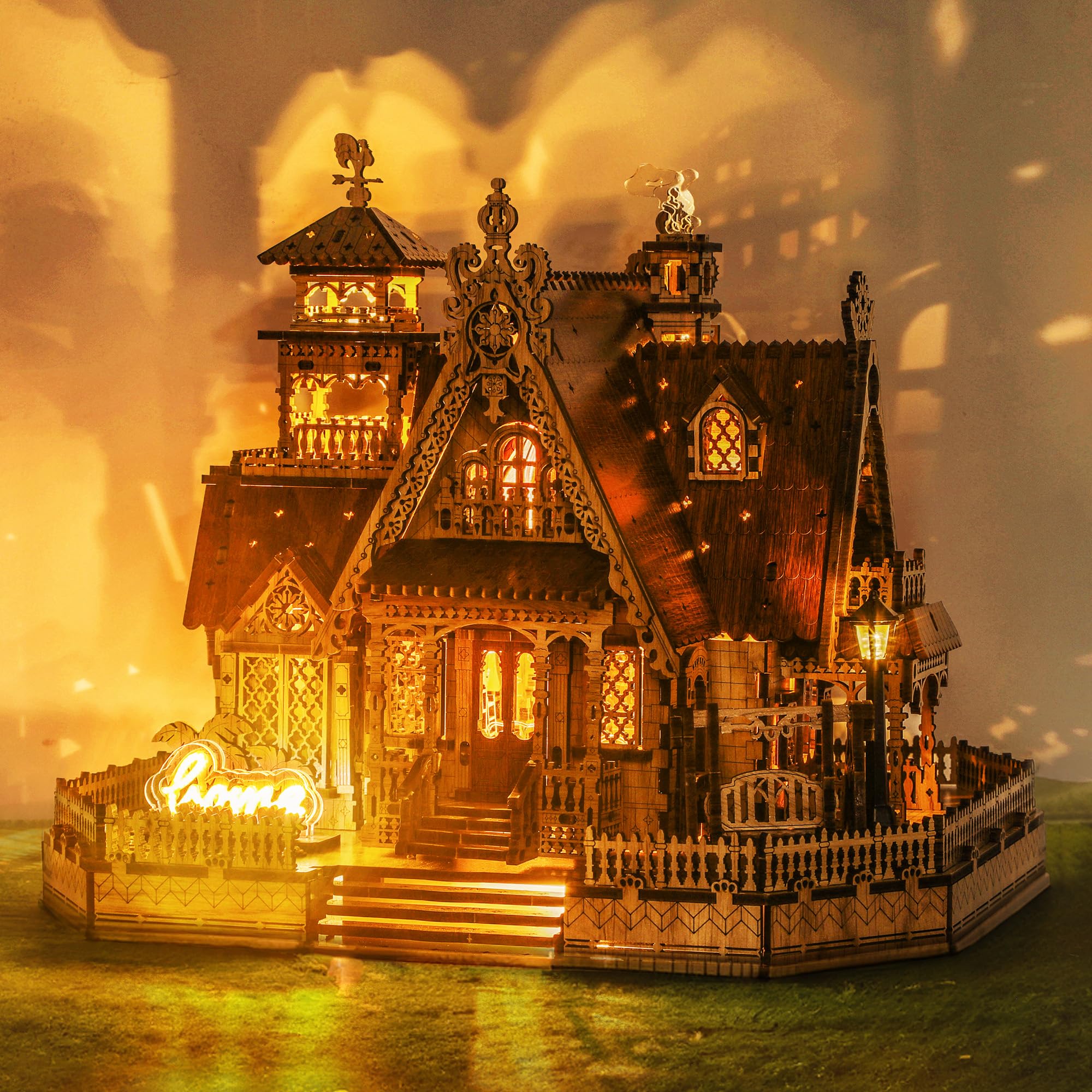
Eight to ten hours is the estimate in the listing, and it is the honest headline. This is the longest build in the group — 251 pieces of MDF and acrylic that fill several evenings before the cottage lights up — so buy it for the process, not for a finished object by Sunday.

What you get for that time is detail: a countryside cottage at about 11.8 by 10.8 by 12.2 inches, with laser-cut walls, acrylic windows and an LED system that throws a soft glow through the whole front. The parts press out of their sheets and seat with a light push, though a few need a file or a strip of sandpaper before they sit flush. That small habit saves you a cracked panel later.

The build suits someone who likes craft more than puzzle-solving. There is no numbering to follow and no picture to reconstruct; you are making a model, and the instructions exist to keep you in order rather than to challenge you. We found that relaxing rather than easy — the evening disappears and the cottage takes shape from across the table.

It is the pick for a long winter project with a lamp at the end of it. Decide the display spot before you begin: this is a tabletop decoration with a real footprint, not something you will tuck back into a box between seasons.

Bottom line: We point crafters here when the evenings matter more than the object — eight to ten hours of building, with a lit cottage at the end.

#8

BePuzzled Squirrel Crystal

BePuzzled Squirrel Crystal

Small gifts

Doodle Score 9.2/10
Check Price

Worth Noting

  • Tiny eye stickers are fiddly to place
Pieces
54
Difficulty
Level 2
Recommended Age
12 years and up
Read the full review

Fifty-four pieces of clear plastic, a center rod, and a finished squirrel about the size of a coffee cup. This is the one that goes in a stocking or on a desk, not the one you clear a table for, and it is the least expensive way into the hobby in this group.

It builds by stacking. The pieces slide onto the rod in order and lock as the last one goes on, which is why the finished thing feels solid and slightly precarious until then. Level 2 is fair: the shape gives you clues and the translucency lets you see how the layers sit, so it is a puzzle you can reason through rather than guess at.

The catch is that nothing in the box tells you the order. The included components are listed as the puzzle itself, and the build sequence lives online, so plan on a phone or tablet at the table. That is fine at home and awkward as a gift opened somewhere without a screen.

As a small gift it is the best value here. The finished squirrel looks like cut glass on a windowsill, and it takes an evening rather than a weekend. Just do not buy it for a child who expects a build to start the moment the box opens.

Bottom line: This is our small-gift pick: 54 pieces, a finished squirrel that catches the light, and no instructions in the box to lose.

How We Built, Shelved, and Stress-Tested 14 3D Puzzles

We started with a shortlist drawn from specialty puzzle shops, gift guides, and customer reviews, then filtered by piece count, age rating, whether tools and glue were included, and how easy the kit would be to give as a gift. That left 14 puzzles to build over five months — architecture, animals, and mechanical models, a few with moving parts and lighting elements.

Every build happened at the same coffee table, mostly on weekend afternoons with a few weeknight sessions after dinner. We dry-fit each puzzle before reaching for glue, checking whether tabs lined up, whether the instruction drawings matched the actual pieces, and how often we had to backtrack. We timed solo builds and noted which kits a 10-year-old could finish with minimal help, then rated the experience on one blunt question: would you keep going if no one were watching?

Finished models lived on a shelf near a window for a month, where we could see whether seams held, colors faded, or the finished thing still looked like the box photo. We spun gears, opened drawers, and flipped every switch on kits with working parts, and we checked whether lighting kits were included or sold separately and whether the bulbs actually reached the spots the box promised. For gift appeal, we looked at packaging, whether the build required glue or batteries we didn't already own, and whether the included tools were reusable. Value came down to what was in the box — spare pieces, display stands, clear instructions — measured against piece count and build time.

How to Choose 3D Puzzles

Piece count sets the length, not the difficulty

Seventy-two pieces is an afternoon with a child; 540 is a project that stays out on a table for a week. Numbers printed on the reverse shorten a build considerably, which is why a 540-piece globe can be a family activity while a 183-piece wooden mechanism is an ordeal. Decide how many sessions you want first, then pick the count that fills them.

Our rough rule: under 100 pieces for a first-timer or a gift that has to land in one sitting, 250 or more when the building itself is the point. Piece count tells you how much table time you are buying, not how hard the puzzle is — a small crystal puzzle can stall an adult for longer than a big numbered globe.

Snap fit, curved plastic, or glue

Plastic ball puzzles click and stay clicked, which makes them the only type here you can hand to a child and walk away from. Curved plastic kits, like the vase, interlock tightly enough to do a job afterwards. Wooden kits are the split: laser-cut tabs usually press together dry, but the miniature houses expect white craft glue, and glue means a permanent model and a proper workspace.

If the finished piece has to survive being handled, snap fit wins. If it has to look handmade, glue wins. Buy the glue with the kit — it is not in the box on most miniature-house sets, and starting without it wastes an evening.

Instructions decide whether a kit gets finished

Look at what is actually in the box: a parts list, a numbered diagram, or a booklet. Pictorial instructions with no words are standard on wooden kits and workable, but they assume you can read a drawing. Some crystal puzzles ship with nothing printed at all, with the build order online — fine at a kitchen table with a tablet, awkward as a gift opened somewhere without a signal.

If you are buying for someone else, check whether the guide is printed. Text-light instructions are not a fault in themselves, but they change who the kit suits.

Lit models: batteries and the order of testing

LED kits almost never include batteries — the Titanic takes two AA, most wooden houses take three. More important, run the light string in the dark before you close the model up. Wiring is what tends to go wrong, and once the hull or the roof is sealed, a dead bulb is a permanent feature of the build.

Fit the batteries, switch it on, then assemble. On a gift, buy the batteries at the same time; a finished model waiting for a store run is a small anticlimax.

Where it will live when it is done

Decide the display spot before you start. A 34-inch foam-board ship needs a sideboard, not a shelf; a book nook needs a gap between books about an inch and a half wide. Foam board is the most fragile material here and bends at the tabs, so keep it out of traffic and out of direct sun.

Wood and snap-fit plastic dust off and survive being moved. If the finished object has no home, that is the sign to choose a smaller build.

Frequently Asked Questions

Final Verdict

The Ravensburger Earth is the 3D puzzle we point most people to. The numbering is the reason a 540-piece sphere gets finished instead of abandoned, and the click fit leaves an actual globe sitting in its stand rather than a bag of plastic. That combination of finishable and displayable is what most shoppers are really after.

If the builder is six, take the Pokemon ball instead: same maker, same click, an afternoon's work. If the appeal is a mechanism rather than a picture, the Vitascope is the one that does something when you turn the handle.