Baby & Toddler

Best Toddler Activity Centers of 2026

The pitch for a toddler activity center is simple: somewhere to put a busy 1- or 2-year-old that isn't a screen. The reality is a piece of furniture the size of a coffee table that chirps, beeps, and plays the same eight-second melody until you hear it in your sleep. Which is why the good ones have to earn their floor space. What you're really buying is twenty minutes to make dinner — and a child who's working something out while you do it.

Over the past six months, my team and I have had 12 of these set up in living rooms, playrooms, and one crowded kitchen, and the pattern held: the centers with the most buttons weren't the ones my toddler came back to. The keepers had a few things in common — legs that locked, a volume switch that actually went quiet, and a frame a newly walking kid could pull up on without the whole thing tipping. Below are the ones that made it through six months of daily use; the rest went back in the box.

#1

Skip Hop Explore & More Activity Center
Skip Hop Explore & More Activity Center

Growing toddlers

Doodle Score 9.6/10
Check Price

Worth Noting

  • Seated stage tops out at 25 pounds
Age Range
4 months and up
Activities
25+
Seat Rotation
360 degrees
Maximum Weight
25 lb
Read the full review

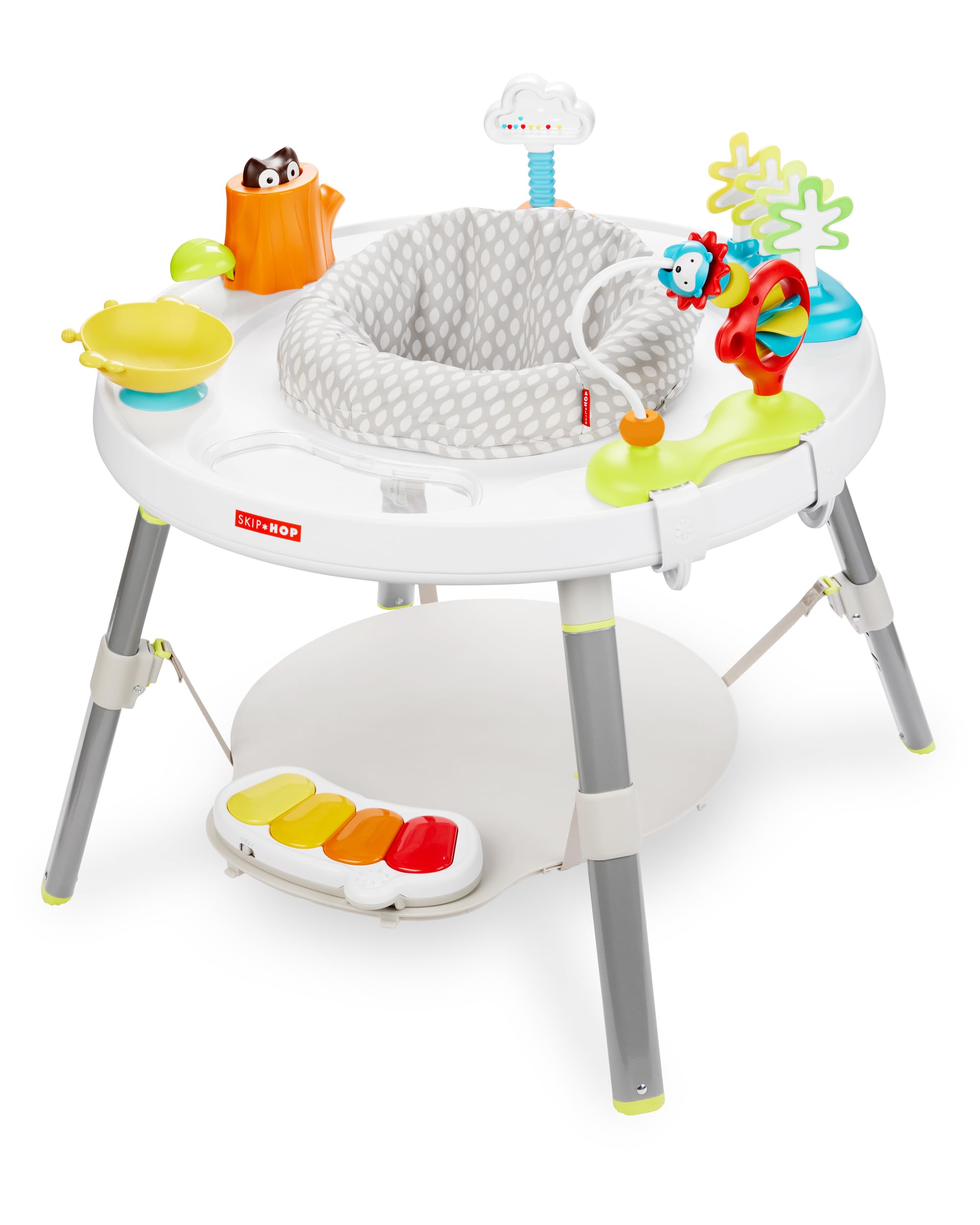
A seat that turns all the way around sounds like a small thing until you watch a baby fight to reach a toy bolted to the far side of a fixed center. Here the seat swivels a full 360 degrees past 25-plus activities, so the play comes to the child instead. The detail we keep coming back to is the Discovery Window: a baby at the piano can see their own feet pressing the keys, which is about as direct a lesson in cause and effect as a toy can give.

What makes it the default pick is the third stage. The seat comes out and the base works as a low table, so the thing that held a six-month-old is still earning its floor space when the same child is two and a half and wants to stand and sort. That is rare in this group. Most of the centers here have one good year in them and then go up to the attic.

Setup is the least painful of anything here, with parts that click together and no tools involved. The toys lift off so the tray can be wiped, there is a molded snack bowl beside the piano, and the surfaces are meant for a cloth rather than a washing machine.

Two things to know. The seated stage is rated from 16 to 25 pounds, so a big two-year-old is finished sitting in it, and the table stage is what carries on past that. It is also one of the pricier centers in this group and bulky enough that carrying it up a staircase is a two-person job, so choose its corner with that in mind.

Bottom line: This is the activity center we recommend to most families: a spinning seat full of things to do, then a table your toddler keeps using after the seat stops fitting.

#2

VTech Busy Learners Activity Cube

VTech Busy Learners Activity Cube

Take-along play

Doodle Score 9.6/10
Check Price

Worth Noting

  • Runs on two AAAs; included cells are demo only
  • Six-inch cube runs out of room as toddlers grow
Age Range
6 months to 3 years
Sides Of Play
5
Item Dimensions
6.2 x 6.2 x 6.5 inches
Songs And Melodies
25
Read the full review

Six inches on a side and a pound and a half: this is the activity center that lives in the diaper bag rather than in the corner of the playroom. Five faces of play, four light-up buttons that name animals and shapes, spinners on the sides, and a motion sensor that fires a sound every time the cube gets picked up, which is precisely the trick that pulls a crawler back across the rug.

The volume dial earns its keep more than the feature list suggests. Twenty-five songs and a dozen animal sounds wear thin by the fourth day, and being able to turn it down, or let the auto shut-off end the party, is why this one stays in rotation rather than getting buried under the couch cushions.

It runs on two AAA batteries, and the pair in the box are demo cells, so plan on replacing them. The bigger limit is size: there is only so much a six-inch cube can offer, and a walking toddler will want something taller to pull up on. As the cheapest thing here, though, it is the one we hand to a nine-month-old on a plane, in a restaurant, or anywhere a full-size center will not fit.

Bottom line: For a baby on the move or a diaper bag that needs a spare toy, this cube packs five sides of sound and motion for the least money in this group.

#3

VTech Magic Star Learning Table

VTech Magic Star Learning Table

Small rooms

Doodle Score 9.6/10
Check Price

Worth Noting

  • Electronics are the weak point
Age Range
6 to 36 months
Batteries
2 AA required
Activities
Six, bilingual
Item Dimensions
14.92 x 19.76 x 16.81 inches
Read the full review

The legs are the interesting part. Snap them off and the Magic Star becomes a floor toy for a baby who is not standing yet; snap them back on and it is a table at a height a crawler can pull up on. Two toys out of one box, and no tools involved either way.

Six activities run in English and Spanish: a steering wheel that drives a bear around the table, a flip book that plays nursery rhymes, gears, light-up buttons that name colors, and a pretend phone that calls animal friends. The phone is our favorite of the six, because it copies something a toddler watches an adult do all day, and it is the activity that holds attention longest.

At just over four pounds it moves from living room to kitchen one-handed, which is not true of any jumper here. The trade is that a light table is a table a child can push: on hard flooring it slides when a toddler leans their weight on it, and a rug under the legs fixes most of that. The electronics are the other soft spot, and since the songs and lights are what make the activities land, a table that goes quiet loses most of its pull.

Bottom line: A bilingual table that works on the floor or on its legs, and the standing pick for a small room where a full-size jumper will not fit.

#4

Battat Wooden Activity Cube

Battat Wooden Activity Cube

Battery-free play

Doodle Score 9.6/10
Check Price

Worth Noting

  • Heavy enough that moving it is a job
  • Finish can chip at a hard-hit edge
Age Range
12 months to 8 years
Batteries
Not required
Item Weight
13.2 lb
Sides Of Play
5
Read the full review

Thirteen pounds of wood standing nearly 18 inches tall: this is an activity cube a toddler can haul themselves up on without it moving underneath them. That is the whole trick. Everything else on the box, five sides of peek-a-boo doors, spinners, a zig-zag race, mix-and-match animals, only pays off because the cube stays where it is put.

The bead maze across the top is the part that gets played longest, and the part that outlives the rest. The age range runs to eight years, which sounds optimistic until you watch a four-year-old run the beads while a one-year-old works the doors below.

No batteries, no songs, no volume button to hunt for. After a day of electronic centers that silence is a genuine feature rather than a gap, and the rounded corners mean the thing a child crashes into while learning to walk is at least forgiving.

Two things to accept. It is heavy enough that moving it upstairs is a job, and it is wood, so an edge that takes a hard knock can chip. What you get in return is the pick most likely to still be in the room in five years, and the one a grandparent recognizes as furniture rather than plastic.

Bottom line: Buy this one for the child who is already pulling up and the household that has had enough of batteries: it is the most furniture-like thing here.

#5

Bright Starts Finding Nemo Jumper

Bright Starts Finding Nemo Jumper

Bouncing babies

Doodle Score 9.6/10
Check Price

Worth Noting

  • ⚠️ Frame brackets can loosen on a hard-used jumper
  • Outgrown at 12 months or 25 pounds
Age Range
6 to 12 months
Seat Rotation
360 degrees
Maximum Weight
25 lb
Height Positions
4
Read the full review

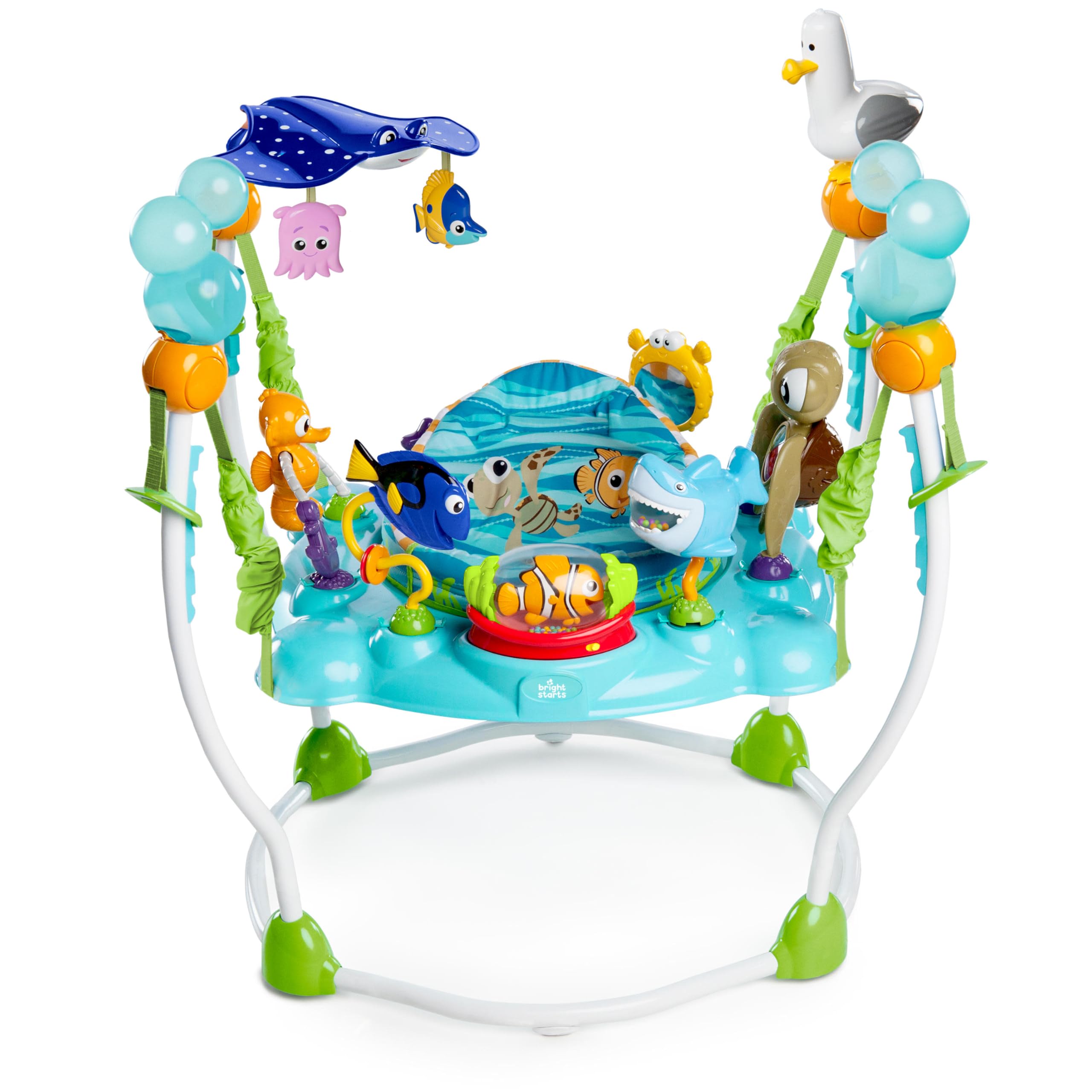
The bounce is why this center exists, and it is a good one: a suspended seat on four height positions, with a high-backed seat that holds a wobbly six-month-old upright while they work out what their legs are for.

Around the seat sit more than a dozen activities, including a rollerball station, a turtle piano, a bead chaser and a baby-safe mirror, and the seat turns a full 360 degrees. That last part matters more than the toy count: a child can work the whole ring without being lifted out and turned around every few minutes.

Be clear-eyed about the window. This is a six-to-twelve-month toy, capped at 25 pounds and 30 inches of height, and it is built for babies who cannot yet walk or climb out. If your child is already cruising, the seat is not the right place for them. If you are buying for a nine-month-old who needs to burn energy before dinner, a good bounce does more than another light-up button, and that is the case for this one over every table here.

The frame and seat take a beating. Brackets are the part to watch, so give the frame a check every few weeks and stop using it if anything has worked loose. Assembly is straightforward and the activity pieces come off for cleaning, which is the difference between a jumper that gets wiped down and one that gets ignored.

Bottom line: For the six-to-twelve-month stretch nothing here beats it for burning energy, as long as you know the seat stops at the first birthday.

#6

Fisher-Price Laugh & Learn Crawl Around Car

Fisher-Price Laugh & Learn Crawl Around Car

Vehicle-loving toddlers

Doodle Score 9.6/10
Check Price

Worth Noting

  • Stickers and screws make assembly the low point
  • Hard plastic base can scuff wood floors
Age Range
6 to 36 months
Batteries
3 AA required
Smart Stages Levels
3
Songs, Sounds And Phrases
120+
Read the full review

A steering wheel, a gear shift, a key that turns, a horn, turn signals and a radio: the dashboard is the reason to buy this one, and it is the only center here a toddler can drive from inside. The lights and sounds fire as they work the controls, which is the sequence a car-obsessed two-year-old is already imitating with a dinner plate.

Smart Stages split the content across three levels between six months and three years, so the same toy asks for shapes and colors early and moves on to counting and opposites. There is a ramp with three balls and a shape-sorting door as well, and at around nine pounds it slides out of the way when the room needs to be a room again.

Plan on a screwdriver and a sheet of stickers. This is the fussiest assembly in the group and the stickers are the part nobody mentions, though the pieces are labelled well enough to get through it. The hard plastic base can scuff wood floors, so a rug underneath is worth the trouble, and it takes three AA batteries that are not in the box.

Bottom line: If your toddler narrates every truck on the street, this center turns that obsession into a dashboard they can actually work.

#7

Hape Country Critters Play Cube

Hape Country Critters Play Cube

Heirloom wooden toy

Doodle Score 9.4/10
Check Price

Worth Noting

  • Balls can jam in the track
  • Paint can chip on the busiest edges
Age Range
12 months to 6 years
Batteries
Not required
Sides Of Play
5
Item Dimensions
13.78 x 13.78 x 19.57 inches
Read the full review

Baltic birch and maple instead of molded plastic, painted animals with faces rather than decals, and five sides that all do something: a bead maze across the top, peek-a-boo doors, spinners, a zig-zag track and a shape-sorting puzzle. This is the wooden cube for a household where the toy has to look right in the room it sits in.

It is heavy enough that it does not shift when a one-year-old uses the top rail to stand up, which is how most of these get used in the second year, as a climbing frame with beads on top. The corner rounding is done properly too, and the whole thing wipes clean in seconds.

The trade-offs are small but real. The wooden balls can jam in the track and need a shake to free them. The paint at the edges of the busiest pieces can chip with hard use, and that shows more on wood than it does on plastic. Assembly is a single screw for the bead-maze top, and there is nothing to switch on and no batteries to buy.

None of that changes our view that this is the best-made cube in this group. It costs the most of the wooden picks, and it is the wrong choice for a household that wants lights and songs. As the one toy that stays in the living room after the plastic has been relegated to the basement, though, it earns the money.

Bottom line: A wooden cube you keep rather than store: the best-finished five-sided play center here, and worth it if the toy has to live in the living room.

How We Tested 12 Activity Centers (With Some Very Honest Toddlers)

We started by reading specs and parent reviews and cutting anything with a footprint wider than a standard play rug, an age range that began at 18 months (no use to the 1-year-olds in our group), or an assembly manual longer than about 20 minutes. That left 12 activity centers, which we rotated through four households with kids between 10 months and 3 years old over six months.

Each one lived where it would in a real home — on a living room rug, on the kitchen floor while dinner got made, in a small playroom — and we moved it at least once to see whether it slid, folded, or had to be taken apart. Every few weeks we went around the frame with a hex key after a toddler had pulled up on it, and we noted whether the whole center scooted across hardwood or stayed put under a leaning 25-pound toddler. Wipes and spills were part of the routine, and we watched for peeling decals, split seams, and buttons that stopped registering after a few hundred presses.

Fun was measured by returns rather than first impressions: we logged which centers drew a child back on day three, day ten, and week six, and which only got touched when an adult sat down first. We wrote down every song and sound effect, whether there was a mute or a genuinely low volume, and which loops became unbearable by the second afternoon. Battery drain and sensors that missed taps got tracked too. Value, in the end, came down to how many weeks of real play a center bought before it turned into furniture.

How to Choose Toddler Activity Centers

Match the Center to the Stage, Not the Age on the Box

Seated centers and jumpers are built for babies who can hold their head up but cannot yet walk or climb out, which is usually a six-to-twelve-month window, and the weight ceiling is the real deadline. Tables and cubes have no seat and no ceiling, which is why they suit an actual toddler better.

If your child is already cruising, put the money into a standing table or a tall wooden cube. If you are buying ahead for a baby, pick a center with a real second stage, the way the Skip Hop's seat comes out and the base becomes a table, so the money does not stop working at the first birthday.

Count What the Child Can Actually Reach

A center with thirty activities is not better than one with twelve if half of them face away from where the child sits. A rotating seat solves that by moving the child around the ring; a fixed seat means the toys on the far side get ignored.

Look at the tray space as well. A flat area beside the toys is where snacks and a spare teether end up, and it is the first thing to disappear on cheaper designs. Count the activities within arm's reach, not the number printed on the box.

Decide Whether You Want Sound at All

Electronic centers buy attention with lights and songs, and they charge for it twice: at the till and again in batteries. Two AAAs in one, three AAs and a screwdriver in another, and the included cells are usually demo batteries that give up early.

Check for a volume control and an auto shut-off before anything else, because without them the toy gets muted by default. A wooden cube makes no noise at all, which is a different strategy rather than a compromise: the play comes from doors, beads and shapes instead.

Measure the Floor, Then Look at the Floor

The footprint matters more than the photograph suggests, and compact in a listing usually refers to the box rather than the assembled toy. A full jumper runs around 34 by 30 inches once it is standing, and a child circling a 360-degree seat needs room for their shoulders, not just the base.

Hard flooring is the other variable. Light plastic tables and centers skate when a toddler leans their weight on them, so a rug under the base is the simplest fix available, and the centers with a heavier base or a wooden body are the ones that stay put without one.

Frequently Asked Questions

Final Verdict

The Skip Hop Explore & More is the center we recommend by default, because it is the one here that changes shape as the child does: a spinning seat for the sitting-up months, then a table for the toddler who wants to stand at something.

If your child is already walking, buy the Battat wooden cube instead. Its weight and height are what make it a place to pull up rather than a toy to grow out of. And if you are buying for a nine-month-old who needs to burn energy before dinner, the Nemo jumper does that better than anything else on this page.