Baby & Toddler

Best Baby Activity Centers of 2026

A baby activity center earns its floor space only if your baby actually wants to be in it. These things take up a corner of the living room, and if your baby lasts ten minutes before arching their back, it becomes an expensive place to store a burp cloth. The right one buys you a safe, contained spot for a baby to swat, bounce, and spin while you chop vegetables or fold laundry.

I spent six months living with ten activity centers, from simple seats to jumper stations, and the difference between a hit and a dust collector comes down to assembly, stability, and whether the toys hold a baby's attention past the first week. We assembled each in a normal living room and watched babies from four to nine months—which toys got grabbed, which seats rotated smoothly, and which frames wobbled when a baby leaned sideways. Safety was the baseline, quality showed up in seams and toy links, and value was cost per use, not sticker price—the picks below kept earning their floor space.

#1

Skip Hop Explore & More
Skip Hop Explore & More

Grow-with-me play

Doodle Score 9.6/10
Check Price

Worth Noting

  • Premium price compared with the jumpers here
Age Range
4 months+
Activities
25+
Weight Range
16–25 lb
Seat Rotation
360°
Read the full review

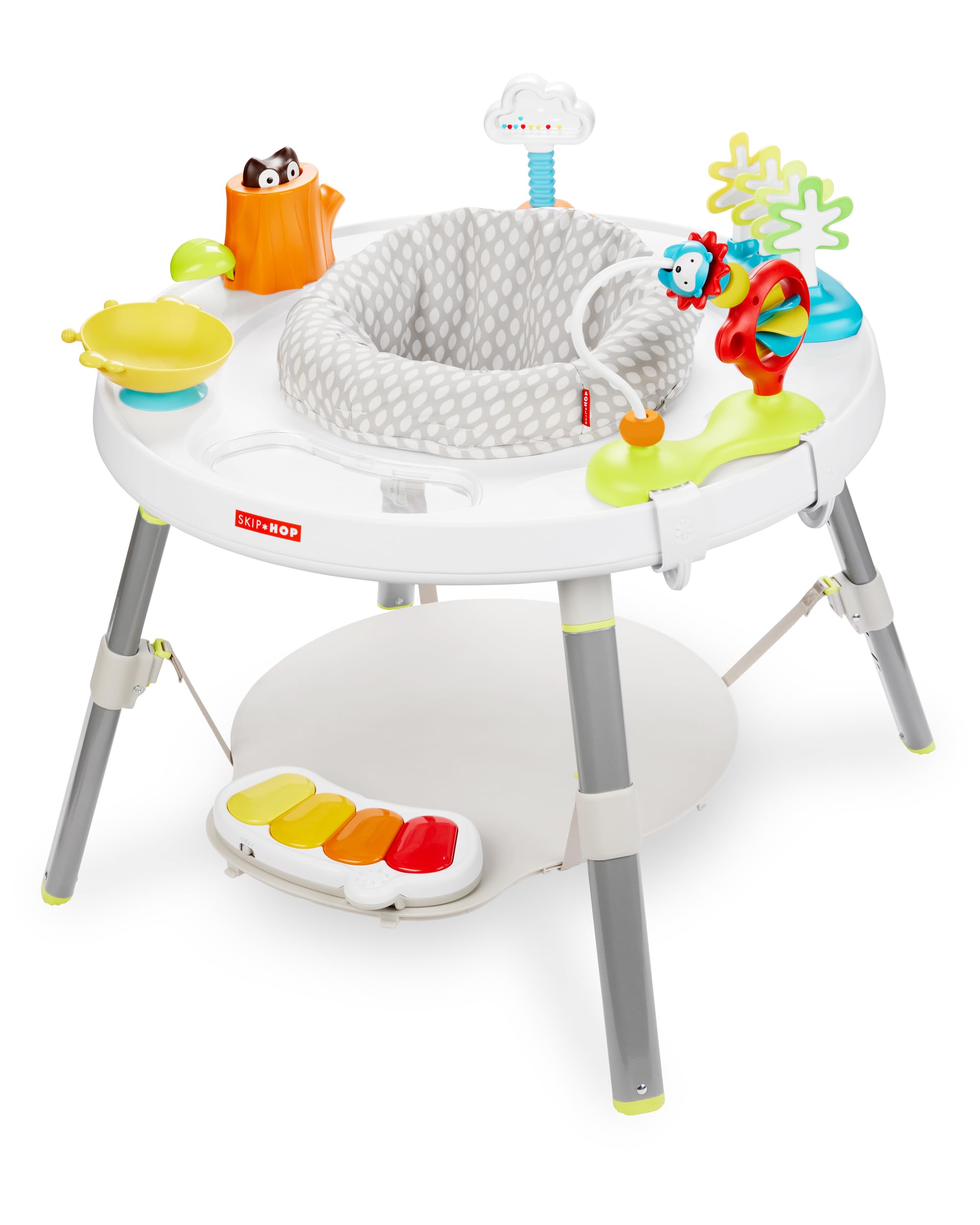
The Skip Hop is built around a three-stage idea: a sit-in activity center for babies who can hold their head up, a 360-degree rotating seat with 25+ developmental activities, and a conversion into a play table. The seat has a discovery window that lets baby see their feet while playing the light-up piano, and there is a snack bowl built into the tray. It is designed for babies from about four months up to 25 pounds.

That flexibility is why we recommend it as the default. A jumper can be brilliant for a baby who wants to bounce, but it has a short run; the Skip Hop keeps earning its footprint after baby is too big for the seat. We also like that the toys are movable and rearrangeable, so the layout can change without buying another center. The 360-degree seat means baby can reach every station without you lifting them around the rim.

The trade-offs are real. It is a chunky piece to move from room to room, and it wants a dedicated corner rather than a quick fold-away spot. The seat pad and removable toys make cleanup manageable, and the surface wipes clean, but you should still expect to vacuum around the base. Batteries are required for the piano and lights.

The footprint is the thing to measure before ordering: it needs a clear, level patch of floor and enough room for a toddler to circle the table later. If that space exists, the Skip Hop is the one we keep coming back to for the widest span of use.

Bottom line: We recommend the Skip Hop for parents who want one center to last from seated play into toddler table time; its three-stage design and 25+ activities earn the premium.

#2

Bright Starts Minnie Mouse

Bright Starts Minnie Mouse

Disney fans

Doodle Score 9.6/10
Check Price

Worth Noting

  • Jumper-only use ends at 25 lb or 30 in
Age Range
6–12 months
Height Limit
30 in
Weight Limit
25 lb
Seat Rotation
360°
Read the full review

This is the jumper we point to when the priority is a baby who wants to bounce and a theme that makes the nursery smile. The Minnie Mouse version packs 10 toys, lights, music, and a 360-degree seat into a frame that adjusts through four heights. It is rated from 6 to 12 months or up to 25 pounds and 30 inches tall.

The play value is front-loaded, and that is fine. A baby who likes cause and effect gets a lot from the heart mirror, bead spinner, and dangling toys, and the jump-activated lights and music give them a reason to push off. We like that the seat turns all the way around so baby can work the room without being repositioned. The two volume settings are a small mercy for parents.

The catch is durability. The frame and seat have held up for plenty of families, but some units have had a metal bracket break, and the plastic parts are not the stoutest in this group. Check the bracket and toy mounts before each use, and stop using it if anything loosens. It is also a jumper only, so it stops being useful once baby outgrows the 25-pound or 30-inch limit. For the money, it is still a strong pick if you want a dedicated jumper with a character theme.

Bottom line: The Minnie jumper is our pick for Disney-loving families who want lights, music, and a 360-degree seat; it is a short-term jumper, not a grow-with-me center.

#3

Baby Einstein Airplane Adventure

Baby Einstein Airplane Adventure

Lights and music

Doodle Score 9.4/10
Check Price

Worth Noting

  • Requires 3 AA batteries, not included
Modes
2-in-1 jumper and floor play
Age Range
6 months+
Weight Limit
26 lb
Seat Rotation
360°
Read the full review

The removable electronic toy station is the feature that makes this jumper more than a one-trick seat. It lifts out so baby can play with the lights, melodies, and language buttons on the floor, then clicks back into the jumper. The jumper itself rotates 360 degrees, adjusts through four heights, and adds seven more toys, including flash cards and crinkle pieces. It is rated from 6 months and up to 26 pounds.

The lights-and-music angle is where this one earns its place. Jumps trigger sounds and lights, the throttle and buttons add another layer, and the 20+ melodies are enough to keep a baby experimenting with cause and effect. We like the four-language color, shape, and number callouts because they give the toy a longer vocabulary runway than the average jumper.

Our reservation is durability. The seat pad and plastic legs are the parts to watch; seats have torn and legs have snapped on some units, so this is not the jumper to hand down without a careful once-over. We still recommend it for the family who wants a removable floor-play station and a busier electronic toy panel. Keep it within the 26-pound limit and check the seat seams and leg joints regularly.

Bottom line: The Airplane Adventure is our pick for lights, music, and a toy station that lifts out for floor play; its removable panel gives it more range than a standard jumper.

#4

Evenflo Exersaucer

Evenflo Exersaucer

Simple exersaucer

Doodle Score 9.4/10
Check Price

Worth Noting

  • No table conversion for longer-term use
  • Stops at 30 inches or when baby walks
Seat Pad
Machine washable
Age Range
4–12 months
Height Limit
30 in
Height Positions
3
Read the full review

The Evenflo keeps the focus on manual play. Seven toys and 12+ activities ring the seat, and the three-position height adjustment lets you set baby at a comfortable leg length. The seat pad is machine washable, and the frame wipes down without a lot of crevices. The Sweet Tea Party theme is bright and busy, and the play is mostly hands-on rather than electronic.

We recommend it for the family who wants a classic exersaucer and a straightforward setup. The base is wide, but it can wobble on uneven flooring, so give it a flat, clear patch of floor. It is an easy second center or a grandparents' house pick.

The open rim also makes it easy to lift baby in and out, which matters more than it sounds when you are doing it several times a day. The toy set is simpler than the electronic centers here, and that is the point: less to break, less to wipe around, and no song library to tire of.

Bottom line: The Evenflo is our pick for a simple, manual exersaucer; it gives baby a seated play space, seven toys, and three height settings without a big electronic panel.

#5

Bright Starts Bounce Bounce

Bright Starts Bounce Bounce

Small spaces

Doodle Score 9.2/10
Check Price

Worth Noting

  • Plastic hooks and hinges can break
  • Seat rotation can be stiff
Modes
2-in-1 jumper and table
Toy Storage
Included bag
Weight Limit
25 lb
Assembled Dimensions
34.6"L x 34.6"W x 18.9"H
Read the full review

The Bounce Bounce is the space-conscious choice in this group. It has a 2-in-1 design that starts as a bouncy activity saucer and converts to a toddler table, and its footprint is smaller than the full-size jumpers here. The electronic frog ribbits, plays music, and lights up.

The jumper stage is built around that bouncy saucer, with the frog toy giving baby a clear cause-and-effect reward. A toy storage bag is included for the table stage, which helps keep the converted table from becoming a pile of loose pieces. The frame is lighter than the full-size centers here, so it is easier to move between rooms.

That smaller footprint is why we keep it on the list for a small apartment or a grandparents' house, where a full-size center would be in the way. The table conversion also gives it a longer run than a jumper-only design. It is a practical second station rather than the center we reach for first.

Bottom line: The Bounce Bounce is our pick for a smaller footprint and a jumper that becomes a toddler table; just check the toy mounts before you commit.

How We Tested Baby Activity Centers

We started by pulling together the activity centers that show up on registry lists and parent forums, then narrowed by price, footprint, and features that change daily use—seat rotation, adjustable height, and whether the frame folds. Each of the ten units was assembled in a living room, timed solo, with only the included instructions and tools; we noted how many steps needed a second person, how many parts required a screwdriver, and whether the toy tray snapped in without pinching fingers.

During the six months, each center lived in the main living area and was used in the same windows: the pre-coffee morning stretch, the fussy hour before dinner, and slower weekend mornings. We watched babies from four to nine months—some cautious, some climbers—and recorded which toys they reached for, whether the bounce felt stiff or springy, and how easily they could turn the seat to follow a sibling or the dog.

We nudged each frame from the side, checked restraints and leg openings, and looked for gaps where a finger could get caught. After every use we wiped down the tray and seat; at the end of six months we checked seams, toy links, and hinges for cracks or stretching. Value was tracked as cost per week of actual use, not sticker price—some centers got ignored after a month, while others became part of the daily routine.

How to Choose Baby Activity Centers

Match the center to your baby's stage

Activity centers come in three useful shapes: a jumper for bouncy cause-and-effect play, a stationary exersaucer for seated toy exploration, and a grow-with-me center that converts to a table or floor-play station. We start with the stage because a jumper can be done by the first birthday, while a three-stage design keeps working after baby is walking. Check the age, weight, and height limits before the toy count: the jumpers here top out at 25 or 26 pounds and 30 inches, and a center rated from 4 months still requires head control.

Put stability ahead of features

An activity center is a place where your baby will push, lean, and bounce, so the base has to stay put. Look for a wide, flat footprint and a seat that locks securely into the frame; if the center converts or has a walk-around mode, make sure the wheels or table sections lock as intended. We are wary of any design whose table sections pop off or whose base tips when a baby leans. Set it on a firm, level floor, and check the toy mounts and seat seams before each use.

Choose height settings and conversions that buy time

Height adjustment is what keeps a center comfortable as baby grows. Three or four positions let you set the seat so baby's feet touch the floor without being on tiptoe, and a higher setting gives a taller baby room to push. A conversion to a table or floor-play station adds months of use, but only if the hardware feels solid; we prefer three secure stages to five flimsy ones. Check the upper limit, too: several centers stop at 25 to 30 pounds, and the Evenflo stops at 30 inches.

Measure the footprint, then plan for cleanup and batteries

Activity centers are bigger than they look in photos. The Bright Starts Minnie has a 36.7-inch square footprint, and the Skip Hop needs room for a toddler to circle the table later. Measure a clear, level patch of floor and leave a walkway around it. A machine-washable seat pad and removable toys make the daily wipe-down much easier; the Evenflo and Skip Hop are the simplest here on that front. If you choose a lights-and-music model, factor in batteries: the Minnie takes 2 AA, the Airplane takes 3 AA, and the Skip Hop takes AAA.

Frequently Asked Questions

Final Verdict

The Skip Hop Explore & More is the activity center we recommend first. It has the widest span of use here: a 360-degree seat and 25+ activities for seated play, then a table conversion that keeps it relevant after the jumper stage. The premium price is the trade, and the footprint is the other thing to measure.

If you want a dedicated jumper, the Bright Starts Minnie is the better fit for Disney fans, while the Evenflo is the simple, no-fuss exersaucer for a grandparents' house or a second station.