Baby & Toddler

Best Baby Musical Toys of 2026

There is a particular kind of regret that comes with handing a baby a toy that plays one tinny song on repeat at a volume you cannot turn down. By day two it is the thing you bury under a couch cushion, and your baby has moved on to the cardboard box it arrived in. A good musical toy does the opposite: it teaches cause and effect — press here, sound happens — and it sounds pleasant enough that you do not mind hearing it for the fortieth time before lunch.

Over the past six months, my team and I have handed 12 musical toys to babies ranging from about three months to 18 months old, and the ones still in rotation share a few traits. Babies do not care whether the tune is in key, but you will, and so will everyone else in the house, since plenty of these toys offer no volume control at all or a low setting that still carries across a room. We favored toys a small hand can actually grip and shake, ones that stay put when a wobbly sitter leans on them, and ones whose strings and tethers stay out of the way. What follows are the ones nobody in our test group got tired of.

#1

Baby Einstein Take Along Tunes
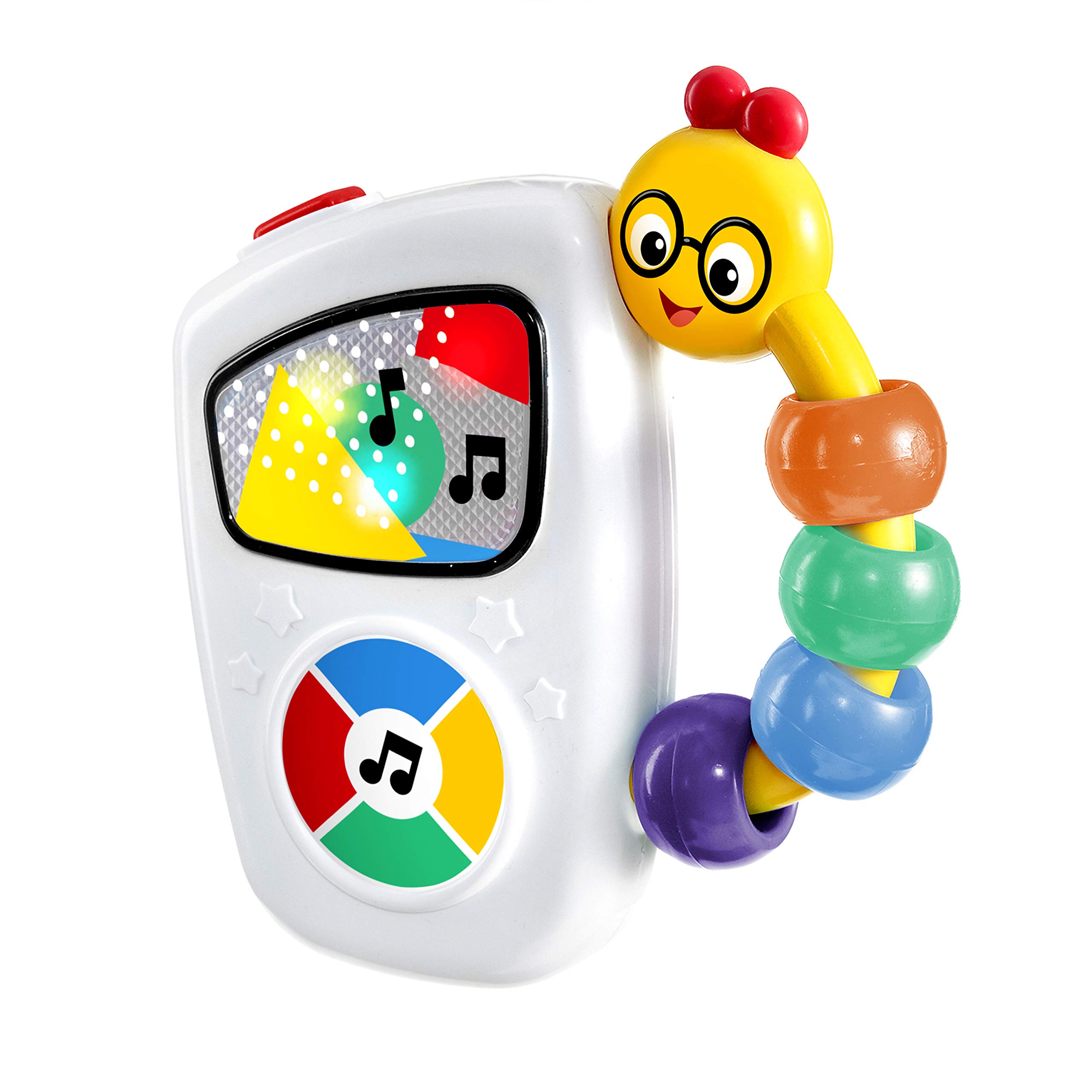
Baby Einstein Take Along Tunes

First musical toy

Doodle Score 9.6/10
Check Price

Worth Noting

  • Hard plastic shell, so it isn't a cuddly toy
  • Speaker turns sharp at the top volume
Size
5 x 4.8 x 1.1 in
Power
2 AA batteries (demo set included)
Controls
One large button with volume control
Melodies
10 classical pieces
Read the full review

One button, one job: press it and ten classical pieces — Chopin, Mozart and the rest — start up while the lights behind the face pulse along with the melody. That single interaction is why this is our default recommendation in a category full of toys that ask a baby for more coordination than they have. A four-month-old can thump this with an open hand and get an orchestra back.

It's also the one that leaves the house. At five inches tall and about an inch thick, it drops into a diaper bag pocket and comes out at the restaurant table, the waiting room, the back seat. Ours took the drops and throws anything at this age takes, and the two volume levels meant we could turn it down in the car without turning it off — not a detail every toy here bothers with. It ships with demo batteries, so put a fresh pair of AAs in before you hand it over.

What it doesn't do is teach. No letters, no colors, no instrument names, nothing that turns into vocabulary later. If you want the music to carry some learning, the VTech Musical Rhymes Book or the LeapFrog Alphabet Zoo does that job. What you get instead is repertoire: ten real classical themes rather than a two-second jingle, which is a different thing for a baby's ear and a much easier thing for an adult to hear for the fortieth time.

Bottom line: The one we recommend first: one button, ten real classical pieces, and a volume switch that keeps it welcome through a second hour in the car.

#2

VTech Musical Rhymes Book

VTech Musical Rhymes Book

Songs and words

Doodle Score 9.6/10
Check Price

Worth Noting

  • Bulky next to the take-along picks
  • Catchy rhymes that stick in adult heads
Keys
5 colorful piano buttons
Modes
Learning and music
Power
2 AAA batteries (demo set included)
Rhymes
Easy-to-turn pages with nursery rhymes
Read the full review

Turn a page and the rhyme starts. That's the whole trick, and it works: five colored piano keys run along the bottom to play melodies and name instruments and colors, and the board pages are thick enough for a baby to grab and haul on. It's rated from six months to three years, and its shape says lap toy rather than carry toy.

Where it earns its place over the cheaper button toys is range. A music mode and a learning mode mean the same object is a sing-along at nine months and a colors-and-instruments quiz at two, which is longer than most musical toys hold attention. The rhymes are genuinely catchy, which is also the catch: after a week you'll have them running in your own head, and the off switch gets used more than you expect.

Volume is the thing we flag. The switch has a low setting and even that carries across a quiet room, so this isn't the toy for the car at naptime. It's a stay-at-home object generally — 8.8 by 7.5 inches and just over a pound — and it does its best work on the floor beside a sitting baby rather than in a bag. Buy it for the child who already likes being read to.

Bottom line: We recommend it where you want the songs to teach as well as entertain: rhymes, instrument names and colors, with a volume switch for the grown-ups in the room.

#3

LeapFrog Spin and Sing Alphabet Zoo

LeapFrog Spin and Sing Alphabet Zoo

Busy hands

Doodle Score 9.6/10
Check Price

Worth Noting

  • Two pounds makes it a floor toy
Modes
Letters, animals and music
Power
3 AA batteries (demo set included)
Learning
A to Z, animal names and sounds
Read the full review

Spin the drum on the front and the wheel behind it turns, lighting up and answering with a letter, an animal name and its sound, or a burst of music, depending on the mode. That motion is the point: this is the one toy here built around something a baby can already do with a flat hand.

Three modes let it change jobs as the child does. At eight months it's a spinner with lights and a beat; at eighteen months it's an alphabet toy that names the animal under the pointer; in between it's something to dance at. The letter and animal content is why it outlasts the cheaper button toys, and the volume is adjustable, which we appreciated by the third consecutive spin of an evening.

Our view is that it's the pick for a baby who'd rather bat and spin than press, and the one here that improves with age rather than wearing out its welcome. The trade-off is size — 1.9 pounds and roughly eight inches across — so it lives on the floor and doesn't travel next to the Take Along Tunes. We didn't mind. It stays where you set it down, and a toy that can't be flung across a restaurant has its advantages.

Bottom line: We recommend it for the baby who'd rather bat and spin than press — letters, animals and music that keep earning their place past the first birthday.

#4

VTech Baby Rattle and Sing Puppy

VTech Baby Rattle and Sing Puppy

Newborns and sitters

Doodle Score 9.6/10
Check Price

Worth Noting

  • Grip suits bigger hands at first
  • Volume is modest in a noisy car
Age
3 months to 2 years
Power
3 LR44 batteries (demo set included)
Content
20+ songs, melodies, sounds and phrases
Textures
Crinkle ears and two textured rings
Read the full review

Most of the toys on this list assume a baby who can sit up and reach. This one doesn't: shake it and the beads rattle, the puppy's cheeks light up, and it answers with a phrase or a snatch of song. It's rated from three months, and the crinkle ears and two textured rings are clearly designed for hands still working out what hands are for.

That's why we keep pointing to it as the starter musical toy. More than twenty songs, melodies, sounds and phrases are packed in here, but they arrive through a shake or a single button rather than a mode dial, so a young baby gets the cause-and-effect payoff without needing aim. The lit cheeks hold attention longest, and the music button gives an adult a way back in when the shaking loses its novelty.

Two things to know. The shape suits a whole-hand grip better than a finger grip, so a very small baby may need a few weeks before it stops being something you hold for them. And the volume is modest — fine in a living room, lost in a car with the windows down. It runs on three LR44 button cells, so check the battery door is tight and keep spares out of reach; the ears get chewed, and the fabric is hand-wash only.

Bottom line: We recommend it as the first musical toy in the house — a shake-and-sing rattle that works from three months, before a baby can aim a finger at anything.

#5

Fisher-Price Classic Xylophone

Fisher-Price Classic Xylophone

Real instrument play

Doodle Score 9.6/10
Check Price

Worth Noting

  • Short tether limits reach across the keys
  • No volume control and no off switch
Age
18 months and up
Keys
8 colorful keys
Play
Pull-along wheels and string
Mallet
Tethered mallet
Read the full review

No batteries, no speaker, no volume switch: eight bars on a plastic frame, a mallet, and four wheels. This is the only acoustic instrument in the group, and that alone earns it a place. It's the one toy here that will still make a sound in ten years, and the one that never needs a fresh set of cells on a holiday morning.

It sounds like a xylophone, which is not a given in this category. The bars are tuned relative to one another, so a toddler hammering away produces something resembling music instead of a clatter. A seven-month-old bangs; somewhere around two they start picking out a tune, and the mallet teaches aiming long before that. It rings, but it rings tunefully.

The tether is the flaw. The mallet is on a short string — short enough that the far keys mean leaning right across the frame — and that's the thing to decide about before you buy. A child who plays sitting down works around it by dragging the whole toy closer. A child who wants to stride up and down the keys gets cross with it.

The pulling side is rated from eighteen months, roughly when the wheels and the lead start making sense; before that it's a floor instrument, and a good one. A longer string from the factory is the fix, and it isn't what ships. Even as it stands, this is the least expensive way to put a real instrument in the house, and the one we keep for the next child.

Bottom line: We recommend it for the toddler who'll sit and play: eight tuned bars, no batteries, and a sound that's music rather than noise.

#6

Baby Einstein Magic Touch Piano

Baby Einstein Magic Touch Piano

First instrument

Doodle Score 9.4/10
Check Price

Worth Noting

  • The priciest pick in this group
Build
Wooden body with touch keys
Modes
2 play modes
Power
3 AA batteries
Included
3 color-coded music sheets
Read the full review

Every other toy here plays music at your baby. This one lets them make it: a wooden body with touch-sensitive keys that sound at the lightest contact, so a palm slap and a careful finger both produce a note. That difference is why it's our pick for a first instrument rather than a first music player.

The touch sensing matters more than it sounds. A seven-month-old doesn't press, they swat, and keys that need real force get ignored at exactly the age when cause and effect is the whole lesson. The tone is bell-like rather than beepy. The volume switch has a low setting that keeps it in the room without taking the room over, and the three color-coded sheets make it a two-year-old's toy as much as a baby's — match the color on the page to the color on the key and a pre-reader is playing a song.

The catch is the body. It's light, and it can tip forward when a baby leans on the front keys, so we played with it on a rug where the pile takes the wobble and kept a hand on the frame during enthusiastic sessions. The rest of what you're paying for is looks: this is the one here that could sit in a living room without being hidden. It's also the most expensive pick of the group by a clear margin.

Bottom line: We recommend it as a first real instrument: touch keys a baby's palm can play, a bell-like tone, and three color-coded sheets that turn into songs later.

#7

JOYIN Dancing Duck

JOYIN Dancing Duck

Crawlers who chase

Doodle Score 9.4/10
Check Price

Worth Noting

  • Loud even on its lower setting
  • Age guidance contradicts itself across the listing
Size
6.6 inches
Motion
Dances and scoots around the floor
Material
ABS plastic
Melodies
7 across 5 buttons
Read the full review

Start with the volume: this is the loudest toy here, and the lower of its settings still fills a living room. For some babies that's the entire appeal. For the adults, it's the reason the duck lives in a cupboard between sessions.

What it does is move. Five buttons trigger seven melodies, and the duck scoots, turns and changes direction when it meets a chair leg, lights flashing, while a smaller duck in its front pouch sings along. For a baby who has just worked out that objects can travel, that's a different pleasure from pressing a button that plays a tune, and it gets the laughs the tabletop toys don't.

It's really a chase toy that happens to sing. The tunes are short, the sound is shrill with it, and the lower setting isn't much lower. The age guidance is contradictory too — the description says six months and up, the detail panel says three years — so check the box against the child before you commit. Buy it for a crawler with a long hallway and forgiving neighbors.

Bottom line: We recommend it for the crawling baby who'd rather chase a toy than press one — as long as the room can live with the volume.

How We Chose and Tested the Musical Toys

We started with the musical toys that keep turning up on nursery registries and in parent forums, then cut anything with a battery compartment a fingernail could pry open, a volume switch that offered only loud and louder, or a body that felt hollow and rattly in the hand. That left 12 toys, from simple chime-filled rattles to pull-string animals and palm-size keyboards. We lived with them for six months.

Testing happened wherever the toys actually end up: on the living room floor during tummy time, clipped to a stroller on the walk to the park, on a high chair tray during the frantic ten minutes before dinner, and in a car seat on the drive to daycare. We kept a decibel meter on the counter and measured each toy at arm's length and from across the room, then noted whether the quiet setting was genuinely quiet enough for a car ride with a sleeping baby.

We watched how babies picked each one up — whether the handle fit a six-month-old's fist or demanded two hands — and what happened when a wobbly sitter grabbed it and pulled: did it tip, slide, or hold its ground? For toys with strings, we measured every tether and pull cord, watched whether it retracted cleanly or snagged, and checked the attachment point after weeks of yanking. Attention span filled in the rest, since we logged which toys got picked up again the next morning and which went quiet within a week.

The highest scorers were not the ones with the most buttons. They were the ones whose sound was still tolerable on the twentieth repeat, whose volume dropped to something resembling a whisper, and whose shape a baby could hold, shake, and hand back to us without a struggle.

How to Choose Baby Musical Toys

Match the mechanism to the hands you have

The most useful thing to know about a musical toy is how the music starts. A three- to six-month-old swipes and shakes; a seven- to twelve-month-old slaps with an open palm; a toddler presses, turns and spins on purpose. A button that needs a firm push sits ignored in a house with a slapper, while a rattle or a touch-sensitive key answers the first clumsy contact.

If you're buying ahead of the stage, a shake toy or one big button is the safer bet than a row of small keys. Watch what your baby already does with the toys in the basket and buy the mechanism that matches it.

Listen past the demo

Nearly everything in this category has an off switch and a volume setting, and the ones that don't are the ones you resent by the third day. Two things decide whether you can live with a toy: how quiet its lowest setting actually is, and what the music is made of. Ten classical themes, five nursery rhymes and a two-second jingle are very different propositions at the hundredth repetition.

Real melodies wear better, and toys that name instruments or colors give you something to say back while they play. Treat the included batteries as a demo — most arrive with cells meant for the store shelf, not for daily use.

Decide between an instrument and a player

This category splits in two, and the listings rarely say which side they're on. A player performs at your child: press, and a recorded song comes out. An instrument answers what the child does, and the pitch changes with where they hit it. The instrument is less tuneful in the first year and far more likely to still be in use at four.

Our advice is to buy the player for a baby under a year, when cause and effect is the whole lesson, and put the instrument on the list for the first birthday, when sitting, aiming and a decent grip have arrived.

Size, batteries and the walk-away test

Compact is the least trustworthy word in these listings: a toy described that way can still be a two-pound floor toy. Check the weight and the footprint instead, and ask whether you'd carry it to a restaurant in one hand. On power, AA and AAA cells are cheap and easy to find; LR44 button cells are neither, and anything powered by them needs a compartment that stays shut.

Finally, decide who else will hear it. The toy that survives a long car ride is the one whose volume control you can reach from the front seat.

Frequently Asked Questions

Final Verdict

For most families the Baby Einstein Take Along Tunes is the right first buy: the least expensive thing here, the easiest for a young baby to work, and ten real classical pieces with a volume switch the adults control.

When your child starts sitting and reaching with intent, move up to the Magic Touch Piano for actual notes, or to the VTech Musical Rhymes Book if you'd rather the songs carried words. Buy for the stage you're in, not the one the box promises.