Baby & Toddler

Best Sorting and Stacking Toys of 2026

A sorting and stacking toy has one job the box copy rarely mentions: it has to be interesting enough that a toddler picks it up without a grown-up arranging a game first. The good ones give little hands practice with size, order, color, and patience without turning playtime into a frustration test. The wrong ones look cheerful on a shelf but are too small to handle, too flimsy to survive a drop, or so limited that kids master them in a morning. I have watched that happen at my own kitchen table, which is why I care less about a perfect display and more about whether a child can use the thing independently.

Over four months, we put 14 sorting and stacking toys through everyday play with toddlers and preschoolers. We looked for sturdy pieces, useful colors, a size that fits small hands and a shelf, and a challenge that matches the child. The best earned repeat play and felt worth the money; the weakest were cute but forgettable. The picks below kept coming back out of the toy bin.

#1

mushie Stacking Cups

mushie Stacking Cups

Living-room play

Doodle Score 9.8/10
Check Price

Worth Noting

  • A design premium over plain cups
Pieces
8 cups
Made In
Denmark
Material
BPA-free polypropylene
Recommended Age
0 months and up
Read the full review

Stacking cups end up living on the kitchen counter or the living room floor, so how they look matters more than it does for a toy that goes back in a bin. The mushie set comes in muted, dusty shades with small shapes cut into the bases, and it's the only set here we didn't mind leaving out when people came over.

They're made in Denmark from BPA-free polypropylene and nest down to roughly the footprint of the biggest cup, which makes them easy to park on a shelf. Eight cups, nothing printed on them, and a matte finish that doesn't read as a baby product. In the bath they behave like the cups at the top of this list — the cut-out shapes let water through — and they wipe clean without fuss.

The trade-off is that you're paying for the look. The job is the same one the plain cups do, and no child stacks any better for a nicer palette. We think it's worth it when the set lives in a shared room, and less worth it when it's headed for the bath, the beach bag, and the bottom of a toy bin, where nobody is looking at the finish.

Bottom line: Choose the mushie cups if the set will sit in a living room rather than a toy bin; you're paying for a muted palette, not for better stacking.
#2

Learning Resources Farmer's Market Set

Learning Resources Farmer's Market Set

Color sorting

Doodle Score 9.8/10
Check Price

Worth Noting

  • Berries are small for mouthing babies
Pieces
30
Baskets
5
Material
Soft plastic
Recommended Age
18 months to 10 years
Read the full review

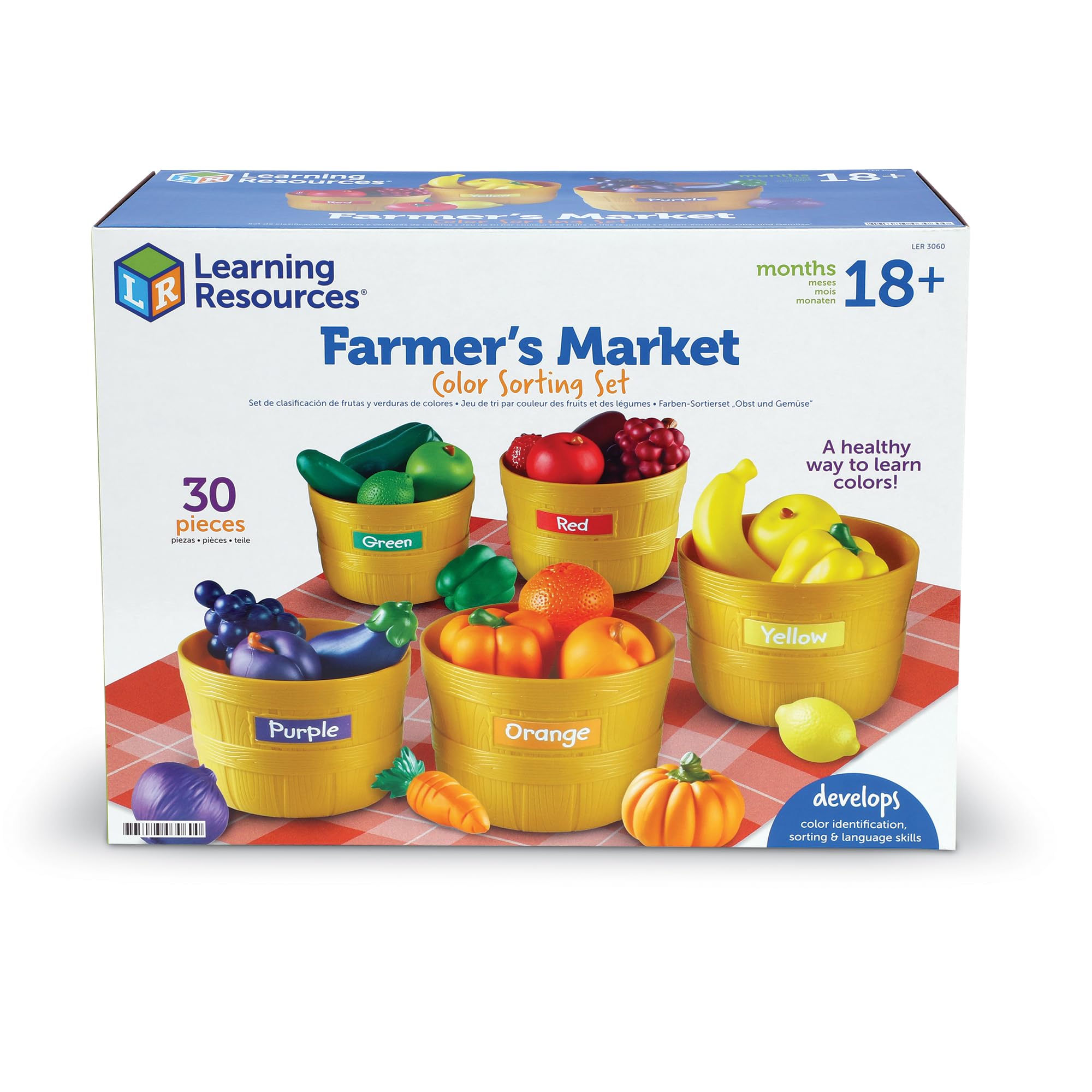
It's shelved with the play food, which is why it's easy to miss: five baskets and twenty-five rubbery fruits and vegetables, divided five ways by color.

The produce is what sells it. Instead of the hollow, brittle plastic that cracks the first time it's stepped on, each piece is a soft, slightly rubbery material that holds its shape and feels closer to a real peach than a toy one. Five pieces in each color means a full sort works out with nothing left over, and the baskets are sturdy enough to carry loaded across a room.

The learning is unhurried. A two-year-old sorts by color, a three-year-old names the produce, and a four-year-old turns the baskets into a market stall. It's also the set that outgrew sorting fastest in our house, because the foods moved into the play kitchen and stayed there.

You pay more for this than for the cups or the blocks, and it earns that back over years rather than months. If you want a sorting toy that is still in use at four, this is the one. If you want something for a one-year-old who puts everything in their mouth, it isn't.

Bottom line: The Farmer's Market set is the one to get if you want color sorting that turns into pretend play; it's the pick here a four-year-old will still use.

#3

The First Years Stack & Count Cups

The First Years Stack & Count Cups

First stacking toy

Doodle Score 9.6/10
Check Price

Worth Noting

Pieces
8 cups
Material
Plastic, BPA-free
Item Weight
4.8 oz
Recommended Age
6 months to 2 years
Read the full review

Eight cups, no batteries, no assembly, and something to do at every stage from sitting up to preschool. They stack into a tower, nest down into a single stack you can carry in one hand, pour water through shaped holes in the base, and keep numbers on the bottom that stay hidden until a toddler flips one over.

That range is why they're our top pick. Almost everything else here does one job well — a ring stacker orders sizes, a shape sorter matches outlines, a block set builds — and the cups do several, which matters at an age when you have no idea which one your child will take to. The holes are the part we underrated: water drains out as a child lifts a cup, so fill-and-dump becomes a game that repeats, and a bath toy that also stacks is one less thing to store.

Nothing about them is refined. The colors are primary, the plastic is plain, and the numbers on the base are small enough that you'll be doing the pointing for a while yet. They're also the set that gets picked up most in our experience, and at this age that counts for more than a nicer finish.

The mushie cups are the same idea in muted colors and a better finish, the Sassy rings suit a baby who chews everything, and the wooden blocks take over once a child is past two. For the first year, though, this is the set we keep coming back to.

Bottom line: We recommend the Stack & Count cups as the first sorting and stacking toy in most homes: eight pieces that stack, nest, pour, and count, and a set that survives the bath.

#4

Sassy Stacks of Circles

Sassy Stacks of Circles

Teething babies

Doodle Score 9.6/10
Check Price

Worth Noting

  • Rings are small next to classic stackers
Pieces
9
Material
Plastic
Recommended Age
6 months to 2 years
Assembled Height
8 inches
Read the full review

Most ring stackers are one texture from top to bottom, which is a problem for the babies who spend more time chewing the rings than stacking them. Sassy gives each of the nine pieces a different surface and a different weight, and one ring is clear with beads inside that rattle when it moves. That's the version we hand to a baby who still mouths everything.

The post is straight and takes the rings in any order, so there's no wrong-answer frustration before a child is ready to order by size. Two things struck us. The first is the scale: assembled it stands about eight inches, shorter than the ring stackers a lot of us grew up with, and low enough that a sitting baby can reach the top ring. The second is the sound — the beaded ring ties what a baby hears to what they see, which is a bigger deal at six months than stacking is.

It's a first-year toy rather than a long-term one. Once a child is deliberately ordering rings by size, a wooden stacker with a wider spread of diameters holds attention for longer. What this one buys is the months before that, when texture and noise are the whole point.

Bottom line: Buy the Sassy rings for a baby who chews more than they stack — nine textured pieces, one rattle ring, and a post that forgives a wrong order.

#5

Melissa & Doug 100 Wooden Blocks

Melissa & Doug 100 Wooden Blocks

Open-ended building

Doodle Score 9.6/10
Check Price

Worth Noting

  • Heavier than plastic; a dropped block hurts
Pieces
100
Shapes
9 shapes
Material
Solid wood
Recommended Age
2 to 8 years
Read the full review

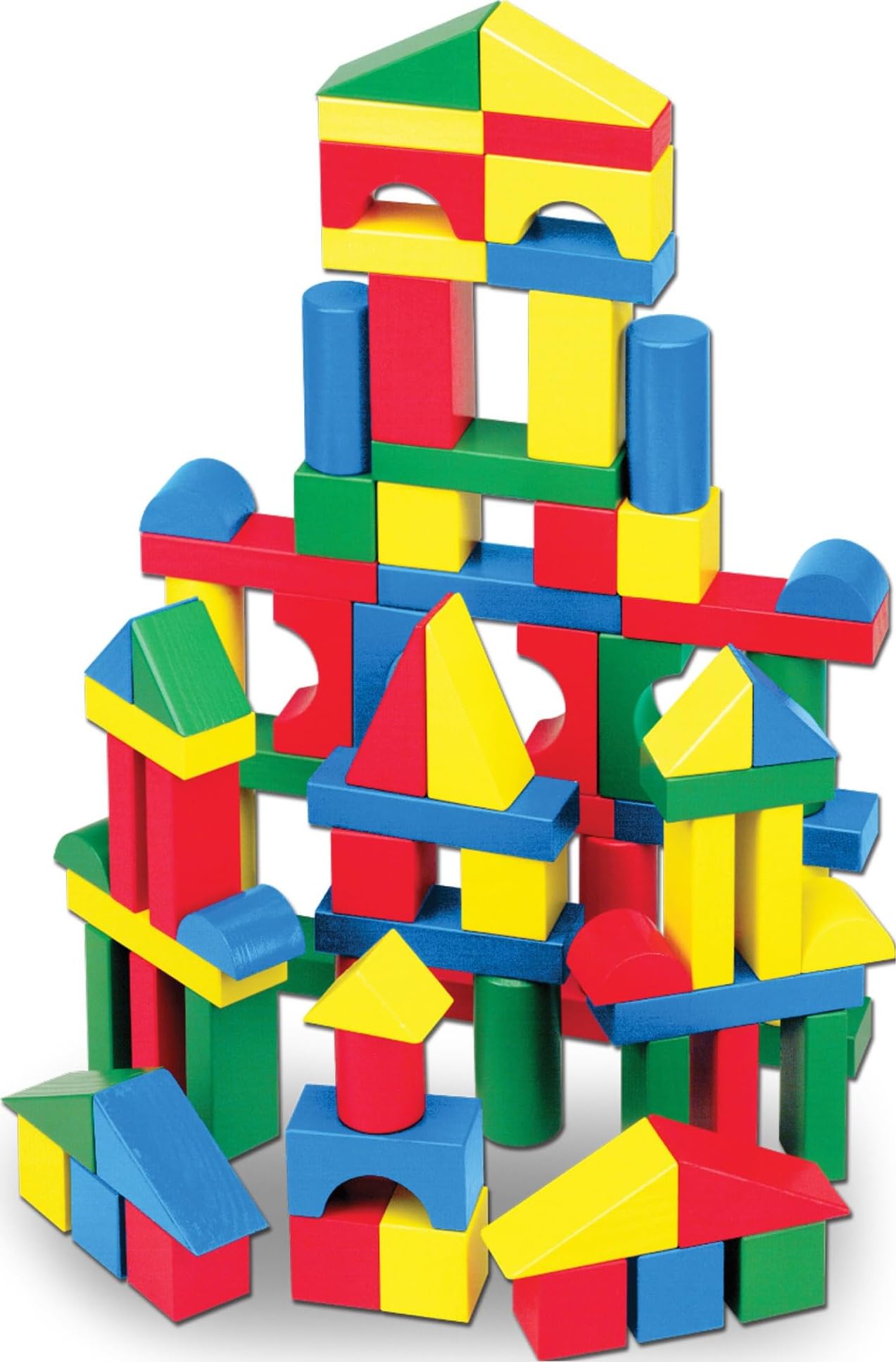
A hundred blocks arriving in one box is a different proposition from a ten-piece set. There's a noise when they hit the floor, and a moment where you wonder what you've done. Then the towers start.

The blocks are solid wood in four colors and nine shapes, from cubes and cylinders to arches and a few longer planks, and they come in a cardboard box sturdy enough to keep using as the storage. We ran a thumb along the edges of a dozen pieces and found nothing to catch, and the paint sits flat rather than thick. They're the plainest thing on this list and the one most likely to still be in the house when everything else has been outgrown.

Set against the plastic options, wood costs more per piece and doesn't go anywhere near water. What it buys is a set that doesn't really wear out. A hundred pieces is also a different kind of play from a stacker: two children can build separate things at once, and one child can build something taller than they are.

This is the set for a child past the mouthing stage — the box says two and up, and that's about right. Below that, the pieces are small enough that you'll be watching closely, and the cups or a ring stacker do more for a baby. Above it, this is the toy that keeps pace with them longest.

Bottom line: For a two-year-old with a playroom floor, these 100 blocks are the last stacking toy you'll need to buy — plain, solid, and impossible to outgrow quickly.

#6

Melissa & Doug Shape-Sorting Dump Truck

Melissa & Doug Shape-Sorting Dump Truck

Truck-loving toddlers

Doodle Score 9.6/10
Check Price

Worth Noting

  • Bulky next to a plain shape sorter
Pieces
12
Material
Wood
Shape Holes
9
Recommended Age
2 to 6 years
Read the full review

The bed tilts and the blocks come out the back. That's the part that gets played with first, and it's why this shape sorter doesn't become a shelf ornament once the shapes are mastered.

Nine shaped holes, nine blocks, two wooden figures, and a truck that rolls — this is the sorter we recommend for a child who already loves vehicles, because the sorting is folded into a toy they want anyway. The tailgate lifts as well as the bed tilting, so there are two ways to empty it and both are worth having. It's solid wood with a proper paint finish, and at around eleven and a half inches long it's a toy that gets pushed around the house rather than tidied away.

The two figures are what turn it into a truck rather than a puzzle box. They give a toddler something to hold and narrate while they work out which hole the triangle goes in, and they keep the toy alive after the shape lesson is over. It costs more than the plain sorters here and takes up more shelf, but it's the version that stays in play longest.

Bottom line: This is our pick for the toddler who wants a truck more than a puzzle: nine shapes to sort, a bed that dumps, and two figures to drive it.

#7

Fisher-Price Blocks & Rock-a-Stack Set

Fisher-Price Blocks & Rock-a-Stack Set

First birthday gifts

Doodle Score 9.6/10
Check Price

Worth Noting

  • Rings have no storage of their own
Rings
5
Blocks
10
Material
Plastic
Recommended Age
6 months and up
Read the full review

This is the box we suggest when someone asks what to buy a six-month-old: a Rock-a-Stack with five rings on a rocking base, plus the Baby's First Blocks bucket with ten blocks and a shape-sorter lid. Two toys covering the first two years in one purchase, and both are Fisher-Price at the age where Fisher-Price is at its best.

The rocker is the detail that earns the Rock-a-Stack its name — the base tips, so a stacked tower wobbles and a baby can bat at it without flattening it. The bucket does the opposite job: put in, take out, and the lid is the sorter, so the same ten blocks work as first blocks and as a matching puzzle. The bucket holds the blocks; the rings have no home of their own, which is our only real complaint.

Bottom line: For a baby shower or a first birthday, this bundle covers stacking and sorting in one box, and both toys are still in use at two.

#8

Aigybobo Farm Animals Set

Aigybobo Farm Animals Set

Counting practice

Doodle Score 9.6/10
Check Price

Worth Noting

  • Small animals for a mouthing child
  • Lids take aim to seat back on
Pieces
20
Animals
10 finger puppets
Barn Lids
Numbered
Recommended Age
12 months to 3 years
Read the full review

The hole in the bottom of each animal is the whole idea. They're finger puppets, so a one-year-old can walk a cow across the floor, and a three-year-old can put on a two-handed show. Ten animals, ten barns, and a lid on every barn with a number printed on it.

The barns turn it into a sorting job with more than one right answer. Match the animal to its barn, match the number on the lid to the animal, sort by color, or line the barns up and count. It's the only set here that gives you a number line and a color sort in the same box, and the pieces are light enough to disappear into a toddler bag.

Size is where it gives ground. The animals are genuinely small, small enough that a child who still mouths everything should meet this set later rather than sooner, and the lids take a bit of aim to seat back on. Neither bothered us enough to drop it from the list — the play it produces is unlike anything else here — but this is a set for a child past the put-it-in-my-mouth stage.

Bottom line: Try the farm set once mouthing has stopped: ten finger-puppet animals and ten numbered barns make sorting, counting, and pretend play one activity.

How We Chose and Tested the Best Sorting and Stacking Toys

We started with a shortlist built from manufacturer specs, age recommendations, piece counts, and the dimensions listed for each toy, then narrowed it by price tier so we were not comparing a tiny travel set with a full playroom set. We ended up with 14 sorting and stacking toys and kept them in regular rotation for four months in homes with toddlers and preschoolers. The testing happened where the toys actually live: on playroom floors, at kitchen tables before dinner, in the car on weekend errands, and in the bottom of a toy bin after cleanup.

We watched kids from about 18 months to four years approach each toy without help. For size and ease of use, we measured the footprint on a shelf, checked whether a two-year-old could grasp the largest and smallest pieces, and timed cleanup with a child helping. We noted whether pieces lined up easily or needed an adult to force them into place, and whether the toy stayed stable when a child stacked it higher than the picture suggested.

For quality, we dropped pieces onto a hardwood floor from table height, wiped them with a damp cloth, and checked for cracks, splinters, and paint wear after repeated play. For color and age-appropriateness, we spread the pieces out and asked kids to sort by color, then watched whether the challenge matched their age or ended in frustration. We tracked enjoyment and playfulness by leaving the toys accessible and noting which ones kids returned to on their own, invented games with, or ignored. To judge value, we weighed how often each toy came back into rotation against what it cost and how well it held up.

How to Choose Sorting and Stacking Toys

Stacking and sorting are different skills

Stacking is about size, balance, and gravity: rings go on a post, cups nest, blocks pile up. Sorting is about matching: the square goes through the square hole, all the red foods go in the red basket. Stacking usually arrives first, around the first birthday, and matching follows once a child is ready to compare two things rather than just handle them.

So if you are buying one toy for a child under two, buy a stacker — the cups at the top of this list or a ring stacker. If the child is already two and has solved the tower, buy the shape sorter or the color set instead.

Piece size decides who can play unsupervised

In a category built for the under-threes, piece size is the first thing we check and the last thing the packaging explains clearly. A ring stacker's topper, the berries in a play-food sorting set, and the animals in a farm set are all small enough to go in a mouth, and the age on the box is the manufacturer's line rather than a promise about your child.

If your child still mouths everything, start with nesting cups and a bucket sorter, and hold the small-piece sets until that stage passes.

Wood or plastic, and what each is for

Plastic wins in the bath and the diaper bag: the cups drain, they don't mind being soaked, and a nesting set weighs almost nothing. Wood wins on the floor at home — it is heavier, it holds its edges, and a solid block set is the thing on this list a second or third child will still be building with.

The trade-off runs both ways. Wood hurts when it lands on a foot and should not be left sitting in water. Plastic is lighter and does the bath, but a painted wooden block will outlast a thin plastic piece by years.

Storage is part of the toy

Every set here has somewhere to go, and the ones that get put away are the ones that are quick to put away. Nesting cups collapse into one stack, a hundred blocks need their box, a shape-sorter bucket holds its own pieces, and the farm animals need a tray or a lidded bin because ten loose animals and ten loose barns migrate.

If storage isn't sorted, the pieces end up in a drawer and the toy stops existing. A lidded bin beside the shelf does more for a set's lifespan than any feature on the box.

Frequently Asked Questions

Final Verdict

The First Years Stack & Count cups are the set we tell most families to start with: eight pieces a baby can bang together, a toddler can nest, and a preschooler can count with, and the only pick here that works in the bath as well as on the floor.

If the toy is going to live in a shared living room, the mushie cups do the same job in better clothes. If there is a two-year-old who wants to build rather than stack, go straight to the hundred wooden blocks. Everyone else should start with the cups and add a shape sorter once the tower stops being the point.