Baby & Toddler

Best Push and Pull Toys of 2026

A push toy can pull a toddler away from a screen without a fight — but only if it moves how they expect. Cheap ones wobble, pull cords tangle around ankles, and the bells that charm you in the store become a headache by Tuesday. Over four months, my team tested 16 push and pull toys with kids ages one to three; the good ones rolled smoothly on carpet and hardwood, kept cords short enough to be safe, and made sounds adults could live with.

The best ones invited repeat play. A toy that does one trick gets abandoned by the second morning; one that lets a toddler stack, sort, or load keeps them coming back. We checked age recommendations, small parts, and whether the educational bits were built in or just painted on. The picks below are grouped by what each toy does best, not by price, so you can match one to your kid's stage.

#1

VTech Sit-to-Stand Learning Walker
VTech Sit-to-Stand Learning Walker

First walkers

Doodle Score 9.6/10
Check Price

Worth Noting

  • Songs and phrases wear thin for adults
Age Range
9 months to 3 years
Weight Limit
35 lb
Wheel Control
Two-speed switch
Activity Panel
Removable, 5 piano keys
Read the full review

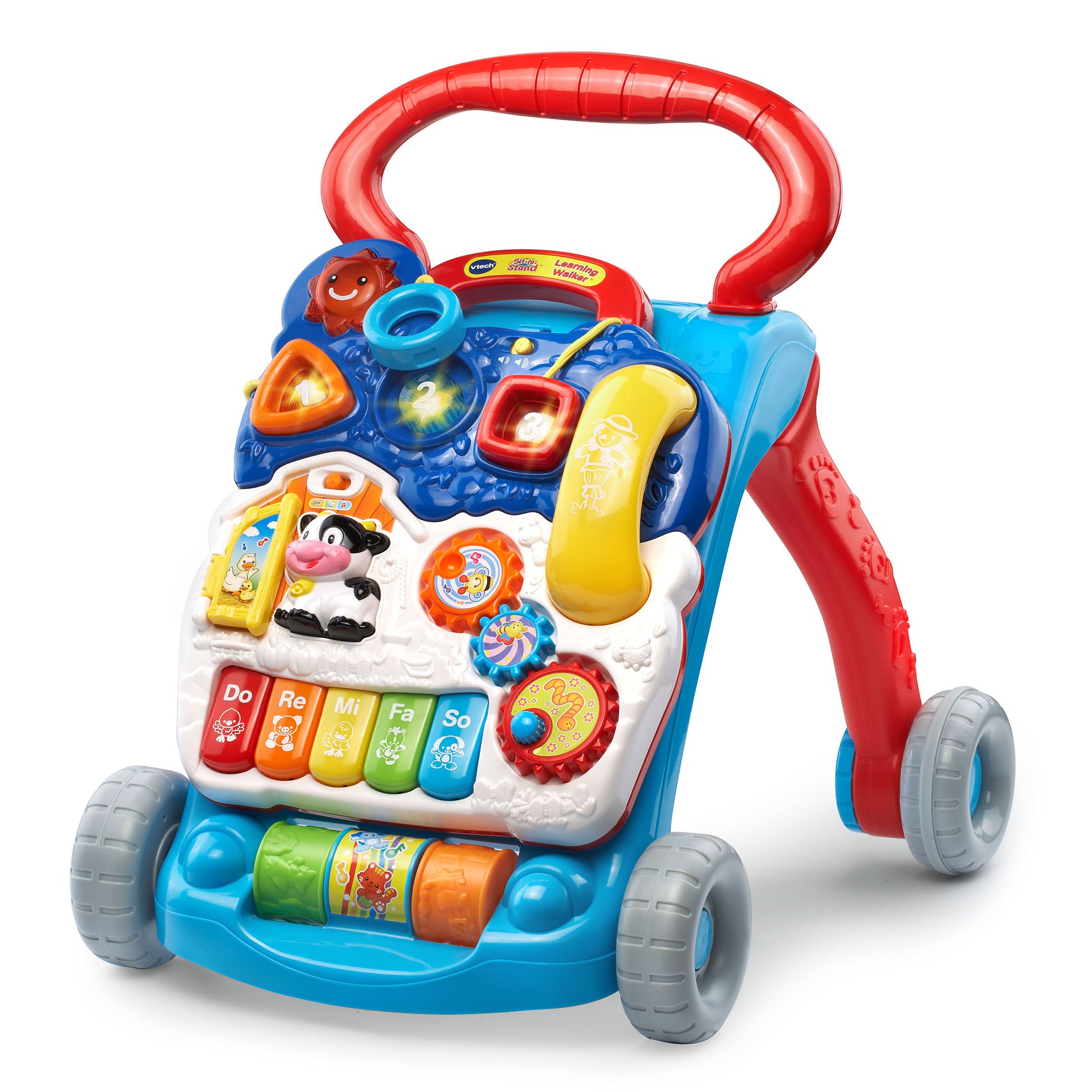
Lift the activity panel off the front of this walker and you get the single most useful thing in the category: a floor toy for a baby who can sit but cannot yet pull up. Five piano keys, a telephone handset, three shape sorters, light-up buttons and a set of rollers, all at an angle a nine-month-old can reach. Click it back on and the same panel becomes the dashboard of a walker.

That two-part design, plus the two-speed switch on the wheels, is why we hand this one to most families. Start slow and a new walker gets a frame that resists them a little; open it up and the same toy keeps pace with a confident toddler. It is rated to 35 pounds and covers nine months to three years, which is a longer useful life than most of what ends up in the toy box.

At four and a half pounds it is light enough to lift over a stair gate one-handed, and it rolls on carpet and hardwood — the two surfaces where a first walker actually spends its time. The footprint runs about 16 by 14 inches, so it tucks beside a sofa instead of taking over the room.

What it will not do is fold, and the 90-day warranty is short for something a toddler climbs on, so keep the receipt. Set against everything else here, this is the walker that asks the least of you and gives a child the most to do before they can even walk.

Bottom line: We recommend the Sit-to-Stand to most families: the panel keeps a sitting baby busy, then clicks back on to steady those first steps.

#2

Kidpop PULA Push and Pull Wagon

Kidpop PULA Push and Pull Wagon

Indoors and out

Doodle Score 9.6/10
Check Price

Worth Noting

Handle
Non-slip, collapsible
Wheels
Fully enclosed EVA
Age Range
7 months to 4 years
Dimensions
19.7 x 16.1 x 18.9 in
Read the full review

It is the most expensive toy in this guide, and for a family with a wobbly almost-walker it is the one worth stretching for. The base is wide, the wheels are fully enclosed, and at 4.5 kg it is the heaviest walker here — heavy enough that a toddler leaning their whole weight on the handle does not take it with them.

The two-in-one part is what earns the premium. Walk behind it now, then drop the handle and tow it later, with a hopper deep enough for a morning's worth of blocks. The EVA wheels are quiet on wood floors, quiet enough that they do not announce the toy from the next room, and the handle collapses for the back of a car or the hall cupboard.

Setup is the one thing to plan for. The fittings seat with a firm press and, on the wheel pieces, a tap rather than a click, so put it together the night before a birthday instead of the ten minutes before. Once it is up, nothing about it feels fragile: the finish shrugs off pavement and patio, and the seven-month-to-four-year span is the widest range here.

Bottom line: The one we reach for with a wobbly walker: a wide, heavy base that stays put, then a wagon that survives the yard.

#3

Hape Walk-A-Long Snail

Hape Walk-A-Long Snail

Quiet wooden play

Doodle Score 9.6/10
Check Price

Worth Noting

  • Shell and blocks come loose in play
  • Tail is thin wood and can snap
Size
11.8 x 5.1 x 9.5 in
Activity
Removable shape sorter
Material
Wood, water-based paint
Age Range
12 months to 4 years
Read the full review

Tug the cord and the shell starts turning, the tail flaps up and down, and the three wooden blocks inside tumble around. It is the sort of motion a one-year-old stops to watch and then follows, which is the whole point of a pull toy.

The shell lifts off and becomes a shape sorter with three holes — a small number on purpose, because three shapes is about what a toddler can hold in mind at once. It goes back on for pulling, so this is two toys in one with no screen and no batteries anywhere.

The cord is the part that matters most. It is elastic and long enough that the snail trails behind a walking child rather than bumping their heels, which is not something every pull toy here manages. The wood carries a water-based finish, and the toy is quiet — the only sound is the blocks knocking together.

This is the one we buy when we do not know the household. It asks nothing of the adults in the house: no batteries, no volume switch, no songs to get out of your head, and a look that does not shout nursery.

Bottom line: Our pick for a quiet wooden toy that is still being pulled around at four, thanks to the shape-sorter shell and a cord that actually trails.

#4

Radio Flyer Push & Pull Walker Wagon

Radio Flyer Push & Pull Walker Wagon

Yard and garden

Doodle Score 9.4/10
Check Price

Worth Noting

  • Wheels can work loose with use
  • Small for the older end of its range
Handle
Locks upright
Included
Garden tool set
Age Range
1 to 4 years
Weight Limit
35 lb
Read the full review

If there is a driveway, a sidewalk or a strip of patio outside the back door, start here. The wagon has a handle that locks upright so a toddler can push it like a walker, and a tray deep enough to carry the garden tools that come in the box.

The lock is the detail we appreciate most. An upright handle turns a toy into something a new walker can lean on, and unlocking it hands the wagon over to a four-year-old who wants to haul rocks. It is rated to 35 pounds, sits on four wheels, and rolls across pavement as happily as a kitchen floor.

Look hard at the size before you order. This is built for one- and two-year-olds — the tray is shallow, the handle is low — and a tall three-year-old ends up stepping over the handle instead of pushing it. Perfect for a first birthday, less so for a child who is already running.

Bottom line: We like it best as the walker that lives by the back door: handle up to walk, handle down to haul weeds and toys.

#5

VTech Pull and Sing Puppy

VTech Pull and Sing Puppy

Songs and buttons

Doodle Score 9.4/10
Check Price

Worth Noting

  • Demo batteries need replacing early
Size
7.9 x 6.7 x 3.9 in
Age Range
6 months to 3 years
Batteries
2 AAA
Push Buttons
3 colorful
Read the full review

The string on this puppy is short. Short enough that a toddler moving at any speed is dragging the dog rather than leading it, and short enough that it works better as a floor toy with a handle attached. That suits the age it is aimed at: the puppy follows for a few steps, then gets picked up and squeezed.

What it does well is the sit-and-play half. Three chunky buttons, a nose that lights up with the voice, and a running lesson in numbers, colors and parts of the body — for a baby who is not walking yet, that is most of the value. Two volume levels keep it under the level of a nuisance, and the ears wiggle as it moves, which is what keeps a child following.

We were surprised by how much of the play happens with the toy standing still: buttons first, pulling second. It survives being dragged, tipped and thrown by a one-year-old, which is the bar these things have to clear. And you will hear one phrase more than any other — the puppy announcing that he needs a rest, often enough that you may start agreeing with him.

Bottom line: We treat this as a button toy first and a pull toy second: buy it for the songs and the light-up nose, not the trailing string.

#6

Fisher-Price Chatter Telephone

Fisher-Price Chatter Telephone

Pretend calls

Doodle Score 9.4/10
Check Price

Worth Noting

  • Short string means it barely trails
Dial
Numbers 0-9
Size
6.3 x 7.7 x 4.2 in
Weight
14 oz
Age Range
12 months and up
Read the full review

The Hape snail is the pull toy for a child who wants something following them across the room. The Chatter Telephone is for the child who wants to make a call. Dial the numbers, watch the eyes roll up and down, hold the handset to an ear — it is a piece of role-play that happens to have wheels.

It is the least expensive toy here and the one that fits in a changing bag. The dial introduces 0 to 9, the phone rings when it is pulled along, and the eyes bob with the motion — small rewards that make a child want to drag it another lap of the kitchen.

We keep recommending it because the play does not depend on movement at all. Sitting and dialling holds a one-year-old's attention on its own, and the pulling is a bonus rather than the whole point. The plastic is light and the finish is basic, so treat it as a first pull toy rather than something to hand down.

Bottom line: We keep coming back to this one as a first pull toy: familiar, cheap, and better for sit-and-dial play than for towing.

#7

Fisher-Price Corn Popper

Fisher-Price Corn Popper

Budget push-along

Doodle Score 9.0/10
Check Price

Worth Noting

  • Balls can be slow to pop
Size
22.5 x 8.5 x 6.2 in
Weight
1.8 lb
Assembly
Two-piece
Age Range
12 months and up
Read the full review

Push the handle and the balls bounce and pop inside the dome. The entire toy is that one idea, and it has been working on toddlers for decades because the reward is instant: push, and something happens.

The version you can buy now is quieter than the one you remember from a childhood living room, which parents count as a win and children seem not to notice either way. It is also light, at under two pounds, with a 22-inch handle that a two-handed toddler can hold on to while they find their feet.

This is the toy to buy if your child ignores everything else on the shelf, and the one that cares least about the floor underneath it. Assembly is two pieces that push together, and then it is rolling.

Bottom line: We think it is still the least expensive way to get a reluctant toddler moving, as long as you can live with the popping.

How We Chose and Tested Push and Pull Toys

We built a shortlist of 16 toys from established brands and a few newer names, filtering by age recommendations, materials, price, and whether the toy had a cord short enough to pass our safety check. We skipped anything with small parts for kids under three and anything that looked likely to tip on a turn. Then we put the shortlist into daily rotation for four months.

Testing happened where these toys actually live: the playroom rug, the hallway, the backyard patio, and a handful of playdates with 1-, 2-, and 3-year-olds. We watched how kids grabbed each handle, whether they could restart a pull string without help, and how often they returned to a toy after the first week. On carpet, we noted wheel drag and tipping on turns; on hardwood, we listened for clatter and checked whether the toy rolled or slid. We measured every cord against a 3-foot-tall toddler's reach and watched for tangles around ankles and furniture legs.

Noise got its own test: we noted the volume of built-in bells, squeakers, and clackers and whether we could still tolerate the sound after 10 minutes of repeat play. We checked age labels against what the toy actually required — small parts, weight, and whether a 1-year-old could use it without a parent hovering. For the educational claim, we looked for sorting, counting, or cause-and-effect play rather than a flashing light. At the end, we compared price to how each toy looked after four months of drops, kicks, and patio drags.

How to Choose Push and Pull Toys

Buy for the stage, not the age on the box

A baby who can sit but not pull up wants a panel on the floor: buttons, keys, a telephone handset at an angle they can reach. A baby who pulls up on furniture wants weight low down and a handle at chest height. A confident walker wants a pull-along, because walking now has a purpose — dragging something across a room.

Buying a stage ahead is the most common mistake, and it is why convertibles earn their keep. The VTech's panel lifts off for a sitting baby and clicks back on for a pusher; the Kidpop and the Radio Flyer start as walkers and finish as wagons.

Wheel control is the whole job

A push walker only helps if it moves at the speed of the child behind it. Hard plastic wheels on a wood floor shoot forward the moment a baby leans on the handle, and the same walker on a deep carpet may not move at all. Look for a switch that slows the wheels, or a heavy frame with widely set wheels: our top pick has a two-speed switch, while the Kidpop relies on weight and enclosed EVA wheels.

The trap is judging that anywhere but at home. Push any walker you are considering across the surface it will actually live on, empty, before a baby tries it.

Pull cords are shorter than you picture

Almost every pull toy here comes with a string that stops well short of the length you imagine. That is deliberate: a short cord keeps a toddler from wrapping anything around themselves and keeps the toy close enough to grab. The practical consequence is that a pull toy follows at heel height rather than trailing across the room.

If a proper trail matters, the Hape snail's elastic cord is the longest of the ones we recommend and behaves most like a real pull-along. Do not add length to a cord yourself — the short string is part of what makes these safe.

Where it will live

Floors and surfaces should decide part of this. A heavy walker with rubbery wheels is the safer bet in a house with hard floors; a light, wide wagon copes with carpet, pavement and patio. If the toy will spend most of its life outdoors, buy for outdoors — the Radio Flyer is built for driveways and sidewalks, and the Kidpop's wheels handle both sides of the back door.

Storage is worth a thought before you buy. Measure the gap beside the sofa or the shelf in the hall; a folding frame like the Kidpop's buys back the most space, and the VTech does not fold at all.

Sound, batteries and the second life

Electronic push toys are the ones children ask for and the ones adults tire of first. If you already know the songs will bother you, buy the quiet option — the wooden snail, either wagon, the Corn Popper's mechanical rattle — rather than the toy with a volume control you will touch once.

Then ask what the toy does once walking is mastered. A panel that detaches, a wagon that converts, a shell that becomes a shape sorter: those are the ones still in rotation at three.

Frequently Asked Questions

Final Verdict

For most families, the VTech Sit-to-Stand Learning Walker is the one to buy. Nothing else here does both jobs as well: the panel keeps a sitting baby busy on the floor, then clicks back on to give a new walker a frame that moves at their speed rather than ahead of it.

Spend more only if the toy will live outdoors, where the Kidpop's weighted base and folding frame earn their keep, or if you want wood and quiet, in which case the Hape snail is the one we hand over without a second thought.