Baby & Toddler

Best Indoor Climbing Toys for Toddlers of 2026

The first time my toddler used the back of the couch as a jungle gym, I knew the living room needed a better outlet. Indoor climbing toys give toddlers a place to pull up, crawl over, and slide down without turning the furniture into a hazard. We put 12 of them through eight months of daily use, and the differences in stability, assembly, and staying power were obvious.

Size is the sneaky variable: a climber that looks compact online can swallow a playroom once it's unfolded, so measure your open floor and decide where it will live between play sessions. Assembly matters more than the box suggests, too—if it takes two adults and a power tool, it had better be worth the effort. The best options felt solid under a climbing toddler, had rounded edges and no finger traps, and were worth the money because they kept getting used in new ways. The right pick for your space is somewhere below.

#1

Play22 Soft Foam Climbing Set

Play22 Soft Foam Climbing Set

Babies and crawlers

Doodle Score 9.6/10
Check Price

Worth Noting

  • Limited climbing challenge for older toddlers
Cleaning
Wipe-clean waterproof
Material
Foam with vinyl cover
Piece Count
5 pieces
Recommended Age
12 months–7 years
Read the full review

The first thing we noticed about the Play22 set is how little ceremony it requires: five foam blocks come out of the box, and a crawler can start pulling up on them. That matters at an age when a wooden climber is still a few months away. The ramp, cylinder, half-circle, cuboid, and rectangle are sized for small bodies, and the non-slip bottoms keep the arrangement from skating across a smooth floor. This is the foam set we point to for babies who are just starting to crawl and cruise.

The firmness is what we noticed next. These are soft enough to cushion a tumble but dense enough that a toddler doesn't sink into them. The vinyl cover wipes clean after snacks and spit-up, and the colors are bright without looking like a plastic toy explosion.

The limitation is size. A tall 3-year-old will run out of climbing challenge, and the blocks are better for building forts and low obstacles by then. If you want a foam set that lasts into preschool, the TODIBY six-piece has more structure; if you want the gentlest first set, this is the one.

Bottom line: For crawlers and new walkers, we start with these soft blocks: they arrive ready to use and forgive the tumbles that come with first climbs.
#2

LOL-FUN Foldable Pikler Set

LOL-FUN Foldable Pikler Set

Small spaces

Doodle Score 9.6/10
Check Price

Worth Noting

  • Compact frame for taller 3-year-olds
Dimensions
36 x 4.9 x 19 in
Play Modes
5-in-1
Weight Limit
110 lb
Recommended Age
1–3 years
Read the full review

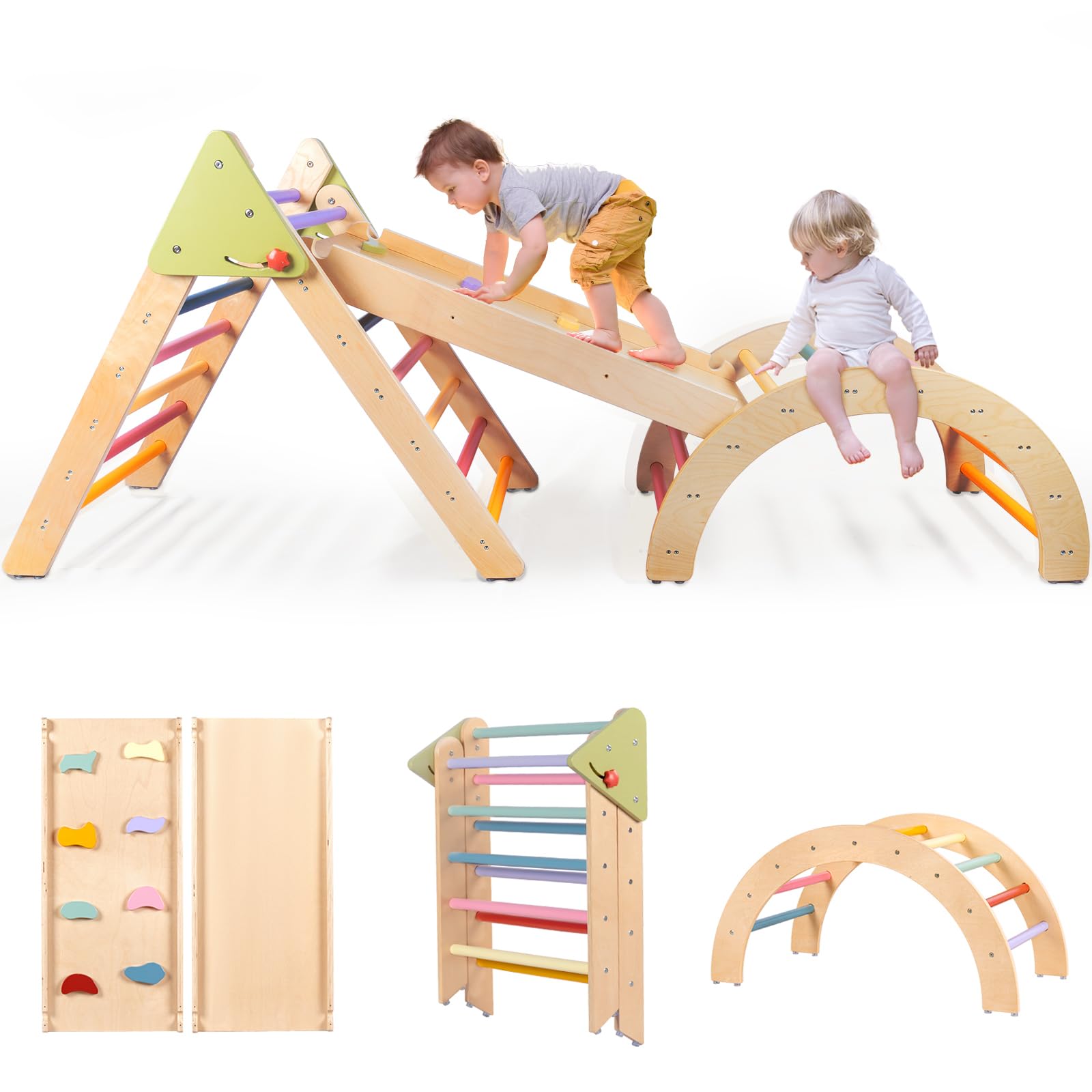
The folding mechanism is the reason this Pikler earns a spot: two screws loosen, the frame collapses, and a small playroom gets its floor back. That is a different promise from the larger wooden sets here, which are happier staying put. The 110-pound limit and 1-to-3 age range are honest for a toddler climber, and the anti-slip rubber base gives it a planted feel on hardwood.

The dual-use ramp earns its keep. One side has eight rainbow grips for climbing; flip it and you have a slide. It is the kind of detail that keeps a 2-year-old busy without adding another piece to store. The water-based paint and solid wood construction also make it feel more substantial than a folding set often does.

Assembly is manageable, but this is still a wooden set with screws, not a pop-up tent. The 36-inch footprint is compact for a Pikler, so taller 3-year-olds may find the climbing angle less challenging than a full-size triangle. For a first wooden climber in an apartment, that is a fair trade.

Bottom line: When floor space and budget are tight, we choose this folding Pikler for its real slide and climbing challenge without a permanent footprint.

#3

Simplay3 Rock Around Wobble Disk

Simplay3 Rock Around Wobble Disk

Active rocking play

Doodle Score 9.4/10
Check Price

Worth Noting

  • Not suitable under 24 months
Material
Plastic
Dimensions
24.5 x 25 x 9.5 in
Play Modes
2-sided rocker/climber
Recommended Age
24 months–5 years
Read the full review

Flipped one way, the Wobble Disk is a bowl-shaped rocker; flipped the other, it becomes a low climbing dome. That two-in-one trick is why it stays in the rotation when the novelty of a static climber wears off. The one-piece plastic body has no assembly and no small parts, and the molded grip handles give a toddler something to hold while they rock or spin.

We were struck by how much movement it invites. This is not a quiet corner toy; it rewards a 2- or 3-year-old who wants to spin, wobble, and climb over something. The 24.5-inch width is small enough for a playroom but wide enough for two kids to take turns, and the indoor/outdoor construction means it can move to the yard without fuss.

The catch is the age floor. At 24 months and up, it is not the first climber for a 1-year-old, and the spinning motion needs a parent nearby until a child has the hang of it. If your toddler is still crawling, choose the Play22 foam set; if they are already climbing the sofa, this is the outlet they need.

Bottom line: We keep this one-piece rocker in the mix for high-energy 2- and 3-year-olds because it flips into a climber and works indoors or out.

#4

BlueWood Pikler Triangle Set

BlueWood Pikler Triangle Set

All-around toddler climber

Doodle Score 9.2/10
Check Price

Worth Noting

  • Assembly takes time and a drill
Material
FSC-certified solid wood
Play Modes
7-in-1
Weight Limit
160 lb
Recommended Age
1+ years
Read the full review

The 160-pound weight limit and two-to-three-child capacity are what make this the first set we point most families toward. Most toddler climbers here are one-child-at-a-time; this one lets a sibling or a friend join without the whole thing feeling overloaded. The seven-in-one layout adds a triangle ladder, slide board, climbing arch, and wooden car, so it keeps earning space as a child moves from cautious steps to real climbing.

What sold us was the combination of FSC-certified solid wood and a two-year parts warranty. Those are the details that make the premium price easier to justify. The 71-inch width is the trade-off: it needs a real wall or playroom corner, and at 25 pounds it is not something you move every day.

Where it separates itself from the other wooden sets is the safe handle and the arch-and-bar design, which gives toddlers a handhold without turning the whole thing into a ladder. We also appreciate that the ramp does double duty as a slide and a climbing surface. It feels like a piece of playroom furniture, not a temporary toy.

If you have a dedicated playroom, this is the wooden set we keep. If you need to tuck it behind a sofa each week, the LOL-FUN is the easier fit.

Bottom line: We point families to this one when they want a wooden climber that can handle two or three toddlers and stay useful through preschool.

#5

ElegantCrafts Pikler Triangle Set

ElegantCrafts Pikler Triangle Set

Maximum configurations

Doodle Score 9.2/10
Check Price

Worth Noting

  • Cushion is thin
Material
FSC-certified pine
Play Modes
9+ combinations
Recommended Age
12 months–4 years
Safety Standard
ASTM F963-17
Read the full review

The nine-configuration claim is the reason to look at this set: triangle, arch, ramp, ladder, cushion, and two wooden cars that can be rearranged into a fort, a rocker, or a slide. That is more pieces than most toddlers need on day one, but it is what keeps the set from becoming furniture by age three. The FSC-certified pine and ASTM F963-17 certification are the right baseline for a wooden climber.

The cushion does more than we expected. It turns the arch into a reading nook and gives a crawling baby a soft place to land. The two cars are a nice touch for imaginative play, and the whole thing looks less like a gym and more like a playroom piece.

Assembly is the weak spot. The instructions are clear, but the ramp sides can need a little coaxing into alignment, and the included tools are not the fastest. Give yourself time and check every screw before a child climbs. The payoff is a set that is genuinely versatile, not just a triangle with extra pieces.

If you want one wooden climber that can be a slide, a rocker, and a fort, this is the one we point to after the BlueWood. If you mostly want a simple first triangle, the LOL-FUN is easier to live with.

Bottom line: We recommend this set when you want the most configuration variety, a cushion included, and can accept a little assembly fiddliness.

#6

WINGYZ 8-in-1 Pikler Set

WINGYZ 8-in-1 Pikler Set

Imaginative animal play

Doodle Score 9.2/10
Check Price

Worth Noting

  • Modest climbing height for tall 3-year-olds
Material
Birch marine plywood
Play Modes
8-in-1
Rung Spacing
2.35 in
Recommended Age
18 months–5 years
Read the full review

The 2.35-inch rungs are the detail that makes this Pikler feel different. They are wider than the thin dowels on many wooden triangles, which gives small hands and feet more to grab and makes the climb less fussy for a 2-year-old. The animal-print slide is the fun part; flip it and the play changes from climbing to sliding without adding another bulky piece.

Birch marine plywood and the FSC/ASTM claims suggest a set that can handle daily use, not just a photo-ready nursery. The 18-month-to-5-year range is broad, and the folding frame helps it tuck away between play sessions. In our group, it is the wooden set that feels most like a toy and least like gym equipment.

The caution is size. The fully extended footprint is generous, but the climbing height is modest, and taller 3-year-olds may outgrow the challenge before they outgrow the slide. Assembly is straightforward, though you should check the joints after the first week. If you want the biggest wooden play value for a preschooler, the BlueWood is sturdier; if you want the animal theme and a friendlier climb, this is the pick.

Bottom line: Animal-loving toddlers ready for a taller wooden challenge get our nod for the wide rungs, reversible slide, and foldable frame.

#7

TODIBY 6-Piece Foam Climbing Set

TODIBY 6-Piece Foam Climbing Set

Structured foam play

Doodle Score 9.2/10
Check Price

Worth Noting

  • Compact size limits older toddlers
Cleaning
Wipe-clean covers
Material
Foam with PU leather
Piece Count
6 pieces
Recommended Age
12 months–10 years
Read the full review

Six pieces sounds like a lot until you see the footprint: this is a compact foam set, not a room-filling gym. The two stairs, two half-moons, square, and slide are best for a 1- or 2-year-old who is just starting to climb and slide. The PU leather cover wipes clean, and the pieces have velcro tabs to keep a configuration from sliding apart. For a playpen or a small playroom, it earns its place.

The foam is firm enough to support a toddler without collapsing, and the covers are much easier to clean than fabric. It is not the set for a tall 3-year-old who wants a challenge; by then, the pieces feel low and the slide is short. That is the trade-off for a set that fits into a small room.

The foam may arrive compressed and need a few hours to fully expand. Check the seams and let it sit before you turn a child loose on it. If you have a baby or a young toddler and a tight room, this is a sensible buy; if you want a climber that grows into preschool, choose a wooden Pikler.

Bottom line: For younger toddlers and compact playrooms, we like this six-piece foam set for its slide, stairs, and easy-clean covers.

#8

Yopnoyik 7-in-1 Pikler Set

Yopnoyik 7-in-1 Pikler Set

Older toddlers

Doodle Score 9.0/10
Check Price

Worth Noting

  • Age floor of 36 months
Material
Wood
Play Modes
7-in-1
Item Weight
24.8 lb
Recommended Age
36 months–6 years
Read the full review

The 36-month age floor is the first thing to notice here. This is a wooden Pikler set with a cushion, ramp, arch, and seven configurations, but it is aimed at older toddlers and preschoolers, not the 1-year-old who is just pulling up. If your child is already 3 and climbing confidently, that is not a problem; if you are shopping for a first birthday, it is the wrong starting point.

The cushion and smooth wood are the appeal. The set feels sturdy once the screws are tightened evenly, and the arch gives a toddler a place to rock or read between climbs. The 24.8-pound weight is heavy enough to feel planted, but you will want two people to move it or a permanent corner for it.

Assembly is manageable, though a few sets arrive a little wobbly until each screw is adjusted. Check the joints after the first week and keep the included gloves for handling the frame. The seven configurations are real, but the climbing angle is not as tall as the BlueWood, so it suits a cautious climber more than a daredevil.

This is the wooden set we point to when the budget is tighter but you still want a cushion and multiple setups. It is not the first choice for a 1-year-old; for that, go foam or a lower Pikler.

Bottom line: We see this as the wooden set for older toddlers around three and up who want a cushion, ramp, arch, and seven setups.

How We Tested Toddler Climbing Toys

We started by pulling together a shortlist of indoor climbing toys sized for toddlers, then narrowed it by reading specs and customer reviews for clues about wobbly joints, confusing instructions, and pieces that arrived chipped. From that pool, we tested 12 units over eight months, rotating them through a carpeted playroom, a living-room rug, and a stretch of hardwood. Each one lived where a toddler actually plays: morning climbs before breakfast, after-nap ramps and slides, and weekend playdates with a 2-year-old and a 4-year-old taking turns.

Assembly was timed from box opening to first climb, with one adult working alone and no extra tools unless the instructions called for them. We noted how clear the diagrams were, whether holes lined up, and if the whole thing still felt tight after a week of use. For durability, we checked joints and screws weekly, looked for splinters or sharp edges, and washed removable covers according to the care instructions. Size got measured in real floor space, not catalog dimensions—then we moved each climber between rooms to see whether it could be stored against a wall or had to stay put.

Fun and playability were judged by what the toddlers did, not what the box promised: did they return to it on their own, invent games with blankets and stuffed animals, or ignore it after the first day? We watched for safe, confident climbing—wide bases, gentle angles, no gaps that caught fingers or clothing. Value came down to how much use each one earned against its footprint and price, plus whether it could be reconfigured as the kids grew. The ones that stayed in rotation were the ones that felt sturdy, went together without a fight, and kept a toddler busy longer than the cardboard box did.

How to Choose Indoor Climbing Toys for Toddlers

Start With the Child's Stage

A 12-month-old needs low steps, a soft landing, and a shape they can crawl over without a big drop. A 2-year-old wants a real climbing angle and a slide; a 3-year-old needs more challenge or the set becomes a fort. A tall wooden Pikler is not the first set for a new walker, even if it has more configurations. The Play22 foam blocks are the better first set for a crawler, while a confident 2-year-old gets more from a wooden triangle.

Match the climbing height to the child, not the box's upper age limit. A set that says 1 to 3 years can still be too tall for a cautious 1-year-old and too low for a tall 3-year-old. Watch how your child gets down, not just up; a controlled slide or a low arch matters more than a fancy ladder.

Measure the Footprint and the Fall Zone

Product photos make climbing sets look room-filling, then the foam blocks arrive smaller than expected, or a wooden set takes over a wall. Tape the assembled dimensions on the floor before you order. The BlueWood runs 71 inches wide; the LOL-FUN is 36 inches, which is a different room decision.

Leave a clear landing zone on every side a child can roll or jump from, and keep the set away from sharp table corners and hard fireplace edges. If the room only works with the climber jammed against a sofa, it is not the right room for that climber.

Choose the Material Around Your Floors

Foam is the forgiving choice for 1-year-olds and hard floors, but foam blocks can slide, especially on smooth wood or tile. Look for non-slip bottoms or put a rug underneath. Wood is more stable and lasts longer, but a fall from a wooden triangle is less forgiving; that is why the age and confidence of the child matter.

Plastic is the odd one out, and that is why the Simplay3 Wobble Disk works: it is a rocker and a low climber that can go outside. We prioritize a stable base and rounded edges over the number of pieces. A simple set a child can use independently beats a complex one that needs an adult to rearrange it.

Decide Whether It Needs to Disappear

Foldable means different things. On the LOL-FUN, two screws loosen and the frame collapses; on larger wooden sets, folding may mean removing hardware, and some so-called folding sets still need tools. If the climber has to leave the living room every week, check the folded dimensions and the mechanism before you buy.

If you have a dedicated playroom, buy for the open footprint and don't pay extra for storage you won't use. A compact foam set like the TODIBY six-piece is easier to tuck into a playpen than a full Pikler, but it also has less climbing height.

Check the Weight Limit and Keep It Stable

Weight limits tell you whether siblings can climb together and whether the frame is built for rough play. The BlueWood lists 160 pounds and two to three children; the LOL-FUN lists 110 pounds. Those numbers are not a challenge. Stay within them, and check screws and joints after the first week and again as the set gets heavy use.

Use the climber on a flat, stable surface and keep the fall zone clear. Adult supervision is not optional for toddlers, especially on a new set or when two children are climbing at once. A mat under a wooden frame doesn't make it soft, but it takes some of the sting out of a tumble.

Frequently Asked Questions

Final Verdict

We keep coming back to the BlueWood Pikler set because it does the most jobs well: it gives a 1-year-old a low climb, a 2-year-old a slide and arch, and a 3-year-old a balance challenge, with a weight limit that lets siblings join.

If your child is still crawling, start with the Play22 foam blocks instead; if floor space is the constraint, the folding LOL-FUN is the smarter fit. Those are the two changes that would move us off the top pick.