Baby & Toddler

Best Pounding Toys for Toddlers of 2026

A pounding toy is about as simple as a toy gets — a mallet, a bench, and a few pegs that disappear when smacked. I've watched my own toddler go from polite taps to full-force wallops in seconds, which is exactly the point: the urge to hit gets a safe, satisfying place to land, and hand-eye coordination comes along for the ride. The trick is that not every bench survives a determined 2-year-old. Some mallets splinter, pegs jam after a week, and benches slide or tip mid-swing.

Over the past four months, we've put 12 pounding toys through daily play with toddlers ages 1 to 3. The differences come down to: whether kids return to it on their own, how well it holds up to repeated whacks (and the occasional chew), and whether it's stable enough to stay put. We also kept an ear out for volume, checked that every mode actually works, and asked whether the price makes sense for a mallet and pegs. The picks below are the ones toddlers love.

#1

Joyreal Wooden Activity Set
Joyreal Wooden Activity Set

All-in-one gift

Doodle Score 9.6/10
Check Price

Worth Noting

  • Xylophone planks are noticeably out of tune
Size
10.39 x 5.94 x 5.62 inches
Material
Wood, water-based paint
Age Range
18 months - 5 years
Activities
Pounding bench, xylophone, fishing game, gears
Read the full review

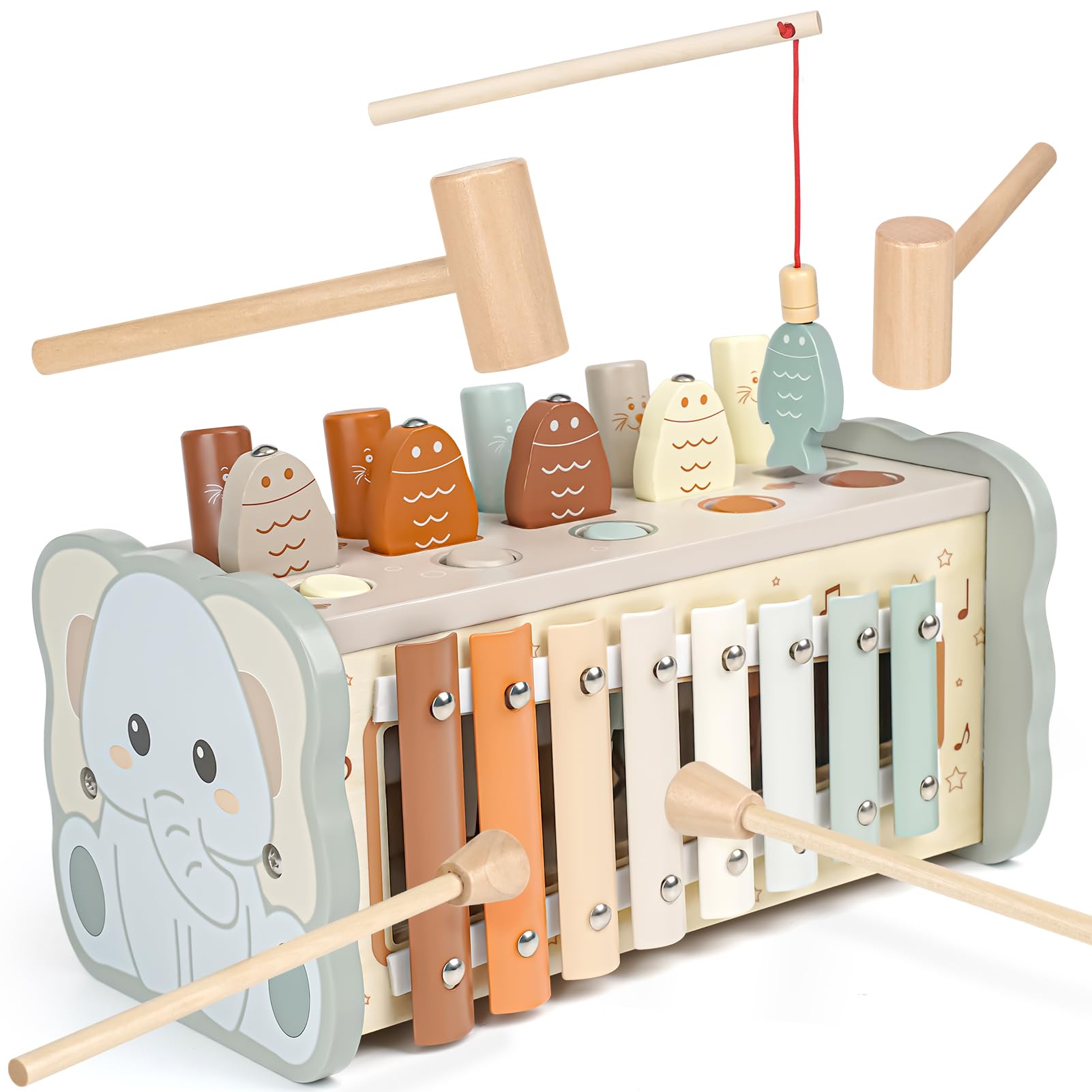
Count the activities: a pounding bench on one face, a xylophone, a magnetic fishing game and a gear wheel, plus two hammers and two mallets in the box. That is a lot of toy in a ten-inch footprint, and it is the reason this set stays out instead of going back on the shelf after a week.

The pounding half is real rather than decorative — pegs pop back up, the mallet is properly sized for a small fist, and the bench sits steady on a rug. The extras are what make it a long-haul buy: the fishing pole and the gears give a three-year-old something to do when hammering loses its edge, and the second hammer means a friend or a parent can join in.

The set arrives as a pile of small pieces — mallets, pole, fish, pegs — so count them before you wrap it, because one missing piece takes a whole activity off the board. The neutral colors are the other reason we like it: this is a wooden toy that does not shout from the corner of a living room.

For the 18-month-to-four-year stretch, this is the box we choose when we want one gift to do a lot. It is not the purest pounding toy here — the Hape's single, focused loop still beats it on that — but nothing else in this group covers as many afternoons.

Bottom line: One box that covers pounding, music, fishing and gears, with a second hammer for a sibling — the best long-haul gift in this group.
#2

Hape Pound & Tap Bench

Hape Pound & Tap Bench

First pounding toy

Doodle Score 9.4/10
Check Price

Worth Noting

  • Notes plink short rather than play a tune
Size
9.45 x 5.91 x 5.31 inches
Material
Wood, water-based paint
Age Range
12 months - 3 years
Xylophone
Slides out for separate play
Read the full review

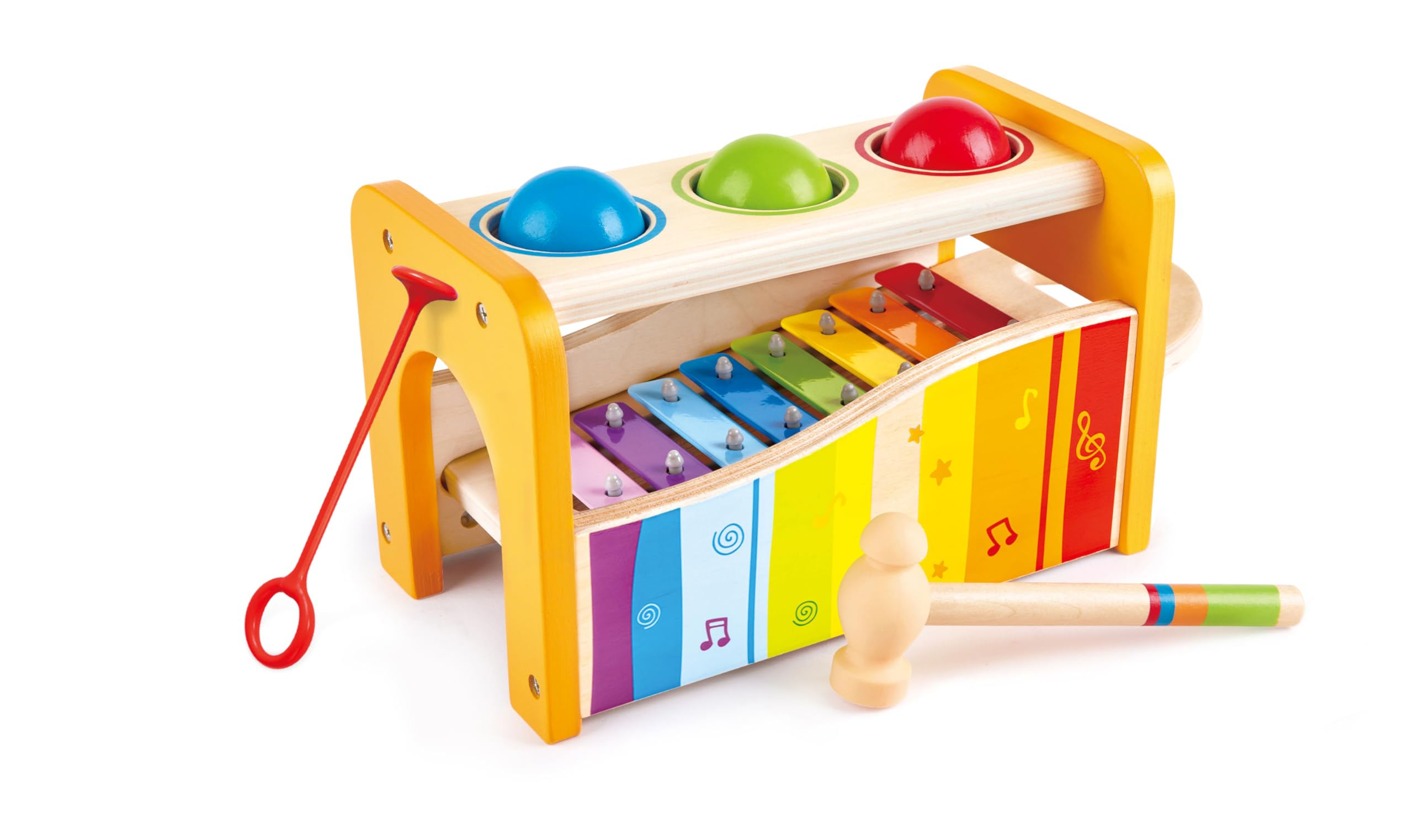
A ball that disappears and comes back as a note is why this bench is our top pick. Hit one of the wooden balls and it drops through the bench, clips a xylophone key on the way down and rolls out the side — one swing, three results. For a 12-month-old working out that their hands cause things to happen, that loop is the entire toy, and it stays interesting long after a plain peg bench has been solved.

The xylophone slides out, which is the detail we appreciate most: leave it in place and you get the plink of a ball crossing a key; pull it out and a toddler can hammer out an actual tune on the bench. That is two toys in one frame with no bag of extra parts, and the finish is water-based paint over solid wood rather than a veneer that flakes at the edges.

Retrieval is the one chore. Wooden balls leave the bench with real speed and keep rolling until something stops them, so a shallow tray or a rug at the exit saves a lot of crawling. Chasing is half the game for a toddler and rather less fun for the adult on hands and knees.

The stated range, 12 months to 3 years, is honest, and it is the widest useful window here: this works as a first-birthday present and still gets played at three, when the xylophone turns into a band. At nine and a half inches wide it fits a lap tray or a high-chair tray, which is more than the taller ball towers manage.

Bottom line: Two toys in one: a pounding bench that turns every hit into a note, and a xylophone that slides out to be played properly. Our default first-birthday pick.

#3

Melissa & Doug Pounding Bench

Melissa & Doug Pounding Bench

No lost pieces

Doodle Score 9.4/10
Check Price

Worth Noting

  • Wood dents and scuffs at the strike zone
Pegs
8 peekaboo pegs, fixed in the bench
Size
10.25 x 5.3 x 5.3 inches
Material
Wood
Age Range
24 months - 4 years
Read the full review

Eight pegs, one mallet, and nothing that can end up under the refrigerator. The pegs are riveted through the bench, so a hit sends one down and its neighbour up on the far side; the toy resets itself, and a two-year-old can keep hammering without an adult crawling around after them.

That self-resetting action is why this is the bench we reach for when we want quiet. It suits a child who has already worked out that hitting is fun and does not need a musical reward for it. The resistance is light, though — a peg gives way under a thumb, so a toddler can push the whole row down without ever picking up the mallet, and the hammer becomes optional.

The ten-inch bench is small enough for a lap and steady enough for two-handed swings, and the wood gives a proper knock that plastic cannot imitate. Ages 2 to 4 fits what we saw; a one-year-old will mostly chew the mallet and watch.

Bottom line: Buy this one if loose pieces make you twitchy: eight pegs that never leave the bench and a quiet thud instead of a tune.

#4

Battat Pound & Count Bench

Battat Pound & Count Bench

Budget wooden bench

Doodle Score 9.4/10
Check Price

Worth Noting

  • Ships with only one mallet
Pegs
10
Size
10.56 x 4.75 x 5.56 inches
Age Range
12 months and up
Mallet Storage
Slot on the side of the bench
Read the full review

Ten pegs, numbers and little mood faces around the top rail, and a mallet that lives in its own slot on the side of the bench. This is the wooden pounding toy we point to when someone wants the classic thing without paying for the fanciest version of it, and it starts at 12 months, which matters if the birthday in question is the first.

One peg down sends its neighbour up, so there is no reset and no loose piece to lose, and the faces give a toddler something to name once the hammering slows down. The build is honest — solid wood, smooth edges, a mallet sized for a small fist — and it looks like the toy that will outlast the interest. It ships with a single mallet, so two children means taking turns.

Bottom line: The wooden bench we point to when the budget is tight: ten pegs, numbers and faces to name, and a mallet that stays with the toy.

#5

Fisher-Price Tap & Turn Bench

Fisher-Price Tap & Turn Bench

Travel and budget

Doodle Score 9.4/10
Check Price

Worth Noting

  • Pegs pull out and can go missing
Pegs
5 shape pegs
Size
5.19 x 9.88 x 8 inches
Material
Plastic
Age Range
12 months and up
Read the full review

The mallet is the first thing to fix. Its handle is fat and stubby, and a one-year-old's fist closes around about two thirds of it; in small hands it gets gripped by the shaft and swung like a club, which works, but it is not the grip the toy seems to have been designed around.

Everything else about the bench is smart. Five chunky shape pegs go into one face; flip the whole thing over and there is a fresh set of holes waiting. It is plastic, so a wipe with a damp cloth deals with a snack, and it is light enough that a toddler can carry it from room to room and flat enough to slide under a couch.

As the least expensive pick here, this is the one we suggest for a first hammer: cheap enough to buy on a hunch, small enough for a diaper bag, and satisfying in the hand — a plastic thump rather than a xylophone note. If you want wood and a tone, pay for the Hape; if you want to find out whether your toddler is a hammerer at all, this answers the question in an afternoon.

Bottom line: The one that goes in the diaper bag: light, wipeable and quiet enough for a restaurant, and the cheapest way to find out whether your toddler likes hammering.

#6

Battat Pound & Roll Maze

Battat Pound & Roll Maze

Neat ball maze

Doodle Score 9.4/10
Check Price

Worth Noting

  • One ball drops straight through, with no tray to catch it
Size
11 x 5 x 11.75 inches
Storage
Balls and mallet store inside
Assembly
Fully assembled
Age Range
12 months - 8 years
Read the full review

The mallet slots into the side of the tower and the balls disappear behind a sliding door in the base, so this is the pounding toy that never needs a separate basket. In a small flat that is the feature that decides it: the whole thing goes on the shelf complete, with nothing left on the floor to stand on at bedtime.

The play value is in the routes. Balls drop through the top and take different paths down through the maze — different enough that a toddler drops one and then hunts for where it will appear. There is no assembly and no batteries, and the plastic takes punishment; our tower has been sat on and shoved off a low shelf without a crack.

We recommend it for the household that has already lost a ball or two: it is self-contained, and the maze gives a two-year-old more to watch than a peg bench does. The trade-off is the material — no tone, no wood, and the ball drop is a clatter rather than a note.

Bottom line: A ball maze that packs itself away, with the mallet and balls living inside the tower — the neatest option here for a small flat or a shared living room.

#7

KIDWILL 3-in-1 Pounding Set

KIDWILL 3-in-1 Pounding Set

Sibling gift set

Doodle Score 9.2/10
Check Price

Worth Noting

  • Board is smaller than the photos suggest
Size
10 x 6 x 6 inches
Hammers
2 hammers and 2 mallets
Age Range
12 months - 6 years
Activities
Pounding bench, xylophone, number maze
Read the full review

Two hammers, two mallets and three activities — pounding bench, xylophone, number maze — make this the box that looks most like a present when the paper comes off. The board is compact at ten inches, the paint is water-based over solid wood, and the pegs pop back up so a two-year-old can keep going without help.

It is a good set that loses to the Joyreal on two counts. The board arrives smaller than the listing photos suggest, and the number maze's magnetic wand has a small ball tip that a mouthing toddler should not have — put the wand away until the chewing phase passes. Do that and you have a sturdy, busy toy that suits siblings; as a gift for a two-year-old it lands well.

Bottom line: A busy three-in-one with two hammers that makes a strong gift, provided you can live with a board that photographs bigger than it arrives.

#8

HopeRock Frog Game

HopeRock Frog Game

Older toddlers' game

Doodle Score 9.0/10
Check Price

Worth Noting

  • Spray feature can leak or stop working
Size
11.8 x 2.3 x 9.8 inches
Modes
5 modes, 45 levels
Players
2
Batteries
3 AAA required
Read the full review

This is the closest thing here to an arcade cabinet: frogs pop out of holes, the soft hammer taps them down and a score builds with music and lights. For a three-year-old with older siblings the pull is real — two can play, and the volume adjusts, which is more than most battery toys in this category manage.

The settings are the catch. Five modes and 45 levels are chosen with buttons, and a two-year-old cannot do that alone; someone has to set the game up and hand over the hammer. On the slowest level it is a toddler game. On a fast one it is frustrating, especially since the frogs want a firm hit to register.

One detail we did not expect: miss a frog and the toy says "what a pity" out loud. It is meant as encouragement and it lands as a small scolding, which is worth knowing if you have a child who takes that sort of thing to heart.

So this is not a first pounding toy. It is the one for the family whose toddler has already hammered a peg bench flat and wants a game with a score, ideally with somebody to beat. Buy it for a three-year-old, leave it on the slow levels, and do not count on the mist.

Bottom line: A whack game for a three-year-old with siblings, not a first pounding toy: the adults set the mode, the kids do the tapping.

How We Chose and Tested Pounding Toys

To build our shortlist, we started with pounding toys that show up repeatedly in parent groups and retailer best-seller lists, then filtered out anything with loose small parts, vague age recommendations, or a price that felt hard to justify for a simple bench-and-mallet setup. We ended up with 12 toys, from classic wooden benches to plastic flip-over designs, and tested them for four months in our own homes — living rooms, playrooms, and one crowded play table. The toddlers in the mix ranged from 14 months to 3 years old.

Each toy stayed on the floor for a week at a time. We watched how often kids chose it over other toys, how long they stuck with it, and whether they came back the next day. We gave every mallet a few hard whacks ourselves to check for splintering, loose heads, or chipped paint; dropped each bench from coffee-table height onto hardwood; and tugged the base while a toddler pounded to see if it slid or tipped.

We tried every mode — flip-over pegs, numbered pegs, shape-sorter hybrids — and noted whether switching was easy for a toddler or needed an adult. Sound got its own check: we stood a few feet away and asked whether we could still hear a podcast or a sleeping sibling down the hall. We also measured each footprint and checked whether the mallets sat comfortably in an 18-month-old's fist.

At the end, we compared notes on which toys toddlers actually returned to after the novelty wore off, which ones looked and felt worth the money, and which we'd pass on to a friend. The ones that made the list did well on all of it, not just the first five minutes of fun.

How to Choose Pounding Toys for Toddlers

Look at the reset before anything else

Every pounding toy ends with a toddler waiting for something. Pop-up pegs keep the game running with no adult help; a ball bench sends its balls out the side, and the session continues on hands and knees. Neither is wrong — the chase is genuinely part of the fun for a one-year-old — but know which one you are buying. If you want an unbroken loop, choose pegs. If you want the cause-and-effect thrill of something vanishing and reappearing, choose balls, and park a shallow tray where they come out.

Test the peg action with your thumb

Peg resistance is the specification nobody prints, and it decides whether the mallet earns its keep. Press a peg down with your thumb: if it sinks with no effort, a toddler will flatten the whole row by hand and the hammer becomes decoration. You want a peg that needs a real tap. Of the wooden benches here, the Melissa & Doug gives way most easily under a thumb, while the Battat holds firmer and rewards an actual swing.

Decide how much noise you can live with

A xylophone bench turns every hit into a note, which is charming for a morning and less so by the fourth rainy day — and the planks on multi-activity sets are not always in tune. A plain peg bench is close to silent: a wooden knock and nothing else. If the toy will live in a shared living room or an apartment, silence is worth more than music. If you want the musical payoff, the Hape's slide-out xylophone is the most playable tuned option here.

Wood, plastic, and the strike zone

Wood dents where the mallet lands and shows wear at the pegs; plastic scuffs, wipes clean and survives being stood on. Either is fine, but look at what takes the miss: a top rail thick enough to absorb an off-target swing, pegs riveted through the body rather than pressed into a plastic frame, and a mallet head that holds. Give the mallet a firm tug before you hand it over — a loose head is the failure that ends a pounding toy's career early.

Match the age and count the children

Twelve months is the earliest sensible start, and the age on the toy is the one to trust: the Fisher-Price and both Battat picks begin there, while the Melissa & Doug bench is aimed at two and up and the multi-activity sets at 18 months and older. If two children will play at once, buy a set with two hammers — the Joyreal and the KIDWILL both ship with two — or plan on refereeing.

Frequently Asked Questions

Final Verdict

If you are buying one pounding toy this year, make it the Hape Pound & Tap Bench. It is the only pick here where a single swing produces a ball, a note and a chase, it holds up from a first birthday to three, and the slide-out xylophone keeps it useful after the hammering phase fades.

Two honest alternatives: the Melissa & Doug bench if loose pieces are the thing you cannot live with, and the Battat Pound & Count if you want solid wood at the bottom of the price range. Both are quieter and tidier; neither gives a toddler the same payoff per hit.