Baby & Toddler

Best Bead Mazes of 2026

A bead maze looks like a simple toy—a wooden base, a few colorful wires, and a handful of beads. But if you've ever watched a toddler try to yank a suction-cup version off a restaurant table, you know the difference between a good one and a bad one is everything. The best bead mazes keep little hands busy for ages, quietly building fine motor skills and color recognition, while staying put and holding up to drops, chews, and the occasional toss across the room. They're not just a waiting-room distraction; a well-made one earns a permanent spot in the playroom.

Over the past five months, we've tested 14 bead mazes, from compact suction-cup travel toys to larger wooden tabletop versions. My own toddler was the primary quality inspector, and the pattern was clear: the ones that got played with longest had beads that glided smoothly, bases that didn't tip, and suction cups that actually stuck. Price didn't always predict quality, either. Below are the ones that passed the tug test and kept my kid engaged—so you can skip the duds.

#1

Melissa & Doug Classic Bead Maze
Melissa & Doug Classic Bead Maze

Playroom floors

Doodle Score 9.6/10
Check Price

Worth Noting

  • No suction cups
Size
11.75 x 11.75 x 12.5 inches
Beads
18 wooden beads
Wires
3 roller-coaster wires
Age Range
12 months to 6 years
Read the full review

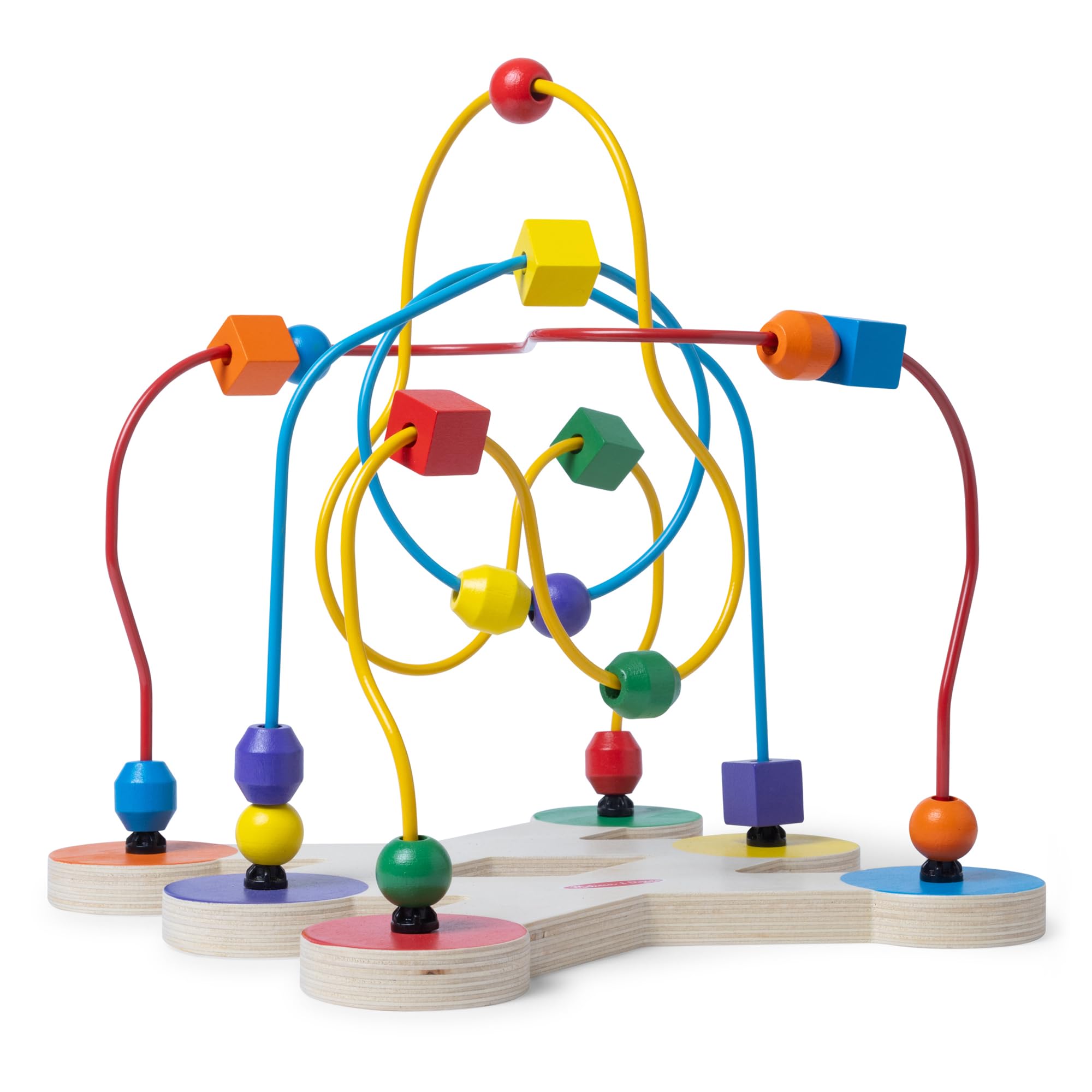
Laid out on a floor, the Classic takes up a square foot and stands a foot tall, which makes it the only one here that reads as furniture rather than as an accessory. The three wires arc high enough that a child can stand at the toy rather than hunch over it, and there is room on either side for two children to work at once. That scale is the entire pitch: it is the maze you leave out instead of the one you put away.

The build justifies the size. The wires are heavy-gauge and do not flex when a toddler leans on them, the base is wide enough to resist a shove, and the 18 beads vary enough in shape that colour and shape sorting becomes its own game. It also carries the longest age range of anything in this group, 12 months to six years, and the height is why that range is not pure arithmetic — there is enough maze there for a five-year-old to reach without kneeling.

Three wires is not a lot of puzzle, and a sharp three-year-old will have them solved inside a week. Where we think it earns its keep is a room with more than one small person in it, since the size and the stability let two of them share it without a fight over whose turn it is, and the whole thing wipes down with one cloth.

Bottom line: The sturdiest and longest-lived maze here — a floor toy for a playroom, rated from 12 months to six years.

#2

Melissa & Doug First Bead Maze

Melissa & Doug First Bead Maze

High-chair trays

Doodle Score 9.4/10
Check Price

Worth Noting

  • Recommended age stops at two years
Base
Suction cup base
Size
8.66 x 8.07 x 4.13 inches
Beads
18 wooden beads plus 3 rings
Age Range
12 months to 2 years
Read the full review

A bead maze earns its place in the ten minutes before dinner, not on a shelf. This one puts four looping wires, 18 wooden beads and three spinning rings on a base that suctions to a high-chair tray, and that single decision is why we hand it to most families first. Press the base down and the toy stays in front of the baby instead of on the floor, which is the whole argument for buying a bead maze for a child who is still working out how to let go of things.

The footprint explains both halves of the reaction it gets. At 8.66 by 8.07 by 4.13 inches it settles onto a tray without crowding the cup holder, and it sits low enough that a seated baby can reach every wire without stretching. It is not a tabletop centerpiece, and that is worth being clear about before you order; if you want the big floor version, the Classic Bead Maze further down is the same brand at three times the height. What is on top is right for the age: chunky wooden beads in varied shapes, soft-coated wires, rounded corners.

The suction is the part to think about before you commit. It grips smooth, non-porous surfaces — a plastic tray, sealed wood, glass — and it can let go on a matte or textured table, so a damp fingertip around the cup before you press down is worth the two seconds it takes. Get that right and this is the toy that stays where you put it, which is more than most of this group can claim.

Bottom line: The default bead maze: it suctions to a high-chair tray, takes a baby's tugging, and keeps a one-year-old occupied through a restaurant meal.

#3

Boby Wooden Bead Maze

Boby Wooden Bead Maze

First-birthday gifts

Doodle Score 9.4/10
Check Price

Worth Noting

Size
8.5 x 6.8 x 8.7 inches
Material
Wood
Age Range
12 months to 8 years
Read the full review

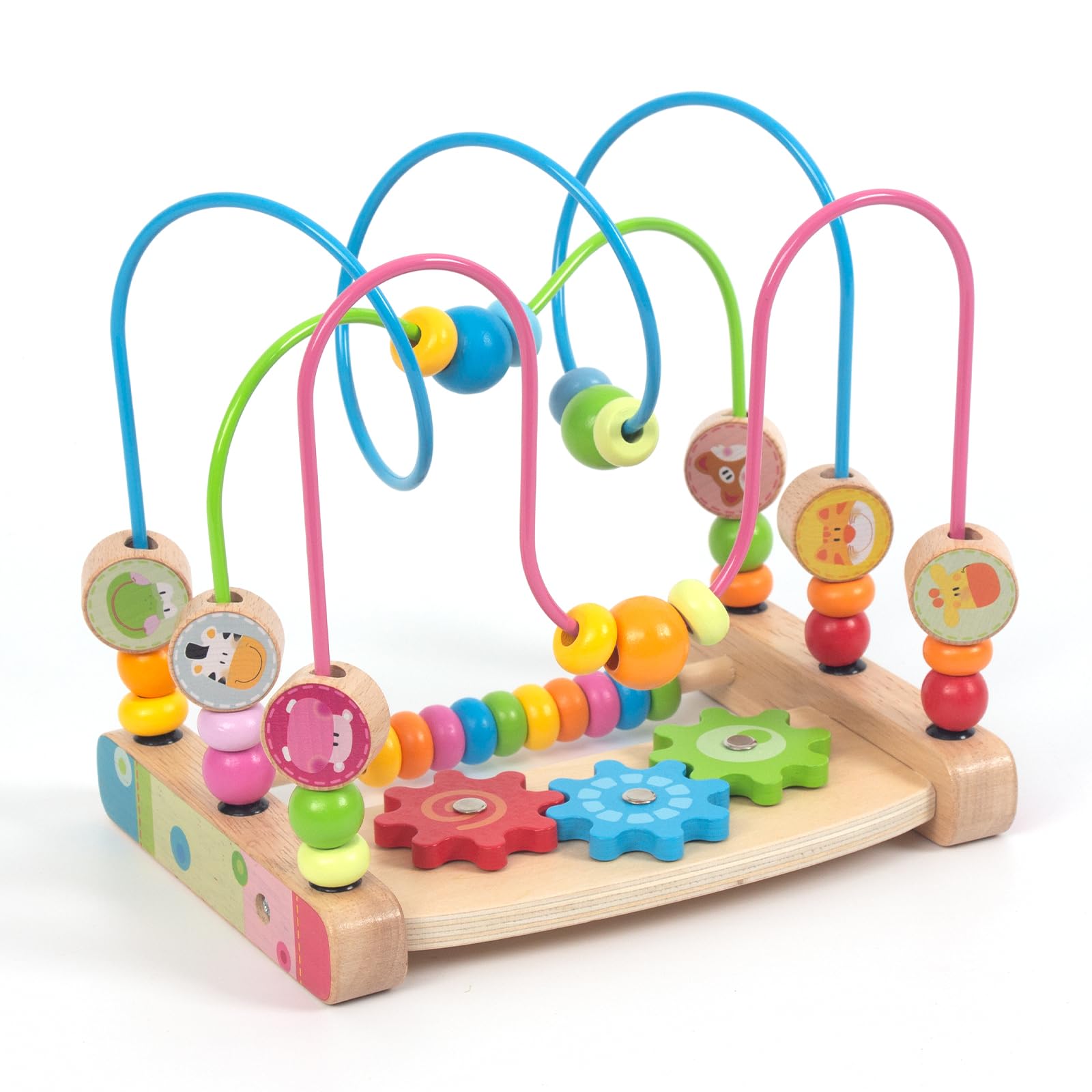
Animal faces are the hook: they are painted onto the beads and the frame rather than left as abstract shapes and colours. For a toddler who is more interested in naming things than in solving a track, that is a better way in than a plain wire maze, and it is the reason this one holds children who are still too young to finish a route.

At 8.5 by 6.8 by 8.7 inches it sits between the tray toys and the big floor mazes. What we appreciate is how little it asks of you: it is light enough to shift one-handed, the paint is bright without being garish, and the 12-month-to-eight-year range, optimistic as it is, points at the right thing — a toy meant to be handed down rather than outgrown in a season. It also ships in a gift-ready box, which matters if it is headed to a party rather than your own playroom.

Bottom line: A cheerful mid-size maze with animal beads and an abacus row, and the one here that arrives ready to give.

#4

Hape Double Bubble

Hape Double Bubble

Babies under one

Doodle Score 9.2/10
Check Price

Worth Noting

  • Suction cups need a smooth, non-porous surface
Size
8.46 x 3.54 x 7.6 inches
Finish
Water-based paint, non-toxic finishes
Age Range
6 months to 3 years
Suction Cups
Four
Read the full review

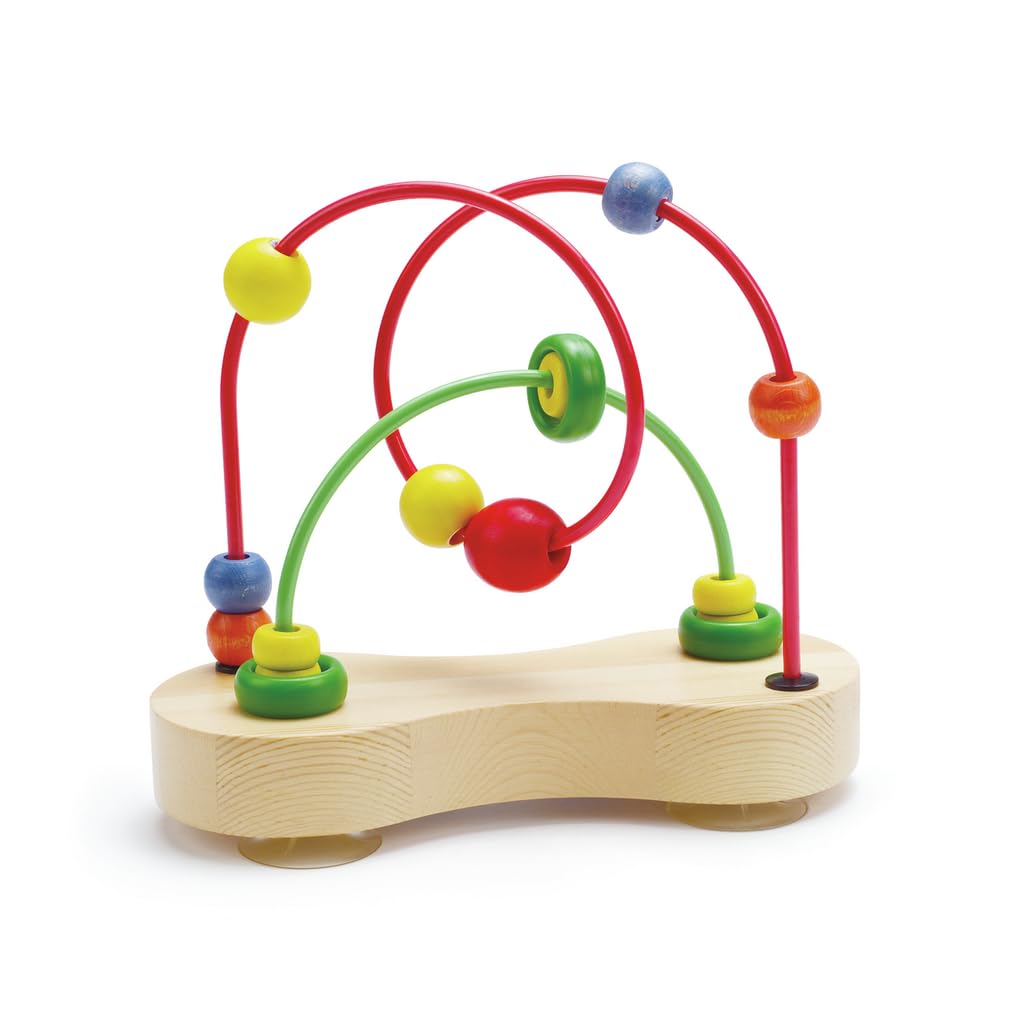
Six months is the youngest starting point in this group, and it changes what the toy is for: a baby who can sit but cannot yet steer a bead around a bend will still bat at a wire and watch what happens. Hape leans into that with nesting beads that slide one inside another, a peek-a-boo effect a seated baby can trigger long before they can follow a track from end to end, with four suction cups underneath to keep the whole thing in front of them.

It is also the smallest of the wooden mazes at 8.46 by 3.54 by 7.6 inches, and the one we picture going into a diaper bag rather than living on a shelf. Give the beads a squeeze every few weeks: this is a toy that gets dropped, and a cracked wooden bead is worth catching before it becomes a mouthful. For the months before walking, nothing else here starts as early.

Bottom line: The one to buy for a baby who is not walking yet — the lowest age floor here, and small enough to move room to room.

#5

B. toys Loopty Loo

B. toys Loopty Loo

Bored two-year-olds

Doodle Score 9.2/10
Check Price

Worth Noting

  • Beads jam where wires run close together
Beads
47 beads
Weight
16 oz
Age Range
18 months to 36 months
Wire Routes
5
Read the full review

Forty-seven beads on five wire routes is more than twice what the rest of this group offers, and for a toddler who has already beaten a three-wire maze that is the difference between a toy that gets picked up and one that gets shelved. The routes cross and double back, so getting a bead from one end to the other takes a bit of planning rather than a single shove. We rate it the one for a child who is already two and already bored.

It is a solid, weighty piece at 16 ounces, which keeps it steady on a lap or a car seat with nothing to stick down. That weight is also why the 18-month guidance makes sense: younger babies cannot lift it and do not have the wrist control for routes this long. At 8 inches it still drops into a diaper bag, though it is the one here that makes a bag noticeably heavier.

The detail we did not expect to like is the sound. Tip it and 47 wooden beads slide and clack against the wires, which turns the maze into a shaker for a few seconds at a time. That is what keeps it in rotation — the noise and the motion give a toddler a reason to pick it up that a static frame never does.

Bottom line: The one to buy for a two-year-old who has already beaten a simple maze: more beads, more routes, more to plan.

#6

Joqutoys Bead Maze

Joqutoys Bead Maze

Preschool play

Doodle Score 9.2/10
Check Price

Worth Noting

  • Smaller in person than the photos suggest
Size
8.66 x 5.71 x 8.86 inches
Material
Wood and metal
Age Range
36 months to 6 years
Bead Trails
3 trails plus 2 slider rows
Read the full review

Maze on top, abacus row along the bottom, cartoon animal faces in between: this is the busiest of the compact mazes, and it is built for a child who wants to switch tasks rather than work one wire to the end. The slider beads on the base are the part we underrated. They are a different motion from the wire beads, and they give a toddler something to do once the tracks have been solved.

Read the age guidance carefully before ordering. The description pitches this at one to three, while the specification block gives a recommended range of 36 months to six years. The second number is the honest one: a one-year-old can push a bead but will not follow a path, and the abacus rows are a three-year-old's game.

Where it earns a spot is variety per inch. Three wire trails plus two slider rows in under nine inches of height is a lot of different motion, and the animal faces give an adult something to talk about while a small person works. It is not the maze to buy first, but it is a good second one for a child who has already worn out something simpler.

Bottom line: A busy three-in-one for a three-year-old — wire maze, abacus and slider beads in one compact frame.

#7

QZMTOY Wooden Bead Maze

QZMTOY Wooden Bead Maze

Small spaces

Doodle Score 9.0/10
Check Price

Worth Noting

  • Beads catch in the tight metal bends
  • Bottom rungs can work loose with rough play
Assembly
Arrives assembled
Material
Wood
Play Modes
Bead maze, abacus and roller coaster
Read the full review

It arrives fully assembled, which sounds like a small thing until you have spent a birthday eve with an Allen key. QZMTOY ships the maze built, so it goes from box to floor in the time it takes to cut the tape, and for a gift you are handing over at a party that is a genuine convenience rather than a footnote.

What you get is a three-part toy: a bead maze on top, an abacus row along the base, and a roller-coaster wire down one side. It is the widest spread of play among the wooden picks here, and the small footprint means it fits on a shelf instead of owning a corner of the room.

Set expectations on scale before you order. This is the smallest-feeling maze in the group, and the gap between the product photos and the box is real — the listing itself sizes it as small. It suits a child who plays on a lap or at a low table rather than one who wants a floor toy to circle.

For a calm sitter, that is plenty. The abacus gives an adult something to count along with, the roller coaster gives a bead a satisfying swoop, and the whole thing wipes clean in a second. It is the pick for a grandparent's house or a small apartment, somewhere the toy needs to occupy a shelf rather than a floor, and we can name nothing else here that fits that brief as neatly.

Bottom line: A shelf-sized three-in-one that arrives ready to play — best for a calm sitter in a small space.

How We Tested the Best Bead Mazes

To build our shortlist, I started with the best-selling bead mazes from major retailers and filtered by material (solid wood versus plastic), base size, and whether they included suction cups. I also read through customer reviews to spot recurring complaints—beads that jammed, suction cups that lost grip, paint that chipped—and made sure our final list included options at a range of price points. That left us with 14 bead mazes to test over five months.

Testing happened wherever bead mazes actually live: on the high chair tray during meals, on the floor of our playroom, stuck to a restaurant table during a long wait for food, and tossed into a diaper bag for weekend trips. With my toddler as the primary tester, I watched how long each maze held attention, whether the beads slid smoothly or got stuck at the turns, and how the suction cups performed when a 2-year-old pulled at the wires instead of the base. I also dropped each one from counter height, checked for loose wires or beads that could come off, and inspected the paint and wood for sharp edges or chipping.

The details that separated the winners were small but consistent. Suction cups that left a ring of residue or popped off after one tug got eliminated. Bases that tipped when a child leaned on them didn't make the cut. And mazes that looked nice but had beads too tight to move got old fast. The ones that lasted the full five months—and are still in rotation—are the ones we recommend below.

How to Choose Bead Mazes

Start With Where It Will Live

A bead maze spends its life in one of two places: fixed in front of a seated baby on a high-chair tray, or standing on a floor where a toddler can circle it. Those are different toys. A suction base is what makes the first one work, and suction needs a smooth, non-porous surface — a plastic tray, sealed wood, glass. Matte finishes, textured plastic and fabric defeat it, which is why the same maze can delight one household and disappoint another. If your tray has any texture to it, treat a suction toy as a floor toy and buy accordingly.

Floor mazes lean on the opposite strategy: weight and a wide base instead of grip. We put far more weight on this single decision than on any other line in a listing, because no amount of bead variety rescues a toy that ends up on the floor every four minutes.

Match the Age Floor, Not the Birthday

Mazes in this group start at six months, 12 months, 18 months and 36 months, and the gaps are not marketing. A six-month-old needs short wires, fat beads and a low frame they can reach while sitting. A two-year-old needs more routes and a taller frame to stand at. Buying above your child's age wastes the first year; buying below it means the tracks are solved by the second week.

Read the specification block rather than the gift copy. Some listings pitch a maze at one to three while the recommended range runs from 36 months, and the second number is the one the toy was built for.

Check How the Beads Are Secured

Every bead maze is small wooden parts threaded onto wires, and the failure that matters is a bead that comes free. Run a thumb over each bead and each wire end when the toy arrives, and repeat the check every few weeks on anything that gets dropped on tile. Cracks tend to start at the paint line, and a cracked bead is the one that comes apart.

None of that is a reason to avoid a wooden maze. It is the reason to buy one you will actually look at, and to treat the squeeze-check as part of owning it rather than as a sign something is wrong.

More Beads Can Mean More Jams

Bead count is the easiest number to compare and the least useful on its own. Eighteen beads on four well-spaced wires can keep a toddler working longer than forty crowded onto wires so close that the beads rub against each other. Look at the photos and judge the gap between adjacent runs: if two wires sit closer together than a bead is wide, expect beads to catch at the crossing.

A busy maze with a permanent jam in it is worse than a plain one that runs clear. When a listing shows a dense tangle of wire, that is a detail worth paying attention to rather than an impressive spec.

Frequently Asked Questions

Final Verdict

For most families we point to the Melissa & Doug First Bead Maze: it grips a high-chair tray, the beads are chunky enough for a one-year-old's hands, and it turns the worst stretch of a restaurant meal into a manageable one.

Buy the Classic Bead Maze instead if the toy will live on a playroom floor and you want something still in use at five. Buy the Hape Double Bubble if the baby is not walking yet. Those three cover the decision; the rest of the list is for narrower cases.