Baby & Toddler

Best Baby Teethers of 2026

Somewhere around four months, every baby decides the whole world is a teething ring — the crib rail, your knuckle, the strap of a diaper bag. A good teether redirects that urge onto something safe: sized so it won't trigger a gag, firm enough to give real counter-pressure, sturdy enough to survive the freezer and the dishwasher. It won't stop the drool, but it can turn a frantic evening into a manageable one.

I've watched my own kids cycle through a drawer of them, and the pattern holds: the cutest ones often get abandoned, while the ones babies come back to fit comfortably behind the gum line and are easy for wet, clumsy hands to grip. Over the past four months, we put 16 teethers through the freezer, the diaper bag, the dishwasher, and more than one drop onto a hard floor. A chilled teether only helps while it's actually cold, so how long it holds temperature matters as much as shape, and anything that clouds, cracks, or takes on water after a few washes is out. The ones below earned their keep.

#1

Comotomo Silicone Teether

Comotomo Silicone Teether

Everyday first teether

Doodle Score 9.6/10
Check Price

Worth Noting

  • Picks up lint and hair between washes
Shape
Finger-shaped prongs
Cleaning
Dishwasher and boiling safe
Material
Food-grade silicone
Construction
One-piece, no seams
Read the full review

The prongs on the Comotomo are the size and shape of a baby's finger, and once you have watched a three-month-old try to fit a teething ring into their mouth, that starts to look like the obvious design. There is no ring to aim at. The whole thing goes in sideways, any prong that lands finds a gum, and the silicone is firm enough to push back against a sore one without making a baby flinch.

It is the teether we recommend first, and the reason is boring in the best way: there is nothing to go wrong. One piece of food-grade silicone, no gel, no hole at the back, no seam where a neck meets a body. It goes in the dishwasher, in boiling water, and in a steam sterilizer, which matters more than it sounds — a teething toy that hits the kitchen floor has to be genuinely washable, not just wipeable.

The round loop turned out to be the part we appreciated most. It is sized so a small fist closes around it early, which means a baby who cannot yet hold a ring can still carry this one around and decide for themselves when to chew. Watching a baby self-serve relief without waiting for an adult is the whole point of the thing.

Where it runs out is reach. Those prongs groom the front gums beautifully, and a baby working on molars will want something longer — that is the Fu Store tubes further down. It is also a single teether in the box, so a lost one is simply lost.

Bottom line: This is the teether we tell people to buy first: one piece of silicone, genuinely washable, and shaped so a three-month-old can use it without help.

#2

Manhattan Toy Winkel

Manhattan Toy Winkel

Two-handed grabbers

Doodle Score 9.6/10
Check Price

Worth Noting

  • Surface wash only, so a floor drop means a wipe
Weight
3 oz
Cleaning
Surface wash only
Material
BPA-free soft tubing
Dimensions
5 x 4 x 3.5 inches
Read the full review

The Winkel is the most expensive teether in this group, and it is still the one we hand to a baby who is more interested in grabbing than in chewing. Somewhere in that nest of soft tubing there is always a piece exactly where a mouth is about to arrive. A baby does not have to aim, and the loops work whether they get one hand around it or two.

Five inches across and three ounces, it is light enough to wave and big enough that a baby can find it in the crib. The cube in the middle rattles, which is the reason this one stays in rotation after the teeth arrive — it does a second job as a car-seat distraction long after the gum pain has passed. The tubing gives just enough under a bite that it reads as chewable rather than springy.

Where it gives ground is at the very beginning. A three-month-old with a small mouth has to work harder to get a loop past their lips than they do with a pronged teether, and the whole toy is bulkier to pack. From about four months, when two-handed grabbing clicks, it becomes the thing that never leaves the diaper bag.

Bottom line: If your baby grabs everything in sight, we think the Winkel's loops and rattle earn their premium over the simpler picks here.

#3

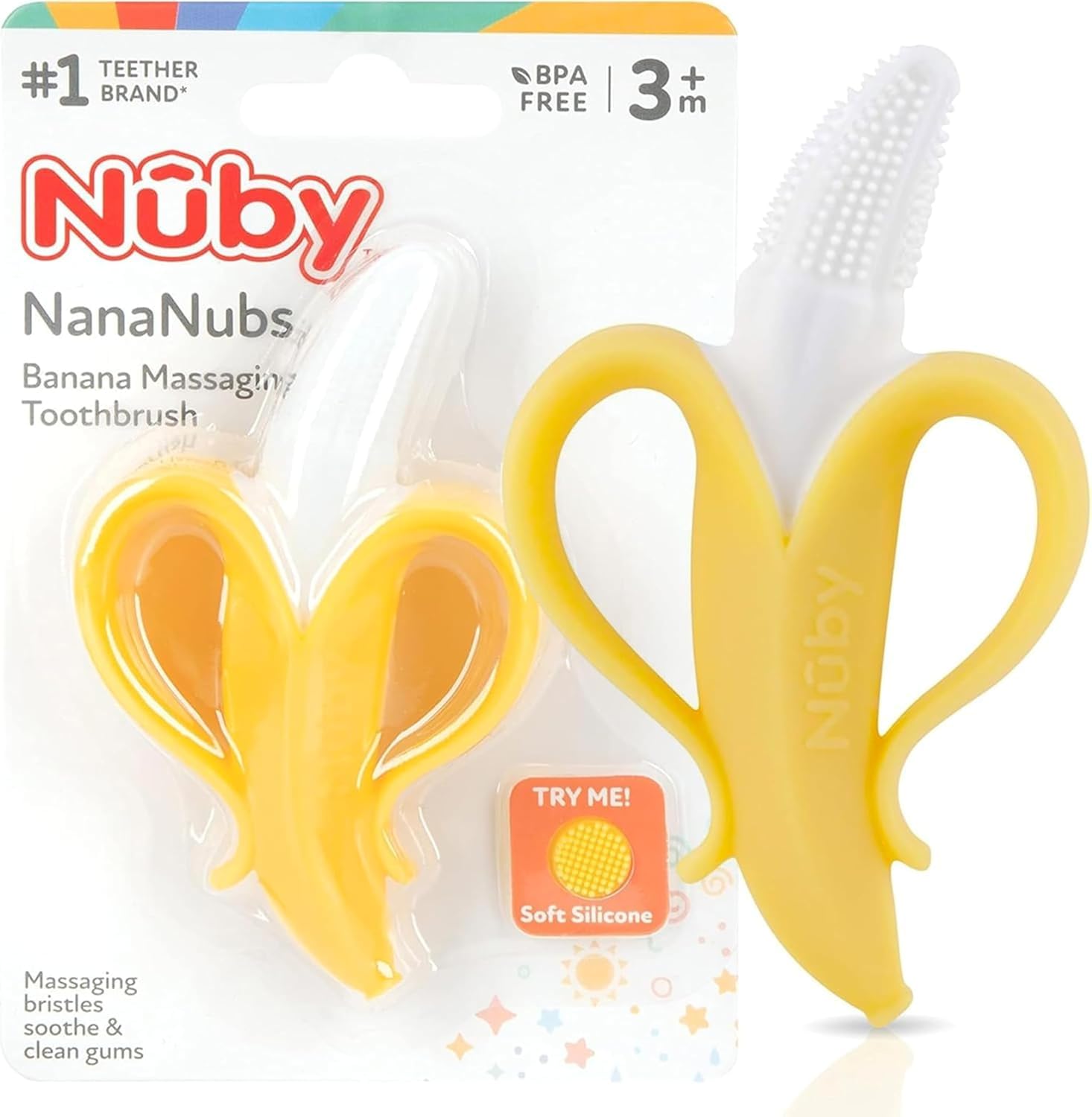
Nuby NanaNubs Banana

Nuby NanaNubs Banana

Early gum brushing

Doodle Score 9.6/10
Check Price

Worth Noting

  • Attracts lint and pet hair
  • Small for a baby past the front teeth
Weight
1.3 oz
Surface
Soft bristles
Material
100% silicone
Age Range
3 months and up
Read the full review

The banana's trick is the bristles. Soft silicone nubs run along the curve, so a baby who chews on them is massaging a sore gum and brushing whatever has already come through. It is the one we pass over when a tooth is on the way and a smooth surface is not getting the job done, because the texture does something a plain ring cannot. It is also the gentlest introduction to a toothbrush we have come across.

The whole thing is 100 percent silicone, rated from three months, and light enough at 1.3 ounces for a young baby to wave and aim. The curve reaches the sides of the mouth where a straight teether misses, which is where a lot of early grumbling happens. It rinses clean in seconds, and it is small enough to live in a coat pocket so there is one on hand when you need it.

Bottom line: We hand the banana over when a first tooth is breaking through and a smooth teether will not do.

#4

Fu Store Teether Tubes

Fu Store Teether Tubes

Back molars

Doodle Score 9.6/10
Check Price

Worth Noting

  • Long tube is awkward for a young baby to aim
Shape
Hollow apple-shaped tubes
Material
Food-grade silicone
Age Range
0-36 months
Pack Size
5 tubes
Read the full review

The Comotomo gets a baby through the front teeth. The Fu Store tubes get to the ones at the back. A hollow silicone tube is long enough to slide past the molars at the hinge of the jaw, which is where teething gets genuinely miserable and where a ring-shaped teether simply cannot follow. If your baby has started shoving a whole fist into their mouth and grinding, that is the moment these become useful.

You get five tubes, each finished with a different texture at either end — one side coarser than the other — plus a slim brush for rinsing out the hollow centre. They are food-grade silicone, soft and bendy enough to squash against a gum rather than jab it, and the apple-shaped ends give a baby something to close their lips around.

The shape is easier for small hands than a sphere. A tube gives a fist something to wrap around along its length, so it does not roll away or need re-aiming every few seconds, and a five-pack means there is always a clean one while the rest are in the dishwasher.

Value is the reason it is here rather than higher up: it is the least expensive way to cover back-molar reach. The trade is that a three-month-old does not need it yet — the tube is long, and they will wave it past their own eye before they get it to their mouth. From about five months, when they are deliberately going after the back of the jaw, it is the one that works.

Bottom line: Back molars are where these tubes earn their place — a ring teether physically cannot reach them.

#5

ChooKaChoo Teething Mitten

ChooKaChoo Teething Mitten

Hand chewers

Doodle Score 9.6/10
Check Price

Worth Noting

  • Picks up dust and pet hair quickly
  • Useful only during the hand-chewing stage
Material
Food-grade silicone
Wearable
Slips over the hand
Age Range
3 months and up
Pack Size
2 pack
Read the full review

A teething mitten earns its keep the first time you watch a baby gnaw their own knuckles and realise there is nothing to hand them. The ChooKaChoo version slips over the hand with a bar inside for the fingers to close around, so the chewing surface goes wherever the hand goes. It looks like a small boxing glove, and it works like one.

For a baby in the hand-chewing phase this is the most direct fix in the group. The silicone is soft enough to be gentle on a gum and thick enough to feel like something, and the nubs run across the palm and fingers rather than sitting on one small patch. Two come in the pack, both dishwasher safe, which covers home and diaper bag without any planning.

The covering hand is the underrated part. A baby who has been sucking a thumb gets a barrier instead, and parents who were fighting that habit tend to be the most enthusiastic about it. The catch is the material itself: silicone this soft grabs dust and pet hair quickly, so a rinse before it goes back in the mouth is part of the routine.

Bottom line: A clever fix we are glad to have found for babies who chew their own hands all day.

#6

Bebecan Teething Sticks

Bebecan Teething Sticks

Older teethers

Doodle Score 9.6/10
Check Price

Worth Noting

  • Stated age of 36+ months does not match the babies it suits
Cleaning
Dishwasher safe
Material
Food-grade silicone
Age Range
36+ months
Pack Size
6 tubes, 3 brushes
Read the full review

Six tubes, three slim brushes, and a drawstring bag: the Bebecan box reads like a kit rather than a single toy, and it is the only pick here that arrives with its own cleaning equipment. In a category where most products are one lump of silicone in a blister pack, that is a real difference on the shelf and in the drawer.

The tubes themselves are soft, flexible silicone sticks with a hollow centre and a texture that changes along the length. The length is the point. It is the shape that gets to the side teeth without a baby having to open wide, and it lets them hold one end while the other works on a gum at the back.

Washing is where the kit pays off. The tubes go in the dishwasher, and the brushes make short work of the hollow centre, which is the part that would otherwise trap drool and get quietly thrown away. Six of them means one in the car, one in the diaper bag, one in the toy basket, and no scramble on a bad afternoon.

Here is the wrinkle, and it is why this sits in the second tier. The listing gives an age range of 36+ months, which is older than the babies this article is for, while the shape and the way these are used read much younger. We cannot settle that from the page, so treat it as a check-before-you-buy: read the age on the packaging, and if it matches the listing, these are a toddler's toy rather than a five-month-old's.

Bottom line: Worth it for the length and the cleaning kit, provided the age on the box suits your baby.

#7

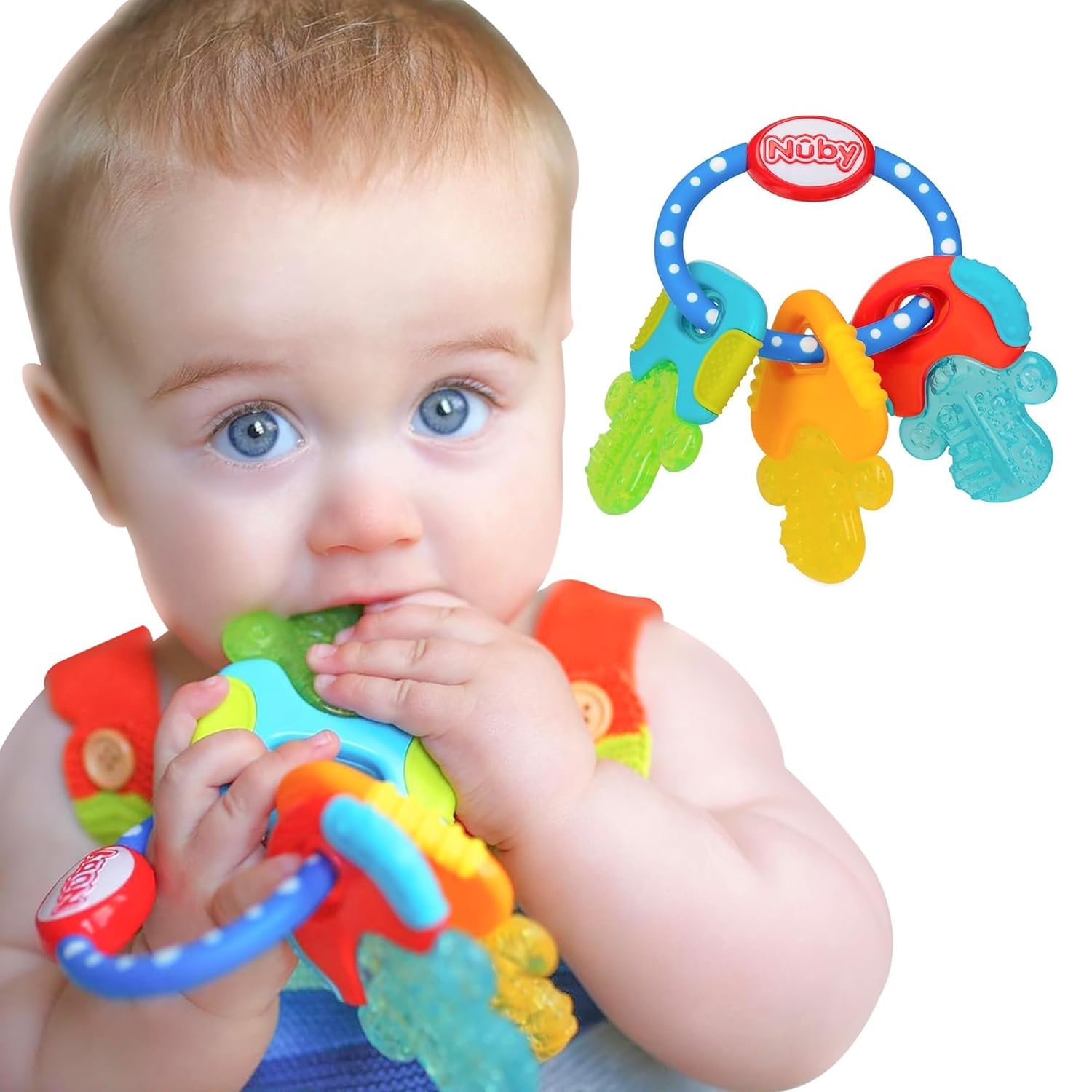
Nuby Ice Gel Teether Keys

Nuby Ice Gel Teether Keys

Cold gum relief

Doodle Score 9.4/10
Check Price

Worth Noting

  • Cold fades quickly once baby starts chewing
Weight
2 oz
Cooling
Refrigerate before use
Material
Silicone with ice gel
Dimensions
6.5 x 4.1 x 1.5 inches
Read the full review

On a bad evening, the Nuby keys are the ones we go to the freezer for. The keys are filled with ice gel, so a stint in the refrigerator leaves them properly cold against a gum that is hot and angry, and the ring lets a baby hold the whole set in one hand. There is nothing subtle about the appeal: cold, on a sore spot, immediately.

Each key carries bumps and ridges, and the whole thing is 6.5 inches long and two ounces, free of BPA, PVC, phthalates, and latex. The care instructions ask for warm water and mild soap — so keep them out of the sterilizer and the boiling pot. A hot cycle is the wrong move for a gel-filled toy, and that is the single most useful thing to know before you buy one.

For the money, nothing else here delivers cooling so directly. Two things to go in knowing. The cold fades once a baby really gets going, so a second stint in the fridge is part of the routine. And the keys are a chunky object, so a small three-month-old may need you to hold the ring while they work on a key; by five or six months they manage it themselves.

Bottom line: For cooling relief on a swollen gum, we reach for these before anything else on the list.

#8

Smily Mia Penguin Teether

Smily Mia Penguin Teether

Pacifier refusers

Doodle Score 9.4/10
Check Price

Worth Noting

  • A short useful life, roughly 0-6 months
Cleaning
Dishwasher and boil safe
Material
Food-grade silicone
Age Range
0-6 months
Pack Size
2 pack
Read the full review

Some babies cannot hold a teether yet. At three or four months the intent is there and the grip is not, and the Penguin is built for exactly that gap. The silicone body sits over the hand with a bar inside it, so closing a fist is enough to keep it in place. It is not a mitten and it is not a ring; it is closer to giving a baby a chewable hand.

Two come in the pack, which is the quietly useful part — one lives in the diaper bag and one stays home, and a lost one is not a crisis. The silicone is food-grade silicone, thick enough to take real chewing, and it goes in the dishwasher or a pot of boiling water. Parents of breastfed babies who refuse a pacifier are the ones who tend to get the most out of it.

Where it runs out is reach. The Penguin works the front gums; a baby hunting a molar back at the hinge will not get there with it, and that is what the tubes further down are for. Otherwise it does the one job it was built for and then hands over gracefully.

Bottom line: Our pick for the three-to-five-month stretch, when a baby wants to chew but cannot hold anything yet.

How We Tested 16 Baby Teethers

We started with a list of more than 40 teethers pulled from brand catalogs, registry bestseller lists, and the recommendations of pediatric dentists and postpartum doulas we've interviewed over the years. We filtered by material (food-grade silicone, natural rubber, untreated beechwood), checked for detachable small parts and unverified liquid fillings, and ruled out any shape that looked likely to jab the back of a baby's throat. That left 16, each of which went home with a family on our team with a baby between four and nine months old.

For four months, the teethers lived where they actually live: clipped to a onesie, rattling around a diaper bag, dropped on a kitchen floor, run through the dishwasher's top rack, and pulled out of the freezer at 6 p.m. when nothing else was working. We timed how long each one stayed noticeably cold once it came out, checking at 10, 20, and 30 minutes, and noted whether condensation made the surface too slick to hold.

We measured each teether's widest point, then handed it to babies with wet, slippery hands to see how quickly it got dropped and whether they could reposition it themselves. From there we watched which end got chewed — front gums, molars — and whether a baby could reach the back of the mouth without gagging. Durability got the least glamorous treatment: repeated freezing, repeated washing, and a bend-and-twist test, with checks for cloudiness, cracks, bite marks, and water seeping inside a sealed teether after a month of use. Anything that failed came out of the rotation for good.

How to Choose Baby Teethers

Match the shape to the age, not the other way round

At three or four months a baby's grip is a closed fist and their mouth is small, so a short, light teether they can keep hold of matters far more than texture variety. The Comotomo and the Smily Mia Penguin are built for that stage. By five or six months they are deliberately going after the back of the jaw, and a long tube like the Fu Store gets there where a ring cannot. Buying a molar-length teether for a three-month-old usually means it lives on the floor for a month.

Check how it cleans before you check anything else

A teether goes in the mouth and on the floor, often in that order, so what the maker allows you to do with it decides how much you will actually use it. Silicone that can be dishwashed or boiled — the Comotomo, the Fu Store tubes, both mittens — is the easy answer. Surface-wash-only toys like the Winkel are fine, but a floor drop means a wipe rather than a rinse.

Anything gel-filled or water-filled stays out of the sterilizer and the boiling pot; warm water and mild soap is the whole routine, and a hot cycle is how these get ruined.

Softness is a range, not a yes or no

A gum cutting a tooth wants counter-pressure, and too soft is as useless as too hard. The silicone worth buying is firm but yielding: soft enough that a baby who mashes it into their face does not flinch, firm enough to actually push back. Hard plastic is what to watch. Any part that sits near the mouth should give under a thumb, and if it does not, a baby will work around it rather than chew on it.

Buy two or three, not one

Babies get bored of a single texture, and the teether that soothed them last week gets flung this week. Rotating two or three shapes — one to hold, one to reach the back, one to wear — keeps each of them useful longer, which is why the multipacks here are better value than they first look. Keep one in the diaper bag and one in the refrigerator; the one you cannot find is always the one that was working.

Frequently Asked Questions

Final Verdict

Start with the Comotomo. It asks the least of you and the least of a baby: one piece of silicone, no seams or fill, dishwasher and sterilizer safe, and a shape a three-month-old can get into their mouth without help. Almost everything else here solves a narrower problem.

So treat the rest as additions rather than alternatives. The Fu Store tubes for back molars, the Smily Mia Penguin for a baby who cannot hold anything yet, the Nuby keys for the evenings when only cold helps. Buy the Comotomo first, then add the one that matches the stage your baby is actually in.