Baby & Toddler

Best Baby Rattles of 2026

A rattle looks like the simplest toy in the nursery, but hand one to a baby and you can almost see the gears turning: shake, sound, repeat. The right one is light enough for a small hand, loud enough to reward a wiggle, and sturdy enough to survive a fling across the room, while the wrong one is too heavy, too shrill, or so plain it gets ignored by Tuesday. Over four months, I've lived with 14 rattles on the play mat, in the stroller, and in the diaper bag, and a good one buys you a few minutes of focused play while giving your baby practice with grip, tracking, and cause and effect.

The ones that stuck around earned it in unglamorous ways: seams that held after washing, a sound that didn't make me wince, and a shape that was easy to grab. Color held attention longer than I expected, and weight mattered once a baby started waving it around. Below are the rattles that survived daily life, with notes on size, noise, and grip for your baby's stage.

#1

Bright Starts Oball Rattle

Bright Starts Oball Rattle

Tiny hands

Doodle Score 9.8/10
Check Price

Worth Noting

  • Wipe-clean only, not submersible
Grip
Flexible Oball holes
Size
4 x 4 x 4 inches
Weight
1.44 oz
Age Range
Newborn and up
Read the full review

At 1.44 ounces, the Oball Rattle barely registers in a diaper bag and is light enough for a young baby to wave around. The open lattice gives a hand dozens of places to grab, so it works before a baby has learned to aim for a handle. We recommend it as the lightest first rattle here, especially for a baby just learning to close a hand around an object.

The 4-inch ball is flexible enough to squish slightly in the hand, and the beads inside add a soft rattle when it moves. That combination makes it a good tummy-time toy: a baby can bat at it, grab a strand, and bring it toward the mouth without needing a perfect grip. It is also easy to wipe clean after it has been on the floor, and the open holes give little fingers a clear target.

The trade-off is that it offers less dedicated mouthing surface than the Winkel. The rounded strands are good for gnawing, but a baby who wants a long chew may prefer a teether with more texture. For the early grab-and-shake stage, though, the Oball is the easier toy to hand over. It is the one we keep for the stroller.

Bottom line: We recommend the Oball Rattle as the lightest first rattle here, especially for a baby just learning to close a hand around an object.
#2

Manhattan Toy Winkel

Manhattan Toy Winkel

Newborn teething

Doodle Score 9.6/10
Check Price

Worth Noting

  • Surface wash only; cannot be submerged
  • Rattle is quiet next to bead rattles
Care
Surface wash only
Grip
Continuous loops
Weight
3 oz
Dimensions
5.02 x 4.04 x 3.54 inches
Read the full review

The Winkel looks like a tangle of soft pretzels, and that shape is the point. Its continuous BPA-free loops leave plenty of room for small fingers, while the center cube adds a gentle rattle. At 3 ounces and roughly 5 by 4 inches, it is light enough for a young baby to wave and small enough to tuck in a diaper bag.

We hand this to a newborn before any other rattle here. There is no single correct grip: a baby can clutch one loop, mouth another, and pass it from hand to hand without needing precise aim. That matters more than a loud rattle at this stage. Compared with a ball rattle, the Winkel gives more mouthing surfaces and a softer feel against the face.

The teething tubes can be refrigerated for extra soothing, which makes it useful during a fussy gum day. The open shape is also easy to wipe down between uses, and the looped body gives a baby a place to hang on when the first teeth arrive. What we appreciate most is how little instruction it needs: a baby can explore it without an adult repositioning a handle. That is why it stays in the diaper bag after the first month.

Bottom line: The Winkel is our default baby rattle because its open loops let a newborn clutch and mouth it from several angles, and it stays useful as the grip gets stronger.

#3

Bright Starts Rattle & Shake Barbell

Bright Starts Rattle & Shake Barbell

Early grasping

Doodle Score 9.6/10
Check Price

Worth Noting

  • Hand wash only
Grip
Thin crossbars
Weight
1.41 oz
Age Range
3 months and up
Dimensions
2.4 x 5.1 x 1.2 inches
Read the full review

The Rattle & Shake Barbell is the old-school one: two clear bead chambers joined by a narrow green handle. The thin crossbars are the reason it works for early grasp. A baby can wrap a whole hand around the middle or grab one end, and the clear shell lets them watch the beads move when they shake it.

At 3 months and up, it is a simple cause-and-effect toy. The beads make a crisp plastic rattle, not an electronic sound, and the lightweight body is easy to swing. There is no music, no lights, and no battery door to think about. That simplicity is a feature if you want a rattle that lives in the diaper bag and comes out ready.

We keep the Barbell in the simple-rattle slot: thin crossbars and clear bead chambers make it easy for tiny hands and easy on the budget. It does not have the soft, chewable surfaces of a teether, so it works best alongside one rather than instead of one. For a baby who just wants to shake something, that is enough. It is also the rattle least likely to frustrate a parent with extra parts. The rattle is loud enough to get attention without being piercing.

Bottom line: We keep the Barbell in the simple-rattle slot: thin crossbars and clear bead chambers make it easy for tiny hands and easy on the budget.

#4

iPlay iLearn 10-Piece Rattle Set

iPlay iLearn 10-Piece Rattle Set

Variety and value

Doodle Score 9.6/10
Check Price

Worth Noting

  • Cannot be soaked or steam-cleaned
Care
Wipe, don't soak
Pieces
10 rattles
Age Range
0-12 months
Materials
BPA-free ABS
Read the full review

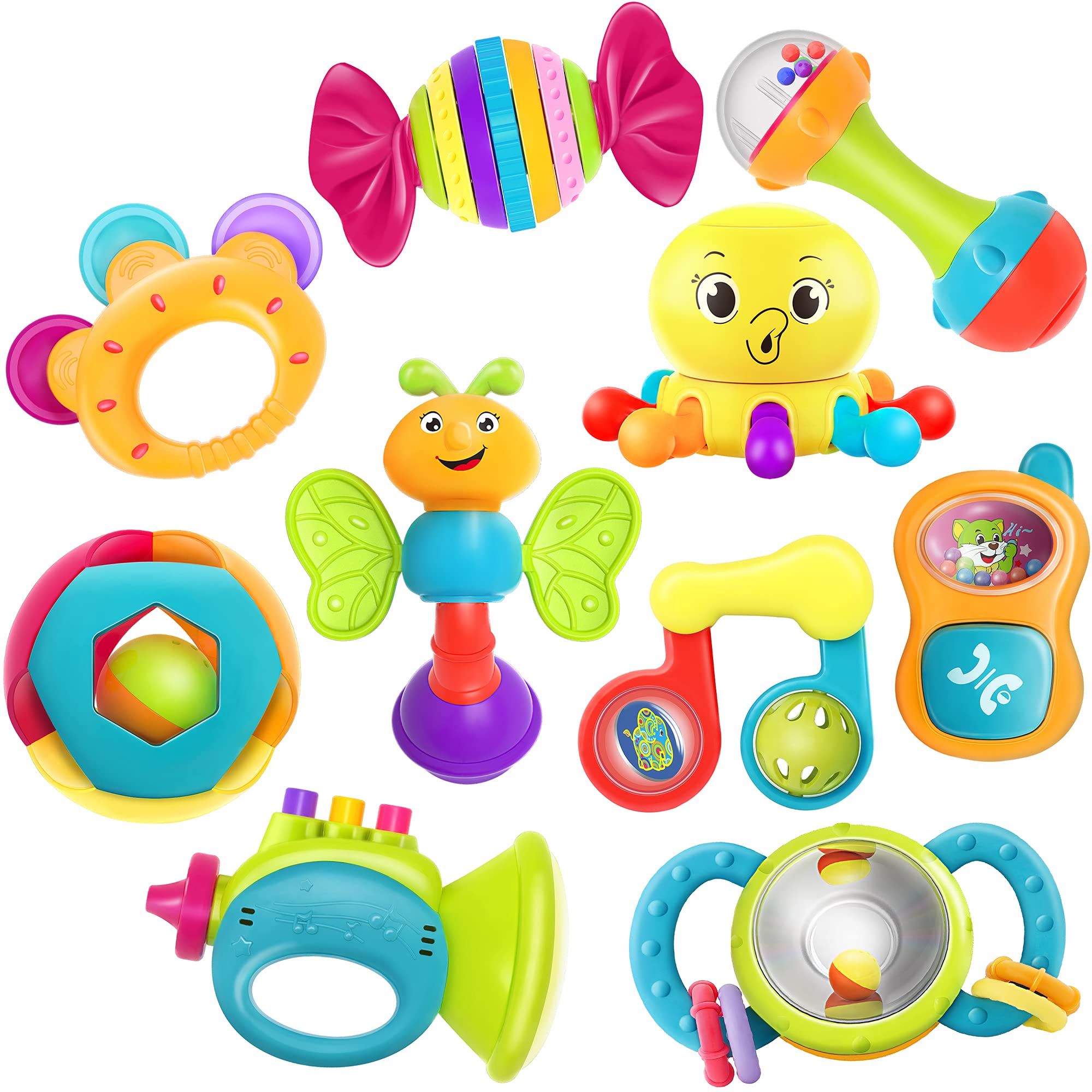
Ten rattles in one box is the appeal here, and the variety is not just filler. The set includes different grips, shapes, and sensory tasks: some pieces rattle, some click, and some have textured surfaces to mouth. The pieces are sized for babies from newborn through 12 months, so you can rotate them as reach and grip improve.

We recommend this ten-piece set when you want a rotation of grips, sounds, and textures without buying them one at a time. Having several options is useful for a baby who loses interest quickly, and it spreads the toys across the house, the diaper bag, and the grandparents' place. The different shapes also let you notice which grip your baby prefers.

The pieces are hard plastic, which makes them sturdy and easy to wipe. The variety is the point: a few pieces can live in the car, a few on the play mat, and the rest can wait for the next stage. It is a set for households that want options, not a single heirloom rattle. If you already have a soft teether, the hard pieces complement it rather than replace it. It is also a practical way to keep one rattle in each room.

Bottom line: We recommend this ten-piece set when you want a rotation of grips, sounds, and textures without buying them one at a time.

#5

VTech Rattle & Sing Puppy

VTech Rattle & Sing Puppy

Musical distraction

Doodle Score 9.6/10
Check Price

Worth Noting

  • Heavier and bulkier than basic rattles
  • Batteries needed for music and lights
Sounds
20+ songs and phrases
Weight
4.64 oz
Age Range
3 months to 2 years
Batteries
3 LR44 included
Read the full review

The VTech puppy is less a first rattle than a handheld entertainment unit, and that is the job it does well. Shake it for bead rattle sounds, press the music button for songs and phrases, or let the cheeks light up as a baby discovers cause and effect. We like it as a distraction toy rather than a first rattle; its songs, lights, and crinkle ears earn their place on car rides.

The sensory package is broad: 20+ songs, melodies, sounds, and phrases, plus crinkly ears and two textured rings that turn and rattle. For a baby who is already sitting and swatting with purpose, that is a lot to explore in one toy. The puppy body gives little hands a place to hold, and the rattle beads work even when the music is off. The lights are the part that pulls a baby back in when attention starts to drift.

This is not the toy we hand to a newborn. The music and lights are better for a diaper change or a car seat than for a quiet play mat, and the toy asks a baby to be old enough to enjoy the show. If you want one simple rattle, look elsewhere; if you want a portable distraction that happens to rattle, this is the one.

Bottom line: We like the VTech puppy as a distraction toy rather than a first rattle; its songs, lights, and crinkle ears earn their place on car rides.

#6

Baby Einstein Opus Rattle

Baby Einstein Opus Rattle

Multi-texture teething

Doodle Score 9.6/10
Check Price

Worth Noting

  • On the heavy side for young babies
  • Wipe-clean only
Weight
3.53 oz
Textures
8 teething textures
Age Range
3-36 months
Dimensions
1.1 x 5.2 x 5.3 inches
Read the full review

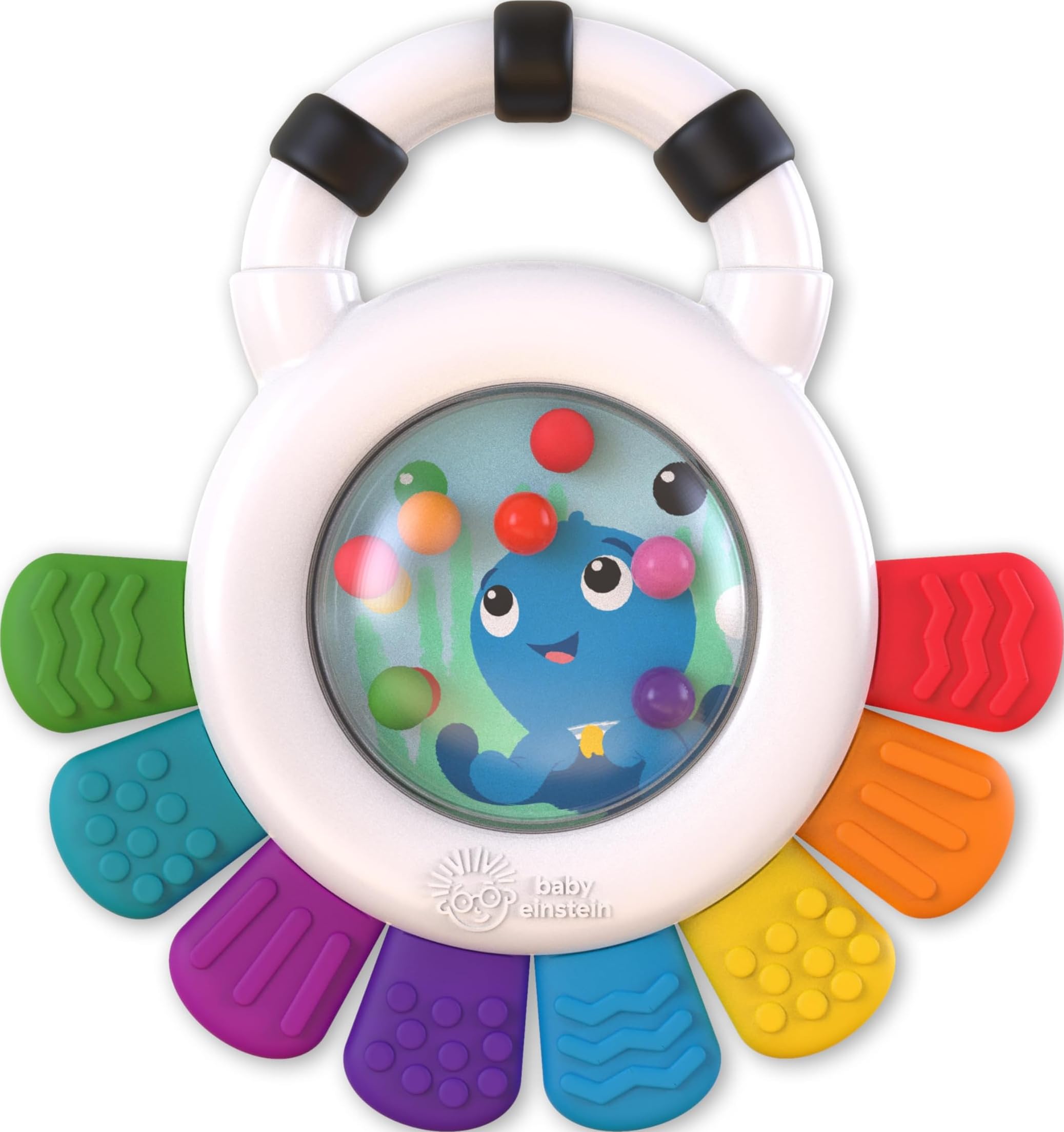
The Opus octopus packs a lot into one handheld toy: eight textured teething surfaces, a rattle, a bubble-pop feature, and a black-and-white handle. The arms give a baby several places to chew, while the rattle and bubble-pop add a little cause-and-effect play. It is a teether first and a rattle second, which is the right order for a baby with sore gums.

The handle is easy to keep hold of once a baby has a firm grip, and the textured arms are soft enough for mouthing without feeling flimsy. The bubble-pop over the character is a small, satisfying action that babies can press again and again. It is also chillable, so it can go in the fridge for extra soothing on a bad gum day. The rattle is gentle, not a headline sound, and that suits the teether-first job.

We recommend the Opus for a baby who is already mouthing well, because its eight textures and bubble-pop give sore gums more to do than a plain rattle. It has more features than the Winkel, but less open space for random clutching, so it suits a baby who reaches with purpose. If you want a multi-use teether-rattle, this is a strong choice; if you want the simplest first grab, the Winkel is easier.

Bottom line: We recommend the Opus for a baby who is already mouthing well, because its eight textures and bubble-pop give sore gums more to do than a plain rattle.

#7

Baby Einstein Teether-Pillar

Baby Einstein Teether-Pillar

Cooling sore gums

Doodle Score 9.4/10
Check Price

Worth Noting

  • Not for steam sterilization
Weight
2.12 oz
Cooling
Water-filled ring
Age Range
3 months to 3 years
Dimensions
1.1 x 4.17 x 3.94 inches
Read the full review

The Teether-Pillar's water-filled ring is the feature that earns it space: it goes in the fridge and comes out cool enough to soothe sore gums. The caterpillar shape gives a baby a clear body to hold, with a rattle tucked inside and textured surfaces along the ring.

At 3 months and up, it is a two-handed toy for some babies and a one-handed grab for others. The plastic caterpillar is easy to grip, and the ring is wide enough to reach with a slobbery hand. The rattle is a bonus rather than the main event, which is fine for a teether-first toy. It also gives a baby a clear edge to aim for when they bring it to their mouth.

We like the cooling feature because it adds a different kind of relief without a gel pack or a freezer brick. The water-filled ring is easy to wipe, and the size is substantial enough that it does not disappear under the couch. It is a practical toy for the fridge door, not a complicated one.

We reach for the Teether-Pillar when cooling relief matters most; the water-filled ring and rattle make it a useful fridge toy for sore gums. It is not the most compact rattle here, but the cooling payoff is worth the extra bulk for a baby who is actively teething.

Bottom line: We reach for the Teether-Pillar when cooling relief matters most; the water-filled ring and rattle make it a useful fridge toy for sore gums.

#8

TOHIBEE Sensory Teether

TOHIBEE Sensory Teether

Sensory ball play

Doodle Score 9.4/10
Check Price

Worth Noting

  • Hand wash only
Colors
12 bright colors
Weight
3.95 oz
Materials
Silicone and ABS
Dimensions
4.72 x 3.15 x 2.36 inches
Read the full review

The TOHIBEE sensory ball is the most compact toy here, and that is its advantage: it fits a diaper bag and a baby's two-handed grip. At 112 grams and roughly 4.7 by 3.2 inches, it is small enough to tuck beside a burp cloth but still big enough to hold with both hands.

The design is busy in a useful way. Twelve bright colors and textured silicone balls give a baby plenty to look at and mouth, while the rattle ring and twisting, clicking ball add sound and movement. The clear ball with smaller colored beads inside is the visual hook; it gives a baby something to track as they turn it. That mix of texture and motion is why it holds attention longer than a plain rattle.

The silicone surfaces are the reason to choose this over a hard plastic set. They are soft against gums, and the different knobs give a baby a choice of textures. The toy also rolls and rattles, so it works on the floor as well as in the hand. It is a good car-seat toy for the same reason: there are several ways to fidget with it.

We like the TOHIBEE as a compact diaper-bag rattle: it packs several textures, sounds, and colors into a palm-sized sensory ball. It is sized for a young baby's hands, not a toddler's, and it rewards a baby who likes to turn, shake, and chew. For a single toy that covers a lot of sensory ground, it earns its place.

Bottom line: We like the TOHIBEE as a compact diaper-bag rattle: it packs several textures, sounds, and colors into a palm-sized sensory ball.

How We Tested Baby Rattles

We started by pulling together the rattles that come up most often in baby registries, parent forums, and safety recall notices, then narrowed the list by materials, size, weight, and whether the shape looked genuinely graspable for a 3- to 9-month-old. That left 14 rattles, which we used for four months in the places they actually live: on the living room play mat during tummy time, in the stroller caddy on walks, on the floor beside the car seat during diaper-bag reloads, and loose in the diaper bag.

Each one got the same run. I shook it at arm's length and again near my ear to judge whether the sound was soft, bright, or piercing; weighed it on a kitchen scale and measured its widest point; and handed it to my baby and two friends' babies to see whether they could lift it, pass it hand to hand, and keep hold once they did. I tracked how long each rattle held attention across several sessions, and whether the colors looked clear in daylight and under indoor lamps.

Quality checks came after the fun part. I inspected seams and caps, washed the surface-safe ones, and dropped each rattle onto a wood floor from table height to see whether it cracked, split, or changed sound. I also noted how each one carried in the diaper bag and whether it was easy to wipe clean after a diaper-change-floor encounter. Value came down to whether a rattle kept earning its place after the novelty wore off, not just how it looked in the box.

How to Choose Baby Rattles

Start With Grip and Size

A rattle has to fit a hand that is still learning to close. We look for several grasp points, a body light enough to wave, and a shape that does not require precise aim. The 1.44-ounce Oball Rattle and the 3-ounce Winkel are good examples: one is an open lattice, the other a set of loops, and both let a baby grab somewhere without finding a single handle.

The trap is assuming a newborn can hold a toy sized for a 6-month-old. Check the age rating and the weight; a 4.64-ounce electronic rattle can be a fine older-baby toy but is a lot for a 3-month-old to wave. If your baby is just batting at objects, start lighter.

Rattle, Teether, or Both

Rattles teach cause and effect; teethers soothe gums. A combo can do both, but only if the chewable parts are actually comfortable and the rattle is not buried behind them. The Winkel and Opus are teether-first designs; the Barbell is a pure rattle.

The choice comes down to stage. If your baby is not mouthing yet, a simple rattle is enough; if they are chewing a fist all day, a textured teether-rattle earns its keep. Water-filled teethers are a separate category: they cool gums, but they need fridge-and-wipe care rather than rough play.

Sound and Electronics

Sound is the reason to buy a rattle, but more sound is not automatically better. A soft bead rattle can hold a baby's attention without making you wince, while a very quiet one may get ignored. The Barbell has a crisp bead sound; the Winkel is gentler.

Electronic rattles like the VTech puppy add songs, lights, and phrases. They are useful for distraction, but they are not the first toy we hand a newborn. If you want one rattle for quiet play and one for the car, that is a sensible split.

Cleaning and Care

Before you buy, read the care line. Many rattles are wipe-clean only, and hollow or water-filled toys can trap water if they are submerged. The Winkel and Oball Rattle should be surface-washed; the iPlay set should not be soaked or steamed. A damp cloth with mild soap is usually the safest routine.

The trap is the word washable. It does not always mean dishwasher-safe or submersible. If a toy has a battery compartment, a water-filled ring, or a sealed rattle chamber, keep it out of the sink unless the maker says otherwise.

One Rattle or a Set?

A single well-chosen rattle is enough for most babies, especially in the first three months. A set makes more sense when you want a rotation for different rooms, a spare for grandparents, or a variety of grips and sounds. The iPlay iLearn set gives ten pieces; the trade-off is hard plastic and wipe-only care.

We prefer starting with one good rattle and adding a set later if your baby loses interest quickly. The exception is a household that wants toys stashed in several places; then a set saves you from carrying one rattle from room to room.

Frequently Asked Questions

Final Verdict

The Manhattan Toy Winkel is the baby rattle we recommend first. Its open loops give a newborn several ways to hold and mouth it, the soft tubes are gentle on gums, and it keeps working as grip improves. It is not the loudest rattle here, but it is the one we reach for most often.

If you want a featherweight first rattle, choose the Bright Starts Oball Rattle. If cooling relief is the priority, the Baby Einstein Teether-Pillar is the better fit. Those are the two alternatives that change the decision most.