Arts & Crafts

Best Toy Drum Sets of 2026

Few toys test a parent’s patience like a drum set. The clatter, the volume, the pieces that scatter—it’s enough to make you second-guess the purchase. But a good one is worth the noise: it gives kids a real outlet for rhythm, builds coordination, and might spark a lifelong love of music. The best sets are sturdy enough to survive a toddler’s enthusiasm, simple enough to assemble without an engineering degree, and tuned to sound like actual drums rather than plastic buckets.

We spent six months with 10 sets, from tabletop kits to full five-piece setups. My team assembled each, then turned kids loose during after-school jam sessions, weekend playdates, and pre-dinner meltdowns. What stood out was how quickly kids lost interest in flimsy sets that wobbled or had tiny, hard-to-hit drums—and how the sturdier ones justified their higher price tags. A good rule of thumb: if it takes more than 20 minutes to put together or the drums slide when hit, it’s not worth the frustration. The picks below survived our testers and kept the kids coming back.

#1

VTech KidiBeats Drum Set
VTech KidiBeats Drum Set

Young toddlers

Doodle Score 9.4/10
Check Price

Worth Noting

  • Plastic pads, no real drum tone
  • Ages out around five
Pads
3 pads plus cymbal
Size
12.1 x 11.5 x 3.9 in
Power
3 AA batteries
Age Range
24 months to 5 years
Read the full review

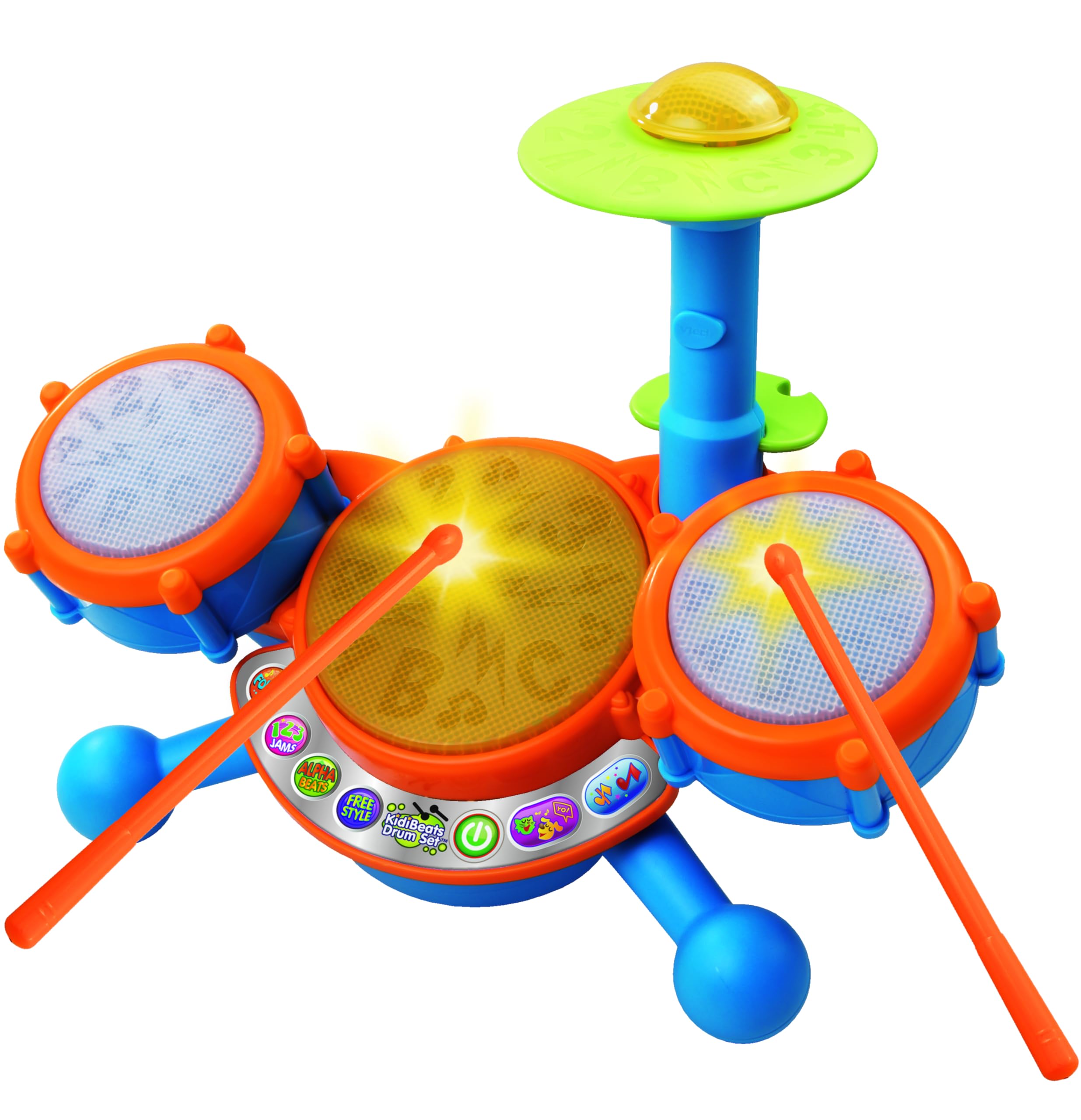
The KidiBeats is smaller than almost everyone expects. The photos and the phrase drum set set you up for a kit; what arrives has about the footprint of a cereal box — 12.1 by 11.5 by 3.9 inches, light enough for a two-year-old to carry by the edge. We stopped judging it as a kit and started judging it as a tabletop toy, and it got a lot better after that.

What it does, it does with care. Each of the three pads and the cymbal has its own voice, four modes cover free play, letters, numbers and a follow-along game where the pad your child should hit lights up, and the two sticks are scaled for small hands. The follow-along mode is the part that earns its place: it turns hitting into a game with a right answer, which is the first step toward keeping time. It runs on three AA batteries, and the cells in the box are for the demo only — put fresh ones in before you wrap it.

For a two- or three-year-old, we think it's close to ideal, for an unglamorous reason: there's nothing to break. No heads to split, no hardware to loosen, no stool to tip, and the volume is polite enough that it can stay in the living room. The pads will never sound like drums, and that's the honest limit of what this is — a first instrument that teaches rhythm and letters, then hands the job to something bigger.

Bottom line: Our pick for two- and three-year-olds: a tough tabletop drum that survives toddler handling, as long as nobody is expecting real drum sounds.

#2

VTech Kidi Star Drum Pad

VTech Kidi Star Drum Pad

Older kids

Doodle Score 9.4/10
Check Price

Worth Noting

  • Four AA batteries, no rechargeable pack
Songs
30+
Age Range
5 years and up
Drum Styles
20
Connectivity
Bluetooth or audio cable
Read the full review

Somewhere around five or six, a kid outgrows the four-pad toddler toy but isn't ready for a tunable snare and a throne. The Kidi Star is built for exactly that gap: a wide black pad with two sticks, a headphone jack, and enough electronic ambition to hold a seven-year-old's attention for longer than a week.

The feature list is genuinely long. Twenty drum styles — rock, marching band, metal, jazz — more than thirty songs, three games, a coach mode, Bluetooth and a record button. The recorder is the piece we keep coming back to: a kid lays down a beat, hits play, and drums over the top of themselves. That loop is the first thing about drumming that feels like magic rather than practice, and it's why this holds attention where a plain pad doesn't.

Bluetooth does more than it sounds like it does. Pair a phone and the pad becomes the speaker for a backing track, and the headphone jack means the whole thing can disappear into a pair of headphones when the house has had enough. Physically it's a plastic slab, 18.5 by 11.1 inches and four pounds, so it lives on a table or a lap; there's no stand in the box.

Here's the honest caveat. This is the one product here whose reliability splits, with a run of units that stop turning on and plenty that run for years. Buy it somewhere with an easy return, keep the receipt, and the risk is manageable. What you're paying for is variety — twenty kits and a recorder for a child who isn't ready to commit to a single snare sound.

Bottom line: We recommend it for the five-to-eight set who have outgrown toddler pads, with the caveat that you buy it somewhere returns are easy.

#3

MUSICUBE 8-Inch Wooden Drum

MUSICUBE 8-Inch Wooden Drum

Hand drum play

Doodle Score 9.4/10
Check Price

Worth Noting

  • Single drum, so no kit to grow into
Includes
Drum, 2 sticks, adjustable strap
Material
Wood
Age Range
6 years and up
Drum Diameter
8 in
Read the full review

This is the one we hand to a kid who likes noise but not electronics: an eight-inch wooden drum with a tensioned head, two wooden sticks, and an adjustable strap. No batteries, no modes, no speaker — you hit it and it makes a drum sound, warm and round rather than a plastic thwack. Of everything here it is the least fussy and the most honest.

The strap is the weak point. It's adjustable webbing with a clasp that lets go under enthusiastic playing, so the drum spends more time on the floor than at hip height; knot it, or swap the strap, if your kid actually wants to march. MUSICUBE also lists the recommended age as six and up, which is older than the toddler-focused copy suggests. With a child who still mouths things, that's a real reason to wait.

What it does better than any electronic toy here is teach dynamics. A hard hit and a soft one produce different sounds, and the head answers back every time, which is the lesson a drum has to teach before anything else. For a preschooler who already hums and taps in time, one good surface is plenty — and it will still be on the shelf when the batteries in everything else have died.

Bottom line: For a preschooler who already taps in time, this is the drum we reach for: real wood, a real head, and no batteries to feed.

#4

Bright Starts Safari Beats

Bright Starts Safari Beats

Babies

Doodle Score 9.2/10
Check Price

Worth Noting

  • Clip-on handle comes off under a firm grip
Drums
3
Modes
2
Power
3 AAA batteries
Age Range
3 months to 3 years
Read the full review

For a baby who can't hold a stick yet, the question is different: you want something that rewards a swat. Bright Starts' three-drum toy does exactly that — three colored drums that light and play when hit, two modes, animal sounds and melodies, and a shape a six-month-old can reach from a high chair.

We were struck by how little it asks of anyone. No sticks to lose, no assembly, no heads to split, and it takes three AAA batteries and then just works. The missing volume control is the trade for that simplicity — the level is whatever the toy decides, and you live with it. For a first instrument it's the right amount of toy: bright colors, immediate cause and effect, and nothing a baby can break by hitting it too hard.

What it won't do is grow. The lights and melodies are the whole offer, and by two and a half most kids have moved on to something they can hit with a stick — which is exactly when a tabletop pad like the KidiBeats takes over. As the very first drum in the house, though, it earns its place.

Bottom line: The best first drum for a baby who swats at everything, provided you can live without a volume control.

#5

Music Alley 3-Piece Kids Drum Set

Music Alley 3-Piece Kids Drum Set

First real kit

Doodle Score 9.0/10
Check Price

Worth Noting

  • Hardware works loose between sessions
  • Needs real floor space
Weight
16.1 lb
Materials
Wood and metal
Drum Heads
Tunable
Kit Contents
Bass drum, snare, tom, cymbal, pedal, throne, sticks
Read the full review

Of everything in this roundup, this is the set that stops being a toy the soonest. The Music Alley is a real junior kit scaled down for small players: wood and metal shells, a bass drum, snare, tom, cymbal, bass pedal, throne and two sticks, with heads you can tune. The proportions are the giveaway. A child sits at this and can reach every piece, which is not true of a pad on a table.

That's why it's our top pick. A tabletop toy is finished growing the day it comes out of the box; this one isn't. The heads tune, so a snare that has drifted can be brought back. The hardware is the same style as a full-size kit, just shorter, so there's something to adjust as your drummer grows. And it sounds like a drum — the snare cracks, the bass drum thumps, and neither is the flat plastic knock of a pad. For a kid who is actually drawn to drumming, that difference is the whole purchase.

The fittings are the part that needs looking after. Screws back out as the kit is played, the bass pedal asks for attention more often than the rest, and if nobody in the house owns a drum key you'll be improvising with pliers. Two minutes of tightening before a session keeps everything in place; skip it and the kit rattles itself out of tune. It's also the biggest thing here by a distance, listed at roughly 25 by 29 inches, so plan on a corner of a room rather than a shelf.

Buy it for a child of about four or older who has asked for drums specifically, or for a family who wants to find out whether lessons are worth paying for before committing to them. Below that age the reach isn't there, and the sticks become a hazard rather than a tool.

Bottom line: For the child who genuinely wants to drum, this is the set we recommend: a real, tunable junior kit that can be adjusted and repaired instead of outgrown.

#6

EKEMOND 9-Pad Electric Drum Set

EKEMOND 9-Pad Electric Drum Set

Quiet apartments

Doodle Score 9.0/10
Check Price

Worth Noting

  • Pads tap rather than rebound
  • No 5V power adapter included
Pads
9
Battery
Rechargeable, up to 10 hours
Outputs
Stereo speakers, 3.5mm headphone jack
Flat Size
15.75 x 12.6 x 1.18 in
Read the full review

The headphone jack is the reason this one is in the roundup at all. Plug in a pair and the EKEMOND goes quiet to the room while your kid hears everything, which in a house where a drum set is a negotiation between one child and everyone else changes the whole answer. For the money it is also a startling amount of kit: nine pads covering toms, snare, bass, hi-hat, ride and two crashes, seven drum tones, ten demo songs, a built-in speaker, a rechargeable battery rated at up to ten hours, and foot pedals.

It's a silicone mat, not a drum kit, and it tells you so the moment you hit it — a firm tap rather than a rebound off a tensioned head. We found that mattered less than expected once the pads were being used for what they're good at: playing along to the demo songs, cycling through the different kits, and doing it late at night without waking anyone. It rolls up to about an inch thick and weighs roughly two pounds, so it goes in a drawer, a suitcase, or the back seat.

One practical note: the 5V 2A adapter isn't in the box, so plan on a phone charger. What it isn't is a substitute for a real kit — the cymbals are printed surfaces rather than metal, and the sounds are samples rather than a drum in a room. As a first taste of electronic drums, or a travel kit for a kid who is already learning, those are fair trades, and the alternative at this price is a plastic toy that makes four noises.

Bottom line: If the house can't take the noise, buy this: nine pads, a headphone jack, and a rechargeable battery in something that rolls up and slides under a bed.

#7

Best Choice Products 3-Piece Kit

Best Choice Products 3-Piece Kit

Bedroom kit

Doodle Score 8.8/10
Check Price

Worth Noting

  • 22 pounds, the heaviest kit here
  • 60-day warranty only
Shells
All-wood, high-gloss finish
Weight
22 lb
Kit Contents
2 toms, bass drum, cymbal, pedal, stool, sticks
Assembled Dimensions
22 x 15 x 29 in
Read the full review

The Best Choice Products kit is the best-looking thing here. All-wood shells under a high-gloss finish, blackened hardware, a cushioned stool — set up in a corner it reads as a scaled-down drum kit rather than a toy, and that counts for something when the thing is going in a living room instead of a playroom.

It's complete: two toms, a bass drum, a cymbal, sticks, a bass pedal, a stool and a single drum key for assembly and future tuning. Assembly is straightforward with that key, and the sealed shells wipe clean, which is more than you can say for a fabric-covered pad. On paper it's the more generous of the two wood sets here, and the cushioned throne is the reason a long session doesn't end in complaints.

Where it loses to the Music Alley is exactly there: the drums drift out of position, the cymbal sags, and the stool's bolts need checking, so keeping it tight becomes a small ongoing chore rather than a one-time setup. If someone in the house enjoys that kind of fiddling, this is a better-looking, wood-shelled alternative. If nobody does, the Music Alley needs less attention for less money.

Bottom line: A handsome wood-shell kit for a family who wants the look of a real drum set, as long as someone is willing to keep the hardware tight.

How We Tested 10 Toy Drum Sets

We started by researching the toy drum sets that parents actually talk about—scanning reviews for complaints about wobbly legs, missing pieces, and volume that could wake the dead. From there, we narrowed to 10 sets that spanned the size and price range: tiny tabletop kits for toddlers, mid-size kits for preschoolers, and full five-piece setups for older kids. We filtered out anything with a lengthy assembly video or a price tag that felt out of line with what you get.

Over six months, I assembled each set with my team in a living room or playroom, timing how long it took from box to first beat. Then we turned a crew of kids loose during after-school jam sessions, weekend playdates, and pre-dinner meltdowns. We watched which drums they gravitated toward, whether the set stayed put when they got enthusiastic, and how quickly they lost interest in kits that wobbled or had tiny, hard-to-hit surfaces.

We also paid attention to sound—not just volume, but whether the drums had a pleasing tone or a hollow plastic clatter. We checked durability by letting kids play hard for weeks, then inspecting for cracks, loose hardware, and stretched heads. Assembly ease mattered too: we noted whether one adult could put it together without swearing, and whether the instructions were clear. And because kids are drawn to bright, inviting finishes, we noted which sets looked the part—colorful without being eyesores.

Finally, we considered value: did the sturdier, better-sounding sets justify their higher price, or were the budget options good enough for casual play? We also tracked reliability—whether the set held up after repeated setup and takedown, and whether any parts went missing or broke. The picks below are the ones that survived our testers and kept the kids coming back.

How to Choose Toy Drum Sets

Three kinds of drum set, three different jobs

Tabletop pads are electronics: three or four surfaces, songs and learning modes, batteries, and a size that fits on a shelf. Wooden hand drums are instruments with one head and no settings — better for teaching hard versus soft than for playing a beat. A junior kit is an actual drum set, scaled down, with a throne and a pedal.

We steer by age first: pads for two and three, a hand drum or a first kit from four. Then by temperament. A child who wants to hit everything at once wants a kit; a child who taps along to music and listens to the tone is the one who gets something out of a single drum.

Size the child first, then the set

Every tabletop set here turns out smaller in person than in the photographs, so read the listed dimensions and compare them with the shelf or floor where it will live. Expect a footprint closer to a cereal box than to a drum kit, and decide whether that's a disappointment or exactly what you wanted.

For a junior kit the test is a seated one: feet flat and reaching the bass pedal, hands reaching the cymbal without stretching. A kit that's slightly too big is unplayable; one that's slightly too small is outgrown in a year. Sit your child at it before you tighten anything down.

Answer the noise question honestly

An acoustic kit has no volume knob, and a child hits harder than you expect. That's fine in a room with a door; it is a genuine problem in a shared apartment. Electronic pads solve it with a headphone jack, and the difference between a set with one and a set without is bigger than any feature list suggests.

Tabletop toys sit in the middle: quieter than a kit, but relentless in a way an instrument isn't, because the songs keep starting over. If the toy will live in the main room, listen to that before you buy, not after.

Know which parts wear out first

Stick and mallet tips go before anything else, and a loose tip on a toy for a small child is a choking hazard, so check them before each session. On a junior kit, the hardware works loose and the bass pedal takes the most punishment; a drum key and two minutes keep it playable.

Wooden shells wipe clean and a tensioned head eventually needs replacing, which is upkeep rather than a fault. None of this is a reason to avoid a drum — it's the difference between a thing you maintain and a thing you throw away.

Frequently Asked Questions

Final Verdict

For most families shopping for a drum set a child will actually play, the Music Alley is the answer. It's the only pick here that behaves like an instrument, it can be tuned and tightened instead of replaced, and it holds a child's interest through the years when that interest is real. If your drummer is two or three, buy the KidiBeats and wait — the reach and the restraint aren't there yet.

And if the objection is noise rather than age, the EKEMOND's headphone jack is the entire argument. Those are the three decisions that matter: how old, how loud, and how serious.