Arts & Crafts

Best Drawing Kits for Kids of 2026

The trouble with drawing kits is that the good ones get used up and the bad ones get abandoned. A rainy Saturday with a fresh set of markers buys you 20 minutes of quiet before a cap goes missing, the black runs dry, and the whole thing lands in the drawer. What a kid actually needs is a kit that survives being shoved into a backpack, has enough colors that two siblings can both use red, and comes in something sturdy enough to keep the pieces together between sessions.

I've bought plenty of these over the years — for my own kids, for nieces and nephews, and once, desperately, at a gas station the night before a party. For this round, my team and I handed 15 kits to kids between three and eleven over four months, and a pattern held: the ones that get reached for again are rarely the ones with the biggest piece count. A 150-piece set sounds generous until you notice most of it is tiny stencils nobody touches. Here's what earned a permanent spot on the shelf.

#1

Crayola Inspiration Art Case

Crayola Inspiration Art Case

Everyday drawing

Doodle Score 9.6/10
Check Price

Worth Noting

  • Large 15.5-inch case won't fit every backpack
Paper
15 sheets
Pieces
140
Weight
3.3 lb
Supplies
64 crayons, 40 markers, 20 pencils
Read the full review

Sixty-four crayons, forty washable markers, twenty short colored pencils, and fifteen large sheets: the Inspiration case is the one kit here that covers all three of the things most children actually draw with, and covers them generously. Forty markers is the number that decided it for us. Markers are what a child reaches for first and what a parent ends up buying again by spring, and these are washable, which matters on the afternoon a cap doesn't go back on.

As a default, this is the case we hand a five- to eight-year-old without a second thought. It does work the supply list doesn't advertise: every crayon, marker, and pencil has its own compartment, so a missing piece shows up the moment the lid closes. Five seconds of scanning the tray beats emptying a bag looking for red, and it gives this kit a better chance of staying complete than a loose boxed set.

Paper is where it runs thin. Fifteen sheets against sixty-four crayons is a mismatch, so plan on a pad of drawing paper in the same order; the crayons will outlast the paper several times over. At 3.3 pounds and 15.5 by 11 inches it is a shelf or a car-seat kit rather than a backpack one, and the Create 'N Carry is the better shape for that job.

The space theme on the lid is the only part of this kit aimed at a particular child. Everything inside is plain enough that a five-year-old who mostly colors and an eight-year-old who has started drawing both get something out of it, which is not true of every themed case on a shelf.

Bottom line: We recommend the Inspiration case as the default: three media, forty washable markers, and a slot for every piece, for the five-to-eight-year-old who draws most days.

#2

Shuttle Art 103-Piece Drawing Kit

Shuttle Art 103-Piece Drawing Kit

Tweens and teens

Doodle Score 9.6/10
Check Price

Worth Noting

  • Leads can arrive snapped
Case
Zippered nylon case
Paper
Sketch pad, watercolor pad, coloring book
Pieces
103
Pencils
Colored, watercolor, metallic, graphite, charcoal
Read the full review

Somewhere around nine or ten, a child stops wanting to color and starts wanting to draw. This is the kit for that shift: twenty-four colored pencils, twenty-four watercolor pencils, twelve metallic pencils, twelve graphite pencils, and twelve charcoal pencils, all in a zippered case with a loop for each one.

The water brush is the piece that earns its place. Watercolor pencils are drawn dry and then wetted into a wash, and a refillable brush means that happens without a cup of water on the table, which is one less thing to knock over and one less reason the set stays shut in its case. We think it is the most useful extra in any kit here.

For a tween ready for real media, this is our pick. Nothing in it is filler: two paper pads, a coloring book for the days a child wants to color instead, two sharpeners, a sandpaper pointer, blending stumps, two paint brushes, and two erasers. The looped case matters as much as the contents, because pencils that rattle loose arrive with the tips gone.

Charcoal is the messy half. It dusts whatever it touches, which is why we keep this kit at a desk rather than in a car. The twelve metallic pencils are the ones that get shown around, and the coloring book is the safety net for a kid who is not sure about sketching yet.

Bottom line: Give this to a nine- or ten-year-old who has started drawing: real graphite, watercolor and metallic pencils, two pads, and a case that keeps the tips intact.

#3

Prina 50-Piece Sketch Kit

Prina 50-Piece Sketch Kit

Budget beginners

Doodle Score 9.6/10
Check Price

Worth Noting

  • ⚠️ Metal craft knife needs adult supervision
  • Small 6 x 9 inch pad
Case
Zip-up travel case
Pieces
50
Sketchbook
3 colors, 50 pages, 6 x 9 in
Graphite Range
5H to 12B
Read the full review

No crayons, no markers, no cartoon on the lid: this is the cheapest kit in the group and the most single-minded. What you get is pencils, fifteen graphite from 5H to 12B, three black and three white charcoal pencils, a woodless graphite, six soft pastel sticks, willow charcoal, three blending stumps, two erasers, and a zip case, plus paper.

The paper is the part that surprised us. It is a six-by-nine pad, fifty pages at 100 gsm, split across white, tan, and black sheets, and those ten black pages change what a beginner can do, because white charcoal on black paper looks like nothing else in this article.

For a beginner on a budget, this is the best drawing value here. A graded pencil range does something a box of crayons cannot: it shows a child what hard and soft graphite do to the same subject, and the three paper colors give each grade a different surface to answer to. It is not a kit for a five-year-old, though, because the charcoal dusts and there is a craft knife in the case.

The ten-step how-to-draw-a-dog tutorial is what makes it a teaching kit rather than a box of supplies. A child can follow it, finish something recognizable, and give the pencils credit for it, which is roughly what keeps a beginner drawing long enough to get good.

Bottom line: For a beginner on a budget, this is the most drawing per piece here: graded graphite, three paper colors, and a tutorial that actually teaches.

#4

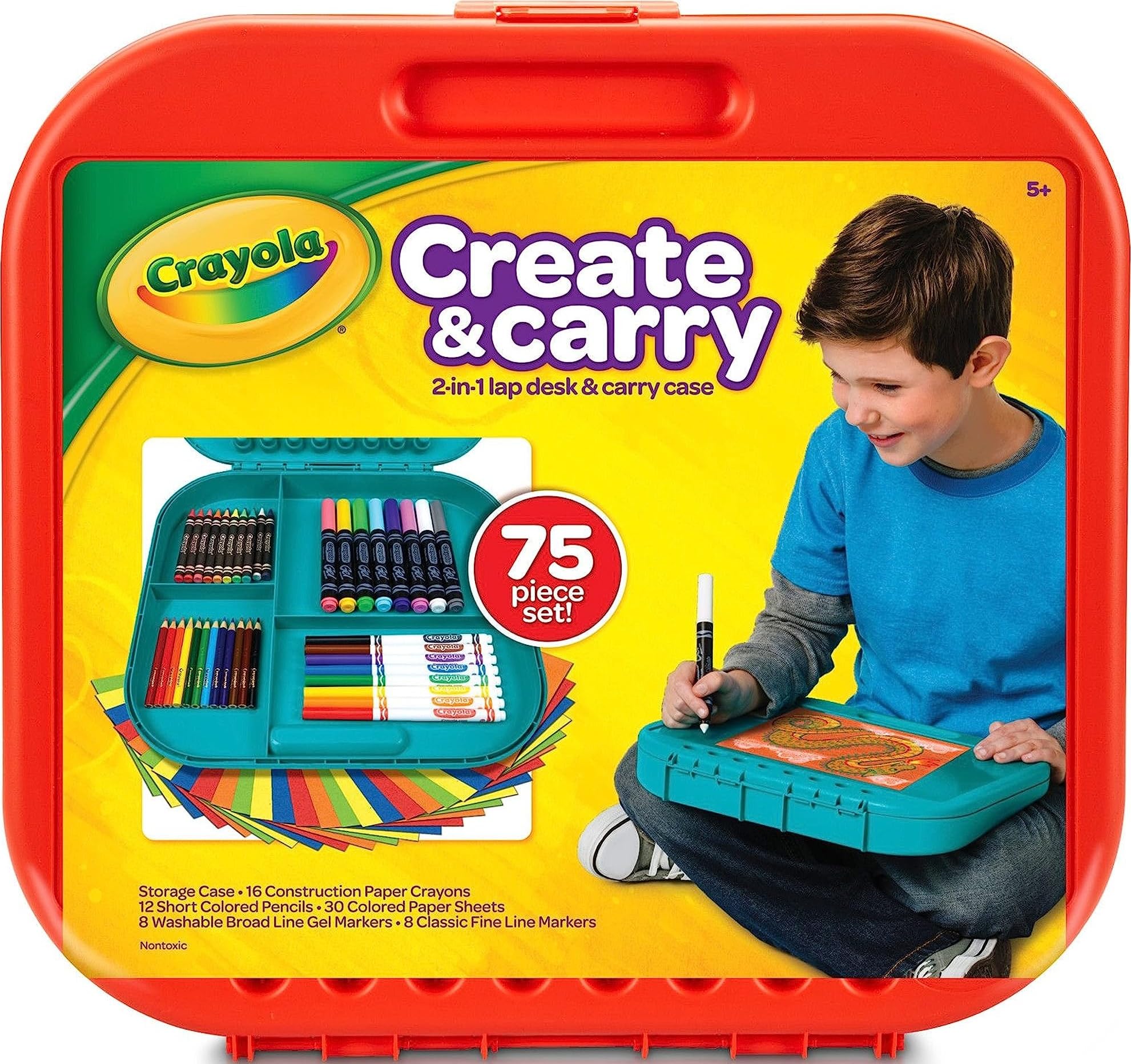
Crayola Create 'N Carry

Crayola Create 'N Carry

Travel and car trips

Doodle Score 9.4/10
Check Price

Worth Noting

  • Paper is 5 x 7, not letter size
Case
2-in-1 lap desk
Paper
30 sheets, 5 x 7 in
Pieces
75
Supplies
16 crayons, 16 markers, 12 pencils
Read the full review

The lid opens flat and stiffens into a lap desk, so a child can draw in a car seat or at a restaurant table without anyone clearing a space or chasing a sheet of paper across the table. That single feature is what the kit is for, and we think it is the right trade for travel.

Inside there are sixteen construction paper crayons, eight Gel-FX markers, eight fine-line markers, twelve short colored pencils, and thirty sheets of construction paper. That makes it a travel kit rather than a full art supply, a fraction of the crayons and markers in the big Crayola case, so we treat it as the set that lives in the car or the backpack while the 140-piece case stays home for long sessions.

The one thing that annoys us is that nothing inside clips down. The trays are open, so a case carried by the handle at an angle arrives with the crayons in a heap against one wall. Keep it flat, as it sits in a car door or on a lap, and it is a non-issue; hand it to a six-year-old by the handle and you will be sorting markers.

Construction-paper crayons are the detail we did not expect to care about. They are softer than the ones in a standard box and made to lay color onto textured paper without hard pressing, which suits a kit whose whole premise is thirty sheets under the lid.

Bottom line: This is the kit we hand over in the car: the lid becomes a lap desk, so a drawing survives the ride instead of sliding off a knee.

#5

Sunnyglade 185-Piece Easel Set

Sunnyglade 185-Piece Easel Set

Painting and easels

Doodle Score 9.4/10
Check Price

Worth Noting

  • Thin plastic case and easel flex
Case
Trifold with dual-side easel
Pieces
185
Weight
3.5 lb
Watercolor Cakes
18
Read the full review

Eighteen watercolor cakes, a brush, a palette, and a folding case that stands up as a double-sided easel: this is the only kit in the group that lets a child paint rather than color.

What earns it a place is the easel, not the piece count. Standing the paper at an angle changes what a wet brush does, because a wash runs down the sheet instead of pooling at the bottom of a flat page, and it means the kit works on the floor or a driveway or anywhere without a table. That is why we point to it the moment a child starts asking to paint.

The rest of the box is generous: forty-eight oil pastels, forty-eight crayons, twenty-four colored pencils, twelve markers, and four large clips that hold a loose sheet to whichever side of the easel is facing up. Paper is the weak part, at twelve sheets the thinnest pack here, so open a pad of watercolor paper the same week and let the clips take it. The other weak part is the shell: the trifold panels are thin plastic and flex when the case is picked up full.

The forty-eight oil pastels are the sleeper of the set. They are softer than a crayon and smudge under a finger, which is how a child discovers shading by accident, and they are the medium a kid who insists they cannot draw tends to take to first.

Bottom line: We pick this one when a child asks to paint rather than color: an easel, watercolor cakes, and a brush in one folding case.

#6

iBayam 150-Piece Wooden Art Set

iBayam 150-Piece Wooden Art Set

Gift presentation

Doodle Score 9.4/10
Check Price

Worth Noting

  • 6.4 pounds is heavy for a child
Paper
2 drawing pads and a coloring book
Pieces
150
Weight
6.4 lb
Supplies
24 colored pencils, 24 oil pastels, 24 watercolor cakes
Read the full review

It arrives as a wooden case inside a printed gift box, which is the whole reason to look at it: this is the only kit here that looks like a present before anyone has unwrapped it.

Inside there are twenty-four colored pencils, twenty-four oil pastels, twenty-four watercolor cakes, three palettes, two drawing pads, and a coloring book. Two pads is the sensible part, because a child can start drawing before an adult finds loose paper. At 6.4 pounds it is the heaviest kit in the group, and that tells you what the wood costs: this is a shelf kit, not something a child carries to a restaurant.

The parts inside are decent without being the best here. The oil pastels are soft, the watercolor cakes work with the palettes, and the colored pencils do what a child asks of them. Nothing in the box draws better than the Crayola or the Shuttle Art, and at the top of this group's price range that is the honest trade: you are paying for wood and packaging.

So the case for it is the case, literally. If you want a birthday gift that looks considered on the table, the wood and the outer box do that work and the supplies are good enough to use afterward. If you want the kit that gets drawn with on a Tuesday, the Crayola case weighs half as much and holds more of what actually runs out.

Bottom line: We recommend it as a gift rather than a workhorse: the wooden case and the gift box do the selling, and the contents are good enough to draw with.

How We Tested the Best Drawing Kits for Kids

We started with more than 40 kits — the ones on every shelf and every wishlist — and cut the pile by checking age recommendations, whether small parts would be a choking hazard for the youngest kid in the house, and whether the case was a real case or a blister pack pretending to be one. That left 15 kits, from crayon-and-paper starters to mixed-media boxes with pastels and watercolors. Price mattered, but we looked at cost per piece a kid would actually use, not the piece count printed on the box.

For four months, the kits lived where kids actually draw: the kitchen table after school, the back seat on a two-hour drive, a playroom floor, and a birthday party where we handed three over unwrapped and watched which one got opened first. We noted which ones got pulled out again without an adult suggesting it, and how long a sitting lasted before someone wandered off. Parents got a say too — whether they'd buy it again, and whether they'd hand it to someone else's kid as a gift.

Color variety was easy to see and harder to judge honestly, so we drew the same rainbow with every kit and paid attention to whether the reds were distinguishable, whether the skin tones went beyond one shade, and whether the markers were still juicy after a week of caps left off overnight. Sturdiness got tested the way kids test it: each case was dropped from counter height onto a driveway, a hinge opened and closed 50 times, and one adult sat on every case. We counted how many pieces got used in a month versus how many were filler, and weighed each kit packed up to see whether a seven-year-old could carry it to the car without help.

How to Choose Drawing Kits for Kids

Match the media to how your child draws

Children under about seven mostly want to color, and that means crayons and markers: bold, fast, and satisfying on plain paper. Somewhere around nine the interest shifts toward drawing, where graphite, colored pencils, and charcoal reward pressure and a sharp point. The kits here split cleanly along that line, and buying two years ahead of the shift usually produces a set that sits in a cupboard.

If a child asks to paint, watercolor cakes are the quickest satisfying route: wet the brush, load color, go. The Sunnyglade set is the only one here built around them, and it pairs the cakes with an easel so the paper is not lying flat while a wet brush works on it.

The case decides whether the kit survives the month

Two things matter more than the supply count: whether a child can work the closure alone, and whether every piece has a home. Open trays spill the moment the case is carried sideways. Molded compartments survive a car trip and make a missing marker visible at cleanup, which is why the Crayola case keeps its contents for longer than a cardboard box does.

Check the footprint against whatever bag the kit will live in. The Inspiration case is listed as compact and measures 15.5 by 11 inches, which suits a shelf rather than a small backpack, while the Create 'N Carry is a squarer 12.9 by 12.2 inches and built to be carried. Compact in a listing often describes how the case folds, not how it fits in a bag.

Paper is the first thing to run out

Count the sheets before you count the crayons. These kits carry anywhere from 12 to 30 loose sheets against 40 or more markers, so paper disappears long before the color does. Buy a pad of drawing paper in the same order rather than after the first week of use; it is the cheapest way to extend a kit by months.

Size is the other half of that decision. Five-by-seven sheets suit a lap desk, six-by-nine suits a pencil kit, and nine-by-twelve is what a child needs for a drawing worth taping to a wall. For watercolor, get paper made for water; ordinary drawing paper buckles the moment a wash hits it.

Piece counts are the least useful number on the box

A 185-piece set and a 50-piece set can hold the same number of usable drawing tools, because clips, palettes, and blending stumps all count as pieces. Read the crayon, marker, and pencil lines instead. The Prina kit's 50 pieces are nearly all drawing media and paper, while the bigger sets pad out the total with accessories a child touches once.

Price tracks the case as much as the contents. The wooden iBayam set sits at the top of this group and most of that premium buys the box and the gift packaging rather than better pencils. If the kit is going to be carried, dropped, and left in a car, spend the difference on paper instead.

Frequently Asked Questions

Final Verdict

The Crayola Inspiration Art Case is the drawing kit we recommend for most families: three media, forty washable markers, and a compartment for every piece, which is what keeps a 140-piece set from becoming a drawer of loose crayons.

Buy the Create 'N Carry instead if the kit lives in the car, because the lap desk is the difference between a finished drawing and a dropped box. For a nine- or ten-year-old who wants a pencil in their hand, go to the Shuttle Art; for a child who asks to paint, the Sunnyglade is the only set here with an easel.