Arts & Crafts

Best Finger Paint for Toddlers of 2026

Finger paint promises twenty minutes of glorious mess and then quietly threatens the rest of your afternoon. The fear is never really the paint itself — it's the handprint on the couch cushion you find two days later, the shirt that comes out of the wash looking exactly the way it went in, the pot that smells faintly of a hardware store. A good finger paint lets the mess be the point, because everything wipes off a high chair tray and rinses out of a cotton sleeve without a fight. The wrong one turns a rainy Saturday into a scrubbing session.

I've cleaned paint out of a rug more than once, so the test that matters most to me is the one that happens after the painting is over. Over the past three months, we've worked through 16 different finger paints on my kitchen table, a high chair tray, and in a few bath-time experiments — thick ones, watery ones, sets that came with paper and smocks, pots that cost less than a coffee. The ones that earned a spot below did two things well: color that stayed vivid after it dried instead of fading to chalk, and paint that came off skin with warm water and nothing else. One thing worth knowing before you buy — a paint that holds a soft peak when you squeeze it out usually means more pigment and less filler, which is why it costs a little more per pot but stretches across a few extra sessions.

#1

Crayola Washable Finger Paints

Crayola Washable Finger Paints

First-time painters

Doodle Score 9.6/10
Check Price

Worth Noting

  • Six colors, with no black or white
  • Can leave a mark on some fabrics
Colors
6
Stated Age
Toddler
Bottle Size
8 fl oz each
Total Paint
48 fluid ounces
Read the full review

Eight ounces is the number that settles this set. Crayola puts six bottles at that size in the box, 48 fluid ounces in total, which is more than twice what most of the two-ounce sets here hold, and the bottles are built for a toddler to operate: squeeze the body, flip the cap with a thumb, and a controlled blob lands on the paper instead of a flood.

That size and dispenser are why it is our top pick; the way it washes off is why it stays there. Hands, highchair trays, floor tiles and table edges all give up the paint to a wet cloth, and it dries matte in about an hour rather than staying tacky all afternoon. Of everything we tested, this is the set we reach for without thinking about the cleanup afterward.

The colors are the quieter strength. Six shades, blue through violet, all creamy enough to drag with a finger and strong enough that a thin smear still reads as color. Mixing two of them to see what happens is half the activity at this age, and the smooth texture means a two-year-old gets a mark worth showing off without needing help.

What 48 ounces means in practice is a box that survives a winter. We never rationed it or scraped the last of a color off the bottom, which is the small failure of the smaller sets: you run out of red in February and the rest of the box sits there until somebody remembers to reorder.

Bottom line: The set we recommend to almost everyone: eight-ounce bottles a toddler can work, and paint that wipes off hands, trays and floors with one wet cloth.

#2

EXTRIC Washable Kids Paint

EXTRIC Washable Kids Paint

Wide color palette

Doodle Score 9.2/10
Check Price

Worth Noting

Colors
12
Stated Age
1–3 years
Bottle Size
2 oz each
Total Paint
24 oz
Read the full review

Twelve bottles is the pitch, and it holds up: most toddler paints here stop at six or eight colors, so a child who wants a dozen shades on one sheet gets them. Each bottle is two ounces, which makes 24 fluid ounces spread across a much wider palette than the big-bottle sets can offer.

The paint behaves the way finger paint should. It is creamy rather than watery, sits on a finger long enough to be dragged into a shape, and dries matte in a couple of hours. Paper, card and wood all take it well, and hands and table surfaces come clean with soap and water. The bottles reseal properly, which we appreciated after a week of half-used colors sitting around.

We wish the bottles were bigger, because twelve small ones buy breadth rather than depth. A toddler who fixates on one color drains that bottle in a handful of sessions while the other eleven sit full, and long sessions around a shared table go through them faster than the eight-ounce bottles in the Crayola set.

Which is why we think of this as the set for a house where color is the whole point. If your child names every shade and wants them all out at once, this is the palette we hand over, and it is the box we take to a playdate with four children painting. If you want to stop thinking about running out, buy bigger bottles.

Bottom line: Choose these if the palette matters more than volume — twelve colors a toddler can actually tell apart, in bottles small enough to empty in a good week.

#3

Shuttle Art Finger Paint Kit

Shuttle Art Finger Paint Kit

One-box gift

Doodle Score 9.2/10
Check Price

Worth Noting

  • Stains fabric if it sits before washing
Colors
10
Bottle Size
2 fl oz each
Total Paint
20 fluid ounces
Kit Contents
37 pieces with apron and tools
Read the full review

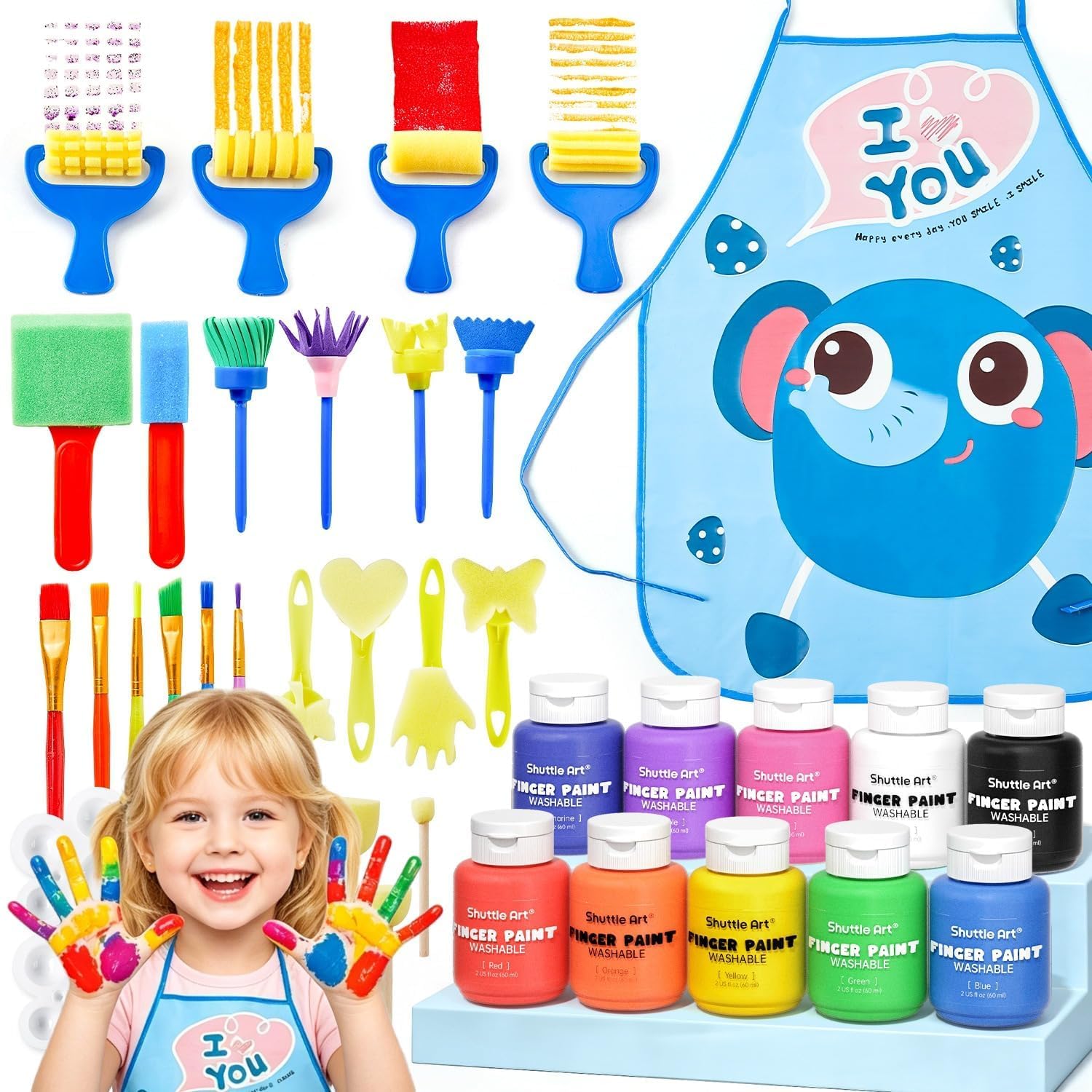
Thirty-seven pieces is a lot to hand a toddler, so it is worth knowing what is in the box: ten two-ounce paint bottles, an apron, two palettes, six brushes, and a pile of rollers, stamps and sponges. The paint is the point, and it is good — thick, bright and generous on paper — but the tools change what the set is for, turning a finger-painting session into an afternoon of stamping and rolling for an older sibling.

On skin and hard surfaces it rinses off with water, and the bottles squeeze a controlled amount rather than dumping. The apron is the part that earns its place: tie it on before the caps come off and the paint has somewhere to land that is not a shirt.

Order paper with it. The listing's own copy mentions a finger paint pad among the accessories, which makes it easy to assume one is in the box — check before the first session rather than discovering otherwise with a toddler already wrist-deep in blue.

As a present, this is the box that looks like an event: it opens into a whole activity, and the apron means the paint has somewhere to go other than a shirt. As a paint purchase it is less of a bargain, because you are paying for the tools as much as the paint, but for a third or fourth birthday we take it over a plain six-pack every time.

Bottom line: Buy it as a gift, not as your paint supply: the apron and tools turn a rainy afternoon into an event, and the paint holds its own alongside them.

#4

Honeysticks Finger Paint

Honeysticks Finger Paint

Ingredient-conscious parents

Doodle Score 9.2/10
Check Price

Worth Noting

  • Premium price for the amount of paint
Colors
6
Colorings
Cosmetic-grade
Container
Recycled plastic pots
Stated Age
12 months and up
Read the full review

Six pots, each a little over two ounces, molded in honeypot shapes from reclaimed plastic, inside an FSC-certified cardboard box. What is in them is the point: water-based paint colored with cosmetic-grade colorings, and a stated minimum age of 12 months, which is the youngest starting point here.

The texture is what we keep coming back to. It is thick and creamy, closer to face cream than to the runny tempera in most of these bottles, so a finger dragged through it leaves a ridge instead of a puddle, and a two-year-old gets control out of it that no squeeze bottle gives. The six colors are strong and mix cleanly, and the wide pots are made for dipping into, which suits finger painting better than a nozzle does.

The deeper colors take more washing off skin than the pale ones, and a smock is worth having on before the pot is open. A quick rinse at the end of the session handles hands; leave a blue smear on a sleeve and you are in pretreat territory. For a young toddler doing a few prints at a time, that is a manageable routine.

Bottom line: Worth the premium if you read ingredient lists and want thick, controllable paint: cosmetic-grade colorings, a 12-month starting age, and recycled packaging.

#5

Nicpro Washable Finger Paint

Nicpro Washable Finger Paint

Controlled pours

Doodle Score 9.2/10
Check Price

Worth Noting

  • Nothing else in the box
Colors
12
Bottle Size
2 oz each
Total Paint
24 fluid ounces
Safety Standard
ASTM D-4236
Read the full review

Flip-top caps on two-ounce bottles are the reason to pick this one: press the lid, squeeze a line, close it again, and the paint goes where a small hand points it instead of flooding the page. Twelve colors, 24 fluid ounces, thick enough to blend two shades on the paper, and a matte finish that does not glare under a kitchen light. It is the bottle set we hand over when an adult does the squeezing and a toddler does the smearing.

It behaves well on the surfaces a toddler actually paints. Paper, card and wood all take it, and it rinses off skin and wipe-clean tables with water. Nicpro states ASTM D-4236, the art-material labeling standard worth looking for on any children's paint, which is the sort of detail we check before a first session rather than after.

Bottom line: A tidy twelve-color bottle set we reach for when an adult squeezes and a toddler smears, with flip caps that keep the paint where it was aimed.

#6

BLOT Finger Paint Tubes

BLOT Finger Paint Tubes

Little hands

Doodle Score 9.2/10
Check Price

Worth Noting

Colors
10
Container
Squeeze tubes
Safety Standard
ASTM D-4236 and EN71
Read the full review

Hand a two-year-old one of these tubes and the paint comes out where the tube is pointed — a line, not a lake. That is the argument for tubes at this age: the flow is limited by how hard a small hand can squeeze, the cap twists back on, and there is no bottle to upend over the paper.

Ten colors, thick enough to spread with a palm, and stated to meet both ASTM D-4236 and EN71, the US art-material standard and the European toy-safety one. It comes off skin with water and a rub, and a little goes a long way, so one small squeeze covers a whole sheet.

The low price and the small format make this the set we buy to find out whether finger painting sticks before committing to eight-ounce bottles. It is also the one we hand to a child who paints in five-minute bursts and loses interest at cleanup time. For a first set, that is reason enough.

Bottom line: A low-risk first set: tubes a small hand can squeeze without dumping, thick paint, and a price that makes trying finger painting easy.

#7

Cra-Z-Art Finger Paint Bulk Pack

Cra-Z-Art Finger Paint Bulk Pack

Classrooms and siblings

Doodle Score 9.0/10
Check Price

Worth Noting

  • Only eight colors, no black or white
Colors
8
Safety
Non-toxic and washable
Bottle Size
4 fl oz each
Total Paint
32 fluid ounces
Read the full review

Picture three children at one table, each with a color, nobody running out: that is the case this set is built for. Eight four-ounce bottles, 32 fluid ounces in all, in the classic shades, with squeeze bottles that recap easily between sessions. Our verdict up front: this is the bulk pack we buy for a classroom, a daycare, or a house where painting is a group activity.

The paint is thick, opaque and genuinely washable off hands, trays and floors. The cleanup is the part that pleased us most, because a four-ounce bottle means a generous squeeze instead of the careful rationing a two-ounce bottle forces. The eight colors are the standard ones, so nobody is mixing a rainbow, but they are strong enough that a handprint reads as a handprint.

What you give up is the gift-ready part: no apron, no tools, no paper in the box, so add a smock and a roll if this is a present. For stocking a shelf that gets used every week, that is the right trade — the money went into the paint.

Bottom line: The bulk buy for a classroom or a table full of siblings: big bottles, classic colors, and cleanup that stays easy even after a generous squeeze.

#8

Funto Finger Paint Kit

Funto Finger Paint Kit

Paper included

Doodle Score 9.0/10
Check Price

Worth Noting

  • Paint can mark fabric and bathroom surfaces
Paint Type
Water-based gel
Total Paint
20 fluid ounces
Kit Contents
25 pieces with paper roll
Read the full review

The roll of finger paint paper is what separates this kit from the pile: a long sheet with an easy-cut edge, so you tear off a length, tape it to the floor or the table, and the question of what to paint on answers itself. Twenty-five pieces in all — paint, brushes, stamps, sponges, a roller and a storage bag — and the bag matters more than it sounds, because loose toddler art supplies migrate through a house.

The paint arrives in tubes that squirt gently, which is easier for a small hand than a big bottle, and the colors are bright while wet. The tools give an older sibling something to do alongside a toddler who is using fingers, which is the real reason a kit like this earns shelf space.

As a first set for a household with no supplies at all, it does the job: paper, tools and a bag together mean a rainy afternoon needs no planning, and the storage bag is the difference between a kit that survives and one that ends up in a drawer in pieces. The paint is the weakest part of the package; the paper and the tools are why we keep it on the list.

Bottom line: The kit to buy when you own nothing: paper roll, tools and a storage bag mean the first session happens the day the box arrives.

How We Tested 16 Finger Paints (and What Survived the Laundry)

We started by gathering every washable finger paint we could find and reading the fine print: which ones carried a non-toxic certification, which listed actual pigments instead of generic "color," and what the price worked out to per ounce once you stopped looking at the sticker. A set got a closer look if it included its own paper, a smock, or brushes, since that's often the difference between a usable gift and an extra trip to the store. That winnowed the field to 16 paints, which we used for three straight months.

Testing happened where finger paint actually happens: the wipeable mat under my kitchen table, a high chair tray on a weekday morning, and the bathtub with a painted toddler and the drain already running. We squeezed a quarter-size blob onto heavy paper and watched whether it held its shape or spread into a puddle, then dragged two fingers through it to see whether it covered the sheet or went see-through. Each color got painted onto a swatch, left overnight, and held up next to the wet sample to judge how much brightness survived drying.

Washability got its own afternoon. We smeared each paint across hands, forearms, and a white cotton T-shirt, let it cure for a full hour — far longer than any toddler sits still — then went at it with plain warm water and no soap, counting how much rubbing it took to get clear. The shirts and a canvas apron ran through a cold-water cycle and came out of the dryer inspected under a lamp for ghosting. Pots were also tested the way a real session goes: lids off for twenty minutes mid-project to see whether the surface skinned over, then sealed and left for three weeks to check for separation or a sour smell.

Along the way we counted what actually came in the box — paper that curled the second paint touched it, brushes small hands could grip, pots narrow enough to be a problem for a whole fist — and weighed whether a set was still worth it once those extras were set aside. Cheap isn't automatically bad here, but how far one pot stretched across a week of sessions told us more than any claim on the lid. The top performers are still in weekly rotation at my house, and we'll keep updating as pots run dry.

How to Choose the Right Finger Paint for Toddlers

What Washable Really Covers

There are two different promises inside one word. Skin and hard surfaces — trays, floors, tabletops, tile — are the easy half, and a water-based paint lifts off them with a damp cloth. Fabric is the hard half. Pigment works into cotton fibers, and the saturated blues, purples and reds are the shades that hold on.

We judge a toddler paint mainly on the easy half and plan for the hard half with a smock and an old shirt. Treat the painting session as the deadline, not laundry day, and rinse any fabric mark from the back with cool water before it dries.

Bottle Size, and Who Is Holding It

Two ounces sounds like plenty until a two-year-old squeezes the middle of the bottle. The difference between a good session and a floor puddle is usually the dispenser: a flip-top squeeze bottle lets you pour a controlled blob, a wide pot lets fingers dip, and a tube gives a small hand something to grip.

For a child under two, decant a spoonful into a shallow dish and keep the bottle out of reach. For a shared table with three or four painters, bigger bottles are simply less work.

Count Ounces, Not Shades

Twelve colors is the more exciting number on the box and the less useful one. Twelve two-ounce bottles is 24 ounces of paint; six eight-ounce bottles is 48, in half as many colors. A toddler uses two or three shades per session and drains a favorite long before the rest, so breadth costs you depth.

Six or eight colors plus mixing is plenty for a first set, and mixing teaches more than a twelfth shade does. Compare total fluid ounces and bottle size before you compare the color count.

Thick Paint Is Finger Paint; Thin Paint Is a Puddle

Texture decides whether your child can do anything with the paint. Thick, creamy paint holds the ridge a finger leaves, spreads under a palm, and stays where it is put. Thin, watery paint runs off the finger, soaks straight through paper, and leaves a puddle with a handprint somewhere near it.

Thick paint also goes further, because a little covers a sheet. Words like creamy, silky or thick are what you want for a child under three; if the listing brags about being easy to pour, expect to be mopping.

Non-Toxic, Standards and Stated Ages

Non-toxic is not the same as edible. What it means in practice is that the paint is formulated and labeled to an art-material standard — ASTM D-4236 in the US, EN71 for toys in Europe — which is the claim to look for on the bottle.

The other line to read is the age statement, because some sets here are labeled for three and up and a few for older children still. Match that to your child rather than to the picture on the box, keep the pots out of reach between sessions, and supervise the whole time.

Frequently Asked Questions

Final Verdict

The Crayola six-pack is the set we point most families to. Eight-ounce bottles a toddler can actually operate, plus paint that gives up on hands, trays and floors to one wet cloth, make it the least stressful way into finger painting, and there is enough in the box to last a season of Saturdays.

Choose the EXTRIC bottles instead if a wide palette matters more than volume — twelve colors, smaller bottles — and the Shuttle Art kit if the purchase is a gift that needs to open into an afternoon. Those three decisions cover almost every toddler painting household, and the rest of the list fills in around them.