Arts & Crafts

Best Musical Toys for Toddlers of 2026

A toddler with a tambourine is pure joy for about 90 seconds — then the clatter starts. I've been there with my own kid, and the best musical toys aren't the loudest or flashiest; they sound pleasant enough for repeat play, survive being dropped down the stairs, and hold a toddler's attention past the first week. They also need to fit in a toy bin without becoming a tripping hazard, stay stable when pushed across the rug, and have any pull-along string short enough not to wrap around a little wrist. Over the past three months, my team and I tested 14 musical toys at home, in the car, and on stroller walks.

What they fix for you: a way for toddlers to make music without driving you up the wall, plus a reliable distraction during fussy stretches. Volume control matters more than you'd think — many toys' quiet setting is still too loud up close, so we looked for adjustable or mute options and noticed which songs stayed tolerable on the tenth repeat. The picks below are the ones we'd hand to a friend's kid without wincing.

#1

Baby Einstein Take Along Tunes
Baby Einstein Take Along Tunes

Travel and listening

Doodle Score 9.6/10
Check Price

Worth Noting

  • Recorded tunes only, no instrument play
Age Range
6-36 months
Dimensions
1.1 x 4.8 x 5 inches
Volume Levels
2
Classical Pieces
10
Read the full review

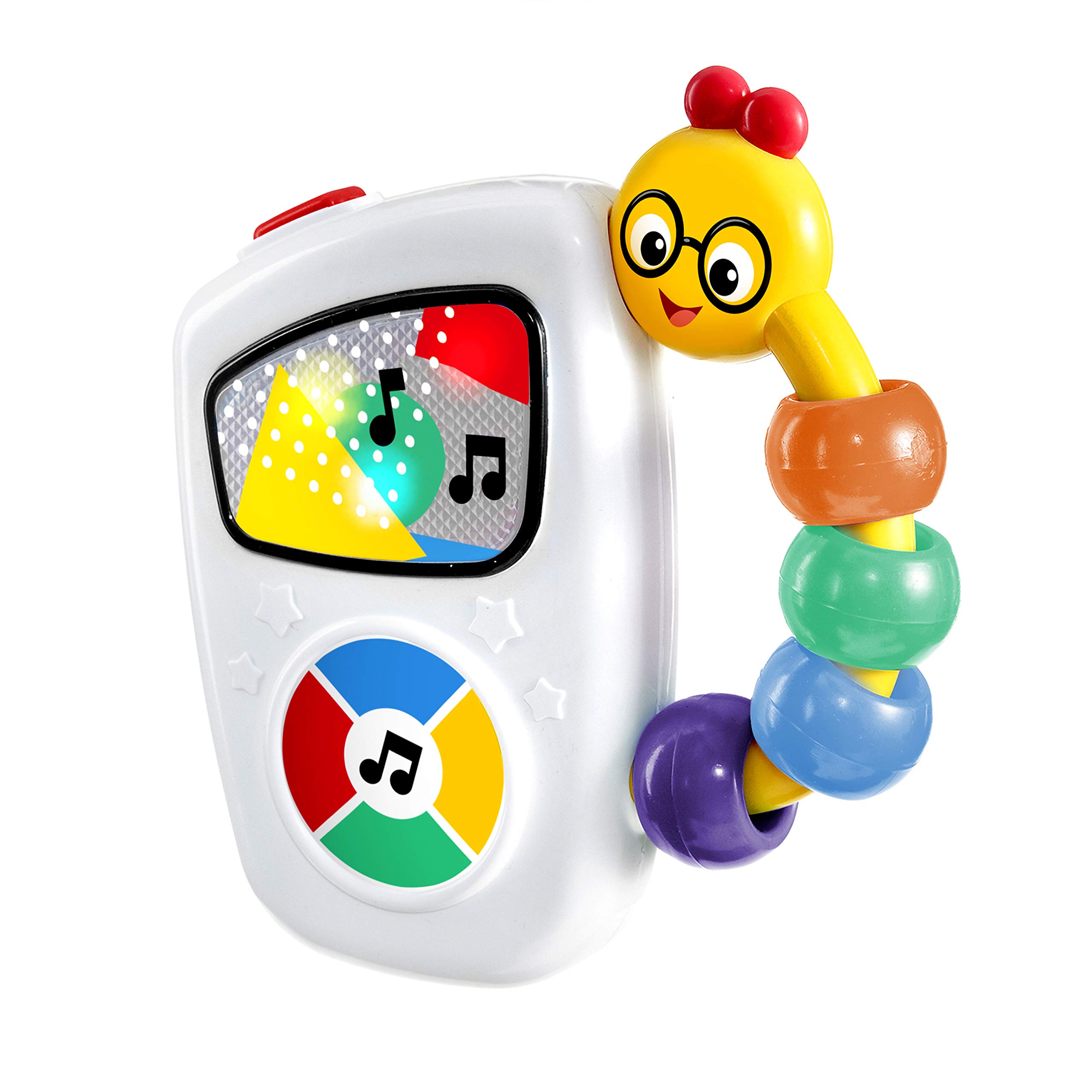
At 4.8 by 5 inches, the Take Along Tunes is small enough to disappear into a diaper bag, and that is a large part of why it is our top pick. One big button starts any of ten classical pieces, with lights dancing along, so a toddler gets a clear cause-and-effect payoff without aiming a mallet or finding the right key. Two volume settings are the difference between a car-ride companion and a toy you hide in the cupboard.

The recorded-tune approach is the point, not a shortcut. A 1-year-old can make music happen before they can carry a tune, and the plastic body is light, wipe-clean, and ready for the floor. We like it for the stroller, the high chair, and the restaurant table because it gives a toddler something to do that does not require a second pair of hands.

What it does not do is let your toddler make the notes. If you want an instrument, the Magic Touch Piano or the xylophone is the better fit; the Take Along Tunes is for listening, pressing, and carrying. That narrow role is exactly why it works so well as a first musical toy.

Bottom line: We keep coming back to the Take Along Tunes as the default first musical toy: ten classical pieces, two volume levels, and a size that goes everywhere.

#2

VTech Musical Rhymes Book

VTech Musical Rhymes Book

Songs and reading

Doodle Score 9.6/10
Check Price

Worth Noting

  • Sound can be harsh at higher volume
Modes
Learning and music
Age Range
6 months-3 years
Dimensions
8.8 x 7.5 x 1.7 inches
Piano Buttons
5
Read the full review

A book that sings is a clever way to get a toddler to turn pages, and the Musical Rhymes Book makes the format work. Easy-turn pages, cheerful pictures, and five colorful piano buttons give a child several ways in: flip, press, or follow the rhyme. It is a lap toy, a car toy, and a first songbook all at once.

The learning and music modes introduce vocabulary, instrument sounds, and colors without making the book feel like a worksheet. The five piano buttons are the part that gives it legs beyond a first read; a toddler can press a color, hear a note, and start connecting the two. That is a better use of music than a toy that only plays a song at you.

The 6-month-to-3-year range is generous. A baby can swipe at the pages and press the buttons; an older toddler can follow the rhymes and pick out a tune. That long runway is why it earns a place in the nursery rather than the toy bin: it changes with the child, from a noisy object to a first songbook.

Bottom line: The Musical Rhymes Book is the one we hand to a toddler who loves books and songs: five piano buttons, familiar rhymes, and a sturdy page-turning format.

#3

Fisher-Price Classic Xylophone

Fisher-Price Classic Xylophone

First instrument

Doodle Score 9.6/10
Check Price

Worth Noting

  • Short tether makes far keys awkward
Keys
8
Mallet
Tethered
Age Range
18 months+
Pull-along
Wheels and cord
Read the full review

The Fisher-Price xylophone gets one thing right that a lot of electronic toys miss: the child makes every note. Eight colorful keys, a tethered mallet, and a pull cord turn music into a physical action, tap, listen, walk, repeat. It is the nearest thing here to a real instrument that fits a toddler's hands.

We see it as a first instrument because the payoff is immediate. A 1-year-old can bang out a sound before they understand a melody, and the pull-along wheels add another reason to move. The tether keeps the mallet from disappearing under the sofa, which is one less rescue for you.

The 18-month age rating is worth respecting: younger toddlers will mostly chew the mallet or drag the toy by the cord. For an older toddler, the eight keys are enough to pick out real nursery tunes, and the classic design has survived because it does not need a screen to be fun. It is the value pick of this group for a reason.

Bottom line: We see the Classic Xylophone as the value-first instrument here: eight keys, a real mallet, and pull-along play that turns a toddler's tapping into music.

#4

Magic Touch Piano

Magic Touch Piano

Instrument play

Doodle Score 9.4/10
Check Price

Worth Noting

  • Can tip forward on small legs
Keys
25
Volume
Low and high
Age Range
6-36 months
Music Sheets
3 color-coded
Read the full review

Twenty-five keys is a serious amount of piano for a toy aimed at babies, and the Magic Touch Piano uses them well. The wooden body gives it more presence than the plastic crowd, and the keys respond to a light touch, so a toddler does not need to pound to get a note. That matters for the child who is just learning that a finger can make something happen.

What earns it a runner-up spot is the two-mode design. A toddler can free-play, or follow one of the three color-coded sheets and hear a tune come together. The low and high volume settings are the other practical touch; we keep it on low in a small room and turn it up when the child is showing off. The sound has a pleasant bell-like quality rather than the harsh beep of some electronic toys.

The color-coded sheets are a teaching tool, not a magic trick: the colors do not always line up cleanly with the keys, so the first few tries need an adult nearby. That is a small speed bump compared with what the piano gets right. For a child who wants to make the notes rather than hear them, this is the instrument to beat in this group.

Bottom line: If your toddler is ready to press keys and make a tune, we recommend the Magic Touch Piano: 25 touch-sensitive keys, a wooden body, and a volume control.

#5

VTech KidiBeats Drum Set

VTech KidiBeats Drum Set

Percussion play

Doodle Score 9.4/10
Check Price

Worth Noting

  • Tabletop size, not a floor kit
Melodies
9
Age Range
24 months-5 years
Drum Pads
3 plus cymbal
Play Modes
4
Read the full review

The KidiBeats is built for the toddler who wants to hit something and hear it answer. Three drum pads and a cymbal give immediate percussion, and the two included sticks make it feel like a real kit rather than a button box. We choose it when the child already bangs on pots and needs a target that can take the energy.

Four play modes, Free Play, Letters, Numbers, and Follow-Along, give it more range than a pure noise maker. Nine melodies and lights reward each strike, and the follow-along mode turns a familiar tune into a hit-along game. The learning layer is a bonus; free play is the mode we keep coming back to because it lets a toddler lead.

The 24-month starting age is honest. A young 1-year-old may enjoy the thump, but the follow-along modes ask for more control, and the included sticks are best kept for a child who has stopped swinging them at everything. For a 2- or 3-year-old, that room to grow is exactly what makes the set worth the shelf space.

Bottom line: We choose the KidiBeats when a toddler wants to hit something: three pads, a cymbal, two sticks, and four play modes in a compact set.

#6

Melissa & Doug Band-in-a-Box

Melissa & Doug Band-in-a-Box

Group instrument play

Doodle Score 9.4/10
Check Price

Worth Noting

  • Tambourine and paper pieces can tear
Pieces
10
Storage
Wooden crate
Age Range
3-6 years
Batteries
None required
Read the full review

Ten instruments in a wooden crate is a different proposition from a single musical toy: this is a set for a household that wants a parade, not a quiet car ride. The Band-in-a-Box includes a tambourine, cymbals, maracas, clappers, tone blocks, and a triangle with a beater, all sized for small hands.

A toddler can hand out instruments, switch roles, and learn that a shake, a scrape, and a ding are different kinds of music. The crate gives the set a home, which matters when ten pieces are spread across the rug. It is also the rare musical toy here that needs no batteries at all, so the play starts as soon as the box opens.

The age range is the catch: this is rated 3 to 6, not for the 12-to-24-month crowd, and the small pieces need a child past the mouthing stage. For an older toddler or a preschooler, we think the group-play value is worth it; for a younger one, the xylophone or Take Along Tunes is the safer starting point.

Bottom line: For older toddlers and preschoolers who want a whole band, we point to the Band-in-a-Box: ten instruments, a storage crate, and no batteries to chase.

How We Tested the Best Musical Toys for Toddlers

We started by pulling together a shortlist of musical toys from the toddler aisles we already trust, then narrowed it by size, price, and the features that matter in a small apartment or a packed diaper bag. That left 14 toys — instruments, sing-along players, and pull-along music makers — which we rotated through three months of real toddler use. Testing happened on the playroom floor, in the car seat, on stroller walks, and during the pre-dinner fussy hour, with kids ranging from 18 months to 3 years.

Durability got the roughest treatment: we dropped each toy from couch height onto hardwood, let toddlers throw them down carpeted stairs, and watched how they held up after repeated bashings. We also measured any pull strings against a toddler's wrist and checked whether they stayed tangle-free, then pushed each toy across a rug to see if it tipped or wobbled. For size, we tried fitting each one into a standard diaper bag and a shallow toy bin, and noted which ones became instant tripping hazards in the playroom.

Sound quality and enjoyment were judged side by side. We played every toy at close range and across the room, listening for harsh distortion and checking whether the quiet volume setting was actually quiet enough for a car ride. Then we tracked how long each toy held a toddler's attention — not just on day one, but after a week and after a month — and whether kids went back to it without prompting. Finally, we compared what each toy offered for its price, because a musical toy that only plays one annoying song is not a bargain at any cost.

How to Choose Musical Toys for Toddlers

Start with the Kind of Music Play

A toy that plays ten tunes and a toy that lets a toddler play ten notes are doing different jobs. Listening toys, like the Take Along Tunes, reward a single press with a complete piece of music; they suit car seats, diaper bags, and children who are still learning cause and effect. Instruments, like the Magic Touch Piano or the xylophone, hand the control over and ask for aim, rhythm, and repetition. Sing-along toys and books sit in between, prompting words and page turns. Decide which of those your child reaches for now, then buy one step beyond it.

Match the Controls to the Child

Small hands need a clear target. A large button, five chunky piano keys, or a mallet that lands on a colored bar will get used; a crowded control panel will not. Age grading is the quickest filter: 6-to-36-month toys assume a child who presses and mouths, while a 2-to-5 drum set or a 3-to-6 instrument crate expects more coordination and, in the case of the crate, a child past the small-parts stage. A short tether on a xylophone mallet is a safety choice, but it also limits reach; expect to help until your toddler learns the arc.

Listen for Volume Control and an Off Switch

Musical toys live in shared rooms, so volume control is not a luxury. Two settings, low and high, let you keep a rhyme book at background level in the car and turn it up for a dance session; a quiet/loud switch on a sing-along doll does the same for a child who is sensitive to sound. Sound quality matters too: a toy that is merely loud is harder to live with than one with a clean speaker. Before buying, look for an off switch and a low setting, and be honest about how repetitive the songs will feel after the twentieth play.

Decide How Much Space and Storage You Can Give It

A Take Along Tunes-sized toy earns its place because it lives in a bag and comes out at a restaurant. A tabletop drum set needs a flat surface but not a playroom; a ten-piece band set needs a crate and a household that tolerates a parade. Measure the shelf or bin you have in mind before choosing a multi-piece set, and think about who will pick up the pieces. The smaller the toy, the more likely it travels; the more pieces, the more the storage becomes part of the gift.

Frequently Asked Questions

Final Verdict

Start with the Baby Einstein Take Along Tunes. It is the one we hand over first because a toddler can press one button, hear a real piece of music, and carry the toy to the car, the restaurant, or grandma's house.

When your child is ready to make the notes instead of just hear them, the Magic Touch Piano is the better buy; its 25 keys and wooden body turn the same cause-and-effect thrill into actual playing. The Take Along Tunes stays the default until that switch happens.