Arts & Crafts

Best Musical Instruments for Kids of 2026

There's a particular sound a house makes when a kid discovers the pots and pans cabinet: a joyful, relentless clatter that stops being charming around minute nine. Most of the toys sold for that phase aren't tuned to anything at all, and a xylophone that's a half-step off teaches a young ear the wrong pitch. A playable instrument fixes two things at once — it turns the banging into a melody they recognize, and it's built to survive hitting the kitchen floor. The real difference between a good one and shelf-filler isn't price; it's whether the thing is still in tune after a week of being dragged around the living room.

Over the past four months we've put 14 instruments through kids between two and ten, and the ones that got played twice were the ones that sounded good and felt easy under small fingers. Size is what adults underestimate most: a junior guitar with a neck a seven-year-old can't reach will live in a corner. Everything below earned its way back out of the toy bin.

#1

Newlam 17-Key Kalimba

Newlam 17-Key Kalimba

First real instrument

Doodle Score 9.6/10
Check Price

Worth Noting

  • Upper tines can drift out of tune
Keys
17
Size
7.08 x 5.08 x 1.18 in
Included
Instruction book, flannel bag, cleaning cloth
Material
Wood with steel tines
Read the full review

The first thing that struck us about the Newlam kalimba is how much music comes out of something so quiet. The tines ring like small bells, the wooden body rounds the tone off, and the whole instrument sits at a volume you can read beside. In a house where a child is learning music, that is the difference between an instrument that lives on the coffee table and one that lives in a drawer, and it is the main reason this is the pick we hand to most families.

It is also a real instrument rather than a toy shaped like one. Seventeen steel tines sit over a solid wood body, and the note names are stamped into the metal instead of printed on stickers that curl off in a month. A beginner finds a melody by letter, and the first recognizable tune is an afternoon away rather than a semester. At around eleven ounces and seven inches long it sits comfortably in two thumbs and a small lap, and it goes into a backpack without a second thought.

Tuning is the one job it hands back to you. It arrives tuned, with a small hammer in the box, and the upper tines are the ones to listen to — that is where drift shows up first and where a two-minute check pays for itself. It is maintenance rather than setup.

What it is not is a baby toy: the tines are thin steel, and a two-year-old's idea of playing is closer to bending them. From about five upward, though, it is the rare thing that works as a toy in the first week and as an instrument a year later — and it is the one here that an adult will still pick up after the children are in bed.

Bottom line: We recommend the kalimba to most families: it is a real, tunable instrument with a soft voice that will not drive anyone out of the room, and a child can pick out a tune the same afternoon.
#2

Stoie's Wooden Instrument Set

Stoie's Wooden Instrument Set

Preschoolers and siblings

Doodle Score 9.6/10
Check Price

Worth Noting

  • Small handles and glued joints can work loose
Size
7.87 x 5.51 x 9.06 in
Material
Wood
Age Range
3 years and up
Instrument Types
9
Read the full review

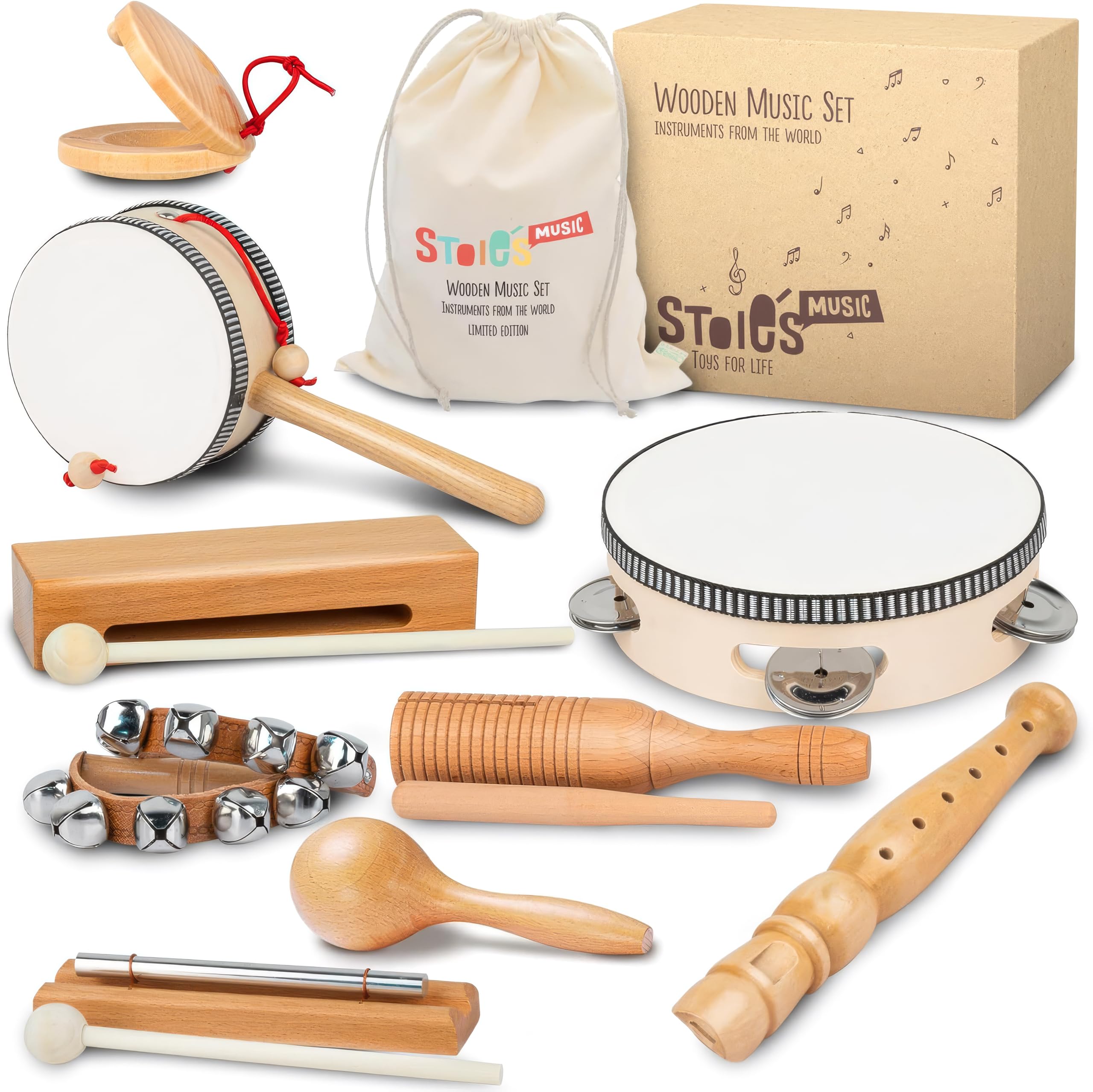
Nine instruments in one box, all wood, all small enough for a three-year-old's hand: a hand drum, a tambourine, castanets, two hand bells, maracas, a flute, a wooden block and sounder, and a chime bar with its own stick. If you are outfitting a preschooler rather than choosing one instrument, this is the most complete answer in this guide, and it is rated from age three.

The mix is the clever part. It covers shake, hit and blow in one purchase, so siblings or a small group can each take something — the listing rates it for four players — and the chime bar and flute add real pitched notes to what is otherwise a percussion box. Wood makes a warmer, less piercing sound than molded plastic, and the drum, the loudest thing in the set, sounds like a drum rather than a bucket.

Durability is where it gives ground. Most of the set holds up to ordinary play, but the small hardware is the weak point: handles and glued joints are where these come apart, and a separated piece can leave a small metal tack exposed. A squeeze of every joint when the box arrives, and again every few weeks, with anything loose removed straight away, keeps that from becoming a problem.

So for a calm three- or four-year-old who wants to make a noise with company, this is the set we point to, and the chime bar and flute give it a longer life than the plastic drum toys. For a child who treats a maraca as a hammer, the plastic VTech set further down the page will survive longer.

Bottom line: Buy this if you are starting a three- or four-year-old with a whole band in one box; nine wooden instruments cover shake, hit and blow, and siblings can play together.

#3

East Top 10-Hole Harmonica

East Top 10-Hole Harmonica

Pocket and travel

Doodle Score 9.6/10
Check Price

Worth Noting

  • Clean single notes take real breath control
Key
C
Size
4.01 x 1.06 x 0.74 in
Holes
10
Included
Case, cleaning cloth, instructions
Read the full review

Four inches long, an inch wide, and it lives in a coat pocket: the East top is the instrument that comes out in the car, on a walk, or in the ten minutes before dinner. Ten holes in C, brass reeds on an 0.8mm reed plate under a polished stainless cover, and a blue plastic comb — a real harmonica rather than a whistle with a logo on it.

For a first wind instrument we rate it above a recorder for a child who wants music immediately, because there is nothing to learn before the first sound: breathe in or out and a note happens. C tuning means beginner songbooks and most tutorial videos are already in the right key. The catch is control — clean single notes and any bending take diaphragm work that surprises people, and a child blowing hard gets a chord rather than a melody for the first week.

It arrives in a case with a cleaning cloth and an instruction sheet, and it looks better than it costs. The one rule is that a harmonica is personal: it goes in the mouth, so it is not the thing to pass around a playdate. If two children want one, buy two.

As a gift, the packaging and the small size do a lot of work — it reads as a keepsake rather than a toy, and it is the one here a grandparent can hand over without adding to the pile of plastic.

Bottom line: Our pick for a first wind instrument a child can carry anywhere: real reeds, real tuning, and no learning curve before the first note.

#4

VTech KidiBeats Drum Set

VTech KidiBeats Drum Set

Toddlers 2-5

Doodle Score 9.4/10
Check Price

Worth Noting

  • Tabletop size, not a floor kit
Size
12.1 x 11.5 x 3.9 in
Modes
Free play, letters, numbers, follow-along
Age Range
2 to 5 years
Batteries
3 AA (included)
Read the full review

A two-year-old does not so much play a drum as attack it, and the KidiBeats is built for that. Three pads and a cymbal take whatever comes, each with its own sound and a light that flashes when it is struck, and two chunky drumsticks come in the box for the children who want to stand and swing.

Four modes do the teaching. Free Play is exactly what it sounds like; Letters and Numbers turn a hit into a spoken letter or number; and Follow-Along plays one of nine melodies — rock, dance or pop — and lights the pad to hit next. That last mode is the closest thing in this guide to actual musical instruction for a toddler, and it is the one we steer a four-year-old toward once the novelty of bashing wears off.

Our reservation is size. It is twelve inches across and under four inches tall, closer to a cereal box than to a kit, so it sits on a table or a lap rather than standing on the floor. For a two- or three-year-old that is arguably better, since it stays within reach, but a five-year-old who wants to stand behind a kit will be disappointed. Set against that, nothing here is more engaging for the under-fives, and it is not as loud as it looks.

It is also molded plastic with no paint and no glued joints, so there is nothing to chip or come apart, and three AA batteries are in the box — as a demo set, so plan on fresh ones. The stated range of two to five is honest: past five, the pads feel like a toy.

Bottom line: The best thing here for a two- or three-year-old: sturdy pads, lights, and a follow-along mode that teaches timing, as long as you know it is a tabletop toy.

#5

Yamaha YRS-24B Recorder

Yamaha YRS-24B Recorder

School recorder lists

Doodle Score 9.4/10
Check Price

Worth Noting

Key
C
Weight
3.2 oz
Material
ABS resin
Fingering
Baroque
Read the full review

The cheapest thing in this guide is also one of the best. The Yamaha YRS-24B is a plastic soprano in C with a straight windway and Baroque fingering, and it does the only thing that matters at the start of a musical life: it plays in tune and gives a beginner a clean note without a fight. When a school list arrives, this is the one we point to.

The straight windway is why beginners sound decent on it. It takes a gentle, even breath, so a child who has not learned breath control yet gets a clear note instead of a shriek, and the tone stays soft rather than piercing — a mercy for everyone in earshot during the first month. At just over three ounces it is light enough that small arms do not tire holding it up.

Two things to know before ordering. Baroque fingering is what most beginner method books assume, but if the teacher's list asks for German, buy German: the F and F-sharp fingerings differ, and a mismatched recorder means wrong notes from week one. The body is one piece, which means no middle joint to work loose or lose.

It comes with a cotton bag and a fingering chart, it survives being dropped in a backpack, and there is honestly not much more to say about a school recorder. It does the job.

Bottom line: If a school list is on your fridge, this is the recorder we recommend — in tune, easy to blow, and cheap enough to buy a spare.

#6

Melissa & Doug Caterpillar Xylophone

Melissa & Doug Caterpillar Xylophone

Cheap first gift

Doodle Score 9.4/10
Check Price

Worth Noting

  • Paint on the mallets chips off
Keys
8
Mallets
Two, self-storing
Material
Wood
Age Range
3 to 6 years
Read the full review

Two wooden mallets store in the caterpillar's antennae, and the whole toy is one painted body you can toss into a bag — that self-storing trick is why this xylophone comes back from a weekend away with both sticks still attached. Eight bars, one octave, and the least expensive way here to give a three-year-old actual pitched notes.

We like it most for what it teaches: melody, high and low, cause and effect on a scale. Hit the bars in order and a tune comes out, which is more than most toys at this level manage, and the wooden body makes a soft, warm sound rather than a plastic clack.

The tuning is not concert-grade — the bars are cut and painted wood, and on some units one note is noticeably flat, so play a scale when it arrives and exchange it if a bar is badly off. That makes it a toy for a three- or four-year-old rather than a first birthday present.

Bottom line: A charming, sturdy, cheap way to give a small child real pitched notes, provided you accept toy-grade tuning and painted mallets.

#7

Melissa & Doug Band-in-a-Box

Melissa & Doug Band-in-a-Box

Group play

Doodle Score 9.4/10
Check Price

Worth Noting

  • Maracas and cymbals are quiet
  • Tambourine head can split
Size
14.9 x 11.4 x 3.5 in
Pieces
10
Storage
Wooden crate
Age Range
3 to 6 years
Read the full review

Set against the Stoie's set above, this one gives you an extra instrument and a wooden crate to keep it all in, for less money, and it is the set we reach for when there are four children in the room. Ten pieces: a tambourine, two cymbals, two maracas, a clacker, two tone blocks and a triangle with its beater.

The crate is the underrated part. A set without a home gets scattered across a house inside a week; this one has a box with room for everything, which means it gets put away and brought out again. The triangle is the standout — it rings properly — and the tambourine and clacker are what toddlers grab first.

Where this set wins is company. Hand the crate to four children and everyone finds something, the noise lands somewhere between fun and chaos, and a living room turns into a marching band. That is what you are buying here: participation, not a tuned instrument.

For a playdate, a preschool classroom, or siblings close in age, this is our choice among the wooden sets. For one child who wants to learn an instrument rather than join a band, a kalimba or a recorder is a better use of the money.

Bottom line: We choose this set for siblings and playdates: ten pieces and a crate that keeps them together, with the quieter instruments as the weak spot.

#8

WITALENT Elephant Piano

WITALENT Elephant Piano

Babies 6-18 months

Doodle Score 9.2/10
Check Price

Worth Noting

  • Much smaller than the listing photos suggest
Size
8.07 x 5.59 x 2.56 in
Modes
Learning and music
Age Range
6 months to 3 years
Batteries
3 AA (not included)
Read the full review

The elephant piano is aimed at the six-month-to-three-year bracket, and it is really two toys in one shell: a short piano keyboard along the bottom and an activity panel above it with a trunk to twist, a ball to spin, a flower to pull, a page to flip and a ring to grab. Add two modes and it covers a lot of a baby's waking hours.

The modes split the work. Learning mode names numbers, instrument voices and animal sounds as they are triggered; music mode plays songs and lights the keys. The elephant sound that comes out of the twisting trunk is the detail that keeps babies coming back, and there are several volume levels for the adults in the room.

Size is the thing to get straight before ordering. It is about eight inches across and five and a half tall — a handheld toy that rides in a car seat or clips to a stroller, not a floor piano. The listing photos make it look considerably bigger than it is.

For a baby of six months to about eighteen, this sits near the top of this group: there is enough to do to hold attention through a diaper change, and the handle makes it easy for small hands to carry. Past two, it is a baby toy. And the electronics are the risk — some arrive refusing to start — so put three fresh AA batteries in on day one, none are included, and keep the packaging until it lights up and sings.

Bottom line: Our recommendation for a six- to eighteen-month-old, with one caveat: check the size against the photos and put fresh batteries in before you wrap it.

How We Tested 14 Instruments With Kids Aged Two to Ten

The shortlist started with research rather than a shopping cart. We read through customer reviews for about two dozen instruments in the $20 to $120 range and pulled out the complaints that kept repeating — keys that went flat within a month, paint that flaked off mallets, drum heads that split at the seam — then filtered by size and recommended age, dropping anything with a body too big for the age group it was sold to or a return window too short to test properly. That left 14 instruments, bought at retail like anyone else's.

Each one went home with a family on our team for four months, and the testing looked like ordinary life: the living room floor, the back seat on the drive to school, the ten minutes before dinner when a kid needs something to do. We handed each instrument over without instructions and watched how long it took a child to get a recognizable tune out of it, since ease of use shows up as time-to-first-song better than it does as a spec. Every week we checked pitch with a tuner app to see what had drifted. Instruments were dropped from table height on purpose, stuffed into bags, and wiped down with a damp cloth while we looked at the painted edges for chipping.

Sound quality separated the field faster than anything else; a shrill, sour note is usually why an instrument ends up in the closet by week three. We logged how often each one came back out unprompted — the most honest measure of fun we found — and whether that frequency justified the price against the cheaper alternatives. Size and durability settled the rest: what a six-year-old could actually hold and carry, and what still worked after four months of not being treated especially well.

How to Choose Musical Instruments for Kids

Match the instrument to the age and the hands

The wrong instrument for a two-year-old is anything with small removable parts or a mouthpiece they will chew. Start a toddler with a drum, a shaker, or a tabletop electronic toy, and move to pitched instruments — a xylophone, then a kalimba or recorder — when they are three or four and can hit a target on purpose.

Wind instruments add a second condition: the finger holes have to be reachable. A recorder's stretch is manageable at six or seven; a harmonica asks less of the hands and more of the breath. If you are buying before a birthday, buy for the child in front of you rather than the one they will be in two years.

Pitch beats volume

A toy that is loud is not necessarily a toy that teaches music. The useful test is a scale: run up the bars of a xylophone or the holes of a recorder when it arrives, and if a note is badly flat, exchange it before a child learns the wrong interval. Recorders and harmonicas are factory-tuned and cannot be adjusted at home; a kalimba can, with the hammer that comes with it, which makes it the forgiving choice if a note drifts.

A warm tone is easier to live with, and an instrument that is easy to live with stays out on the table instead of going back in the box.

What actually breaks

Failures cluster in predictable places: glued joints and small handles on wooden sets, tambourine heads, painted mallets, and the plastic joints of a recorder. None of that argues for plastic over wood — it argues for checking. Give a new set a squeeze and a shake when it arrives and again every few weeks, and retire anything that comes apart with a small metal part attached.

Age floors exist for this reason. A set rated 3+ with tiny components is not a two-year-old's toy, however much they want it.

One good instrument, or a set?

A set buys variety, company, and a bit of everything; a single instrument buys a skill. If one child is the player, a kalimba, recorder, or harmonica will hold attention longer than nine pieces that each do one thing. If there are siblings, a classroom, or a lot of playdates, a multi-piece set earns its keep.

Storage decides how much a set gets used. The ones that come with a crate or a bag go back on the shelf and come out again; the ones that don't end up spread across three rooms by the second week.

Frequently Asked Questions

Final Verdict

For most families the Newlam kalimba is the one to buy: a real, tunable instrument with a voice soft enough to keep in the living room, and a first tune an afternoon away. If the child is three or four and wants company while they play, the Stoie's wooden set is the better first purchase. And when a school list lands, the Yamaha recorder settles the question for less than anything else here.