Arts & Crafts

Best Doodle Boards for Toddlers of 2026

Twenty minutes into a restaurant dinner, the crayons are on the floor, the paper menu is shredded, and the wall is one wet napkin away from a permanent exhibit. A doodle board buys that twenty minutes back: one tethered stylus, one sliding eraser, a surface that clears with a swipe. It's the rare toddler toy that works as well on an airplane tray table as on the kitchen floor — no screen, no loose parts, no ink on the upholstery.

The trouble is these boards look identical in a product photo and feel very different in a toddler's hands. My team spent three months with 14 of them, from palm-sized travel versions to full desk-size boards, and the gaps show up fast: erasers that leave a ghost of the last drawing, stylus strings that snap within a week, color zones that go patchy at the corners. Value matters more here than in most categories — the best boards weren't the most expensive ones. The picks below are the ones my testers kept reaching for.

#1

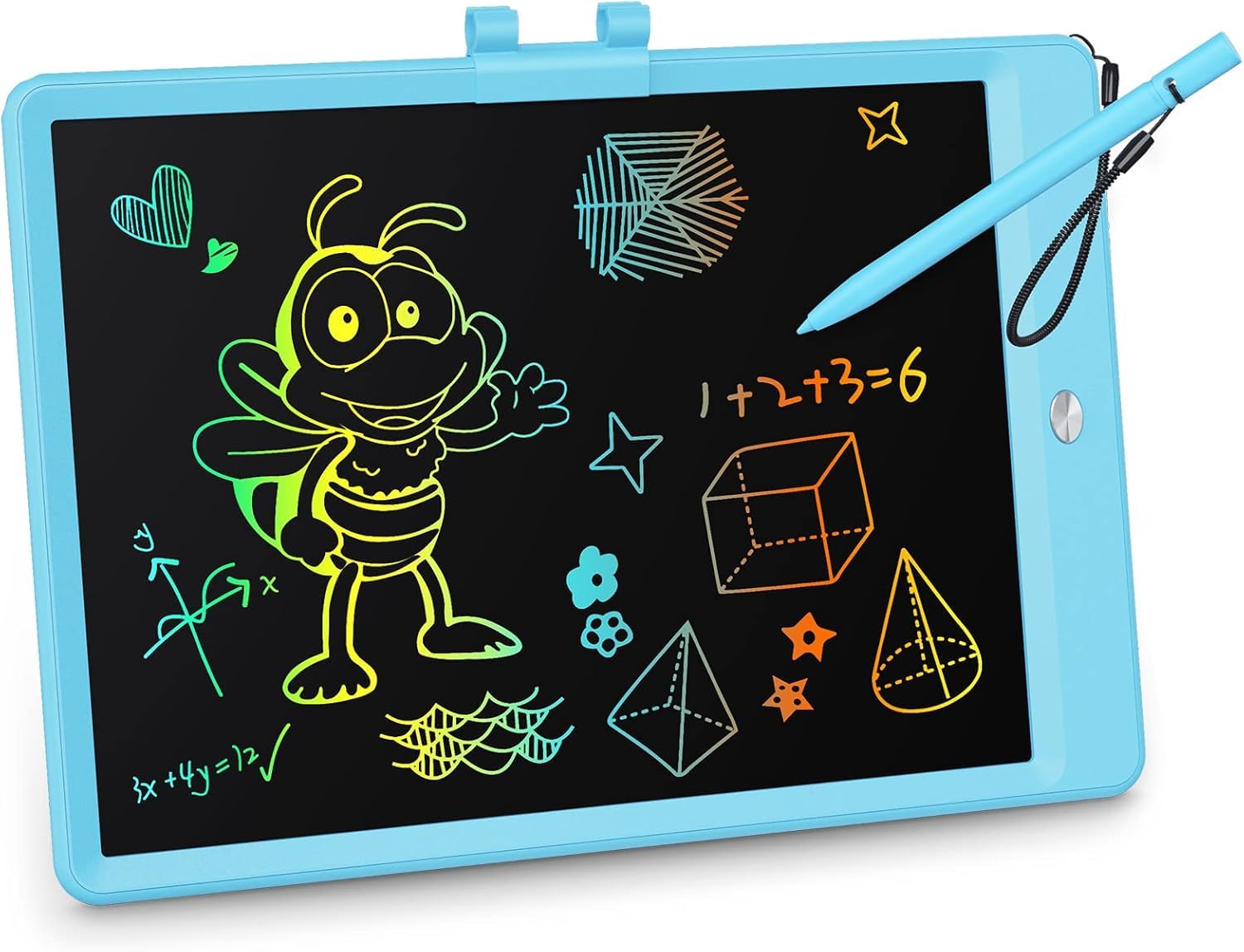
bravokids 10-Inch LCD Tablet

bravokids 10-Inch LCD Tablet

Everyday toddler doodling

Doodle Score 9.2/10
Check Price

Worth Noting

  • Muted, dim lines compared with the photos
  • Screen can stop clearing over time
Erase
One-press button
Screen
10-inch LCD
Weight
5.29 oz
Dimensions
6.8"W x 10"H
Read the full review

Two numbers decided this one for us: 150 grams and a 10-inch screen. That's light enough for a two-year-old to carry one-handed and big enough that a scribble doesn't immediately run off the edge, and the frame measures 6.8 by 10 inches, so it drops into a diaper-bag pocket and lies flat on a restaurant table. It's the board we reach for first when someone asks which one to buy.

Drawing on it is as simple as these get. Pressure alone makes a line — the stylus, a fingernail, the back of a plastic spoon — and one push of the button wipes it clean. Erasing was never the part of testing that needed a second pair of hands; a child who can press a button can run this board alone, which is the difference between a toy and a chore.

Color is where we cooled off a little. Lines come out in muted bands rather than the bright rainbow the product photos promise, and in a dim room the whole screen reads closer to grey than to color. A toddler mid-scribble doesn't care; a four-year-old who wants to draw a red fire engine will.

The honest risk is the screen itself. These panels can stop clearing after a while, and a board that won't wipe is finished, so we treat a doodle board as a year-or-two toy rather than an heirloom. What tips it back for us is the price against the rest of this group: the least expensive 10-inch board here, and no better drawer among the pricier ones. It's for the three-year-old learning to copy letters, not the one still checking whether things bounce.

Bottom line: Our default pick: a 10-inch board light enough for a toddler to carry and simple enough to erase alone, at the lowest 10-inch price in this group.
#2

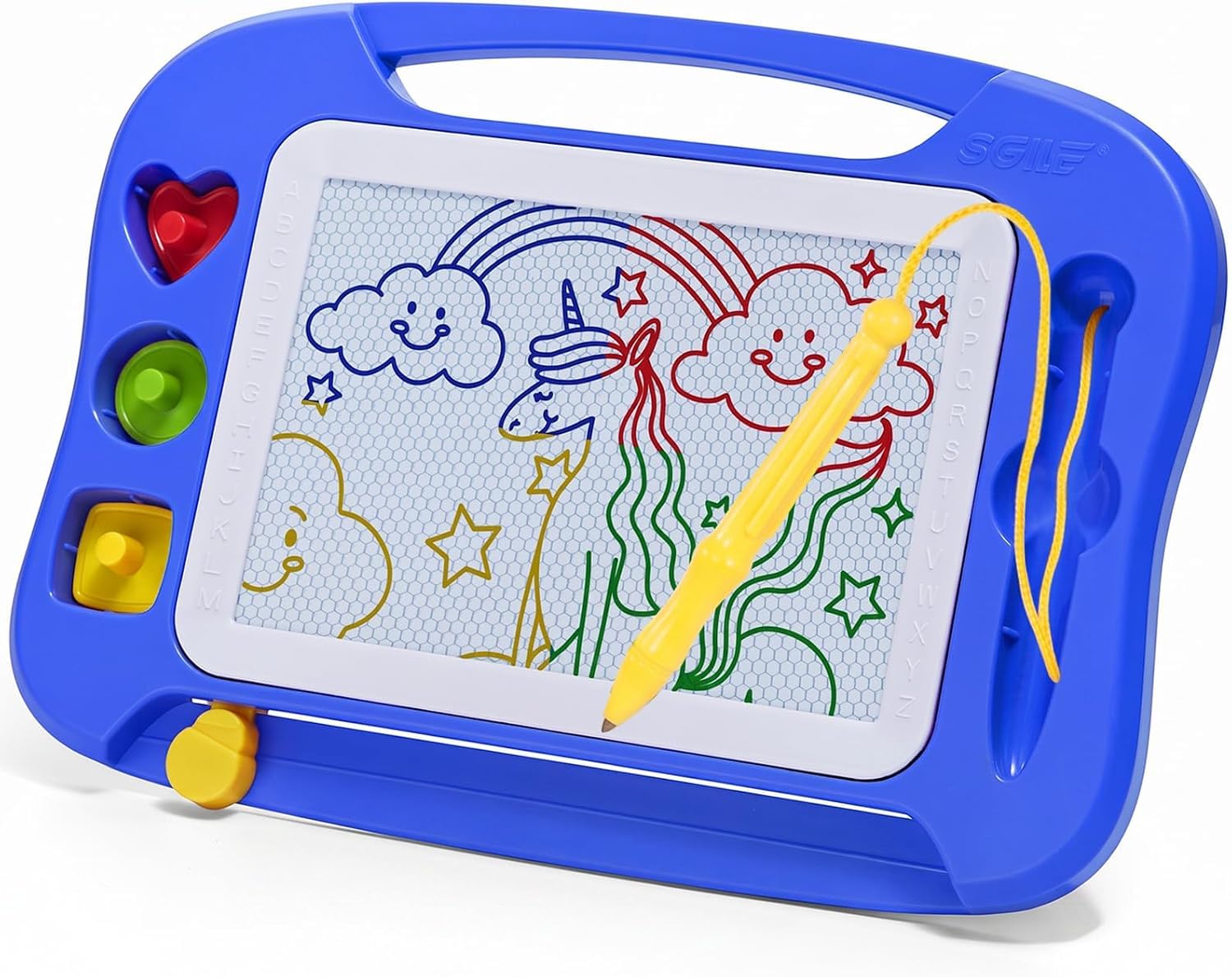
SGILE Magnetic Drawing Board

SGILE Magnetic Drawing Board

No-battery first board

Doodle Score 9.2/10
Check Price

Worth Noting

  • Fixed four-color drawing, no line variation
Frame
9.84"W x 7.09"H
Safety
ASTM and EN71 certified
Weight
6.7 oz
Drawing Area
5.62" x 3.86"
Read the full review

Certification is not the exciting part of a toy page, but ASTM and EN71 are the first things we look for on a board aimed at one-year-olds, and SGILE states both. Add BPA-free ABS, rounded edges and a rounded pen head, and you have something built for a child who explores with their mouth. There's no battery in it at all, which removes the one genuinely dangerous component of every LCD tablet here.

Size is where we'd slow down, so slow down here: the standard board's frame is 9.84 by 7.09 inches, but the drawing window inside it is only 5.62 by 3.86 inches. That's fine for a one-year-old's first scribbles and a bit cramped once a child starts drawing a whole house. The same board also comes in a large version at 16.5 by 12.5 inches, and if it's going to be shared or the child is already two, that's the one to order.

What it does well is what magnetic boards always do well: a thick, positive line the moment the pen touches down, four color zones, a few stamps for the days when scribbling isn't enough, and a sliding eraser. Expect to work that eraser yourself for the first few months — it wants a deliberate swipe and a one-year-old doesn't have one yet. The palette is fixed and the line is chunky, so this is a drawing toy rather than a writing surface, and for a first board that's the right trade.

Bottom line: Buy this one if your child is under two: a certified, battery-free magnetic board that takes the knocks an LCD tablet wouldn't.

#3

Smasiagon Magnetic Board with Legs

Smasiagon Magnetic Board with Legs

Sit-down drawing

Doodle Score 9.2/10
Check Price

Worth Noting

  • Sliding eraser is stiff for a two-year-old
  • Short pen cord limits reach
Screen
8.9 inches
Age Range
12 months - 4 years
Dimensions
12 x 10.5 x 4.5 inches
Load Capacity
Up to 120 lbs
Read the full review

Four legs screw onto the bottom of this board and turn it into a small chair-desk, which is the one trick nothing else in this group has. A toddler who won't sit still for a lap board will sit at this one, and the legs are rated to carry up to 120 pounds, so climbing on it is part of the deal rather than the end of it. That's why it's our pick for the child who wants a desk of their own.

Take the legs off and it's a lap board with a carry handle: 1.4 pounds, 12 by 10.5 inches overall, an 8.9-inch drawing screen and four color zones. In person it's smaller than the photos suggest — right for a one-year-old, tight for a four-year-old. The pen cord is short enough that the stylus won't comfortably reach the far corner, and the legs are the least substantial part of the build.

The sliding eraser is the thing to think about before you buy. It needs a firm, deliberate push and a two-year-old usually can't shift it alone, so for a while this is a board you clear for them — fine at a kitchen table, less fine in the back seat. Where it earns its place is the sitting: give a toddler somewhere of their own to sit and the drawing gets longer and more absorbed, and no other board here does that.

Bottom line: For the toddler who won't sit still for a lap board, this one becomes a desk — just expect to work the eraser for them at first.

#4

ORSEN 8.5-Inch Dinosaur Doodle Board

ORSEN 8.5-Inch Dinosaur Doodle Board

Small hands, travel

Doodle Score 9.2/10
Check Price

Worth Noting

  • No stylus tether and a pen slot that can snap
Color
Green dinosaur
Screen
8.5-inch LCD
Weight
7.8 oz
Age Range
2-6 years
Read the full review

At 8.5 inches this is the smallest tablet in the group, and that's the point of it. A two-year-old can hold it in two hands without the far edge waving around, and the green dinosaur shell gives them something to grab that isn't the screen. The listed weight is 7.8 ounces, more than you'd guess for a board this size — the body is built for grabbing rather than for sliding into a pocket.

Everything else is standard and works: pressure-sensitive lines, one-button clear, a screen lock so a drawing survives until someone wipes it, and a battery in the box. It's listed for ages two to six, a wider band than most here, and the body is an inch thick, which is the sort of chunkiness that makes a drop survivable.

There's no tether for the stylus, and the slot it sits in can snap, so the pen outlasting the board and the board outlasting the pen are both live outcomes. A loop of yarn through the stylus and around a corner fixes it before it becomes a problem, and it's worth doing on day one. What sells it is the shape and the size: this is the board a toddler reaches for by name, and the one that fits a car-seat pocket where a 10-inch board doesn't.

Bottom line: The small-hands pick: an 8.5-inch board a two-year-old can hold in two hands, with a chunky dinosaur shell that survives being grabbed.

#5

TEKFUN 2-Pack 8.5-Inch LCD Tablets

TEKFUN 2-Pack 8.5-Inch LCD Tablets

Siblings and sharing

Doodle Score 9.2/10
Check Price

Worth Noting

  • Stylus isn't tethered to the board
Color
Blue
Screen
8.5-inch LCD
Weight
4.64 oz
Pack Count
2
Read the full review

Two boards in one box solves the problem that makes a single doodle board a bad buy in a house with two children: the second one always wants whichever board the first one is holding. Each is 8.5 inches and 4.64 ounces, light enough for a toddler to carry around, and both come with a stylus and a lock switch.

The stylus isn't attached to anything — no string, no cord — and a loose pen is the fastest way to lose one down the side of a car seat. It also sits tight enough in its holder that small children struggle to pull it out, so the pen is either lost or stuck, with not much in between. A rubber band through the stylus and around the corner of the board fixes both, and it's the first thing to do. Once the pens are sorted, this is the best value in the group: two boards for about what one of the 10-inch tablets costs.

Bottom line: The two-child answer: two light 8.5-inch boards for roughly the price of one tablet, as long as you tether the styluses yourself.

#6

Kikidex Magnetic Drawing Board

Kikidex Magnetic Drawing Board

Under-threes

Doodle Score 9.2/10
Check Price

Worth Noting

  • Faint color on the drawing surface
  • Costs more than any 10-inch tablet here
Weight
1.21 lb
Material
BPA-free ABS
Age Range
12 months - 3 years
Dimensions
12.53 x 10.9 x 1.31 inches
Read the full review

Twelve months to three years is the age band on this one, and the build follows it: a sealed back, rounded corners, no small parts, BPA-free ABS and a smooth eraser knob. It's the magnetic board here most obviously sold as a first toy, down to the removable legs that let it stand on a table or sit on the floor.

The body measures 12.53 by 10.9 by 1.31 inches at 0.55 kg, and in person it's smaller than the pictures imply — most of the frame is border, and the drawing surface inside is compact. For a one-year-old that's the right scale. For a three-year-old who has started drawing people, it runs out of room.

The detachable legs are the part that goes first: a toddler who stands on the board can snap one, and a board with three legs is a board that lives on the floor. That's not a reason to avoid it, since the legs come off anyway — just don't count on them outlasting the drawing surface.

Our read is that this is the nicest-feeling magnetic board in the group and the one that makes the best first-birthday present, because it looks like a proper toy rather than a screen and carries a year of warranty. If the board is going to live in a bag and get thrown around, the cheaper magnetic option above does the same job for less.

Bottom line: The nicest-feeling magnetic board here for a one-year-old, if you're willing to pay 10-inch tablet money for a smaller drawing surface.

#7

Genialba 2-Pack 8.5-Inch LCD Tablets

Genialba 2-Pack 8.5-Inch LCD Tablets

Budget pair

Doodle Score 9.2/10
Check Price

Worth Noting

  • Screen can crack or stop clearing
  • Colors read dim
Colors
Pink and blue
Screen
8.5 inches
Weight
5.29 oz
Pack Count
2
Read the full review

This is the cheapest way on the page to put a doodle board in front of two children: an 8.5-inch pink one and an 8.5-inch blue one, 150 grams each, both with a stylus. If you want one for the car and one for the kitchen drawer, this is the pair that makes that affordable.

The detail we appreciate most is the elastic band holding each stylus to its board. Loose pens are the failure mode of every cheap tablet in this group — the pen goes missing and the board becomes a coaster — and an elastic loop is a cruder fix than a proper tether, but it works, and it's the reason we'd take this pair over the other two-pack.

Build is where the money was saved. A screen can arrive cracked, and a hard knock can leave one that won't clear, so we treat these as a season's toy rather than an heirloom — which is exactly why the price makes sense. They're the ones to put in a party bag, a grandparent's house, or the back of the car and not worry about.

Bottom line: The cheapest way to get two boards into two pairs of hands, with the elastic pen loops that the pricier two-pack leaves out.

#8

KOKODI 10-Inch LCD Writing Tablet

KOKODI 10-Inch LCD Writing Tablet

Battery-door safety

Doodle Score 9.0/10
Check Price

Worth Noting

  • Erase button can stop working over time
  • Dim colors next to the product photos
Screen
10-inch LCD
Weight
8.82 oz
Dimensions
9.8"W x 6.9"H
Battery Compartment
Screw-secured
Read the full review

A screw holds the KOKODI's battery door shut, and that single detail is why we'd hand this one to a curious two-year-old before any other tablet here. A coin cell is the one component of an LCD board that can seriously hurt a child, and a screwed compartment is what stands between them and it. It's stated in the product description rather than left to a photo, which is more than most of this group manages.

The rest is a well-sorted 10-inch tablet: a 9.8 by 6.9 inch frame, a cord that keeps the stylus on the board, a lock switch that holds a drawing until somebody decides to wipe it, and a battery you can replace. The lock matters more than it sounds. It's the difference between a board a child draws on and a board that gets wiped every four seconds by whoever is closest.

The soft spot is the erase button. It's the function that can give out after months of use, and when it goes, the board is a plastic slab. We still choose this one for a two-year-old who has worked out how to open things, because the battery is the risk that can actually hurt and this is the board here that addresses it out loud. Go in knowing the erase is the part most likely to end its life, and that the stated minimum age is three.

Bottom line: The 10-inch tablet to buy if you have a child who opens everything, thanks to a screwed-down battery door and a corded stylus.

How We Tested the Best Doodle Boards for Toddlers

We rounded up every magnetic doodle board sold for ages 1 to 4, then cut anything with a removable stylus (a lost part and a choking hazard in one), anything with an unsealed bead chamber that could leak, and anything over $35 — past that you're paying for the frame, not a better drawing surface. Fourteen made the cut, all bought at retail.

Those 14 boards spent three months in our homes, in the places these things actually live: backseat organizers, restaurant tables, waiting rooms, airplane tray tables, and the kitchen floor at 6 p.m. while dinner got made.

Erasability separated them first. Every night I scribbled edge to edge, slid the knob ten full passes, and looked for ghost lines and grey haze in the corners; a few boards also rode around in a hot car for an afternoon to see whether the surface still cleared afterward. I compared how bright and even the color came through, since cheap screens go muddy where the zones meet, and measured the drawing area against the overall footprint so a board that looked big online wasn't mostly frame.

For portability I weighed each one and tried it in a diaper bag pocket next to a sippy cup — the chunky frames with short stylus strings were the ones that got left at home. Durability meant drops from high-chair tray height, a wipe with a damp cloth, and a check of the frame seams. The last test was the honest one: I handed each board to toddlers between 18 months and 4 years and watched how long they stayed with it, whether they came back to it, and whether an adult could reset it one-handed.

How to Choose Doodle Boards for Toddlers

Magnetic Board or LCD Tablet?

Start with the child, not the product. A magnetic drawing board has a sealed screen, a fat pen and no battery, which makes it the better first board for a one- or two-year-old who still mouths things and drops them off a highchair. An LCD tablet draws a finer line and weighs about 150 grams, and it suits a child closer to three who wants to write letters and carry their own things.

The trap is that the LCD looks like the better toy in the photos. For a three-year-old it is; for a one-year-old it is the wrong first board, because the two things that make it good — a thin screen and a small battery — are the two things you don't want near a child who tests everything with their teeth.

Can Your Toddler Erase It Alone?

Erasing is the whole point of a reusable board, and a toddler who can't do it hands the board back every thirty seconds. Button-erase tablets are easiest: one press and the screen is blank, and most children work it out on the first day. Magnetic boards use a sliding knob that wants a firm, deliberate swipe, which is often beyond a two-year-old for the first few months.

Ask the question before you buy, because it decides how much use the board gets. The Smasiagon board is the clearest example here: a genuinely good sit-at design whose eraser a two-year-old will need help with for a while.

Battery Doors and Button Cells

Most LCD tablets run on a coin cell, and a swallowed coin cell is a real medical emergency rather than a fussy-parent worry. That makes the battery compartment the first thing to check, ahead of screen size or color.

Buy one whose compartment is screwed shut, then confirm the screw is actually fitted and tight when it arrives — a missing screw undoes the whole design. Keep spare cells in a high cupboard and change them yourself rather than in front of an audience. The KOKODI is the board here that states a screwed compartment outright.

Size, Weight and the Drawing Area Trap

Frame measurements tell you what fits in a bag; the drawing area tells you what a child can actually draw on. The SGILE standard board measures 9.84 by 7.09 inches outside with a 5.62 by 3.86 inch window inside it, which is worth knowing before you assume you've bought a big board.

For hand size, 8.5 inches is the sweet spot for a two-year-old and 10 inches starts to be a two-handed, tabletop object. Weight matters just as much: 150 grams is carryable by a toddler, a pound and a half is not. And remember that compact in a listing means it fits a changing bag, not that a small child can hold it comfortably.

Pens, Tethers and the Parts That Go Missing

Every board here is one lost stylus away from being a paperweight, and the tether is the specification nobody lists. A cord, a string or an elastic loop keeps the pen with the board; a slot alone does not. If the board you want has no tether, add one — a rubber band through the stylus and around a corner of the frame takes seconds and outlasts good intentions.

Fingers work on pressure-sensitive LCD screens, so a lost pen isn't fatal there. On a magnetic board it is: the pen is the only thing that draws, and there is no substitute sitting in the room.

Frequently Asked Questions

Final Verdict

The bravokids is the board we recommend for most toddlers: light enough to carry, big enough to draw on, the least expensive 10-inch tablet in this group, and simple enough that a child can erase it alone.

If your child is still under two — still mouthing things, still dropping them — start with the SGILE magnetic board instead. No battery, no screen to crack, and a pen that survives being chewed. Everything else here covers a specific job: siblings, small hands, or a child who wants a desk of their own.