RC & Vehicles

Best Toy Police Cars of 2026

A toy police car earns its keep when a kid starts narrating a chase across the living room—siren, squeaky tires, the whole production. The wrong one becomes a five-minute distraction, then a plastic carcass under the couch. I’ve watched enough cheap cruisers lose a wheel on day one to know the difference comes down to build quality, a size small hands can manage, and whether it stays stable through a sharp corner. The best are fun first, but they also survive being dropped, stepped on, and hauled to Grandma’s.

Over three months, I’ve had 14 toy police cars in rotation with my kids and a few neighbor families, and the gap between keepers and giveaways was wider than I expected. Some lit up and peeled out; others barely survived the first playdate. We paid attention to value—not just the sticker, but how much enjoyment each car delivered before something snapped. A few became birthday-gift favorites. Below are the ones that earned repeat play, stayed reliable, and didn’t make me regret the purchase.

#1

Paw Patrol Chase's Patrol Cruiser

Paw Patrol Chase's Patrol Cruiser

Preschool play

Doodle Score 9.6/10
Check Price

Worth Noting

  • Rear fan piece can pop off and go missing
Wheels
Working, push-along
Included
1 vehicle, 1 figure
Vehicle Size
6.68 x 3.5 x 3.13 in
Recommended Age
3 to 9 years
Read the full review

Chase clips into the driver's seat and lifts back out again, which sounds like a small thing until you watch a three-year-old do it twenty times in a row. That clip is why this cruiser earns the top spot: it's a car and it's also a figure, so the play doesn't stop when the driving does. The wheels turn freely, so there's nothing to charge and nothing to switch on.

At 6.68 by 3.5 by 3.13 inches it's sized for two small hands and still drops into a backpack or an Easter basket without a fight. We stopped worrying about it early: the body absorbed the drops and throws that come with the age group, and the plastic has held its shape through all of it. For a three- or four-year-old who wants a police car to push around the floor, it does more of the job than anything else in the guide.

Where it stops is the license. If the child doesn't know Chase, the LEGO car gives you a build and the Crown Victoria gives you metal, and neither needs a favourite show to land. It's an indoor toy, too — grit and gravel will scuff the plastic. In a Paw Patrol household, though, the uniform and the badge read from across the room, and that's the whole point of a licensed toy.

Bottom line: The one we hand to a preschooler first: a sturdy little cruiser with a Chase figure that clips in and out, working wheels, and no batteries to feed.

#2

LEGO City Police Car 60312

LEGO City Police Car 60312

Building fans

Doodle Score 9.6/10
Check Price

Worth Noting

  • 5 and up only
  • Finished car is pocket-sized
Pieces
94
Built Size
4.5 in. long, 2 in. wide
Minifigure
Officer with cap and flashlight
Recommended Age
5 years and up
Read the full review

Ninety-four pieces is a lot for a car the length of a hand, and that's the point: the build is the activity. There's a chassis, flared fenders, wide rims, a light bar and an officer to put behind the wheel, with a printed guide in the box and the same steps in the LEGO Building Instructions app if you prefer a screen. A five-year-old can follow it with a little help.

The pieces buy you a police car that looks fast standing still — the flared fenders and wide rims do most of that work — plus a minifigure with a police cap and a flashlight element who sits behind the wheel. It also comes apart and goes back together, which is more than the die-casts can offer, and the instructions survive a second and third build.

Our take: this is the pick for the child who likes the making as much as the having, and the only one here that's a rainy-afternoon activity before it's a toy. The limits are honest. Ninety-four small pieces put it at 5 and up, and a two-year-old sibling will find them. And the finished car is 4.5 inches long by 2 inches wide, so it's a pocket model, not something that races across a kitchen floor.

Bottom line: Buy it for the building as much as the car: 94 pieces, an officer minifigure and instructions a five-year-old can follow, then a model that goes in a pocket.

#3

Mighty Fleet Police Pickup Truck

Mighty Fleet Police Pickup Truck

Big push-along play

Doodle Score 9.4/10
Check Price

Worth Noting

  • Three AA cells rather than a rechargeable pack
  • Age band stops at six
Length
Almost 12.5 in
Features
Siren, horn, flashing lights
Batteries
3 AA included
Recommended Age
3 to 6 years
Read the full review

Almost 12.5 inches long, this is the biggest police vehicle in the guide for the money, and the size is most of the argument. It fills two hands and reads as a police truck from across a room. The roof buttons give you a siren, a horn and a revving engine with the lights flashing, and one of them sends the truck rolling forward on its own. Three AA batteries come in the box, so it runs on the day it's unwrapped.

We liked how little there is to go wrong: no app, no pairing, no charging dock, and plastic thick enough that a four-year-old's version of parking isn't a disaster. What you're accepting is the body style and the scale. This is a police pickup rather than a cruiser, and it's a two-hand toy that lives on a shelf instead of in a pocket. The age band stops at six, which is about right — by seven, most kids want something that steers.

Bottom line: The most truck for the least money here: almost 12.5 inches, three AA batteries in the box, and a siren a four-year-old can run without help.

#4

KiNSMART Ford Crown Victoria

KiNSMART Ford Crown Victoria

Collecting and pocket play

Doodle Score 9.2/10
Check Price

Worth Noting

  • Roof light bar can snap off in a fall
Scale
1:42
Action
Pull-back, opening doors
Length
5 in
Recommended Age
3 years and up
Read the full review

Five inches is smaller than most people picture when they order a police car, so start there: this is a pocket model, not a floor toy. Once that's settled, it's the best value in the guide — a 1:42 Crown Victoria in die-cast metal with rubber tires, a light bar and both front doors opening on their hinges.

The weight sold us on it as more than a trinket. Die-cast metal with rubber tires feels like a model rather than a toy, and the grille, badging and black-and-white paint stay legible at a size that disappears into a coat pocket. Pull it back, let go, and it shoots forward on a wind-up spring, so there's nothing to charge and nothing to fail the way the battery cars can. It's also the only car here modeled on a vehicle that actually served as a police interceptor.

Bottom line: Five inches of die-cast with doors that open and a pull-back motor — the best small police car here, as long as you're expecting a pocket model.

#5

JOYIN 25-in-1 Police Set

JOYIN 25-in-1 Police Set

Siblings and parties

Doodle Score 9.2/10
Check Price

Worth Noting

  • Value is in the count, not the finish
  • Storage doors open too easily in transit
Length
17.24 in
Features
Sounds and lights
Set Contents
12 vehicles, 12 figures
Recommended Age
3 to 12 years
Read the full review

Open the carrier and a 17-inch truck unfolds into a playset with twelve mini police vehicles and twelve figures inside it. The mix is what makes it useful: a helicopter, an ambulance, an armored car and a long truck alongside the patrol cars, all small enough for a child's hand and a jacket pocket.

There are sounds and lights — the buttons on the roof cycle through siren and music effects — and the little vehicles are die-cast at the front, which gives them enough weight to feel like toys rather than tokens. The hinged doors that hold the minis in place open easily, which is convenient at tidy-up time and less so when the truck is being carried.

It's the one we hand over when the gift is a whole afternoon rather than one car: a set to split between siblings, cousins or party bags, and the only thing here that gives three children something to play with at once. Finesse isn't the point. The minis are simple castings and the carrier is the plainest plastic in the guide — the value is in the count.

Bottom line: The birthday-party answer: a carrier truck that opens into a playset, with a dozen die-cast minis and a dozen figures to divide among siblings.

#6

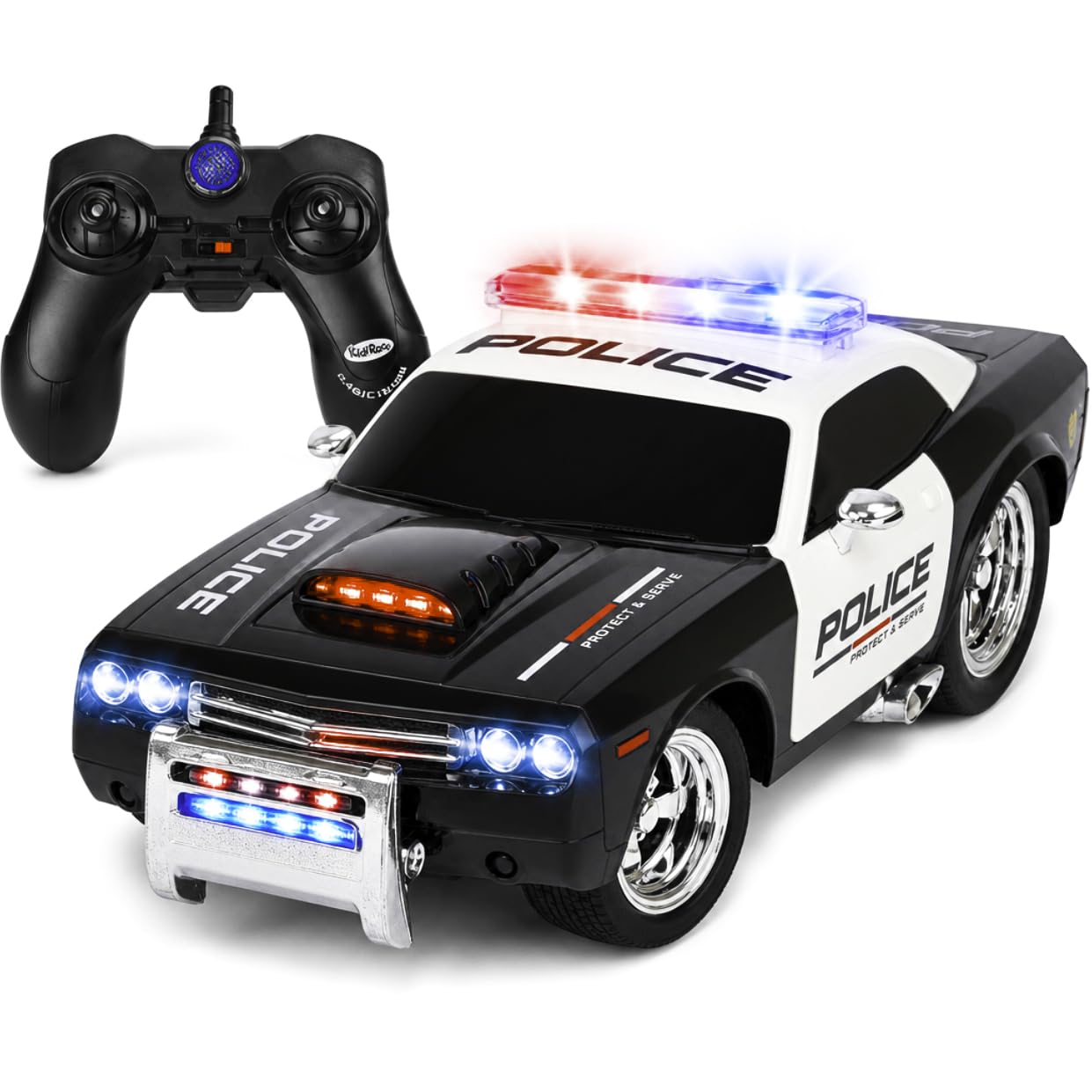
Kidirace RC Police Car

Kidirace RC Police Car

Older RC drivers

Doodle Score 9.0/10
Check Price

Worth Noting

  • Charging or wheel faults can end play early
  • The priciest pick here by a wide margin
Size
14.8 x 7.6 x 6.5 in
Battery
Rechargeable, up to 30 min
Control
2.4 GHz
Recommended Age
3 to 12 years
Read the full review

This is the priciest pick in the guide by a wide margin, and what the money buys is a proper radio-controlled car: 2.4 GHz control that lets several run in the same room, a rechargeable pack good for up to 30 minutes of driving, and a 14.8-inch body with working lights and a siren triggered from the controller.

On the floor it behaves like an RC car rather than a toy with a motor — non-slip rubber tires, a tight turning radius, and controls simple enough that a six-year-old can manage forward, reverse and steering without a lesson.

The risk is the electronics. A car that stops taking a charge, or loses drive to a front wheel, ends the fun in a way a chipped die-cast never does. That's the pattern we planned around rather than a reason to skip it: the car carries a 30-day manufacturer warranty, and buying from a seller with painless returns turns a dead battery into an errand instead of a loss.

It suits a seven- or eight-year-old who has outgrown push-alongs and wants to chase the dog around the kitchen. For a first police car, or for a child who still throws things, put the money into the Mighty Fleet truck or the Crown Victoria instead — no battery to fail, and the same badge on the door.

Bottom line: If the child is ready for a real remote-control car, this is the one that drives properly — just buy it somewhere with an easy return, because the electronics are the risk.

#7

FDJ Transforming RC Car

FDJ Transforming RC Car

Robot fans

Doodle Score 8.8/10
Check Price

Worth Noting

  • Plastic shell and joints give way in rough play
  • Slow and basic as a plain RC car
Scale
1:18
Weight
1.08 lb
Control
2.4 GHz
Top Speed
5 km/h
Read the full review

Press the button on the controller and the car rises into a robot; press it again and it folds back down. It performs the change while it's driving, which is the part that gets a reaction the first time — the car spins, stands up and carries on, with the police lights flashing throughout. The 2.4 GHz radio lets a couple of these run in the same room without crossing signals.

We were surprised by how much the transformation carries the toy. As a straight RC car it's slow — 5 km/h on the spec sheet — and the steering is basic, so it isn't the pick for racing. As a robot that becomes a police car and back again, it's the most entertaining thing here for the money, and the one-button control means a five-year-old can run the trick without being shown twice.

The trade-off is the shell. ABS plastic over moving joints is the opposite of a die-cast body, and the car that gets stepped on is the car that stops transforming. It suits a careful six- or seven-year-old and it's the wrong gift for a rough three-year-old. It's a toy built around a trick, and tricks do get old — what keeps this one in the drawer is that the car underneath still works as a car.

Bottom line: Two toys in one: a police car that stands up into a robot at the push of a button. Buy it for the trick, and keep it for a child old enough not to drop it.

How We Chose and Tested the Best Toy Police Cars

We started with a shortlist of more than 40 toy police cars sold at major retailers and narrowed it by age recommendations, chassis size, battery security, and whether replacement parts were available. Cars with exposed wires, tiny detachable lights, or a pattern of wheel complaints got cut before testing. That left 14 models, which we put into rotation for three months in playrooms, living rooms, backyards, and the back seats of cars.

Each car was dropped from couch height onto hardwood, pushed across carpet and tile, and steered into baseboards, doorframes, and a plastic ramp to see whether it tipped, stalled, or lost a wheel. We measured footprint and checked whether a preschooler could carry it in one hand and fit it into a standard toy bin. We also ran sirens and lights through repeated on-off cycles, noting when a switch stuck or a battery door loosened.

Play testing happened the way it actually does: after school, before dinner, and on weekend mornings when the living room became a traffic jam. We watched which cars kids reached for without prompting, whether they kept narrating chases after ten minutes, and which ones got handed to a friend at a birthday party. After each week, we checked seams, stickers, and axle play, then compared what each car delivered against what it cost.

How to Choose Toy Police Cars

Start with the format, not the model

There are five formats worth knowing: the pocket die-cast you pull back and let go, the free-rolling character car, the battery push-along with lights and sirens, the remote-control car, and the building set that arrives in pieces. Each is a different kind of gift. A die-cast is an add-on that lives in a coat pocket; a motorized truck is a main present that needs floor space; an RC car is a commitment to charging and to a child who can steer.

We start every recommendation with format because a handsome cruiser in the wrong format gets played with once. If you don't know the child well, a plastic push-along or a character car is the safest bet — no batteries, no assembly, nothing to configure.

Read the length in inches, not the scale

Scale numbers flatter. A 1:42 model is about five inches long, which is smaller than most shoppers picture when they order a police car, and 1:18 covers everything from a 490-gram desk model to a 14.8-inch remote-control car. Ignore the ratio and find the length: five inches is a pocket toy, seven inches fills two preschool hands, and anything near twelve inches needs a floor to itself.

If the gift has to fit a stocking, a party bag or a car journey, buy from the five-inch end. If it has to survive a playroom, buy the twelve-inch end and accept that it will live on a shelf between sessions.

Age band, small parts and the younger sibling

Three and up is the floor for almost every vehicle toy here, and five and up is the honest number for anything with small pieces — the 94-piece building set earns its 5+ label, and the die-casts carry detail parts that do come off. A younger sibling changes the purchase more than any other factor: the chunky plastic cruiser is the safer bet, and the metal models can wait until the youngest child has stopped putting things in their mouth.

Read the box rather than the photo. A listing that says three and up is telling you the toy has no loose small parts, not that a three-year-old will get the most out of it.

What breaks first

Every format fails in its own way. On die-casts it's the roof light bar, the first piece to snap when a car lands upside down. On character cars it's the small glued-on extras. On transforming toys it's the joints in the shell. On remote-control cars it's the battery and the front wheels.

None of that is a reason to avoid a format, but it is a reason to buy electronics from a seller with straightforward returns and to keep the box through the warranty window — the RC car here carries a 30-day manufacturer warranty, and a car that stops taking a charge is only a problem if you can't send it back.

Decide whether you want sound

Sirens are the most divisive thing in this category. The battery-powered trucks run their sounds from the toy itself with no volume dial, and the RC car's siren comes off the controller, so the noise level is something you buy rather than something you adjust.

If the adults in the house won't tolerate a siren at seven in the morning, the silent options are genuinely competitive: the Paw Patrol cruiser and the die-casts make no noise at all, and the LEGO set is as quiet as the child building it. Sound is a feature you buy for the household as much as for the kid.

Frequently Asked Questions

Final Verdict

Start with Chase's Patrol Cruiser. Of everything here, it's the one that gets played with rather than admired: the figure comes out, the wheels roll, and the plastic takes the knocks a three-year-old delivers. It costs about the same as a pocket die-cast and does considerably more.

If the child is five or older and likes building, the LEGO City car turns the gift into an afternoon's work. If they want something that actually steers, the Kidirace is the only hobby-grade RC here, so buy it where returns are simple.