RC & Vehicles

Best Toy Buses of 2026

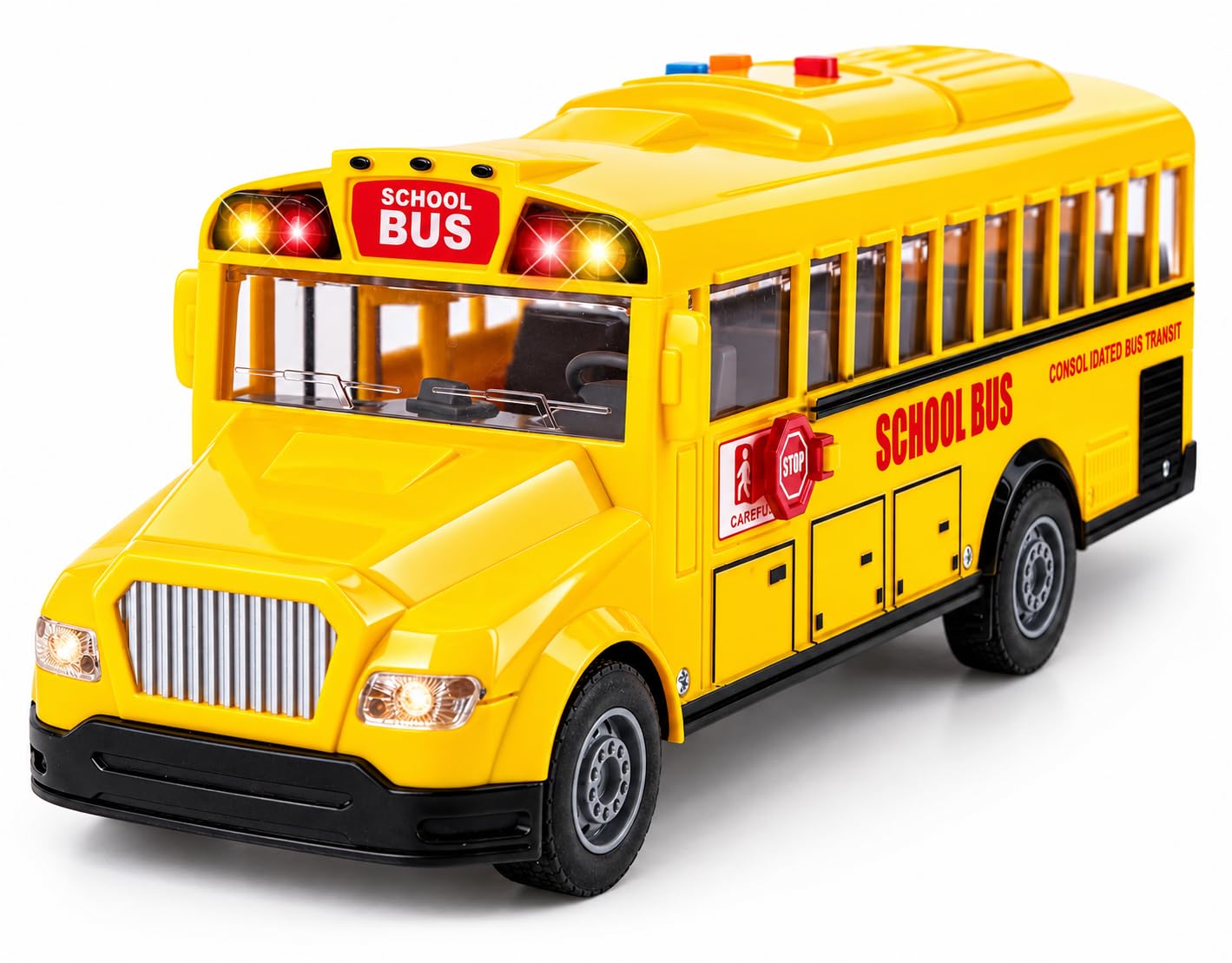
A toy bus looks like a simple thing until you've watched a 3-year-old work one over for an afternoon. The doors go first — they either click shut the way they should or dangle from a hinge that gives up by dinner — and then the wheels start wobbling, the handle pulls loose mid-roll, or the sound chip loops a jingle you'll hear in your sleep. A good one buys you longer, calmer play: doors kids can actually open, wheels that roll where they're pushed, and a body that survives the drop off the couch. I've had 14 of them underfoot for the past four months, and the gaps between models show up fast.

Here's what surprised me most: size cuts both ways. A bus a preschooler can carry by its handle all day gets played with far more than a shelf-bound showpiece, but the smallest ones tip over on carpet and lose their doors between the couch cushions. Check for an off switch on the sound, too — several jingles come in exactly one volume, and it's loud. The picks below earned their spot on quality, durability, and the kind of playability that keeps the game going.

#1

Fisher-Price Little People School Bus

Fisher-Price Little People School Bus

Ages 1 to 5

Doodle Score 9.8/10
Check Price

Worth Noting

  • Large footprint at nearly 20 inches long
Age Range
12 months to 5 years
Dimensions
19.29 x 7.68 x 10.63 in
Seats Up To
12 figures
Figures Included
4
Read the full review

Nineteen inches long and 2.7 pounds is not a desk ornament, and that is the first thing to understand about this bus: it takes up real floor and needs somewhere to live between sessions. What the size buys is a vehicle a one-year-old can crawl up to and load with both hands, and a five-year-old can still build a bus stop around. Fisher-Price rates it from 12 months to 5 years, and that spread is the honest measure of the thing — very few toys in this category stay in play across four years.

Four Little People figures come in the box and the bus seats twelve, which is the detail that decided the top spot for us. You are not buying a bus with passengers so much as a bus that keeps absorbing the figures a child already owns, so the play does not stall waiting for a second purchase. Three Smart Stages levels layer on more than 40 songs, sounds and phrases that shift from letters to counting to shapes as the child grows, which is why the same bus still has something new to say in year three.

The play mechanics are all manual, and they are better for it: the door swings open, the stop sign flips out, the wheelchair ramp folds down, and a Discovery Button sets off music and lights. The pull handle stows underneath so the bus can be pushed or towed, though it does not always lock firmly into its stored position — a small annoyance when you are pulling it along, and nothing at all if your child pushes it.

Sound is the part we underestimated. Forty-plus phrases is a lot of audio, and because the Smart Stages switch changes what plays, the bus does not cycle the same eight seconds all afternoon. That variety is doing more work than it looks like, and it is the reason this one stays in the middle of the room instead of the bottom of the toy bin.

Bottom line: We recommend it as the default family bus: it seats twelve, comes with four figures, and its three learning levels span a one-year-old to a five-year-old.

#2

Melissa & Doug Wooden School Bus

Melissa & Doug Wooden School Bus

Quiet, screen-free play

Doodle Score 9.6/10
Check Price

Worth Noting

  • Figures too large for other brands' buses
Pieces
8 (bus and 7 figures)
Weight
14.1 oz
Material
Solid wood
Age Range
3 to 6 years
Read the full review

The reason to choose this one is the material: a solid-wood bus with seven chunky wooden passengers, no batteries, no speaker, and nothing to switch off. We think that is the right call for a house where the plastic buses have already been through their song cycle — it is the one here you can hand over during a quiet hour without bracing for a jingle.

Eight pieces come in the box, and the figures are the point. They are thick enough for a toddler's fist to close around and wide enough that they do not vanish under the sofa, and the bus has the details that make a school bus a school bus: a door that opens, a stop sign that flips out, and wheels that roll smoothly across a hard floor. The play is entirely in the child's hands, and it is rated for ages 3 to 6.

Wood is also the reason there is so little to break. There is no hinge spring, no battery door, no sliding mechanism, just a solid body and seven figures that take drops and knocks without much drama. At 14 ounces it is light enough for a child to carry in one hand, and the paint on the figures has held up to the chewing and dragging that wooden toys get.

Bottom line: We pick this one for quiet households: seven wooden passengers, a working door, and nothing that beeps or needs batteries.

#3

Green Toys School Bus

Green Toys School Bus

Bath and sandbox

Doodle Score 9.6/10
Check Price

Worth Noting

  • No figures in the box
Care
Dishwasher safe
Axles
No metal axles
Material
100% recycled plastic
Dimensions
10.75 x 6 x 6 in
Read the full review

Recycled milk jugs are the raw material here, and it shows in the best way: a thick one-piece body with rounded edges, no metal axles to rust, and a finish you can put in the dishwasher. If the bus is going to end up in the sandbox, the bath or the garden, that combination is worth more than any feature list.

There are no passengers and no sound. The bus is a single open-topped vehicle with a wide cabin, and children fill it with whatever figures or small toys they already have. In practice that is less of a limit than it sounds, because a bus that becomes whatever the child loads into it stays in rotation longer than one tied to a character. At 10.75 inches long and 16 ounces it is a good size for a one-year-old to push along a floor, and the one-piece body means there is nothing to snap off.

We keep coming back to this one for parents who want a toy that survives being left outside, and the durability is the reason: it takes throwing and dropping without cracking. The catch is the wheels. Some buses arrive with a rear axle that binds instead of rolling, which turns a push-along toy into a carry-along one, so roll it across the floor before the wrapping paper comes off and send it back if it drags.

Bottom line: We keep this one for outdoor play — recycled plastic, no metal axles, and a body that goes in the dishwasher.

#4

Ms. Rachel My First Learning School Bus

Ms. Rachel My First Learning School Bus

Ages 1 to 3

Doodle Score 9.6/10
Check Price

Worth Noting

  • Figure-activated songs play in segments
Figures
2 (Ms. Rachel and Herbie)
Age Range
12 months and up
Batteries
2 AAA (included)
Dimensions
9.06 x 5.06 x 5.82 in
Read the full review

The trick in this one is the driver's seat. Click Ms. Rachel into it and the bus plays her song in phases; swap her out for Herbie and the sounds change. That figure-swap mechanic is what separates it from the other musical buses here, where a button plays a clip and the child moves on to something else.

What surprised us is how much of the play sits in the moving parts rather than the speaker. The wheels turn, the doors open, the wipers swish and the horn beeps, so a toddler who does not yet follow the words still has something to do with their hands. For the one-to-three set, that cause-and-effect loop is the right shape: put a person in the seat, something happens; take them out, something changes.

Size is the other thing to know. At roughly nine inches long and 1.4 pounds, this is a lap-and-table bus rather than one that fills a playroom floor. That suits the age group it is built for, since a one-year-old does not need a two-foot vehicle, but if you are choosing between this and the Fisher-Price above, the difference in scale is the deciding factor.

Bottom line: Our pick for a Ms. Rachel fan aged one to three: the figure-swap songs do work a push button cannot.

#5

KinsFun 6-Inch Die-Cast School Bus

KinsFun 6-Inch Die-Cast School Bus

Stocking stuffers

Doodle Score 9.4/10
Check Price

Worth Noting

  • Doors and tires are the first parts to fail
  • Smaller than the photos suggest
Action
Pull-back motor
Length
6 inches
Material
Die-cast metal
Batteries
None required
Read the full review

Six inches is the whole proposition, so be clear about it before you order: this is a die-cast model that fits in a coat pocket, not a floor bus. What you get for very little money is a bus that opens its side door, swings out a stop sign and pulls back and goes, in a metal body that shrugs off the drops a plastic shell would show.

The detail is what earns it a place beyond the price. Both the side door and the rear emergency door open, the stop sign folds out, and the pullback motor sends it a few feet across a hard floor — enough to feel like it is driving without disappearing under the furniture. It looks like a model, which is why it appeals to a five-year-old and a bus-obsessed adult in equal measure.

It is also the pick here for the child who takes a bus everywhere: a coat pocket, a car seat pocket, a restaurant table. Six inches goes where the big buses cannot, and a die-cast body does not mind being carried around all day. If you want the same idea with more presence in the hand, the 8.5-inch ArtCreativity below is the step up.

Bottom line: Our budget pick: a metal die-cast small enough for a coat pocket, with opening doors and a pullback motor.

#6

ArtCreativity 11-Inch Lights and Sounds Bus

ArtCreativity 11-Inch Lights and Sounds Bus

Lights and sounds

Doodle Score 9.2/10
Check Price

Worth Noting

  • Doors and stop sign can snap off in a fall
Doors
Side door slides, rear door opens
Length
11 inches
Movement
Friction push-and-go
Batteries
3 LR44 (included)
Read the full review

Eleven inches of yellow bus with four sound buttons on the roof, flashing red and yellow lights at both ends, and a friction motor underneath: this is the one for a child who wants the toy to do something back.

The moving parts are more interesting than the electronics. A switch slides the side door open, the rear door swings up to show the seats inside, and the stop sign works by hand — three separate things for a child to operate while the bus is parked at a pretend stop. Then you rev the wheels on the carpet, set it down, and it cruises off on its own momentum, with no batteries involved in the motion at all.

Batteries are where ownership gets fiddly. It runs on three LR44 button cells, which are included, and those are not the AA cells you probably have at home. Buy a strip of spares when the bus arrives and the lights will not be the reason it goes quiet.

Where it falls short is at the hinges. The doors and the stop sign take the force of every drop, and they are the parts most likely to snap, so this suits a child who drives a bus around the floor rather than one who launches it off the sofa. For the driver, the light-and-sound show is worth the fragility.

Bottom line: We reach for this when the bus has to entertain: four sounds, flashing lights, and an 11-inch friction-powered body.

#7

ArtCreativity 8.5-Inch Die-Cast Pullback Bus

ArtCreativity 8.5-Inch Die-Cast Pullback Bus

Older bus fans

Doodle Score 9.2/10
Check Price

Worth Noting

  • Doors can need a firm push to latch
Action
Pull-back motor
Length
8.5 inches
Weight
8.8 oz
Material
Die-cast metal
Read the full review

If the six-inch die-casts feel too small in the hand, this is the step up: 8.5 inches long, 8.8 ounces of die-cast metal, rubber tires, and a pullback spring that sends it across a hard floor rather than a few inches.

What convinced us was the weight. It is the one here that feels like a model rather than a toy, and children notice the difference the moment they pick it up. The features are the ones that matter on a bus, too: doors that open, a stop sign that swings out, and a pullback motor that needs no batteries at all. The rubber tires and the die-cast body are what you are paying for over the smaller KinsFun bus.

The catch is the door latches, which can take a firm push before they click shut, and the size puts it out of pocket territory. Neither matters much for a five- or six-year-old who lines buses up on a shelf and runs them along the hallway. Both matter if you are buying for a toddler who expects everything to work on the first try.

Bottom line: We like it as the step up from the small die-casts — more metal, more weight, and a pullback that crosses a room.

#8

Kinsmart 7-Inch Coach Bus

Kinsmart 7-Inch Coach Bus

Coach-bus fans

Doodle Score 9.2/10
Check Price

Worth Noting

  • Coach styling will not pass as a school bus
Door
Front door opens
Scale
1:64 scale
Action
Pull-back motor
Length
7 inches
Read the full review

This is not a school bus. It is a white highway coach — 1:64 scale, seven inches long, with a pullback motor and a front door that opens — and that distinction is the whole reason to consider it. A child fixated on the yellow school bus will spot the difference instantly; a child who points at every coach on the interstate will not care in the slightest.

What we appreciated is the interior: individual seats are visible through the windows and the open front door, and the proportions read correctly at 1:64. It looks like a coach at arm's length rather than a toy pretending to be one, and the pullback motor and opening door give it something to do beyond sitting on a shelf.

Think of it as the bus for the older child who has outgrown the chunky toddler vehicles — it is rated from three to eight — or for the adult who wants one on a desk. At just over 20 grams it is the lightest thing here, and it is a display-and-push toy rather than one to hand a two-year-old who tests everything against the floor.

Bottom line: We point coach enthusiasts here rather than school-bus fans; the 1:64 detail and opening front door are what earn the place.

How We Tested the Best Toy Buses

We started by gathering every toy bus we could find aimed at roughly ages 2 to 5, then narrowed the field by materials, price, and the features that actually get used: doors that open and latch, a real carry handle, wheels that spin freely. That left 14 buses, which went home with our editors, into a preschool playroom, and out to the sidewalk for four months of steady play.

Doors took the worst of it. We counted open-and-shut cycles until a latch stopped catching, and noted whether hinges were pinned metal or molded plastic that could tear. Wheels were rolled across hardwood, low-pile rug, and concrete, and we watched for veering, wobble, and anything that snagged on carpet fiber. Handles got loaded with a full set of toy passengers and lifted repeatedly to see what flexed.

Each bus was dropped from couch height onto hardwood 20 times, then checked for cracks, popped-off parts, and pieces that could be snapped back together. Sound got its own quiet-room check — volume level, whether there was an off switch, and how quickly the jingle wore on us. We also measured every model against a kid's backpack and a bookshelf, since a bus that's too big to carry or too small to hold figures tends to get abandoned. The winners weren't the priciest ones; they were the ones still fully assembled in month four.

How to Choose Toy Buses

Match the Bus to the Child, Not the Age on the Box

Age ratings are a safety floor, not a description of who will enjoy a toy. The jump that matters here is from a floor bus to a model: a large plastic bus with figures suits a one- to three-year-old who loads, dumps and pushes, while a die-cast model with opening doors and a pullback motor suits a four- or five-year-old who lines vehicles up and compares them.

Get that wrong in either direction and the toy sits unused. A six-inch die-cast handed to a toddler usually ends up under a sofa; a 19-inch bus bought for a five-year-old can be outgrown in a month. Buy for the child you have now, and accept that a big bus will be handed down rather than worn out.

Measure Before You Fall for the Photos

Product photographs flatter size. The buses here run from about six inches to more than nineteen, a difference of more than three times, and both ends of that range are sold with the same cheerful yellow packaging. A nineteen-inch bus needs floor space and somewhere to live between sessions; a six-inch one fits in a coat pocket and travels well.

Decide first whether you want a toy that stays in the playroom or one that goes in a bag for restaurants and waiting rooms, then check the listed length rather than the picture. Length is the number that most often disappoints, and it is the easiest one to check before you order.

Doors, Stop Signs and Wheels Are the Parts That Fail

Every moving part is a hinge waiting to be stressed, and on a bus the side door and the stop sign take the worst of it. That is not a reason to avoid moving parts — they are most of the play value — but it is a reason to match the number of small mechanisms to the child.

For a child who hurls vehicles across a room, choose fewer and chunkier mechanisms; for one who parks and loads, doors and stop signs are worth having. Whatever you buy, work the door and the stop sign as soon as the box is open, while returning it is still easy.

Decide How Much Noise You Can Live With

Talking buses split into two families: song-and-learning buses that speak, count and teach, and light-and-sound buses that beep, flash and play engine noises. Both need batteries, and the cells are not always the ones you keep in a drawer — button cells are common in the smaller light-and-sound models, so buy spares with the toy.

If quiet matters more than features, a wooden or plain plastic bus asks nothing of you: no batteries, no speaker and nothing to switch off. That is worth more in some houses than any amount of alphabet singing.

Passengers: What Is in the Box and What Will Fit

Passenger capacity varies wildly in this group, from none at all to twelve. Check both what comes included and what will fit later, because brands size their figures differently — a chunky wooden passenger will not ride in a bus built for small plastic people, and the reverse can be just as awkward.

If your child already owns a set of figures, match the bus to them. If not, a bus that arrives with three or four passengers saves a second purchase and keeps the play going on day one.

Frequently Asked Questions

Final Verdict

We recommend the Fisher-Price Little People Big Yellow School Bus for most families. It seats twelve, comes with four figures, and the three learning levels mean it is still earning its floor space when the child is four — that combination is why it takes the top spot rather than any single feature.

If your house has had enough of batteries and jingles, the Melissa & Doug wooden bus is the better buy. Just check the size of its passengers against any figures your child already owns before you commit.