RC & Vehicles

Best RC Excavators of 2026

The first time a remote-control excavator actually dug into a wet pile of sand and lifted a full bucket, I got it. These aren’t just toy trucks with a joystick—they turn a patch of backyard dirt into a job site, and the difference between a good one and a dud shows up fast. Most shoppers are really asking three things: will the bucket dig, will the tracks go where I point them, and will it survive being handed to a kid who has no mercy? A dependable RC excavator fixes the afternoon where the toy dies, the arm jams, or the battery quits before the fun does.

Over six months, I put 12 RC excavators through dirt, sand, gravel, and living-room carpet with my team, and the pattern was clear: the fun ones were the ones that felt like real machines. Battery life matters, but so does track grip and a bucket that scoops instead of scrapes. My advice: watch the arm and bucket move under load before you worry about top speed. The picks below are the ones we kept reaching for after the novelty should have worn off.

#1

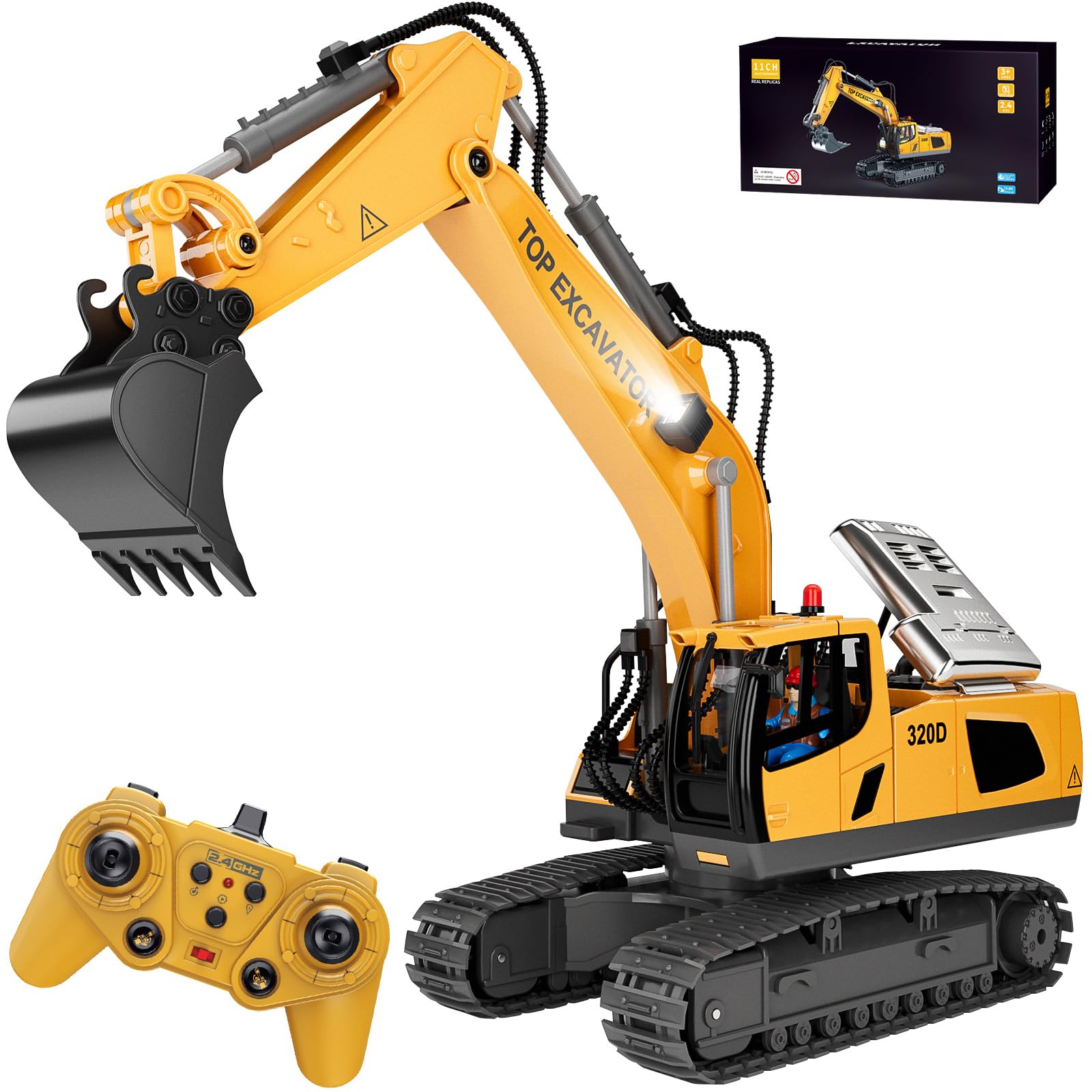
Samtop 11-Channel Excavator
Samtop 11-Channel Excavator

Easy controls

Doodle Score 9.2/10
Check Price

Worth Noting

  • Small 1:20 footprint
  • Controls can overwhelm younger drivers
Scale
1:20
Control
11-channel, 2.4GHz
Rotation
680 degrees
Batteries
Two rechargeable
Read the full review

The Samtop's 680-degree cab rotation is the feature that made us look twice. It spins the upper body around like a real excavator, and the 11-channel, 2.4GHz control gives you forward, reverse, turning, and digging without a confusing bank of switches. For a beginner, that is a friendly combination.

We found the layout easy to explain, and the dual rechargeable batteries mean a second pack is ready when the first runs down. The 1:20 size is small enough to use on a patio or short grass, and the thick tracks handle loose dirt and short grass without much drama. Lights and sounds are there, but the digging action is the main event.

It is not the most capable digger in this set, and it does not have the independent bucket control of the premium models. What it does have is a low-stress layout that lets a beginner make real moves early. We recommend it when the driver is ready for more than a scoop-and-lift toy but not ready for a 22-channel hobby model.

Bottom line: We recommend the Samtop for beginners who want 680-degree rotation and dual batteries in a simpler, easy-to-learn package.

#2

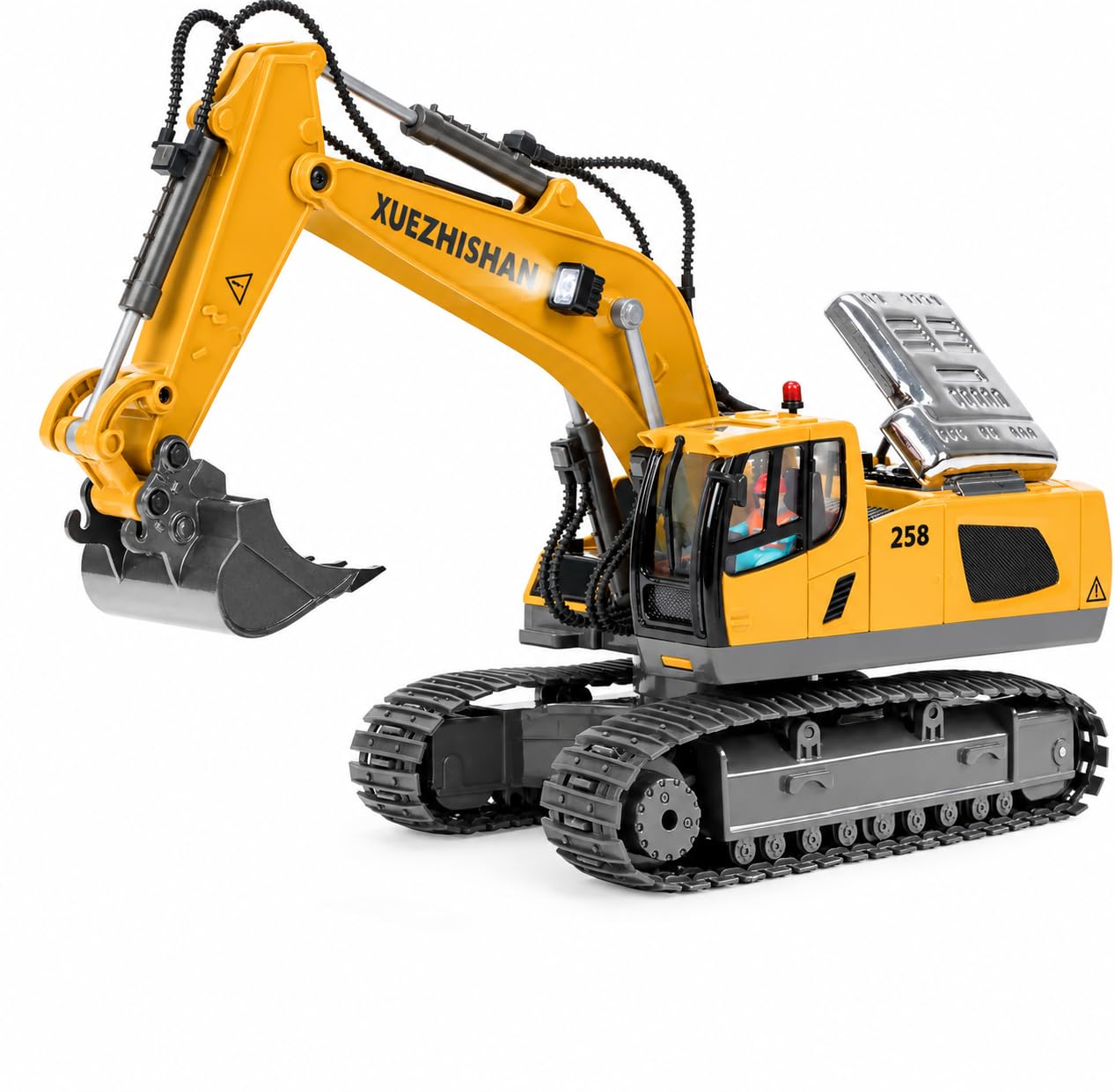
JOYIN RC Excavator

JOYIN RC Excavator

First excavator

Doodle Score 9.0/10
Check Price

Worth Noting

  • Limited arm articulation
  • Tracks can slip in loose sand
Size
10 x 5 x 3 inches
Control
2.4GHz
Features
LED lights, digging arm
Batteries
Two 600mAh rechargeable
Read the full review

The JOYIN is the cheap, cheerful way into RC digging. It drives forward and reverse, and the arm scoops and lifts, but it does not have the independent cab, boom, and bucket controls of the bigger models. That simplicity is the point: a young child can press a stick and see the bucket move without learning a 17-channel layout.

We like the size for a first toy. At 10 by 5 by 3 inches, it fits on a shelf and does not need a dedicated jobsite. The two 600mAh packs and LED lights are generous at this end of the group, and the 2.4GHz control is easy to pair. It feels like a toy, not a scale model, and that is fine for the price.

We hand this one to the kid who has never driven an RC before. The lights and two batteries make it feel more complete than the price suggests, and the simple layout means fewer wrong buttons. It is the budget pick, not the long-term hobby pick, and that is exactly what we want it to be.

Bottom line: We recommend the JOYIN as a first RC excavator for younger kids, provided the play stays on firm ground and the sandbox is a supervised treat.

#3

KidsFaves 1:20 Excavator

KidsFaves 1:20 Excavator

Younger operators

Doodle Score 8.8/10
Check Price

Worth Noting

  • Small 1:20 scale
  • Battery packs can arrive weak
Scale
1:20
Shovel
Alloy
Rotation
680 degrees
Batteries
Two 1200mAh
Read the full review

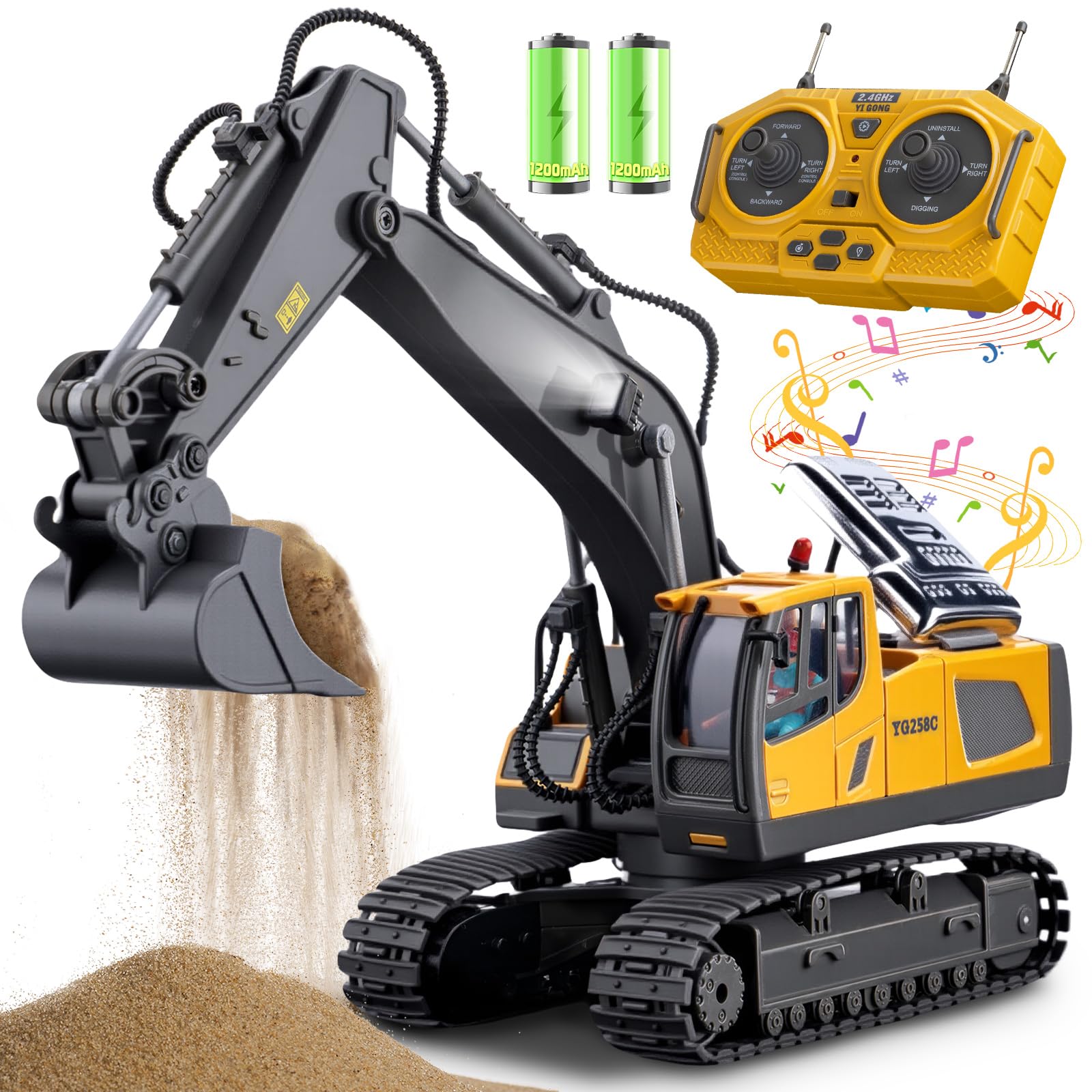
The KidsFaves is built for the driver who is still learning. The 680-degree cab turns, the alloy shovel scoops, and the two 1200mAh packs keep a spare ready. We like that combination for younger kids because the remote is intuitive and the digging motion is easy to follow.

At 1:20 and just under 12 inches long, it is small enough to use on a coffee table or a patio, and the alloy shovel gives it more bite than a plastic bucket. The lights and sounds are a nice touch, and the 2.4GHz control has been reliable for basic driving and digging.

We recommend it for the younger operator who wants a working boom without a complicated joystick. It is happiest on hard floors and short carpet, where the tracks can grip and the bucket can pick up small toys or loose dirt. For a first remote with a real scoop, the friendly layout is the reason to choose it.

Bottom line: We recommend the KidsFaves for younger kids who need an intuitive remote and a real working bucket, especially for indoor and patio play.

#4

Double E Volvo EC160E

Double E Volvo EC160E

Small spaces

Doodle Score 8.8/10
Check Price

Worth Noting

  • Controller can stop working
  • Short battery life
Spin
360 degrees
Scale
1:26
Shovel
Metal
Cab Rotation
330 degrees
Read the full review

The Double E Volvo EC160E is the compact option: a 1:26 licensed model that fits on a shelf and turns in tight spaces. The metal shovel, 360-degree spin, and 330-degree cab rotation give it more realism than its size suggests. We like it for a small apartment or a balcony where a 1:14 model would live in a closet.

The 2.4GHz remote handles forward, reverse, and digging, and the rubber tracks move smoothly on hard floors. It is not a fast machine, and it is not meant to move big loads. The appeal is the detail and the scale: it looks like a Volvo, and the cab motion makes it fun to pose and operate.

We tested it as a first RC, not as a jobsite workhorse. The compact body is easy to store, and the controls are manageable for a child who has used a remote car before. The digging is best in loose sand or soft dirt; hard-packed ground is beyond it.

For a small space, that trade is worth it. It is the one we keep on a shelf and take down for a short session, not the one we fill a sandbox with. If you want maximum digging, go larger; if you want a detailed excavator that fits your room, this is the compact pick.

Bottom line: We recommend the Double E EC160E for small spaces and first-time operators who want a detailed, licensed excavator rather than a large digging machine.

#5

KIDMARKT 11-Channel Excavator

KIDMARKT 11-Channel Excavator

Long battery play

Doodle Score 8.8/10
Check Price

Worth Noting

  • Smaller than expected
  • Digging button can fail
Scale
1:20
Shovel
Metal alloy
Playtime
Up to 120 minutes
Rotation
360 degrees, 680-degree cab
Read the full review

The KIDMARKT leads with battery life: two packs and a 120-minute play claim. That is the number to notice if your child hates stopping to charge. The 1:20 body, metal alloy shovel, 360-degree rotation, and 680-degree cab swing give it the feature list of a more expensive digger.

The metal shovel does scoop loose sand and small objects, and the 11-channel remote is straightforward enough for a school-age child. We like the one-year manufacturer warranty, which matters more on a toy that will live outdoors. It feels sturdy in the hand, and the tracks handle short grass and dirt.

The digging action is the catch. The bucket does not move independently on this version, so the arm follows a preset scoop rather than letting you place the bucket exactly. Set up loose piles and let it scoop; it is not the tool for precise trenching. That limitation is easy to live with if the long battery life is the priority.

We recommend it for long afternoons when the job is scooping, not excavating. The two packs and the metal shovel make it a capable toy for the money, but the preset bucket keeps it out of our top picks. It is the one we leave in the car for the beach or the backyard, with the understanding that it is a scooping toy first.

Bottom line: We recommend the KIDMARKT for long battery play and simple scooping, but not if you need independent bucket control for realistic digging.

#6

Double E Volvo 1:16 Excavator

Double E Volvo 1:16 Excavator

Serious digging play

Doodle Score 8.6/10
Check Price

Worth Noting

  • Steering can feel clumsy in tight turns
  • Single battery pack limits long sessions
Range
100 ft
Scale
1:16
Control
17-channel, 2.4GHz
Attachments
Metal shovel, drill, grab jaw
Read the full review

Three swappable metal tools, a shovel, a jack hammer, and a grab jaw, are the reason this Double E Volvo is the first excavator we reach for. On a 1:16 body, they turn one machine into three jobs: scooping loose dirt, breaking up a pile, and picking up smaller debris. The 17-channel, 2.4GHz remote and three separate motors give the arm more independent movement than the simpler scoop-and-lift toys here. That is the difference between driving an excavator and pretending to dig.

The cab turns and the arm works in multiple directions, so setting up a load takes some thought. We like that. It makes the toy feel like a scaled machine rather than a remote-control car with a bucket bolted on. The 100-foot range is generous enough for a backyard jobsite, and the metal shovel has enough weight to move loose sand and dirt. Packed sand is not its friend, so keep the digging surface loose.

At 1:16, it has real presence. That cuts both ways: it is easier to see and control outdoors, but it needs shelf space and a clear patch to turn. We do not treat it as an indoor toy for a small apartment, and we do not hand it to a child who still needs help steering a basic RC car. This is the one for supervised, older-kid or adult digging.

The attachments are what keep it interesting. Each one changes the job, so the digging does not collapse into the same scoop again. For an older child or an adult who wants the most capable digger in this set, that variety is worth the extra care.

Bottom line: We recommend the Double E Volvo 1:16 when you want the most capable digger here and have room for a larger, premium model.

#7

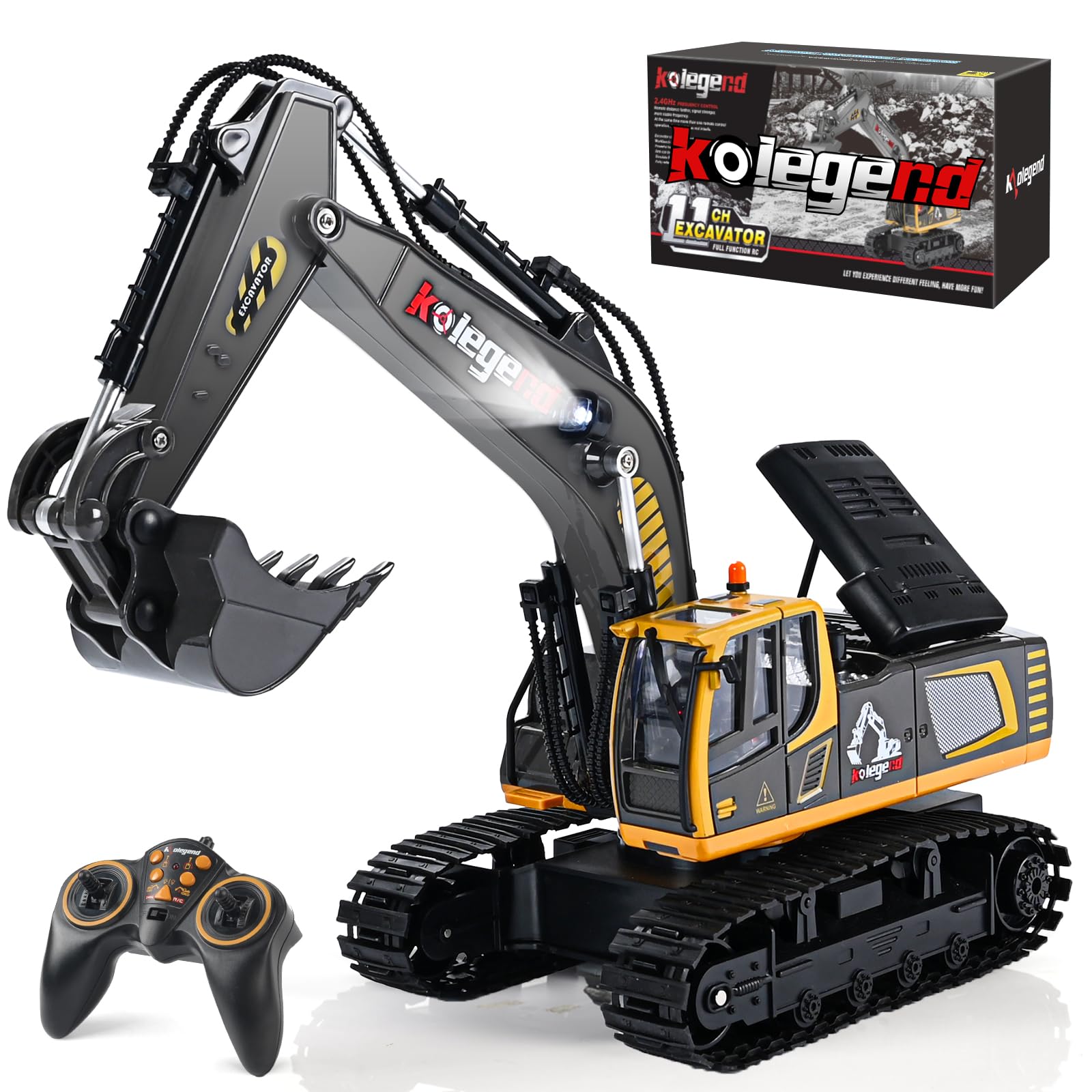
Kolegend 1:18 RC Excavator

Kolegend 1:18 RC Excavator

Family value

Doodle Score 8.6/10
Check Price

Worth Noting

  • Battery packs can lose charge
  • Arm and track durability varies
Scale
1:18
Shovel
Metal
Control
11-channel, 2.4GHz
Batteries
Two rechargeable, 30 min each
Read the full review

Two rechargeable packs are the first thing we look for in this class, and the Kolegend 1:18 includes them. Each pack is rated for about 30 minutes, so one can charge while the other digs. Add the metal shovel, rubber tracks, and 11-channel 2.4GHz control, and you have the family-value pick of this group.

The digging is real enough for loose sand and soft soil. It scoops, lifts, and turns, and the metal shovel gives it more bite than the all-plastic buckets on the cheapest toys. We think the 1:18 size hits a sweet spot: big enough to feel substantial, small enough to store without clearing a shelf. The engineering cards are a nice extra, though most kids will ignore them once the bucket moves.

It is not the most realistic digger here; the arm follows a simpler path than the premium models, and the bucket does not have the same fine control. That is the trade for the family price. For a first excavator that will see sand, dirt, and a fair amount of rough handling, the simpler layout is easier to live with.

Bottom line: We recommend the Kolegend 1:18 for families who want real digging and a spare battery without paying premium prices.

#8

Kolegend 1:14 Excavator

Kolegend 1:14 Excavator

Large jobsites

Doodle Score 8.6/10
Check Price

Worth Noting

  • Boom arm can fail under hard use
  • Not for hard-packed soil
Scale
1:14
Battery
7.4V 1200mAh, 30 min
Control
22-channel
Digging
Six independent motors
Read the full review

The Kolegend 1:14 is the largest and most complicated excavator here, and it is the one that feels most like a jobsite machine. Six independent motors control the tracks, cab, boom, arm, and bucket. The cab rotates 680 degrees, the metal bucket digs into loose sand, and the 22-channel remote gives you separate control over movements that are combined on cheaper toys. We were struck by how much more deliberate the digging becomes.

At 18.9 by 7.09 by 15.94 inches, it needs a real patch of ground and a place to store it. The 2.4GHz control reaches about 130 feet, and the 7.4V 1200mAh pack is rated for roughly 30 minutes. That is enough for a focused session, not an all-day dig. The lights, sounds, and demo mode add realism, but the arm is the reason to buy it.

This is a hobby-grade toy with a hobby-grade price. It is not the right first excavator for a small child. We prefer it for older kids and adults who want to set up loads and move material, not just drive around. The independent movement is the reason to make space for it.

Bottom line: We recommend the Kolegend 1:14 for older kids and adults who want the most realistic digging in this set and have the space and budget for a large model.

How We Tested 12 RC Excavators in Real Dirt

We started by pulling together the RC excavators shoppers actually shortlist, then narrowed by size, control layout, claimed run time, and what each could lift and dig without stalling. We ended up with 12 units and ran them for six months, rotating them through backyard dirt piles, a sandbox, a gravel driveway, and indoor floors and carpet. Every machine was driven by adults and kids, including first-timers who had never used a multi-function remote.

Battery life was timed from a full charge to the last slow crawl, and we noted how long each pack took to recharge. For diggability, we loaded buckets with damp sand and loose soil, lifted a full scoop, swung it, and dumped it, watching for stalls, spilled loads, and arms that flexed too much. Mobility got checked on smooth floors, carpet, grass, and gravel, with tight turns and small obstacles. We also noted whether the boom, arm, bucket, and swing could work together smoothly instead of one function at a time.

Build quality was tracked after every session: loose pivot pins, cracked bucket seams, track tension, stripped screws, and how much mud the undercarriage collected. We let the machines bump patio edges, tip on grass, and get cleaned up, then checked what still worked. Enjoyment is harder to measure, but we watched how long people kept playing after the first ten minutes and whether they came back to a model the next day. Value came down to what each machine could actually do relative to the others, not the box copy.

How to Choose RC Excavators

Start With the Digging Arm

A basic RC excavator moves forward, reverses, and works a single scoop-and-lift arm. An 11-channel model adds cab rotation and more arm movement; a 17- or 22-channel model can separate tracks, boom, arm, and bucket. We put independent bucket control at the top of the list because it is the difference between positioning a bucket and watching a preset cycle. If your child mostly wants to scoop loose sand, a simpler arm is fine. If they want to load a toy dump truck, look for separate arm and bucket channels.

Match the Scale to the Digging Spot

Scale is a footprint decision. A 1:26 model like the Double E EC160E is about 10 inches long and fits a balcony or a small room. A 1:14 model like the Kolegend is nearly 19 inches long and needs a real patch of ground plus shelf space. Bigger models handle rougher terrain and look more convincing, but they are harder to store and slower to turn in tight quarters. Compact in a listing means small for a toy, not foldable, so check the listed length and measure where it will live, not just the sandbox.

Treat Batteries as Part of the Play

Most picks include two rechargeable packs, and that matters more than a big runtime claim. A second pack lets one charge while the other digs, which keeps a short session from turning into a charging break. Battery performance varies with load: dragging a bucket through wet sand drains a pack faster than driving on a patio. Check how the pack is removed and charged before the first outing; a pack that needs a screwdriver every time is a chore.

Check Tracks and Arm Materials

A metal shovel or bucket gives a toy more bite in loose sand, but the tracks and arm joints still decide how long it lasts. Rubber tracks grip better than smooth plastic on dirt and short grass, and they can shed grit without scratching floors. Wet sand and mud pack into the works and are harder on the mechanism than dry sand. Start in loose, dry material, keep water away from the electronics, and expect the arm and tracks to be the parts that need the most attention.

Choose Controls for the Driver

More channels mean more to learn. A 22-channel hobby model rewards an older child or adult who wants independent movements, while a simple scoop-and-lift remote lets a younger child start driving right away. We prefer a remote that a child can master in one session; the extra functions can come later. If two children will share the toy, look for 2.4GHz control and a layout that does not require reading a manual for every move.

Frequently Asked Questions

Final Verdict

For most buyers, the Double E Volvo 1:16 is the excavator we recommend. Its three metal attachments and 17-channel control make it the most capable digger in this set, and the 1:16 scale gives it real presence. It is not the simplest or the smallest, but it rewards the space and supervision it asks for.

If the budget is tighter, the Kolegend 1:18 is the family pick, with two batteries and a metal shovel. If you are short on space, the Double E EC160E is the compact alternative; for the most realistic large-scale digging, choose the Kolegend 1:14.