RC & Vehicles

Best Toy Excavators of 2026

A kid with a shovel and a bare patch of dirt is happy for about an hour — until the dirt turns up in the grass seed, the flowerbed, and somehow the kitchen floor. A toy excavator gives them the digging they're after with a machine that scoops, lifts, and dumps, and keeps most of the mess in one corner of the yard. The good ones also survive past the first week, handling wet sand, gravel, and a determined four-year-old without stripping a gear or shedding a tread. Over the past six months, my team and I have put 12 of them through exactly that kind of abuse.

Here's what nobody tells a first-time buyer: the battery life on the box never matches real digging, since wet sand drains a pack roughly twice as fast as cruising the driveway. Size and weight matter nearly as much — a ride-on that sits too tall gets abandoned, and one that won't fit in the garage gets returned. Paying more hasn't meant getting more, either. The picks below are the ones that earned their price.

#1

Tonka Steel Classics Mighty Excavator

Tonka Steel Classics Mighty Excavator

Long-term play

Doodle Score 9.6/10
Check Price

Worth Noting

  • Five pounds is a lot for a small child
Weight
5 lb
Material
Cold-rolled steel and plastic
Arm Rotation
360 degrees
Recommended Age
36 months - 12 years
Read the full review

Five pounds is the first thing you notice about the Tonka. Nothing else here has this much mass, and the weight is doing real work: the machine sits planted while a child works the arm, instead of skittering away when the bucket bites into a pile.

That solidity is the whole proposition. Cold-rolled steel and heavy plastic, an arm that swings a full 360 degrees so the bucket can dump anywhere around the machine, and a build that feels specified by someone who has watched a four-year-old destroy a plastic truck. It's the pick for a family that wants one excavator instead of a rotation of them.

The catch is the money. This is the most expensive excavator here and it does nothing clever: no lights, no sounds, no remote, just steel and a working arm. If the digger will be shared between siblings or handed to a cousin, the arithmetic works out; if it's for a child who wants buttons, the remote-control picks will get more use.

Bottom line: Our premium pick: five pounds of steel and plastic with a full-swing arm, for families who want one excavator that survives being handed down.

#2

Cat Construction Fleet Excavator

Cat Construction Fleet Excavator

First excavator

Doodle Score 9.4/10
Check Price

Worth Noting

  • Wheels skid rather than roll on smooth floors
Power
Manual, no batteries
Weight
15.5 oz
Dimensions
10.63 x 5.25 x 6.5 inches
Recommended Age
36 months - 8 years
Read the full review

Ten inches long, 15.5 ounces, and the lowest price in this group: the Cat Fleet is the excavator that lives in the beach bag. The boom and bucket are articulated, the wheels roll free, and there's no battery compartment, no remote, and nothing to lose in the sand.

That's why we recommend buying two of them. This is the digger for the car, the grandparents' house, and the bottom of the toy box, because losing one or leaving one out in the rain doesn't feel like an event. It's also the version we hand a two-year-old first: small enough to hold in two hands, simple enough that there's nothing to explain.

Weather resistance is the quiet advantage. Sand, dirt, and snow brush off, a rinse handles the rest, and with nothing electronic inside there's nothing to corrode after a wet afternoon. It's also the one in this group that can stay out in the yard between sessions and still look like a yellow excavator rather than a grey one.

Bottom line: Our budget pick, and the one worth buying two of: a light ten-inch digger with a working boom, no batteries, and a price that makes losing it painless.

#3

John Deere Big Scoop Excavator

John Deere Big Scoop Excavator

Sandbox play

Doodle Score 9.2/10
Check Price

Worth Noting

  • Listed age range tops out at 5 years
Length
15 inches
Weight
1.9 lb
Working Parts
Scoop, arm, free-rolling wheels
Recommended Age
3 years and up
Read the full review

Most toy excavators are either too small to move anything or too big for a preschooler to push around. The Big Scoop lands in the middle at 15 inches long and 1.9 pounds, and that turns out to be the useful size: the bucket lifts a real scoop of sand or gravel, and a three-year-old can still drag the thing across a yard without help.

Everything on it is kid-powered, which is the appeal. There's no battery door, no remote to lose, and no charging cable to hunt for before a beach trip. Sand and mud rinse off the plastic with a hose, the free-rolling wheels work on carpet, grass, and packed sand, and the whole thing doubles as a push-along truck when the digging loses its novelty.

The arm is the part that takes teaching. It wants a firm, deliberate pull rather than a flick, so a two-year-old will need an adult working the scoop alongside them for the first few sessions; a stiff-but-solid linkage beats one that strips in a week. Once a child is closer to six and wants to move serious dirt, the Cat Steel or the Tonka is the better fit. This one is happiest in a sandbox.

Bottom line: Our default pick: a 15-inch digger that scoops real sand, weighs under two pounds, and needs no batteries, which is what we recommend for sandbox families with kids aged three to five.

#4

Samtop RC Excavator

Samtop RC Excavator

Remote digging

Doodle Score 9.2/10
Check Price

Worth Noting

  • Listed for ages 6 to 12, not preschoolers
  • 1:20 scale means small bucket loads
Scale
1:20
Control
11-channel, 2.4GHz
Rotation
680 degrees
Recommended Age
6 - 12 years
Read the full review

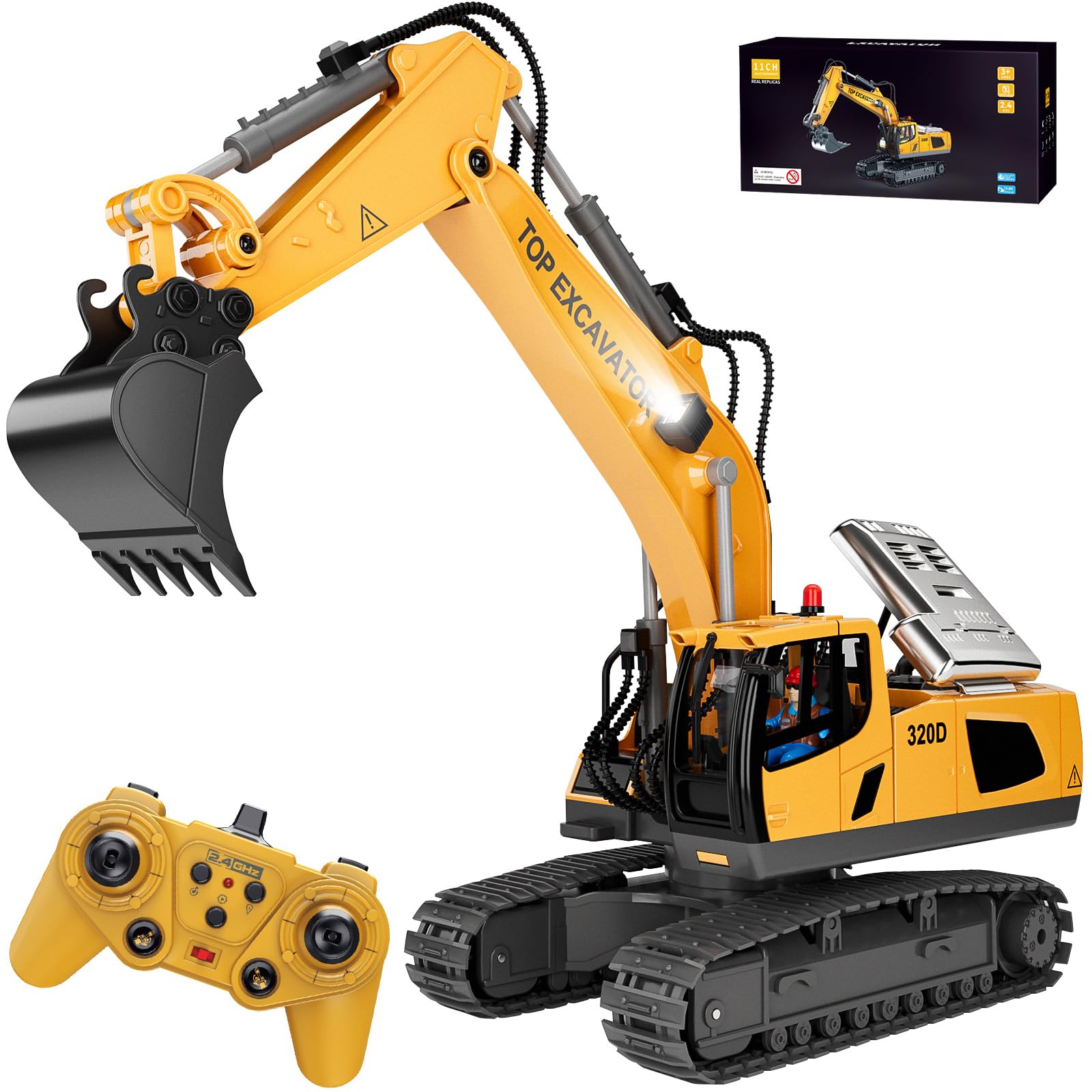
Eleven channels sounds like homework, but the Samtop is the remote-control excavator that takes the least explaining. The controls split cleanly between driving and digging, and a demo button runs the machine through its dig-and-dump sequence so a child can watch the arm move before taking the controller. That's the difference between an RC toy that gets played with and one that gets parked.

It digs, too. The tracks crawl over dirt and gravel, the body swings 680 degrees so the bucket can dump to the side without repositioning, and the arm lifts small rocks and debris out of the way rather than just nudging them. Loose dirt and mulch are its home ground; at 1:20 the loads are modest, but the motion is the real thing.

Two rechargeable packs come in the box with a USB charger, and swapping takes seconds — with a spare on the charger, a session ends because the child is bored rather than because the battery died. The 2.4GHz link held up across a yard without drama. Six is the right starting age and the listed range runs to twelve, so this stays interesting once the novelty of steering wears off and there's still a bucket to fill.

Bottom line: Our pick for remote-control digging: it scoops, swings, and drives on tracks, and with two rechargeable batteries it stays in the yard instead of sitting on the charger.

#5

JOYIN RC Excavator

JOYIN RC Excavator

Younger RC drivers

Doodle Score 9.0/10
Check Price

Worth Noting

  • Arm scoops and lifts but doesn't articulate
Control
2.4GHz remote
Batteries
2 x 600mAh rechargeable
Dimensions
10 x 5 x 3 inches
Recommended Age
36 months - 12 years
Read the full review

Two remote-control excavators made this list, and they aren't chasing the same child. The JOYIN is the smaller, simpler one: a ten-inch tracked digger with a 2.4GHz remote, two 600mAh packs, and LED lights that make it feel busier than it is.

In play it's straightforward in a good way. The tracks handle carpet, patio, and dirt, the arm scoops and lifts, and the controls are few enough that a four-year-old can learn them without help. The lights come on with the ignition, the body is light enough to pick up and move when the dig site relocates, and the whole thing feels sturdier in the hand than the price suggests.

Where it earns its place is as a first remote-control excavator. That's partly the simplicity and partly the two batteries: a dead pack doesn't end the afternoon, it just means a swap. The caveat is ground. Soft, wet sand is where the tracks start to struggle, so point it at dirt, gravel, or a drier corner of the sandbox and it's happy.

Bottom line: The remote-control excavator we recommend for younger kids: simple controls, two batteries, and a light body that's easy to point at a dirt pile.

#6

Cat Steel Excavator

Cat Steel Excavator

Real dirt piles

Doodle Score 9.0/10
Check Price

Worth Noting

  • Mostly plastic for a steel-branded toy
Weight
4.2 lb
Warranty
Lifetime against defects
Dimensions
20 x 8.5 x 11.5 inches
Recommended Age
3 years and up
Read the full review

Twenty inches long and 4.2 pounds, the Cat Steel is the biggest kid-powered excavator here, and it's the one that feels most like a tool. The ergonomic handles are the giveaway: this is a machine a child stands over and works, not one that gets pushed around the floor.

That difference shows the first time there's a real pile to attack. The metal bucket bites into dirt and gravel instead of bouncing off, the handles give a child enough leverage to fill it, and the working parts are built around an activity that lasts longer than five minutes. It's also the only pick here with a lifetime warranty against manufacturer defects, which tells you what Cat expects the thing to survive.

Where it fits is a yard with a dirt pile in it. This is a specialist: brilliant for a kid who wants to dig an actual hole and move actual soil, less appealing if the toy is going to be carried to the beach and home again. If the digging happens in a sandbox, the lighter John Deere is the better all-rounder.

Bottom line: A specialist pick for the yard: twenty inches, a metal bucket, and handles that give a child real leverage in packed dirt.

#7

KIDMARKT RC Excavator

KIDMARKT RC Excavator

Lights and sounds

Doodle Score 8.8/10
Check Price

Worth Noting

  • Bucket doesn't move independently
  • Digging controls can be finicky
Scale
1:20
Control
11-channel remote
Batteries
2 x 1200mAh rechargeable
Recommended Age
3 years and up
Read the full review

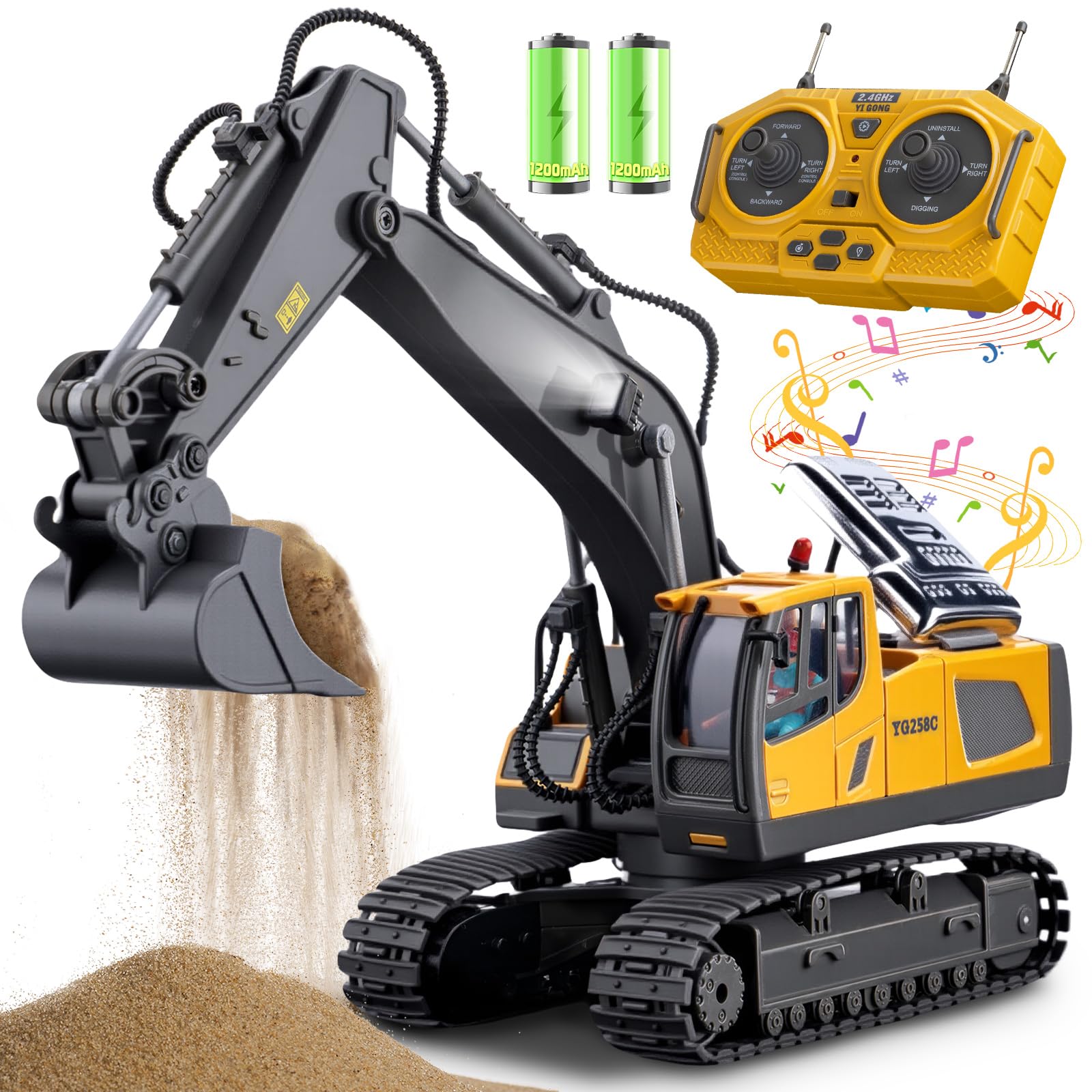
On paper the KIDMARKT has the fullest spec sheet of any remote-control excavator here: eleven channels, a metal bucket, 360-degree rotation, a 680-degree cab swing, lights, sounds, and two 1200mAh batteries quoted at 120 minutes of running time.

In use, most of that lands. It scoops dirt, leaves, and small objects without complaint, the lights and sound effects do their job for a child who wants a machine that feels alive, and the twin batteries mean a session doesn't end at the first recharge. Kids who have driven one take to the controls quickly; the channel count doesn't get in the way of the basics.

The scale is where expectations need calibrating. This is a compact 1:20 machine, and the listed dimensions — 6 by 11 by 5 inches — are worth reading before you order, because the product photography makes it look like a yard-sized digger.

We place it behind the Samtop because the extra channels buy features rather than better digging; the same small machine sits underneath all of them. If lights, sounds, and a long battery are what your child will actually notice, it's a good buy. If the bucket doing real work is the point, put the same money into the simpler machine.

Bottom line: We rank it a close second among the RC machines: lights, sounds, a metal bucket, and two big batteries, though the digging isn't sharper than the simpler pick.

How We Chose and Tested These Toy Excavators

We started with more than 30 models and narrowed by age range, material, whether the arm was motorized or hand-operated, and what it actually weighed and measured once assembled. We ruled out anything with a battery compartment a child could open without a tool, anything with sharp-molded seams, and anything whose listed weight limit sat close to the age range it was sold for. That left 12, spanning simple sandbox diggers, remote-control machines, and small ride-ons, all under a few hundred dollars.

Testing ran for six months, mostly on weekend mornings in a backyard sandbox, with regular sessions on a gravel driveway, a playroom carpet, and the wood mulch at a neighborhood park. We charged every battery to full and ran it dead twice — once digging wet sand and once driving on flat pavement — timing each run and noting whether the pack came out for charging or had to be plugged in place. We watched kids from 3 to 7 climb on, steer, and work the arm, measured how tight a circle each machine turned on grass, and lifted a bucket loaded with wet sand to full reach to see whether the arm held or sagged.

For durability, we hosed each one down, left it outside overnight, and then checked screws, pivot pins, and plastic seams for cracks, rust, and loosening. We counted how many scoops of wet sand each bucket actually held, noted which machines bogged down on a slight slope, and measured seat height and storage footprint against a typical garage shelf. After six months of use, we asked the same question about every unit: does this still feel worth what it costs?

How to Choose Toy Excavators

Kid-powered or remote control

Push-along and hand-worked excavators suit two- to five-year-olds, because the toy responds the instant a child touches it — which is the whole appeal at that age. Remote control puts a layer between the child and the digging, and most RC machines are listed for six and up for that reason. The JOYIN is the exception, with few enough controls for a four-year-old to learn unaided.

If the child is still in the carry-it-around stage, buy kid-powered and save the remote for a later birthday. We see more RC excavators parked on a shelf than manual ones, simply because the learning curve arrived before the child did.

How the arm works, and whether it will actually dig

An excavator earns its keep at the bucket. Two things to check: whether the arm swings far enough to dump what it scoops, and whether the bucket articulates on its own or only scoops and lifts with the arm. Independent bucket movement is what lets a child pick up a rock rather than push dirt around, and it's the feature most RC models skimp on.

Handles give a child leverage in packed dirt, which is the Cat Steel's whole idea. A light plastic boom is easier for small hands, as on the John Deere. A stiff arm usually frees up with use; a bucket that only lifts is a design limit, not a break-in period.

Size, weight, and where it will live

A ten-inch excavator is a bag toy; a twenty-inch one is a destination toy that needs a dirt pile to justify itself. Bigger machines scoop more and stay planted, but four or five pounds is a lot for a small child to haul across a yard, and the toy that gets left outside is the toy that gets played with.

Match the size to the space: sandbox and beach, ten to fifteen inches and under two pounds; a real dirt pile in the yard, twenty inches and four pounds plus. Read the listed dimensions rather than the photos — product shots flatter scale considerably.

Sand, water, and cleanup

Sand is the great divider. Plastic bodies shrug it off — hose them down and they're done — but grit and tracks don't mix: the RC machines are happiest on dirt, gravel, and short grass, and soft wet sand is where tracks slip and gears complain.

If the digging happens at the beach, favor a kid-powered plastic truck and rinse it before it goes back in the car. Steel-bodied toys want drying off after wet sand if you want them to keep looking new.

What the extra money buys

Past the budget tier you're paying for material and mechanism, not features. Steel and heavy plastic buy stability and a longer life, with the Tonka the extreme case; a metal bucket buys bite in packed dirt; a lifetime warranty buys an argument for the price.

Electronics buy play value for a particular child and one more thing to charge for everyone else. Decide which of those you actually want before you spend up, because the most expensive excavator here does the least clever things.

Frequently Asked Questions

Final Verdict

For most families the John Deere Big Scoop is the one to buy: fifteen inches of truck that moves real sand, weighs under two pounds, and has nothing to charge, lose, or sync. It's the excavator a three-year-old can use alone on day one, and the one that still gets picked up at five.

Change the requirement and the answer changes. Want steel that gets handed down through siblings? The Tonka. Is the child six or older and asking for a remote? The Samtop, with the tracks and two packs to keep it working.