Outdoor Play

Best Roller Skates for Kids of 2026

The cruelest math in childhood: a pair of roller skates that fits in May pinches by September. Adjustable skates solve that — the boot slides out two or three sizes so one pair survives a growth spurt — but the cheap ones rattle, flex underfoot, and start scraping the toe stop on the pavement at the first setting. What you actually want is a skate that grows without feeling like it's coming apart while it does.

I've laced up a lot of very small skates on the front step, and fit beats almost everything else. A half size off, and the pair lives in the garage no matter how good it looks on the shelf. Over six months my team and I put 11 pairs through driveway laps, rink birthday parties, and a great many sidewalk wipeouts, tracking how they adjusted, how they held up, and whether the kids asked to go again. One thing nobody tells you at the counter: kids' skate sizes rarely match their shoe sizes, so measure the foot and leave a thumb's width of room. The pairs that got both the fit and the fun right are below.

#1

SULIFEEL Rainbow Unicorn

SULIFEEL Rainbow Unicorn

A first pair

Doodle Score 9.6/10
Check Price

Worth Noting

  • Plastic toe stop grinds down on concrete
Lights
All wheels, motion-powered
Wheels
82A PU, ABEC-7
Closure
Lace-up
Size Adjustment
4 sizes, Medium band
Read the full review

Three things put this pair at the top of our list: a boot that clicks through four sizes, all eight wheels lighting up with no battery in sight, and 82A urethane wheels on ABEC-7 bearings instead of the unmarked hardware that turns up on a lot of light-up skates. None of it is exotic on its own. Together it gives a kid a skate that looks like a treat and a parent one that will still fit after the next growth spurt.

The adjustment is a length-only affair inside one band, which is the part people get wrong. This listing is the Medium — the big-kid end — so a small child will rattle around in it however far you slide the boot. Check the chart against a measured foot before ordering, and buy the band your child sits in the lower half of, because that is where the extra seasons come from.

The wheels are the pleasant part. Urethane at this hardness rolls quietly on a rink floor and copes with a swept driveway, and the lights are driven by the wheels themselves, so there is no switch to forget and nothing to recharge. That detail matters more than it sounds at bedtime: a child is much easier to spot coming down the street at dusk when all eight wheels are lit.

Laces are the trade. With no buckle or power strap, a five-year-old needs an adult kneeling down for the first few weeks, though a lace-up boot does hold a heel more precisely than a strap alone once it is done. If independence is the point, look at the buckled pairs below. If you are tying them anyway, this is the pair we hand people first.

Bottom line: Our default for a first pair: a four-size boot, battery-free lights and real urethane wheels in one package that will fit again next season.

#2

Nattork Adjustable Kids

Nattork Adjustable Kids

Bigger kids

Doodle Score 9.6/10
Check Price

Worth Noting

  • Sizing ends at youth 6
Lights
All wheels, motion-powered
Wheels
54 mm PU, ABEC-7
Closure
Ratchet buckle, strap, laces
Size Adjustment
4 sizes, Large 3–6
Read the full review

The Large band is what separates this one: youth sizes 3 to 6, adjusted through four positions with a push button. If your child has grown past the small and medium skates that make up most of this list, this is the pair that still has room in it.

It is also the most locked-in boot here — a ratchet buckle across the instep, a power strap over the top of it, and laces underneath. That is three separate things to do up, and a seven-year-old will need a few tries before the sequence sticks, but the payoff is an ankle that does not move around inside the boot.

Underneath it is 54 mm polyurethane wheels on ABEC-7 bearings with the usual motion-powered lights, all hung on a 2.4 kg boot. That is the heaviest pair here, which you notice lifting it off the shelf and stop noticing once it is on; the bigger shell and the ratchet hardware are where the weight comes from.

Where it earns its place is staying power. Durability and value are the two dimensions where this pair stands out against the rest of the set, the lights keep working over years rather than weeks, and the boot still looks like a boot after a full season of driveway use. Buy it for the eight-year-old who has already accepted that falling is part of it.

Bottom line: For a seven- to ten-year-old who has outgrown the small bands, this is the most skate for the money in this group, and the most locked-in.

#3

Sowume Adjustable Kids

Sowume Adjustable Kids

Little kids

Doodle Score 9.6/10
Check Price

Worth Noting

  • Small 10–13 band only in this listing
Wheels
Urethane, all light up
Closure
Buckle
Bearings
ABEC-7
Size Band
Small, US 10–13
Read the full review

One buckle over the instep and the boot is closed — no laces to thread with cold fingers, no adult kneeling on wet pavement. That single design choice is what puts the Sowume at the front of the list for a house with a five- or six-year-old who insists on doing it themselves, and the 10–13 band is where most preschoolers and early grade-schoolers land.

The spec is honest for the money: ABEC-7 bearings, urethane wheels, and all eight lighting up as they roll with nothing to charge. We reach for this one when the child is small and the morning routine is already a negotiation — a skate they can put on without help is worth more than a nicer wheel compound.

Stopping is the skill to work on first. These roll freely, and a beginner who has not learned to lean into the toe stop will keep going until something else stops them, so give them flat, empty pavement and a hand to hold for the first session. After that it keeps up with the sidewalk and the rink alike.

Bottom line: The one a small child can put on alone — a single buckle, lights that need no batteries, and a 10–13 band that covers the preschool years.

#4

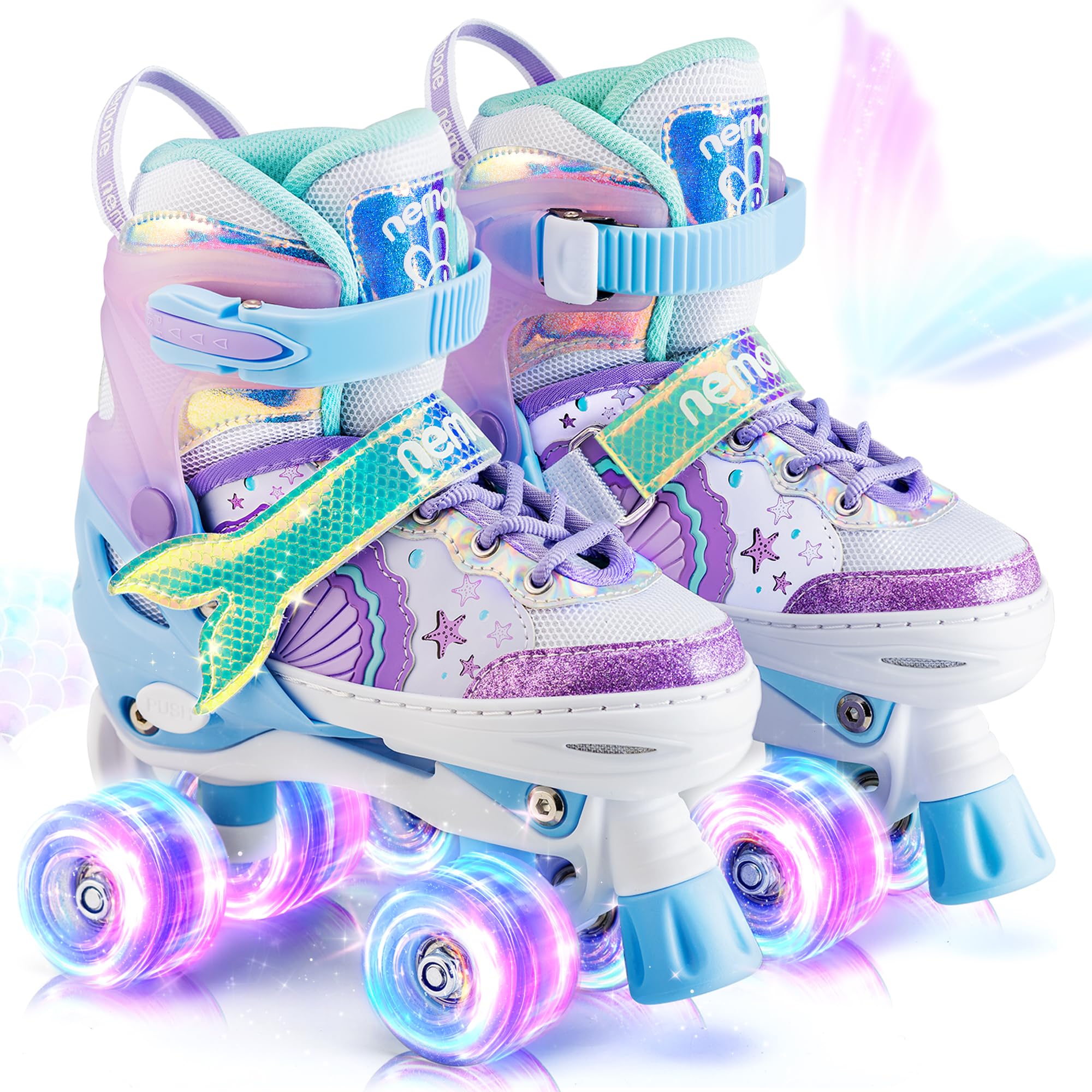
NEMONE Mermaid

NEMONE Mermaid

Inline converts

Doodle Score 9.6/10
Check Price

Worth Noting

  • Medium band only in this listing
Brake
Heel brake
Wheels
54 mm PU, light-up
Closure
Buckle and laces
Size Adjustment
4 sizes, Medium band
Read the full review

Most quads stop with a toe stop: point the toe down, lean forward, and let it drag. The NEMONE puts the brake on the heel instead, which flips the technique — you lean back and push, the way an inline skate teaches you to stop.

That is a genuinely useful difference for a child who has already skated on blades and a confusing one for a child being taught the classic toe-drag. The rest of the skate is a four-size adjustable boot with a ratchet buckle and laces, 54 mm wheels, all-wheel lights, and a 1.5 kg weight that makes it one of the lightest pairs here. The mermaid print is the draw for the kid; the buckle is the draw for the parent.

We recommend it for the child moving over from inline skates, or the one who has already worked out that leaning back is how they stop. A complete beginner learning from scratch should start on a toe stop, because that is the technique every rink and every friend will teach them.

Bottom line: A good pick for a kid moving over from inline skates, because the heel brake teaches the stop they already know; beginners starting fresh should learn on a toe stop.

#5

MammyGol Adjustable Kids

MammyGol Adjustable Kids

Long coverage

Doodle Score 9.6/10
Check Price

Worth Noting

  • Hook-and-loop strap is less locked-in than a buckle
Lights
All wheels, motion-powered
Closure
Hook and loop
Warranty
2 years
Size Adjustment
4 sizes, Large 3–6
Read the full review

Two years of warranty on a kids' skate is unusual enough to lead with: most of this group is covered for 90 days. If you have ever had a buckle let go in February, that difference is the whole argument.

The skate underneath is a Large-band (3–6) adjustable boot with a four-position button, hook-and-loop straps, all-wheel lights that need no battery, and a 4.5 lb weight that sits at the heavier end of the pairs here — noticeable carrying them to the car, irrelevant once they are on.

We recommend it to the family that wants one pair to survive two winters: the cautious driveway skater, the second child in line for hand-me-downs, anyone who would rather not think about skates again for a while.

Bottom line: Two years of coverage on a solid adjustable skate — the pick for a family that wants the longest warranty and doesn't need the stiffest boot.

#6

Tudoccy Shine Kids

Tudoccy Shine Kids

Cheap starter pair

Doodle Score 9.6/10
Check Price

Worth Noting

  • Lace-up only; a kid needs help
Lights
All wheels
Wheels
54 mm PU, ABEC-7
Closure
Lace-up
Size Band
Small, US 10C–13C
Read the full review

Of the fully adjustable pairs here, this is the least expensive, and it is the one we suggest when a small child needs a first pair that will not break the budget. The Small band covers 10C to 13C — the listing puts that at roughly four to seven years old — and the boot adjusts through four positions.

What you get is a polymer boot with 54 mm polyurethane wheels on ABEC-7 bearings, all-wheel lights, and a padded liner that kids stop noticing after the first session. At 5 lb it is not the lightest pair here, and the finish is plainer than the printed shells on the NEMONE, but nothing about it reads as disposable.

Spin each wheel before the first skate. A nut set too tight makes the whole skate feel slow and draggy, and it is a quarter-turn fix with a wrench. After that it is a small band for a small rider, which means one or two seasons before you are shopping again.

Bottom line: The cheapest way into an adjustable boot: small sizes, real urethane wheels and lights, with laces you will be tying for a while.

#7

Roller Derby Firestar

Roller Derby Firestar

Tight budgets

Doodle Score 9.4/10
Check Price

Worth Noting

  • No light-up wheels
Size
Fixed, US child 2
Wheels
54 mm urethane, 608Z
Closure
Laces and power strap
Read the full review

No lights, no size adjustment, and a white-and-mint boot that looks like it came out of a rink equipment cupboard — because that is what it is. The Firestar is a plain youth quad with a torsion-beam frame, 54 mm urethane wheels and 608Z bearings, and it is the least expensive pair in this roundup by a clear margin.

That is exactly why we keep recommending it. A fixed-size skate costs less than any adjustable one here, and for a child who skates a handful of times a season, two fixed pairs over three years can still come in under a single grow-with-me boot. The build does not feel like a compromise either: urethane wheels and a proper bearing spec are what you want on a rink floor, and the lace-plus-power-strap closure locks an ankle down as firmly as anything in this group.

Fit is the thing to get right, because the same listed size has landed snug on one child and roomy on another — measure the foot and use the chart rather than the age line. Then buy it for the rink regular, the second pair for a sibling, or the family that would rather replace an inexpensive skate than maintain an expensive one.

Bottom line: Buy it if the budget is fixed and the rink is the destination — a real quad skate for less than anything else here, as long as you buy the size right.

#8

Roller Derby Fun Roll

Roller Derby Fun Roll

Toddlers and preschoolers

Doodle Score 9.4/10
Check Price

Worth Noting

  • Runs narrow; wide feet should size up
Wheels
50 mm urethane
Closure
Buckle
Size Adjustment
4 sizes, Small 7–11
Read the full review

Roller Derby built this one around the smallest skater in the house: a low shell that sits close to the ground, 50 mm wheels, and a twist lever that stretches the boot through four sizes. It comes in the strawberry-and-cream prints that four-year-olds pick for themselves, and the junior band runs from 7 to 11.

The low shell is the part worth paying for. A tall boot on a three-year-old is a leverage problem — every wobble travels up to an ankle that is still learning what ankles do — while a shell that sits low keeps the centre of gravity where a first-timer can find it. The padded liner is genuinely cushy rather than token, and the buckle is one motion, which is about all the patience a preschooler has for getting dressed.

None of the Roller Derby pairs here light up, and that is the one thing that could sink this with a child who has been promised sparkle. It is worth deciding early whether you are buying a stable first skate or a light show, because at this end of the market you generally pick one.

We take the stable skate every time for a three- or four-year-old, and we hand this to a family whose child is starting near the bottom of the 7–11 band, where the adjustment buys a couple of seasons rather than one. A child who starts at the top of the band gets a single winter out of it — worth knowing before you fall for the print.

Bottom line: The pair we hand to a three- or four-year-old: a low, stable shell and a lever that buys a second season out of one purchase.

How We Tested Kids' Roller Skates

We started by gathering every kids' skate we could find that offered a genuine size range, then cut anything with buckles that reviewers reported snapping, wheels that couldn't be replaced, or a top size that stopped short of a kids' 3. That left 11 pairs, a mix of classic quad skates and adjustable models, which we skated for six months.

Testing happened where kids actually skate: driveways and quiet cul-de-sacs, a rink birthday party, an empty tennis court, and the long sidewalk loop around the block. Each pair got the same routine. We did a first-fit check with socks on and toes pressed to the front, then handed the skate over and timed how long the kid needed to lace or buckle it alone, because a skate a seven-year-old can't tighten is a skate they won't wear.

As the weeks went on we scuffed the boots against curbs to see how the finish marked, yanked the frame after extending the size to check whether it stayed tight, and compared ankle support at the smallest setting with the largest. We also counted the minutes each kid stayed on their skates before asking to stop. That number told us more about enjoyment than any spec sheet, and it tracked closely with price, which is where our value notes came from.

How to Choose Roller Skates for Kids

Start with the band, not the age

Kids' skates come in overlapping bands. The pairs here run junior 7–11, 10C–13C, 13C–3Y and 3Y–6Y, and a boot with four-size adjustment moves through roughly four sizes inside its own band — it does not stretch into the next one.

Measure the foot, then buy the band your child sits in the lower half of. A seven-year-old at the top of a band gets one season; the same child one band up gets two. Ignore the age printed on the box, which is a marketing average rather than a fit guide.

Fixed or adjustable: what you're paying for

A fixed-size pair costs less than any adjustable boot in this roundup, and for a child who skates a handful of times a year that is the sensible spend: you replace it when the foot grows and you never pay for adjustment hardware. Adjustable earns its price when the child is new to skating and about to grow a size or two, or when two siblings will share a pair.

Our rule: adjustable for the first pair, fixed for the rink regular whose foot has settled.

Who does the lacing

There are three closure families: laces only, a buckle or strap, and the three-point system that stacks a ratchet buckle, a power strap and laces underneath. Laces give the most precise heel hold and need an adult. A buckle a five-year-old can click shut buys you a child who dresses themselves.

Three-point is the most secure and the slowest to do up. If the skates live by the front door and get used daily, the closure matters more than the wheel compound.

Brakes, wheels and where they'll skate

Almost every quad here stops with a toe stop: point the toe, lean forward, drag. A heel brake flips that — lean back and push — which is how inline skates work, so it suits a child arriving from blades and confuses one learning from scratch.

On wheels: urethane is the rink standard and copes with swept pavement. The 50 mm wheels on a toddler's boot roll lower and slower than the 54 mm youth size. Plastic toe stops grind down fast on concrete, so expect to replace them.

What the lights are worth

Motion-powered lights need no batteries, come on as the wheels roll and brighten with speed. They are genuinely useful for spotting a child at dusk and they are often the reason a reluctant skater puts the skates on at all.

They are not a quality signal either way. Settle size, closure and boot first, then let the lights break a tie between two pairs that both fit.

Frequently Asked Questions

Final Verdict

The SULIFEEL is the pair we point most families to: four sizes of boot, lights that need no batteries and urethane wheels that behave on a rink floor or a swept driveway, in a package that will still fit next season. That combination is the deciding advantage — nothing else here balances growth, looks and rolling quality as neatly.

If the budget is the whole conversation, the Roller Derby Firestar is a genuine rink skate for less than anything else here, as long as you measure the foot because it won't grow with them. And if your skater is still three, start with the Fun Roll's low shell and accept that the lights are the thing you're giving up.