Outdoor Play

Best Binoculars for Kids of 2026

The first time a kid turns the focus wheel and a gray smudge on the fence snaps into a cardinal, something sticks. That moment is the whole reason to hand a child binoculars, and it's also the reason a bad pair does real damage — plastic toy optics that show a foggy smear can convince a curious kid that looking closely isn't worth the trouble. What you actually want is a pair that's genuinely clear, light enough for small hands to hold steady, and sturdy enough to survive an entire afternoon swinging from its strap.

One thing I wish more parents knew before buying: the big number printed on the box is the least useful thing on it. Ten or twelve power magnifies the wobble in a seven-year-old's hands as much as it magnifies the bird, and the small exit pupil makes everything dim and hard to aim. Eight power is the sweet spot, and any "night vision" claim on a kids' pair deserves a raised eyebrow. We've had 14 pairs in and out of backpacks for the past four months, and the ones that earned their keep got picked up long after testing ended — those are the picks below.

#1

GeoSafari Jr. Kidnoculars

GeoSafari Jr. Kidnoculars

Toddlers and preschoolers

Doodle Score 9.2/10
Check Price

Worth Noting

  • Fixed focus leaves no correction for one weaker eye
Focus
Fixed
Weight
7.05 oz
Magnification
2x
Objective Lens
45 mm
Read the full review

There is no focus wheel, no adjustment between the eyepieces, and nothing to twist, and that is the entire design argument. A three-year-old presses the big rubber eyecups against their face and looks. The eye openings are enormous by binocular standards, so there is no lining up to do, and the 45 mm front lenses keep the view bright enough to use indoors on a rainy afternoon.

We think that makes it the best first pair for a three- or four-year-old and a poor choice for anyone much older. Two-power magnification is a nudge, not a zoom: the bird at the far fence stays at the far fence, and a curious five-year-old will notice that within a week. What the binoculars do teach is the habit — lift, look, point at the thing — and that habit transfers to a real pair later.

The neck cord works loose and separates more often than you might expect, and that is largely by design: it is a breakaway strap, meant to give way rather than hold. Retie it, or thread on a lanyard you prefer, and the annoyance is gone in a minute. The body itself takes a drop onto pavement without complaint, because the eyecups are doing the armoring.

Bottom line: A three-year-old can use this one without help — nothing to focus, soft oversized eyecups — provided nobody expects a zoom out of it.
#2

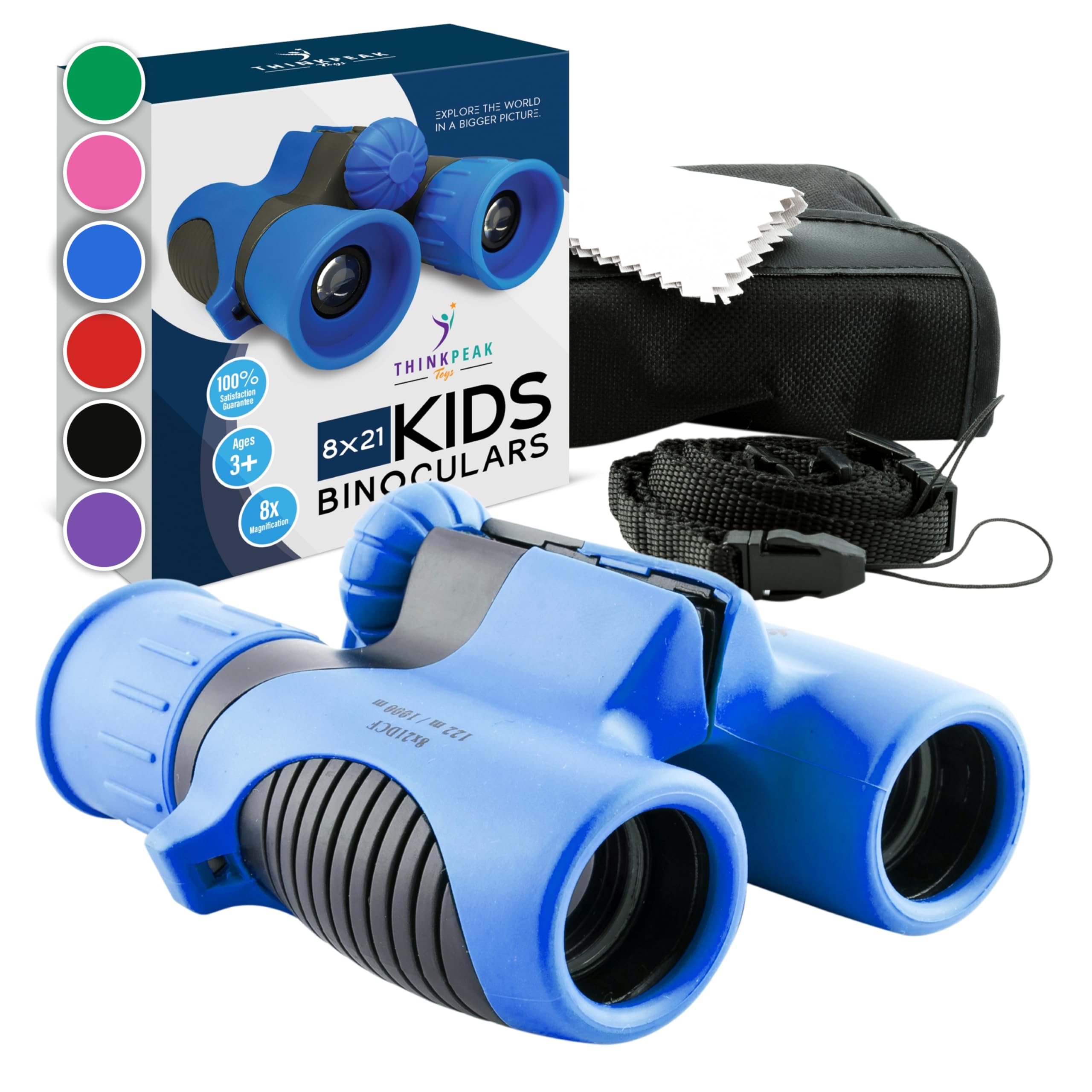
Think Peak 8x21 Kids Binoculars

Think Peak 8x21 Kids Binoculars

Rough outdoor use

Doodle Score 9.2/10
Check Price

Worth Noting

  • Eight ounces, the heaviest kid-first pair here
Prism
Roof prism
Weight
8 oz
Magnification
8x21
Water Resistance
Waterproof
Read the full review

This is the priciest kid-first pair in the group, and the money goes somewhere specific: a body built to be dropped and barrels sealed against weather. The optics are 8x21 BAK-4 with a prism coating, the housing is shock-resistant, and the model is rated waterproof — a combination that matters if the binoculars live in a backpack that gets set down in wet grass.

The handling is what made it a pick rather than a curiosity. The barrels swivel easily to set eye spacing, the center focus knob is wrapped in textured rubber for a thumb and forefinger, and the eyepieces measure 1.5 inches across, big enough that a seven-year-old is not hunting for the exit pupil. At four inches square it sits compactly in a child's hands, and the swivel has stayed firm with use rather than going floppy.

Against the two cheaper 8x21s here, the premium buys armoring and sealing rather than a better picture, and that is a fair trade only for a particular kid: one who hunts with a parent, camps in the damp, or treats gear like a hammer. For a careful six-year-old who mostly watches the feeder, the top pick does the same job and leaves budget for a bird book.

Bottom line: Buy this for the kid who drops things: real 8x21 glass in a shock-resistant, waterproof body that comes back from a wet weekend still working.

#3

Noptix Kids Binoculars 8x21

Noptix Kids Binoculars 8x21

Bird-curious beginners

Doodle Score 9.2/10
Check Price

Worth Noting

  • Eyepieces can be unscrewed by determined fingers
Weight
6.08 oz
Bird Guide
40-species sticker book
Field Of View
6 degrees
Magnification
8x21
Read the full review

The extra in this box is a sticker book — forty bird species, each sticker labeled — and it changes what the binoculars are for. A six-year-old with a page to fill has a reason to hold the pair up for longer than thirty seconds, and a name to put to what they saw. Plenty of kids' binoculars come with a case; very few come with a reason.

The binoculars underneath are sound: roof prisms with coated lenses, a shockproof rubber shell, 6.08 ounces, and a breakaway strap we are always glad to see on a product aimed at three-year-olds. The field of view is the narrowest of the 8x21s in this guide at six degrees, which you notice when a child tries to follow something moving rather than something parked, and the body comes in pink or blue.

Bottom line: Buy this one as a present: real 8x21 binoculars plus a bird sticker book that gives a six-year-old something to do with them.

#4

Little Experimenter Night Vision

Little Experimenter Night Vision

After-dark play

Doodle Score 9.2/10
Check Price

Worth Noting

  • Not water resistant
  • Runs on three LR44H button cells
Focus
Fixed
Batteries
3 LR44H
Magnification
2x
Objective Lens
36 mm
Read the full review

What arrives is a pair of two-power, fixed-focus binoculars with a green light built into the front, and that light is the whole of the night-vision feature. It throws a beam on whatever is ahead while the optics do their modest work. For a four-year-old at dusk that is genuinely exciting; for anyone expecting to see in the dark, it is a torch with a green filter.

The build suits the age group. Molded rubber eyecups sit against a small face, the shape is easy to grip with both hands, and the whole thing weighs about a quarter of a kilo. It runs on three LR44H button cells, and the beam is bright enough that you want to be behind it rather than in front — a child swinging this around at head height will find your eyes.

We hand this to the child who is already asking to stay outside after dinner, not to the one who wants to see a woodpecker at the top of a tree: at two power the reward is the light, not the magnification. Next to the toddler pairs here, it is the one that gives an evening walk a job.

Bottom line: If the appeal is being outside after dark, this is the pick: a two-power viewer with a built-in light and a body made for small hands.

#5

JovialToyz 4x30 Kids Binoculars

JovialToyz 4x30 Kids Binoculars

Youngest beginners

Doodle Score 9.2/10
Check Price

Worth Noting

  • Smaller in the hand than the photos suggest
  • Four power runs out of reach by about seven
Extras
Compass and canvas bag
Age Range
3-8 years
Dimensions
4.92 x 4.92 x 2.28 inches
Magnification
4x30
Read the full review

This is the smallest and cheapest way into a real pair: a red 4x30 about five inches square, with a compass set into the body and a canvas bag in the box. Four power is a genuine step up from the fixed-focus toddler pairs without asking a small child to hold anything steady at eight.

The advertised range runs from three to eight, and the body suits the bottom of it. It is light enough to hang around a neck, the eyecups are soft, and the compact shell fits a small face. A seven-year-old with a bird book will want more reach within a season, so treat the upper end of that range as optimistic.

Where it earns its place is brightness. Four power behind a 30 mm front lens means a large exit pupil, so the view stays usable in shade and under trees where a cheap 8x goes murky, and the compass gives a child something to do when the birds refuse to cooperate.

We treat it as a starter with a shelf life: the right call for a three- or four-year-old who has just learned to point at things, and the wrong one for a second-grader who has already borrowed a grown-up's pair. Either way, it is cheap enough that losing it in a hedge is not a tragedy.

Bottom line: The pair to buy when the child is three or four and the budget is small: 4x is a real step up from toddler optics, and the compass gives it a second job.

#6

OBUBY 8x21 Kids Binoculars

OBUBY 8x21 Kids Binoculars

Everyday kid use

Doodle Score 9.0/10
Check Price

Worth Noting

  • Center focus needs two hands at first
Prism
BAK-4
Weight
6 oz
Field Of View
7.2 degrees
Magnification
8x21
Read the full review

Eight times magnification in a six-ounce body is the balance we kept coming back to, because it is the point where a child can still hold the thing steady. Push to ten or twelve power and every heartbeat shows up in the view; drop to two and there is nothing to look at. The 8x21 optics here sit in the middle, and the 7.2-degree field of view is wide enough that a kid sweeping a back yard finds the bird again without hunting.

The rest of the design follows the same thinking. BAK-4 prisms and multi-coated lenses give a view bright enough for a shady hedge, the barrels twist to match a child's eye spacing, and the rubber eyecups rest against the brow instead of grinding into it. We liked that the focus knob falls under the fingers of the hand already holding the barrel, so a five-year-old can sharpen the image without taking the binoculars away from their face.

Six ounces sounds like a detail until you watch a child carry something for an hour. This one disappears on a neck strap, and the carry case and velvet bag in the box mean it rides in a backpack without a lens picking up scratches. The body is PVC rather than armored metal, but it has survived the back yard, the car floor, and the bottom of a bag in our time with it.

It also keeps working as the child grows, which is more than the two-power toddler pairs can claim: the same view a five-year-old uses on a feeder still makes sense for a ten-year-old on a camping trip. That longevity is the reason this is the default here rather than a starter that gets replaced inside a year.

Bottom line: For most kids from about five to twelve, this is the pair we hand over: real 8x21 optics, six ounces, and a case at a price that doesn't sting.

#7

Hontry 10x25 Compact Binoculars

Hontry 10x25 Compact Binoculars

Older kids and teens

Doodle Score 9.0/10
Check Price

Worth Noting

  • Ten power shows every wobble in small hands
Weight
9.6 oz
Eye Spacing
60-75 mm
Magnification
10x25
Water Resistance
Waterproof
Read the full review

Ten power is more than we hand a five-year-old, and that is exactly why this is our pick once a child is around ten. The 10x25 glass pulls a heron out of a far treeline in a way the 8x pairs here cannot, and the eye spacing adjusts from 60 to 75 mm — wide enough for a child's face in the morning and a grown-up's in the afternoon.

The rest is adult gear in a small body. BAK-4 prisms and fully multi-coated lenses hold up on a gray afternoon, the housing is waterproof, and it weighs 9.6 ounces with a neck strap and a nylon bag in the box. We noted that the focus wheel and diopter feel like the parts of a proper binocular rather than a toy's, which matters when a child is learning to sharpen an image instead of just pointing.

Twelve power exists at this size, and we stop at ten on purpose: the extra reach costs you a 2.5 mm exit pupil and a picture that dims quickly as the light goes. Ten is about as much power as a young teenager can hold on a target without a rest, and this is the pair that makes that power portable.

Bottom line: For a ten-year-old who has outgrown toy optics, start here: adult-grade 10x25 glass in a body that still fits a child's eye spacing.

#8

Occer 12x25 Compact Binoculars

Occer 12x25 Compact Binoculars

Teen birders

Doodle Score 8.8/10
Check Price

Worth Noting

  • Twelve power needs steady hands and good light
Weight
13.8 oz
Eye Relief
20 mm
Field Of View
273 ft at 1,000 yds
Magnification
12x25
Read the full review

Twelve power in a kids' roundup is a warning, so let's be clear about what this is: a 12x25 adult compact that happens to be small enough for a teenager. The exit pupil is 2.5 mm, which means a dim picture at dusk, and the field is 273 feet at a thousand yards — narrow enough that picking up a moving bird takes real work.

The mechanical side is where it earns its place. The eyecups pull down for glasses, eye relief is 20 mm, the diopter adjusts five either way, and the body is sealed and waterproof. At 0.39 kg it is the heaviest thing in this guide, which is the sort of specification you notice after an hour on a strap.

The glass is better than the body has any right to be at this size: in daylight the image is crisp, the focus wheel moves smoothly, and a careful teenager can pick a warbler out of a hedge at a distance the 8x pairs give up on.

This is a pair for a fourteen-year-old who wants reach and has steady hands, not for anyone under ten. If the child in question is younger, or wants to look at things rather than at distance, the top pick and the two-power toddler pairs serve better.

Bottom line: Hand this to a teenager who wants real reach: 12x25 glass, sealed and pocketable, as long as their hands are steady and the light is good.

How We Tested the Best Binoculars for Kids

We started by gathering every pair we could find that claimed to be built for kids, then cut anything above 10x magnification, anything too heavy for a five-year-old to hold up for more than a few seconds, and anything priced like a serious adult optic. These are tools for children, and the ceiling should feel like a birthday present, not a graduation gift. That left 14 pairs, which we lived with for four months.

Clarity came first, because it's essentially the whole product. We focused each pair on a chain-link fence about 30 feet away and looked for color fringing at the edges of the image, then had kids pull back and check whether the two barrels lined up into one clean circle or gave them a headache-inducing double image. We also asked whether the view felt like real glass or like looking through a plastic toy. Every pair went outside at dusk and again in full dark to see what the night-vision label actually delivered — in most cases, nothing your own eyes weren't already doing.

Fit and toughness came next. We weighed each pair with the strap attached, timed how long a six-year-old could hold them up before the arms dropped, and watched whether kids could reach the focus wheel without pulling the binoculars away from their face. Small faces got the eyecups in every position, including with glasses on, and we checked that the barrels closed narrow enough to match a child's eye spacing. Then we were unkind: dropped from a picnic table onto grass, stuffed into a backpack next to a water bottle, and passed around a playground.

Enjoyment is the hardest thing to measure and the most obvious in the end. Months on, we noted which pairs the kids reached for unprompted and which ones stayed in the basket, then weighed that against price to sort genuine value from merely cheap. The ones that survived all of it — still sharp, still solid, still fought over — are the picks below.

How to Choose Binoculars for Kids

Match the power to the child, not the box

The x-number is how much closer things look, and more of it is usually worse for small hands. Hand shake gets magnified along with the bird, so a 12x pair shows a six-year-old a shaking blur where an 8x pair shows a sparrow. Two and four power suit three- and four-year-olds who mostly need the habit of looking; eight is the sweet spot from about five to eleven; ten and twelve belong to teenagers who can brace their elbows.

So buy 8x unless the child is very young or nearly grown. A bigger first number on the box reads as more value and usually delivers less, and that is the single most common way a pair of kids' binoculars ends up in a drawer.

Eye spacing and eyecups decide comfort

Binoculars only work when the two barrels line up with the two pupils. A child's eyes sit closer together than an adult's, so check any stated eye-spacing range against the child — the Hontry lists 60 to 75 mm — and set the hinge before they look through. If a child sees two circles or a black crescent rather than one round picture, the spacing is wrong for them, not the magnification.

Then look at the eyecups. Rubber cups that fold or twist down let a glasses wearer get close enough to see the full view, and oversized cups are what make a two-power toddler pair usable at all.

Fixed focus or a focus wheel

Toddler pairs are fixed-focus: nothing moves, so nothing can be wrong, and the only cost is that anything past a few feet stays soft. From about five, a center-focus wheel is worth the small learning curve because it is what makes a distant bird sharp. Check where the wheel sits — under the fingers of the hand already holding the barrel is right — and how easily it turns.

A stiff focuser is one of the quickest ways to lose a child's interest, and it is the sort of thing you can test in ten seconds before wrapping the gift.

Straps, cases, and surviving a drop

Assume the binoculars will be dropped, sat on, and left in the yard. Rubber armoring and a sealed body are worth paying for if the child is rough or the weather is wet; the Think Peak is the pair here that leans hardest that way. The strap matters just as much: a breakaway cord is a genuine safety feature on a young child, which means it will come apart in normal use.

Expect to retie the lanyard and don't read the separation as a fault. A case, meanwhile, is what keeps the lenses usable between trips rather than scratched in the bottom of a bag.

Accessories are a bonus, not the reason

Compasses, magnifiers, whistles and sticker books get printed large on the box, and they are worth having only when the binoculars behind them are sound. A compass that does not point north, or a magnifier that does not magnify, is a small disappointment a child remembers longer than they should.

Buy for the optics and the fit, then enjoy the extras. A bird sticker book is the rare bundled item that keeps earning its place after the first afternoon.

Frequently Asked Questions

Final Verdict

If you want one pair and no more thinking, buy the OBUBY 8x21. Eight power is what most children can actually hold steady, six ounces is what they will carry, and the case means it survives the trip home.

Spend up to the Think Peak only if the child is hard on gear or will be near water. Move to the Hontry 10x25 once they are around ten and asking for more reach. Below five, skip both and start with the Kidnoculars.