Outdoor Play

Best Kids Slides of 2026

A slide looks like the simplest thing in the toy aisle: a ladder, a ramp, a bit of plastic. Then it arrives, and you find out whether the ladder is too steep for a 2-year-old, whether the whole thing skates across the floor the moment someone climbs it, and whether the assembly instructions assume you own tools you don't. Get those right and it becomes the one thing your kids return to every day — a way to burn energy and practice a very specific kind of bravery without a trip to the playground.

We've lived with 12 of them now, in playrooms, in backyards, and through a run of rainy weekends when the only place to climb was the living room. The pattern that kept emerging: weight and footprint matter more than ramp length, and a light slide on a wood floor is a moving object. The picks below cover toddlers just learning to sit down and go, bigger kids who want a climbing wall attached, and parents who'd rather not lose a Saturday to assembly.

#1

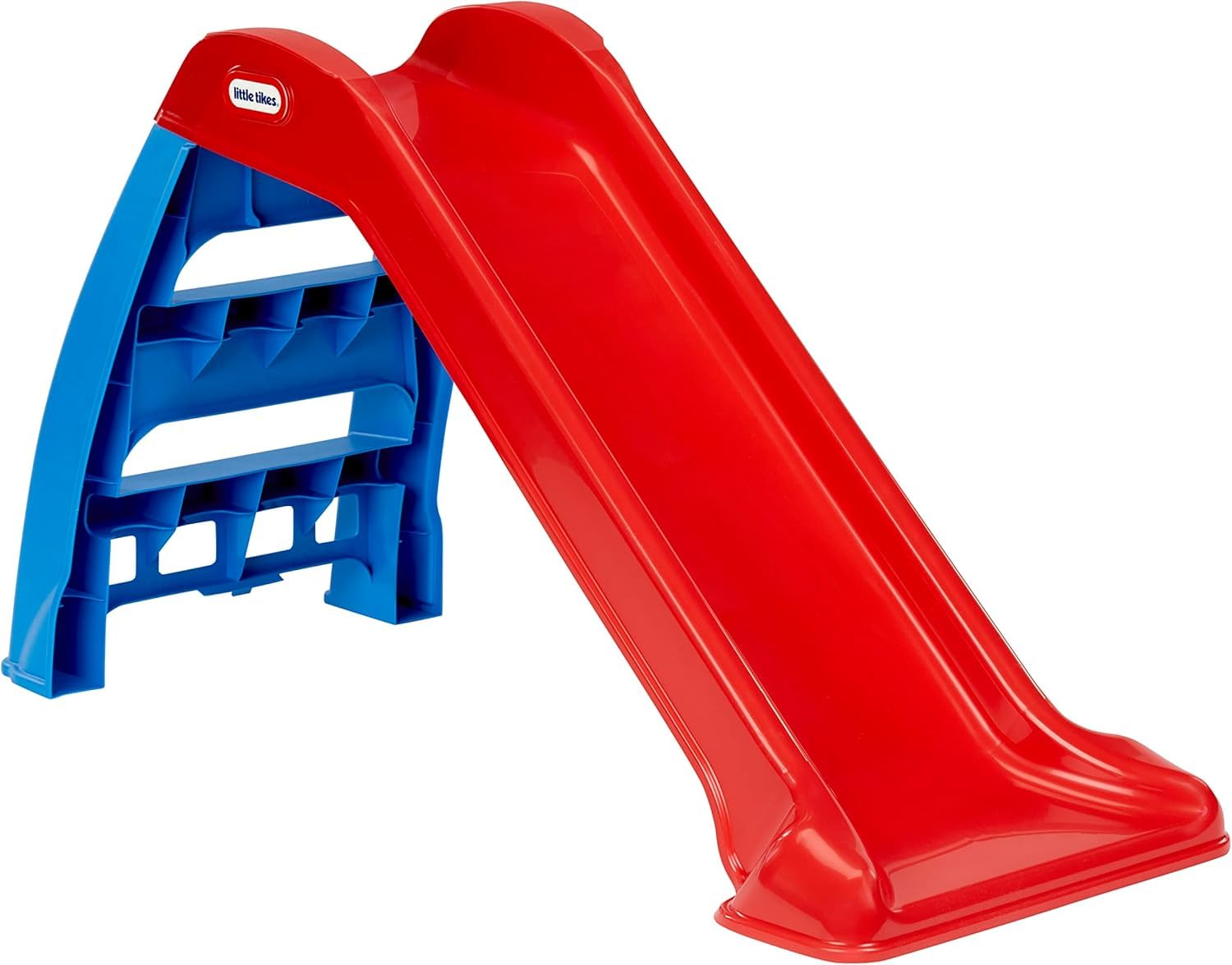
Little Tikes First Slide
Little Tikes First Slide

Toddlers and preschoolers

Doodle Score 9.4/10
Check Price

Worth Noting

  • Clip-on rails work loose in small hands
  • Shell can crack if folded roughly
Weight Limit
60 lb
Assembled Size
39"L x 18"W x 23"H
Recommended Age
18 months - 6 years
Folds For Storage
Yes, without tools
Read the full review

Thirty-nine inches long, eighteen wide, twenty-three high. That is the shape most of us picture when we hear the words toddler slide, and this is the model that fixed the shape in everyone's head. At nine and a half pounds it is a one-hand carry from the living room to the driveway, and the four main pieces snap together and fold back down without a single tool.

It takes the top spot because the ride is real. Plenty of first slides are ramps with a lip on the end; twenty-three inches of platform gives a child enough drop to feel it and enough run-out to arrive sitting up rather than tumbling. Our advice for most families is to start here and go bigger only if your child is already three or tall for their age, because a five-year-old on this deck looks like a grown-up on a kitchen chair.

The blue rails are the part to watch. They clip on rather than lock, and small hands can work them loose on the way up, so press them down before each session and skip the slide on any day one will not seat. Folding is a deliberate operation too. The shell is thin enough that one hard yank on a stubborn hinge is how these crack, so take the two seconds to do it properly.

Inside on a level floor the base stays put. Outdoors on grass it is stable, but on a smooth patio it will creep a couple of inches with each landing, which a rubber pad under the back feet solves. The 60-pound limit and the manufacturer's six-year ceiling are generous on paper; in the room, this is a slide for the two-to-four stretch, and it is very good at exactly that.

Bottom line: Our pick for most families: a genuine slide a toddler can climb alone, light enough to move room to room, and it folds flat when the living room needs to be a living room again.

#2

Arlopu Toddler Indoor Slide

Arlopu Toddler Indoor Slide

Long indoor runs

Doodle Score 9.4/10
Check Price

Worth Noting

  • Screws work loose over months of use
Extra Play
Basketball hoop
Weight Limit
110 lb
Assembled Size
70.8"L x 17.7"W x 33.4"H
Folds For Storage
Yes
Read the full review

Seventy-one inches is a lot of slide for a living room, and that is the entire case for this one. The platform sits at 33 inches, ten above the Little Tikes First Slide, so a child who has outgrown a starter gets a descent that lasts longer than a second, with an acceleration section at the top and a flattened buffer at the bottom that puts them down on their feet.

The long slope is what we appreciate most. A steep short slide is a drop; a long one is a ride, and the difference shows in how often a child turns around and climbs back up. It also spans an unusually wide age spread — an eighteen-month-old goes down slowly enough to be caught at the bottom while a tall four-year-old gets the speed they came for.

We rate it the strongest of these for indoor use by an older toddler, with one condition attached to the room rather than the product: the landing is a full stride from the ladder, so you need clear floor at both ends, not just under the slide. Check that before you order, because there is no folding your way out of a 71-inch run.

The 110-pound limit is high enough that an adult can sit on it to test for wobble before a child ever does, and the triangular base with anti-slip pads holds steady on a hard floor. The catch is the fasteners: screws back out over months of use, so put a reminder in your phone and tighten them quarterly, sooner on a slide that gets jumped on.

Bottom line: The best long run in this group: seventy-one inches of slide and a 33-inch platform give older toddlers the speed a starter slide cannot, and the hoop brings them back up.

#3

Simplay3 Young Explorers Climber

Simplay3 Young Explorers Climber

Indoor-outdoor climbing

Doodle Score 9.4/10
Check Price

Worth Noting

  • Assembly needs two adults and clear bolt holes
Doorway Fit
Fits a standard doorframe
Weight Limit
60 lb
Assembled Size
55.5"L x 37.75"W x 46.75"H
Recommended Age
18 months - 6 years
Read the full review

It goes through a standard doorframe. That sounds like a small thing until you have tried to move a two-level climber from a playroom to a patio, and it is the detail that makes the Young Explorers the most practical climber here for a family who wants one structure doing both jobs.

We rate the play value highly. A climbing wall up one side, an extra-wide slide down the other, and a crawl-through space underneath that becomes a fort the moment a child finds a blanket. Two children can be on it at once without queuing, and the 60-pound limit with an 18-month-to-six-year range means it stays useful after the slide stops being the main attraction.

Assembly is the part to plan for: two adults, a drill, and bolt holes that occasionally need clearing before a bolt will pass. Check the holes before you start rather than discovering a blocked one halfway through, and the reward is a double-walled shell that is UV resistant and does not mind being left out in the rain.

At 55 inches long and 38 wide it takes real floor space, and it sits near the top of the range for something a child climbs rather than rides. What you are buying is the second and third use — the fort under the deck, the wall climb, the fact that a five-year-old still finds something to do on it. If you only want a slide, the simpler picks do that for less.

Bottom line: The one to choose when a slide has to work indoors in winter and outside in summer: it passes through a standard doorframe, and the crawl-through level keeps two children busy.

#4

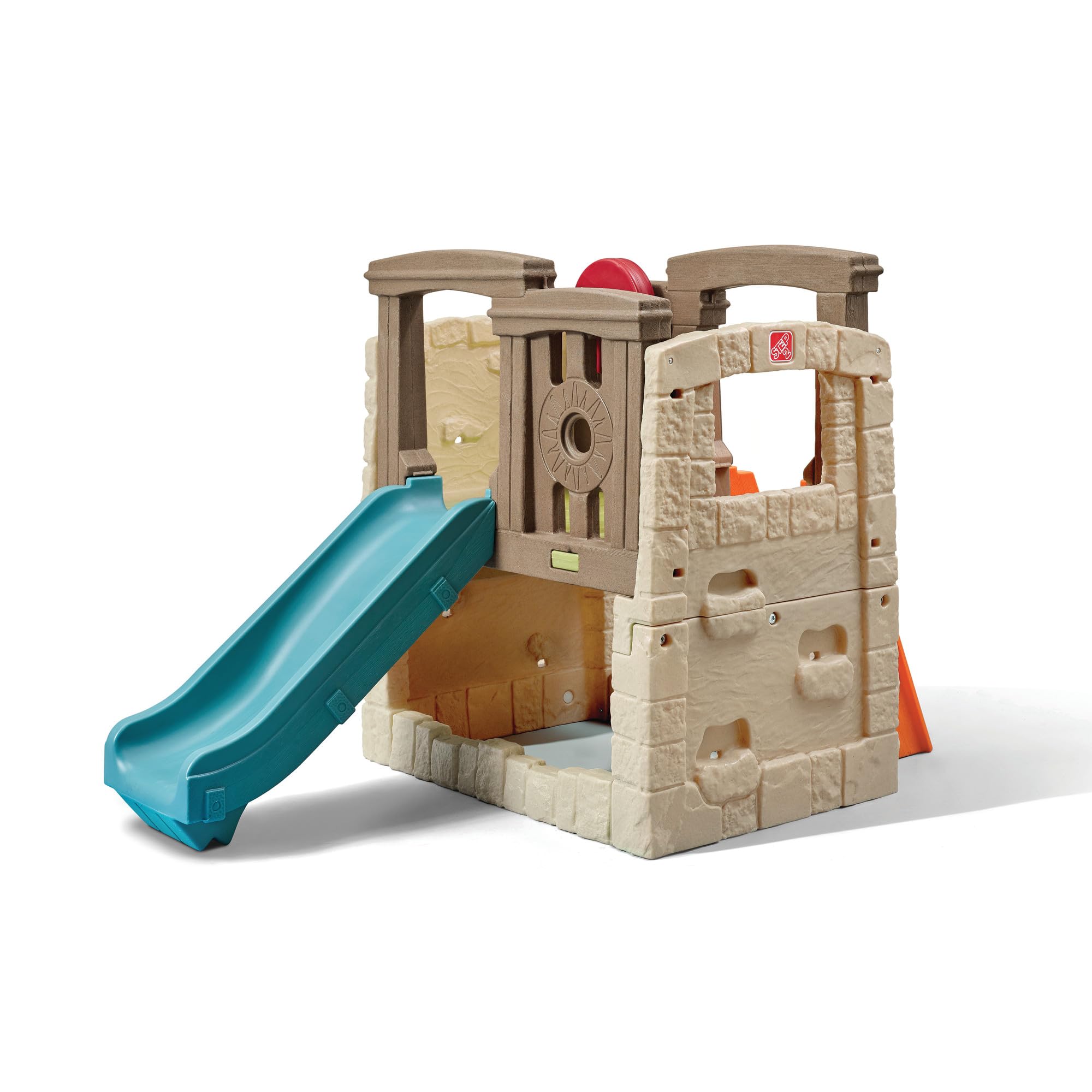
Step2 Woodland Climber II

Step2 Woodland Climber II

Backyards

Doodle Score 9.4/10
Check Price

Worth Noting

  • Needs a permanent, level corner of a yard
Construction
Double-walled plastic
Play Features
Climbing wall, ladder, slide, two steering wheels, hideout
Assembled Size
75 x 47 x 53.75 inches
Recommended Age
24 months - 6 years
Read the full review

Seventy-five inches long, forty-seven wide, fifty-four high. This is yard furniture, not something you slide behind the sofa, and the footprint is the first honest conversation to have with yourself before ordering. What fills that space is the most complete play structure here: a climbing wall, a ladder, a roomy deck with two steering wheels, a slide, and a lower level that works as a fort or a toy bin.

The age spread is what justifies the space. It is rated from two to six and the design earns it, because a two-year-old can manage the ladder while a five-year-old is still working out the climbing wall. Two children fit on the deck at once, which changes the dynamic from a toy one child monopolises into something they do together.

Construction is the other half of the argument. Double-walled plastic with rounded edges, a three-year limited warranty, and a shell that hoses down in a couple of minutes in spring. Setup is a straightforward hour with two people and a drill; the pieces are large but the sequence is logical, and nothing needs to be wrestled into place.

Where it earns its place is the ratio of play to upkeep. There is nothing to inflate, nothing to bring indoors, and no small parts to lose. What it asks in return is a level corner of the yard — a slope makes the ladder side feel different from the slide side — and a budget that is the largest here. With children between two and five, it is the one that will still be in use when the smaller slides have been outgrown.

Bottom line: For a backyard that can give up a corner permanently, this is the climber we point to: two ways up, two steering wheels, a hideout underneath, and a build that shrugs off weather.

#5

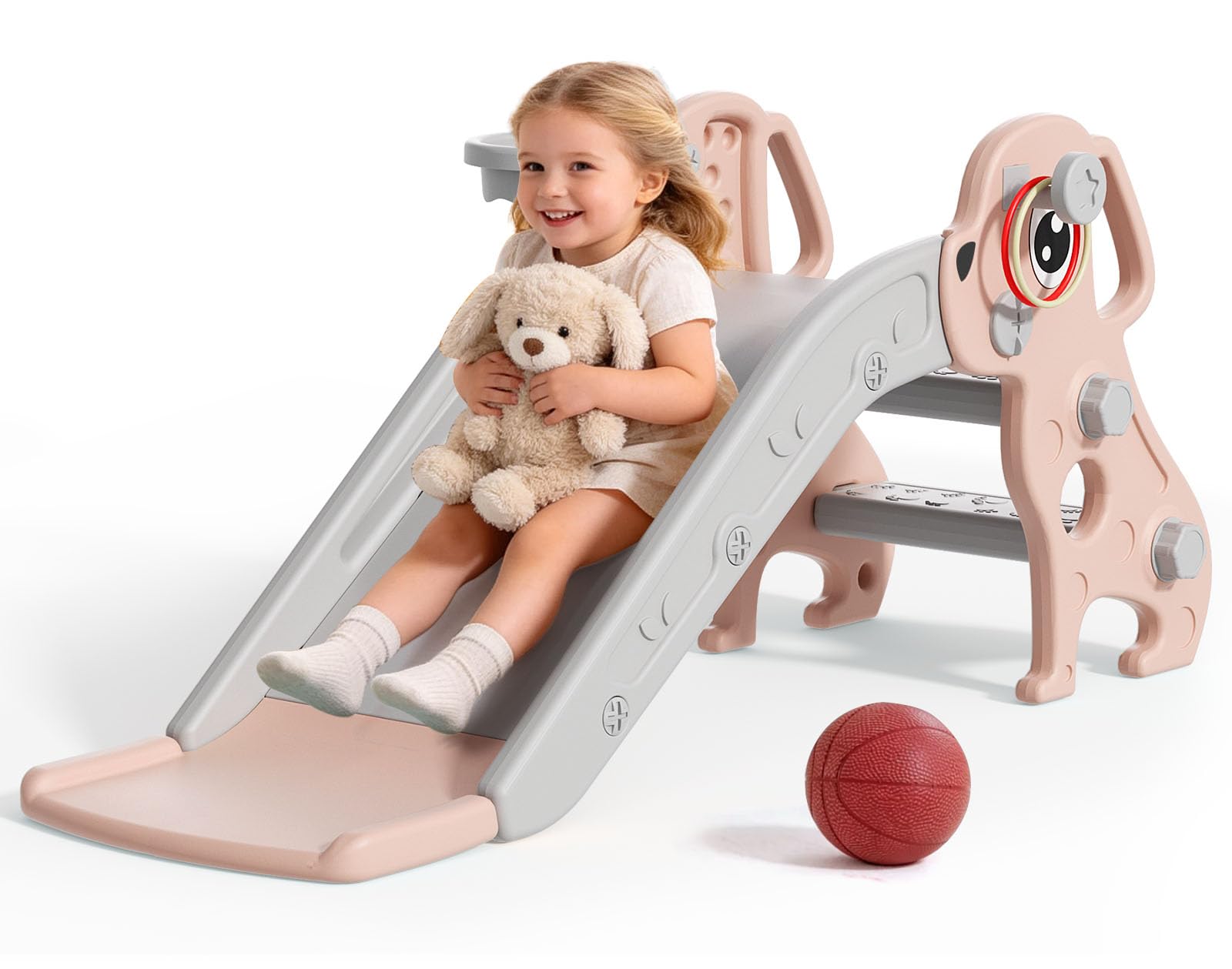
Onasti Kid Slide

Onasti Kid Slide

Small apartments

Doodle Score 9.4/10
Check Price

Worth Noting

  • Narrow 11-inch slide deck
  • Outgrown quickly after age three
Extra Play
Basketball hoop and ring toss
Weight Limit
110 lb
Assembled Size
49.21"L x 11.02"W x 25.98"H
Recommended Age
6 - 36 months
Read the full review

Eleven inches is the number that decides this one. The slide deck is the narrowest here, so a toddler sits in it with room to spare and a bigger child looks crammed. At 49 inches long and 26 high it is a small slide for small people, and it makes no apology for that.

What it does well is live in a small space. It folds, it weighs about thirteen pounds, and the platform is low enough that a nervous first-timer can be talked onto it. The 110-pound limit is generous for the frame, but the six-to-36-month recommendation is the honest one — past three, the run ends before the fun does.

We rank it behind the BIERUM 4-in-1 for a first slide, and the difference is the deck: the puppy slide gives a wobbly child more room to correct a bad turn. Where the Onasti wins is looks. The pale grey and pink palette is the only one here that does not announce itself as a toy the moment you walk into the room.

It also folds, which in an apartment is the whole argument. If the slide lives in a closet and comes out for twenty minutes at a time, the narrow deck matters far less than the footprint and the fact that you can put it away one-handed.

Bottom line: Worth considering for a flat or a small playroom: it folds away, sits low enough for a cautious toddler, and looks good enough to leave out, but it will not last past three.

#6

Little Tikes Easy Store Large Slide

Little Tikes Easy Store Large Slide

Growing toddlers

Doodle Score 9.2/10
Check Price

Worth Noting

  • Steps-to-base join takes real force to seat
  • Ladder can pop out of its base socket
Slide Length
5 feet
Weight Limit
50 lb
Recommended Age
24 months - 6 years
Folds For Storage
Yes
Read the full review

The join between the steps and the base takes serious force to seat, and the locking support arm needs a firm shove before it clicks home. That is the honest first impression of the Easy Store, and it is worth knowing before the box arrives: plan on a second adult for that step, and run a hand along the molded seams while the pieces are still loose.

What the effort buys is the longest folding slide in this group at five feet, with a gentle slope that lets a small child control the descent and a wide base that keeps the whole thing planted. The height is the real argument. It is tall enough that a four-year-old still gets a proper ride, which is precisely the problem the First Slide runs into, and the 50-pound limit and two-to-six range line up with that.

Stability divides opinion, and the ladder is why. The wide base and locking arm do their job on level ground, but the ladder can pop out of its socket when a child leans on it instead of climbing it. Seat it fully every time you set the slide up, check it again after the first week, and put it on grass or a mat rather than a slick patio.

It folds, which matters more at this size than it does on a small slide — folded, it leans against a garage wall out of the way. One last detail that surprises people: the slide surface runs slow. A light child may need a push to get going, and in exchange nobody arrives at the bottom too fast on damp grass.

Bottom line: Buy this when your child is three or older and the small slides already look like toys: five feet of run, a 50-pound limit, and a setup that wants a second adult.

#7

BIERUM 4-in-1 Puppy Slide

BIERUM 4-in-1 Puppy Slide

One-year-olds

Doodle Score 9.2/10
Check Price

Worth Noting

  • Narrow 15.7-inch deck
  • Little room to grow past age three
Extra Play
Basketball hoop and ring toss
Weight Limit
120 lb
Assembled Size
45.3"L x 15.7"W x 19.7"H
Recommended Age
12 months - 3 years
Read the full review

The platform sits 19.7 inches off the floor, roughly knee height on an adult, and that is the reason this works for a child who has only just started walking. From that height a slip is a tumble rather than a fall, and it changes how comfortable you feel about letting a toddler climb without a hand hovering behind them.

We like that it commits to being a small slide instead of pretending to be a big one. Forty-five inches long and just under sixteen wide, it fits along a wall, goes together by hand without tools, and gets the details right at this size: non-slip pads under the base, anti-slip treads on the steps. The 120-pound limit reads as absurd for a toddler slide until you realise it means the shell will not flex when a child stands on the deck.

The puppy shape could have been pure decoration and turns out to do a job. The raised side panels at the top give a wobbly one-year-old something to hold while they turn themselves around, which is the single hardest part of a first slide. The hoop and ring toss sit off to one side, so a child bored with sliding has somewhere to go without leaving the structure.

Buy it for the twelve-months-to-three window and accept that the window closes. A three-year-old's feet run past the end of the slide, and the narrow deck leaves little room to correct. As a first slide that lives in a playroom and comes out most of the day, though, the size and the amount of structure are pitched exactly right.

Bottom line: The best first slide for a one-year-old: a 19.7-inch platform low enough that a fall is a tumble, a short climb, and a hoop and ring toss that bring a two-year-old back.

#8

Babytronic 6-in-1 Slide

Babytronic 6-in-1 Slide

Maximum activities

Doodle Score 9.2/10
Check Price

Worth Noting

  • Plastic screws loosen with use
  • Smaller than photos suggest
Weight Limit
110 lb
Play Features
Slide, climber, hoop, telescope, hideout
Assembled Size
59"L x 27.6"W x 33.5"H
Recommended Age
1 - 3 years
Read the full review

Six activities in one footprint is the pitch, and the count is roughly honest: a slide, a climbing side, a basketball hoop, a telescope on the deck, and a crawl space underneath. The parts a two-year-old cycles through in an afternoon all sit within arm's reach of each other, which is why this keeps a child occupied longer than a plain slide does.

The shell is thick, and at twenty pounds this is one of the more substantial structures here. It assembles with plastic screws and no tools in about the time it takes to get dinner started, and at 59 inches long and 27.6 wide it sits between the small starter slides and the big backyard climbers.

Plastic screws are also the catch. They loosen with use, and a slide that wobbles is one a child stops trusting. The fix is boring and effective: go around the joints with a screwdriver every few weeks, and again after any session where a child has been standing on the deck.

We rate it the most feature-dense pick here for a one- to three-year-old, with one reservation — it photographs bigger than it is, and a tall four-year-old will be at the end of it. For the two years when a slide, a hoop and a telescope are all equally fascinating, it packs a lot of play into a small corner of a room.

Bottom line: The pick for a family who wants maximum activities in one footprint, as long as you will walk the plastic fasteners with a screwdriver every few weeks.

How We Tested a Dozen Kids Slides

We started with the slides that turn up most often in searches and parent forums, then filtered by the things you can check from a listing: age range, weight limit, footprint in inches, whether there's a handrail at the top, and price. Anything with a steep ladder and nothing to hold onto got cut before it shipped. Twelve slides made it through, from foldable toddler models to backyard climbers with a climbing wall, and we spent six months with them.

One adult assembled every slide, stopwatch running, using only the tools in the box; we counted the steps and noted where the instructions stopped matching the parts. We taped each footprint onto a playroom floor before unpacking, then measured the assembled slide to see whether the listing told the truth. Handles got watched closely — whether kids reached for the rail or grabbed the sides of the ladder, and whether a 2-year-old could actually reach it.

Stability separated them. Each slide went on carpet, grass, and hardwood, and we watched a 2-year-old and a 6-year-old climb while checking whether the base crept, tipped, or flexed at the joints. The wheeled and folding models got rolled across both surfaces to see if they tracked straight and whether the wheels locked firmly enough to stay put mid-climb. Durability came from leaving the outdoor slides out through rain and sun for six months, looking for fading, cracking, and screws working loose. Playability we mostly counted: how often each slide got used without prompting, and whether it held up for a toddler and an older sibling in the same week.

How to Choose Kids Slides

Start with platform height, not the age range

Age ranges on these boxes stretch from twelve months to six years, which is a marketing spread more than a fit guide. Platform height is the honest measure: the picks here run from 19.7 inches on the BIERUM puppy slide to 33.5 inches on the Babytronic, a span of well over a foot.

Use hip height as the rule. A platform that lands at hip level is comfortable now; once it sits at mid-thigh, the child has outgrown it. In practice that means a 19-to-23-inch deck is a one- to three-year-old's slide, and a 33-inch deck is for a four-year-old who wants speed. Photos flatten the scale badly, so read the number.

Slide length decides where the landing goes

A long slide is a gentler slope with a longer run-out; a short one is steeper and stops sooner. The Little Tikes First Slide gives 39 inches of run, the Arlopu 70.8 — that difference is not just speed, it is floor you cannot put a toy box on.

Plan the room around both ends. The ladder needs clearance behind it and the landing needs a clear stride in front, so measure the full length rather than the footprint of the base. And when a listing calls a slide compact, check whether it means folded or set up; on these products that word almost always means folded.

Folding, doorway fit, and the moving problem

Some slides fold down without tools — the First Slide, the Easy Store, the Onasti — and that is what lets a slide live in a closet and come out for half an hour at a time. Others are bolted structures that stay where you build them, and the Arlopu, Simplay3 and Babytronic all sit in that camp.

The Simplay3 adds a genuinely unusual trick: it fits through a standard doorframe, so a two-level climber can move from playroom to patio with the seasons. If your plan involves a doorway, measure it before ordering. If it involves a garage wall, measure the folded depth instead.

Fasteners, base shape, and the assembly evening

Molded one-piece shells and bolt-together frames behave differently after a year. Screws and plastic bolts back out on any slide a child jumps on, and a joint that has loosened makes the whole structure feel untrustworthy. A wide base, anti-slip feet and a locking support arm do more for stability than a heavier shell.

Assume an hour and a second adult for anything with a ladder, and check that the bolt holes are clear before you start rather than discovering a blocked one halfway through. Once it is up, walk the joints with a screwdriver every few weeks and set the slide on level ground, since a slope loads one side of the frame.

How much climbing you actually want

A single slide serves one child at a time and takes a minute to master. A climber with a ladder, a climbing wall and a deck gives two children somewhere to be at once, and the deck is usually where the pretend play happens — a steering wheel or a hideout under it extends the age range more than a longer slide does.

If you have two children close in age, spend the extra on the structure rather than the slide: the Step2 Woodland takes two on the deck and keeps a five-year-old interested, while a plain slide is done by four. If you have one toddler and limited floor, a plain slide is the better buy.

Frequently Asked Questions

Final Verdict

For most families the Little Tikes First Slide is the one to buy. It gives a toddler a real ride at a height they can climb alone, it weighs under ten pounds, and it folds without tools, so it survives in a house that does not have room for a slide.

Change the recommendation if your child is already three or tall for their age: the Little Tikes Easy Store Large Slide adds two feet of run and a taller deck, at the cost of a genuinely awkward assembly. And if you have a flat corner of a yard and two children under six, skip the slides entirely and put the money into the Step2 Woodland Climber II, which will still be in use when the small ones have been outgrown.