Outdoor Play

Best Bug Catching Kits of 2026

The chase is the easy part. It's the ten minutes after — a sweating kid, a yogurt cup, a lid that never quite fits — that decides whether the bug goes back in the garden or escapes under the car seat. A decent kit fixes that: a lid that locks down, vents that actually let air through, a handle a small hand can hold on to. My team and I spent the past three months handing 14 kits to kids between four and nine, then standing back and watching what happened.

What surprised me is how little the net matters. Kids flip the habitat upside down to study a beetle, swing it by one finger, set it on the driveway and forget it — and the kits that looked the part, with bright colors, decals, and a magnifying top, were usually the ones that gave out first. The gap between a kit kids use once and one they drag out every evening comes down to a few unglamorous parts. The ones built to take that kind of handling are below.

#1

B. toys Bug Bungalow

B. toys Bug Bungalow

First-time bug hunters

Doodle Score 9.6/10
Check Price

Worth Noting

  • No net, so flying insects are out of reach
  • Mesh house suits short viewing, not long keeping
Pieces
4
Includes
Mesh case, magnifying container, tweezers, magnifier
Age Range
3 to 8 years
Case Size
7.8 x 5.7 x 8.85 inches
Read the full review

Seventeen-piece kits look like better value in a listing. This one is four pieces, and it is the kit we hand to a three-year-old first. A mesh bungalow, a clear pot with a magnifying lid, a pair of tweezers and a hand magnifier — nothing to assemble, no batteries, no net to untangle from a bush.

The door is what earns it the top spot. It rotates open with a thumb, so a preschooler can drop in a ladybug without an adult holding the lid, and the catch stays put once it is shut. The handle on top matters just as much: the house becomes something to carry, which means the hunt keeps going instead of ending at the first capture.

Durability is the other reason it is here. We have not seen a better record in this group — multiple years of use, toddler handling, the kind of treatment that snaps thinner plastic. The magnifying lid does the teaching, too: a pill bug's segments are obvious without tipping it out.

What it does not include is a net, so butterflies and fast fliers are out of reach; for beetles, roly-polys and anything slow enough to scoop, the tweezers and pot are plenty. The mesh sides also make this a look-and-release house rather than a permanent terrarium — plan on an afternoon, then put the bug back where it came from.

Bottom line: Our pick for a first kit: four tough pieces, a door a three-year-old can work alone, and a handle that turns a catch into a carried treasure.

#2

National Geographic Bug Catcher Kit

National Geographic Bug Catcher Kit

Watching and observing

Doodle Score 9.4/10
Check Price

Worth Noting

  • Smaller in hand than the photos suggest
  • One habitat means one viewer at a time
Includes
Catching net and tweezers
Age Range
4 years and up
Habitat View
360 degrees
Built-in Magnifiers
2
Read the full review

The habitat is the reason to buy this one. It is a clear container with a 360-degree view, a removable base and two magnifying viewers built into the lid, so a child can watch a spider work from any side without opening anything. Of the containers in this group, this is the best one to look through.

The catching side is covered by a net and tweezers, and the habitat is roomy enough for the usual backyard cast — ladybugs, worms, a grasshopper — with a latching lid that stays down. A base that comes off makes emptying and rinsing it far less of a chore than the one-piece cages here.

The thing to know before ordering is the footprint. It is smaller in hand than the photos suggest, and a big grasshopper fills a good part of the view; with one habitat, only one child gets the magnified look at a time. What we appreciate most is that the whole kit is built around observation rather than collection — it pushes a child toward catching, looking hard and letting go, which is the habit you want a backyard naturalist to learn first.

Bottom line: Our pick when the fun is in the looking: a 360-degree habitat with two magnifiers and a latching lid, so a child can study a catch without handling it.

#3

ibwaae Wooden Bug Catcher Kit

ibwaae Wooden Bug Catcher Kit

Long-term gifting

Doodle Score 9.4/10
Check Price

Worth Noting

  • Net-rod screw and viewer hinge are weak points
  • One of the heavier kits here
Extras
Organizer ring, retractable net
Pieces
10
Material
Wood
Age Range
4 years and up
Read the full review

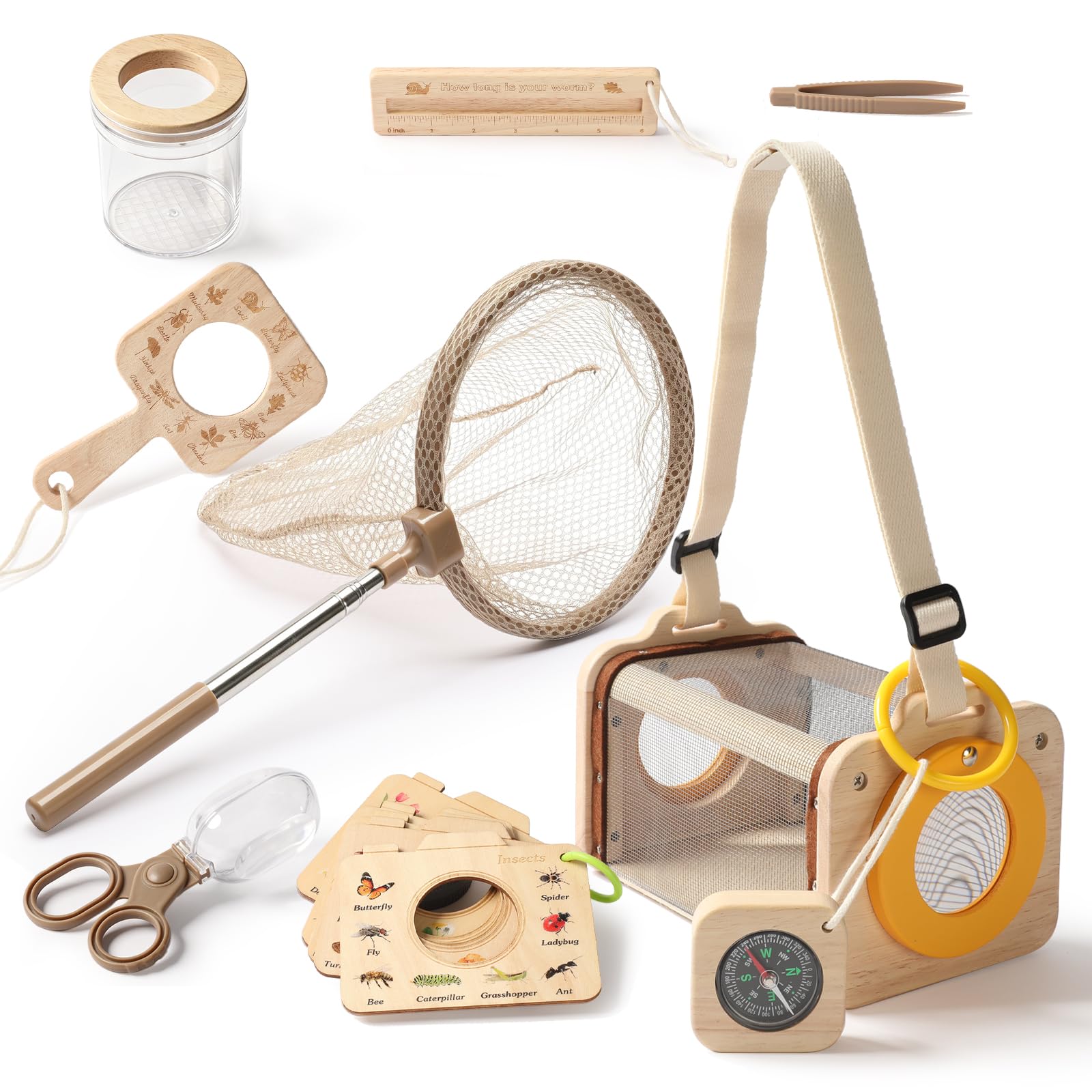
The first thing you notice is that it is not plastic. Ten pieces in wood — a bug house, tweezers, a clamp, a compass, a magnifier and a retractable net — and for a present that has to survive being handed to a grandchild, that changes the calculation.

The organizer ring is the detail we appreciate most. Every tool clips onto one loop, so the net, the tweezers and the magnifier come back inside together instead of being left in the grass. The retractable net is the other good piece of thinking: it collapses for the walk home instead of dragging behind a bicycle.

On build, the moving parts are where this one has come unstuck. The screw on the net rod and the hinge on the scissor-style viewer are the two places to check when it arrives and to keep an eye on afterward; a hinge can work loose with a determined child on the other end of it. Real wood takes knocks better than thin plastic, but it adds weight — this is one of the heavier kits here for small hands — and it does not read as a toy that gets thrown out with the wrapping paper, which is the whole point of paying more.

Bottom line: For a gift that should outlast the birthday, this wooden set earns it: ten pieces that pack onto one ring, with real material where the usual plastic would be.

#4

Biubee 2 Sets Bug Catcher

Biubee 2 Sets Bug Catcher

Two kids at once

Doodle Score 9.4/10
Check Price

Worth Noting

  • Bug box is small for larger critters
  • Spare set is wasted on an only child
Sets
2
Box Size
6.1 x 3.35 x 3.74 inches
Strap Length
Up to 31.5 inches
Pieces Per Set
4
Read the full review

Two of everything is the entire point. Biubee sells this as two complete kits — each with a bug box on an adjustable strap, a scissor-style capsule catcher, a net and tweezers — which is the version of this purchase that ends the argument over whose net it is.

The strap does more than the listing suggests. It runs out to about 31.5 inches, long enough for a five-year-old to wear the box across the body and keep both hands free for the net, which turns a carried box into a hunting kit. This is the pair that goes to the park in one bag and comes home with two children arguing about who caught more.

The caveat is size. The box measures about 6.1 by 3.35 by 3.74 inches, so a couple of beetles and a spider is a realistic load, and if you have one child, half of this purchase is a spare. For siblings, cousins or a pair of friends, that spare is exactly what you want. Everything is light plastic, which is the right call: the whole kit disappears into a tote bag, and a kid will carry it to the end of the street and back without asking you to hold it.

Bottom line: The sibling answer: two complete, wearable kits in one box, so nobody stands around waiting for a turn with the net.

#5

ESSENSON 2 Pcs Bug Cage

ESSENSON 2 Pcs Bug Cage

Car and travel

Doodle Score 9.2/10
Check Price

Worth Noting

  • Hatch leaves a gap small insects escape through
  • Whistles add little to a bug hunt
Sets
2
Age Range
3 to 9 years
Cage Size
7.5 x 3.5 x 3.5 inches
Magnification
2x
Read the full review

Two mesh cages, two magnifiers, two tweezers and two bags of plastic bugs: this is the doubling-up kit, right down to the throwaway pieces.

The cage is a flat 7.5 by 3.5 by 3.5 inches with mesh sides and a 2x magnifier in the frame, so it slides into a backpack better than the round habitats here, and the rotating hatch on top is easy for a small hand to work. The fake bugs are a nice touch for a first hunt — they go in the cage before anything with legs does.

Our reservation is the hatch. It does not seal tightly, and small insects can work their way out through the gap; a firefly will find it, a toad will not. For beetles, roly-polys and the kind of backyard haul most kids come back with, it does the job. Where it earns a place is as the second kit — the one that lives in the car or at Grandma's house, ready when a mood strikes. It is not the one we give as the main present, but it is the one we are glad to have in the trunk.

Bottom line: A pair of flat, backpack-friendly cages with the tools to fill them — the kit we keep in the car for an unexpected afternoon outside.

#6

HAIMST 17 PCS Bug Catching Kit

HAIMST 17 PCS Bug Catching Kit

Budget starter kit

Doodle Score 9.0/10
Check Price

Worth Noting

  • Short net and small box limit bigger hunts
  • Light plastic build
Pieces
17
Viewer
Magnifying lid
Age Range
3 to 8 years
Artificial Insects
12
Read the full review

Twelve plastic insects come in the box, and they turn out to be the smartest part of the kit. A four-year-old can run a whole hunt in the living room, learning how the capsule clip opens and shuts, before anything with legs is involved.

The other five pieces cover the real thing: a viewer box with a magnifier in the lid, a hand magnifier, a butterfly net, tweezers and a scissor-style capsule clip that closes around an insect instead of pinching it. The clip is the piece we rate highest here — it is what lets a nervous kid pick something up without a chase or a squash.

It is a small kit. The net is shorter than the ones on the bigger sets here, the box is not much bigger than a fist, and the plastic is at the light end of this group. For a five-year-old working a backyard that is fine; a seven-year-old trying to sweep a meadow will notice the difference.

What we like is that it covers the whole sequence — catch, hold, magnify — in one small box, and the plastic bugs mean it works on a rainy afternoon, which the catching-only kits here cannot claim.

Bottom line: A good first kit for a small backyard hunter: a gentle capsule clip, a magnifying viewer, and twelve plastic bugs to practice on before the real thing.

#7

Nature Bound Bug Vacuum Kit

Nature Bound Bug Vacuum Kit

No-touch catching

Doodle Score 8.8/10
Check Price

Worth Noting

  • Runs on AA batteries; spares are essential
  • Priciest kit in this group
Light
Built-in LED
Power
AA batteries
Age Range
3 to 13 years
Catching Method
Battery-powered vacuum
Read the full review

A vacuum looks like overkill until you picture the child who will not touch a beetle. This kit puts a small battery-powered vacuum in their hand — no net, no tweezers, no negotiation — and the bug ends up in the habitat without anyone having to grab it.

The rest is built around that idea: a habitat with dual magnifying lenses, a built-in LED for hunting after dusk, and a carabiner clip for a belt loop. It runs on AA batteries, which is the practical detail that decides whether it comes to the park — a spare pair in a pocket is the difference between a working vacuum and a plastic tube.

Our view is that this is worth the money for exactly one kind of kid. A child who happily grabs a beetle does not need the electronics, and a net does more for butterflies. But the child who shrieks and backs away does not use a net at all; this keeps them in the hunt, and that is worth more than the tools it replaces.

It is also the biggest thing to carry here, at roughly 11 by 5 by 8 inches and about 1.2 pounds, so it lives in a backpack rather than a pocket and a small child will want both hands for it.

Bottom line: The one we hand to a kid who will not touch bugs: a gentle vacuum, an LED for dusk, and a magnifying habitat that keeps the catch contained.

How We Tested 14 Bug Catching Kits

We started with research, reading through listings and spec sheets for roughly 40 kits and checking what actually came in the box — net, habitat, tweezers, magnifier, strap — plus how each one was assembled. Anything with glued-on mesh, a lid without vents, or a container a child couldn't open without adult help got cut. That left 14 kits, which we used from late spring through the end of summer.

Testing happened where these kits actually live: backyards, a neighborhood park with a creek, a school parking lot full of roly-polies, and one camping weekend. Four kids between four and nine were the primary testers, with adults handling the netting and the cleanup. Kits got dropped on pavement, carried by one finger, left in the sun, and stuffed into backpacks alongside snacks.

The lids came first. Each habitat got turned upside down, shaken, and carried by the handle to see whether anything slipped past the seal, then checked for condensation after an hour in the shade — too few vents and the critters fog up, too many and the smallest ones escape. We noted whether a five-year-old could open and close it alone without pinching a finger. Size was next: whether a full container was manageable for a small kid or turned into a two-hand waddle to the porch.

Durability and build quality came down to handling. We flexed the net rims, pulled gently on the mesh, and inspected seams and hinge pins at the end of each week. Value meant counting what was genuinely useful — a magnifier that didn't distort, tweezers that closed flush, a net that didn't bend double on the first swing. Appearance got graded at summer's end rather than the start, because decals peel and bright plastic fades. The kits the kids reached for without being asked are the ones that made the list.

How to Choose Bug Catching Kits

The container decides what you can keep

Mesh cages breathe and squash into a backpack, but you view the catch through netting, and a loose hatch lets small insects out. A clear habitat with magnifiers built into the lid gives the best view — the National Geographic container is the strongest example in this group — and suits a child who wants to watch rather than collect. One trap: a kit described as compact usually means it fits a bag, not that it holds a grasshopper.

Think about the catch, too. A toad, a beetle and a roly-poly are fine in a mesh cage; a firefly or an ant needs a lid that closes tight. If your child's quarry is small, weight the latch above the size.

Match the catching tool to the child

A net is for butterflies and anything that flies; tweezers and capsule clips are for beetles and whatever lives under a log. The scissor-style capsule clip is the gentlest hand tool of the bunch — the two cups close around the insect instead of pinching it — and it is the piece we look for with a nervous four-year-old. A battery-powered vacuum skips the touching entirely, which matters for one specific kid and costs more than the rest.

Piece count is not usefulness

Seventeen pieces photograph well and half of them end up in the grass. Count what your child will actually carry: a net, one grabbing tool, a magnifier, a container. Big sets earn their place in two situations — two children hunting at once, or a child who wants the pretend-play pieces alongside the real ones. Otherwise the four-piece kit is the one that gets used, and the one whose parts you can still find in September.

The parts that break first

Failures cluster in the same places: the hinge on a magnifying lid, the clip that holds a lid down, the screw on a retractable net rod, and the joint where a net meets its handle. Check those four points when the box arrives and keep the kit out of sand. Wood takes knocks better than thin plastic but adds weight, and a heavier kit is one a small child sets down sooner.

Frequently Asked Questions

Final Verdict

Start with the B. toys Bug Bungalow. It is the kit we hand to a young child without a briefing: four pieces, a door that opens with a thumb, and a handle that lets the catch travel with them.

If the child would rather watch than chase, the National Geographic habitat gives a better view; if they will not touch a bug at all, the Nature Bound vacuum keeps them hunting. Buy for the kid you have, not for the biggest box.