Games & Puzzles

Best Travel Toys of 2026

The gate agent hasn’t called your row yet, and the snack bag is already empty. That’s the moment a travel toy has to prove itself: small enough to live in a backpack, quiet enough for a waiting room, and interesting enough to survive the return trip. I’ve watched travel toys lose their charm before the plane even boards, usually because a piece rolls under a seat or the novelty wears off in ten minutes. Over the past four months, my team and I put 16 travel toys through real trips and everyday outings, from airport gates to the back seat on a grocery run.

The keepers felt well made, had a clear game or open-ended play pattern, and were simple enough for a kid to open, play, and repack alone. I also noted suction cups and sticky pads that held on a tray table, sound that wouldn’t bother a seatmate, and colors that stayed bright after a week in a tote. At this price, they’re easy gifts, but value only counts if the toy survives the trip—and these did.

#1

Melissa & Doug Water WOW
Melissa & Doug Water WOW

Planes with toddlers

Doodle Score 9.6/10
Check Price

Worth Noting

  • Pages scratch and dull with heavy reuse
  • Four scenes are the entire pad
Size
6.1 x 10 x 1.18 in
Weight
3.68 oz
Water Pen
Refillable, stores in the cover
Reusable Pages
4
Read the full review

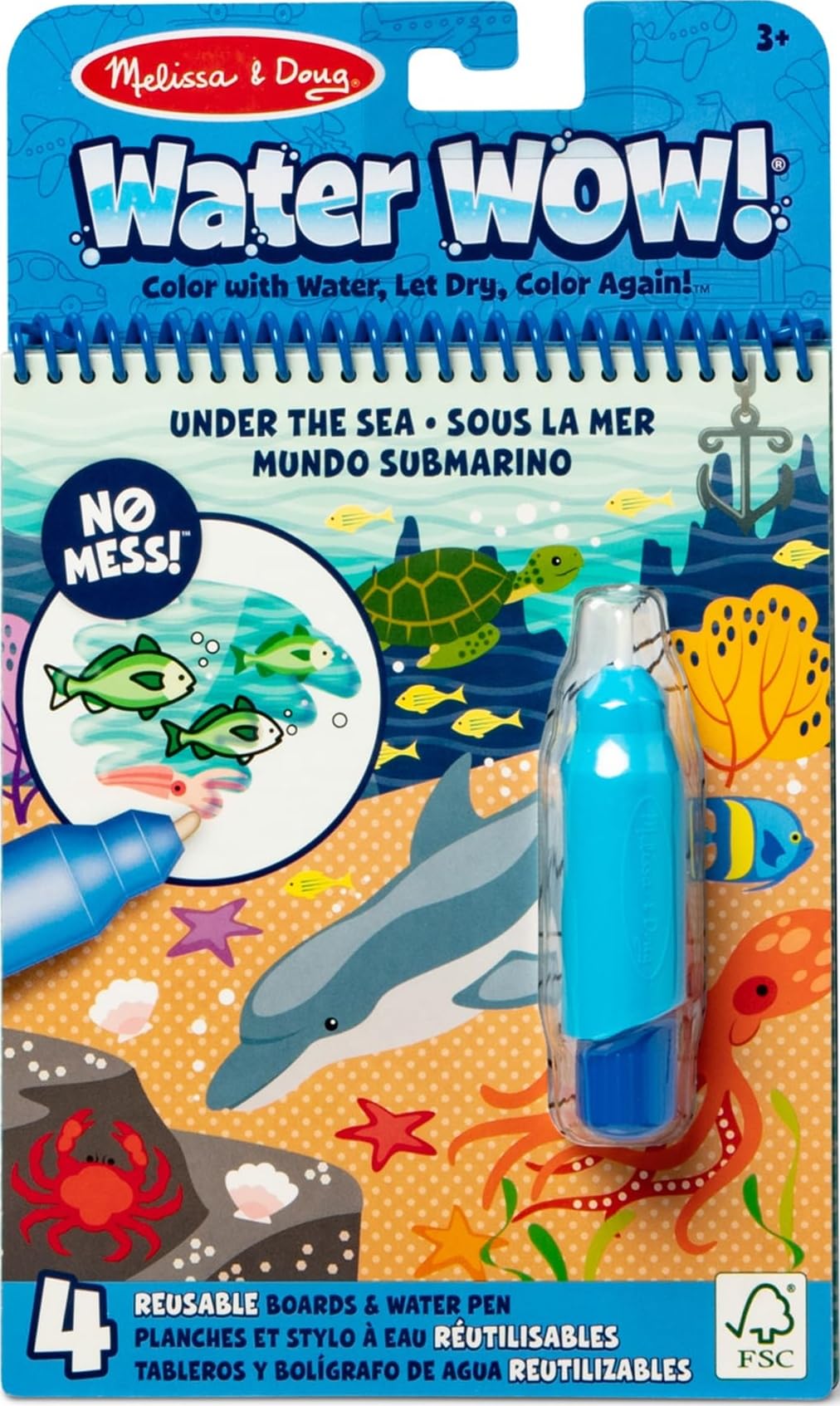
The tray table is the test that matters. Anything that needs a cap, a flat surface or a parent's hand on it ends up on the floor before the drink cart arrives. This pad passes because the only liquid involved is water: the pages are coated so color appears only where the wet pen touches, never on the seat, the armrest, or the sleeve that drags across it.

Physically it's a slim spiral pad, 6.1 by 10 inches and under four ounces, with a chunky refillable pen that slots into the cover, so there's no separate cap to lose in a seat-back pocket. Four ocean scenes, each with line art that colors up wet and fades back to blank as it dries. That reset is the whole trick: nothing gets used up, and the pad is ready again for the return leg.

Two things to know before you pack it. The page needs a few minutes to dry between rounds, so this is a cycle rather than an all-flight activity — hand it over, let it fade, hand it back. And the pen is refillable but not sealed, so fill it at the tap, cap it, and keep it upright in the bag.

We keep coming back to the format because it removes the job parents usually do on a flight: watching. There's nothing to spill, nothing to pick up, and no argument about putting a cap back on. For three- to seven-year-olds it's the surest bet in this guide. Below that, the pen becomes something to chew; above it, they'll want the Kanoodle.

Bottom line: For a toddler on a plane, this is the one we pack first: water only, no loose pieces, and it dries blank so it works again on the way home.

#2

LEGO Classic Creative Suitcase

LEGO Classic Creative Suitcase

Building on the go

Doodle Score 9.6/10
Check Price

Worth Noting

  • Only 213 pieces, so keen builders outgrow it
Case
Sorting compartments and carry handle
Pieces
213
Case Size
11 x 10 x 2 in
Recommended Age
4 years and up
Read the full review

A yellow suitcase with a handle and sorting compartments is a better idea than it sounds. Two hundred and thirteen bricks in an open tub become a footwell problem within a mile; sorted into this case they stay divided by color and shape, the lid closes, and a four-year-old can carry the whole thing himself. At 11 by 10 by 2 inches it's lunchbox territory, not backpack territory.

The bricks are the part we trust. They're standard LEGO, compatible with everything already in the house, and the included booklet has builds simple enough to follow without an adult reading aloud. The case hardware is where the set is weakest: the clasps and hinges are what give out, and a case that pops open in a bag leaves you collecting bricks from under a seat. A strap or a packing cube around it solves that — treat the closing clasp as a hint rather than a lock.

As a starter set it lands right for four- to seven-year-olds: enough colors to build something recognizable, few enough pieces to tidy up in a minute. Keen builders will run out of bricks quickly, and that's the honest limit of it.

Bottom line: If your kid builds rather than draws, this is the travel set: 213 bricks that live in a handled case with sorting compartments.

#3

LeapFrog 100 Words Book

LeapFrog 100 Words Book

Toddler word play

Doodle Score 9.6/10
Check Price

Worth Noting

  • Needs fresh AA batteries for a trip
  • Bulky at 9.4 inches square and 1.5 pounds
Size
9.4 x 9.2 x 1.9 in
Words
100+
Batteries
2 AA
Languages
English and Spanish
Read the full review

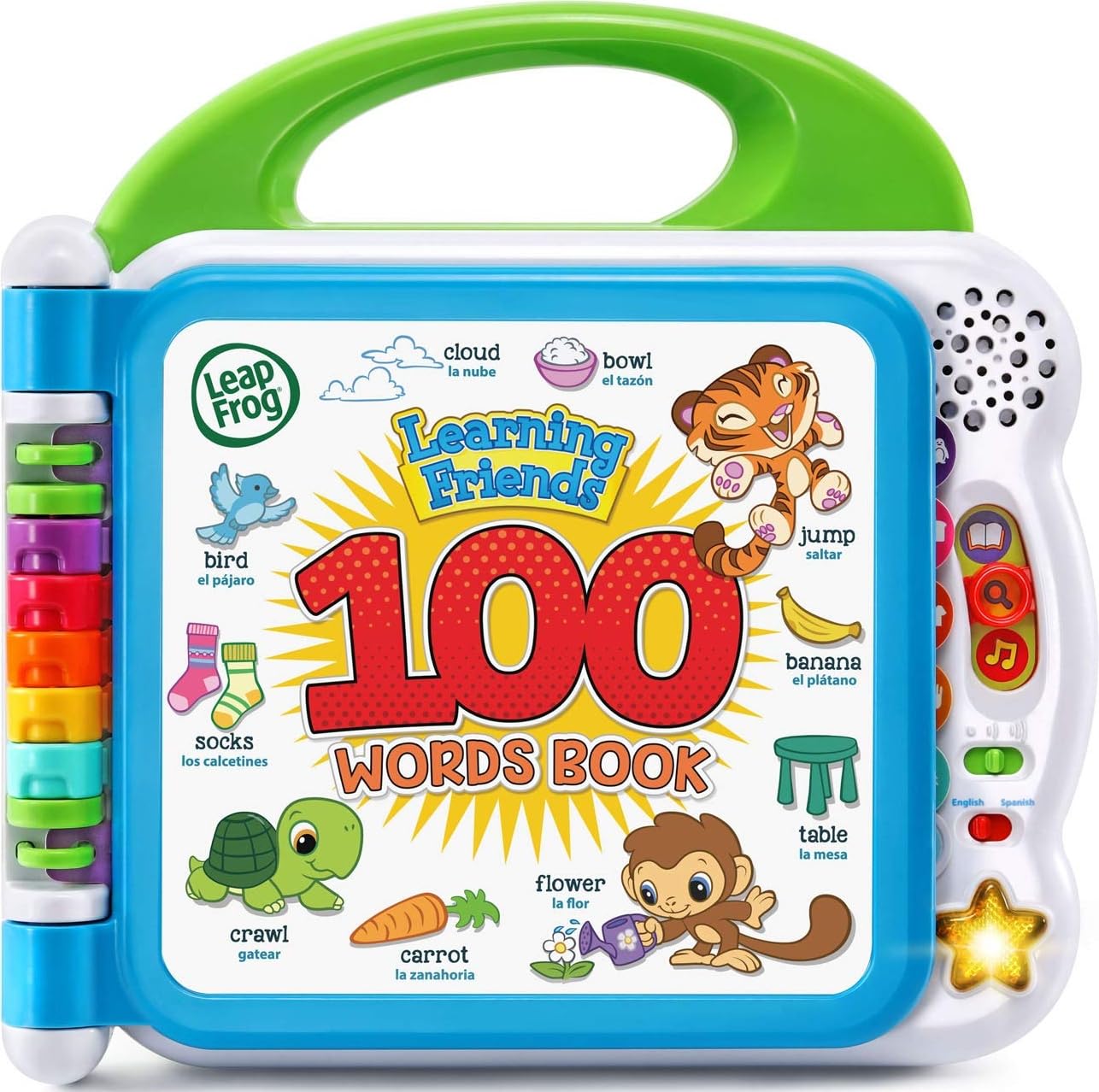
The switch on the side is what gives this book a second life. Every word, song and instruction plays in English or Spanish, so a child who has heard the English side a hundred times gets a new set of sounds out of the same pages, and a bilingual household gets both without buying twice.

The rest is straightforward in a good way. Touch a picture and it says the word, adds a sound effect, sometimes a fact; the categories run through pets, food, colors, opposites and outside; the light-up star plays the theme song. Parents can also set the book to help a child spell their own name, which is the detail that turns it from a generic toy into theirs.

Physically it's a 9.4-inch-square lap book at 1.5 pounds, running on two AA batteries. Demo cells come in the box, so put fresh ones in before a trip. It plays out loud through a volume dial rather than headphones, which matters in a quiet cabin or a restaurant — the recorded voice is pleasant at low volume and tiring at high.

It earns its place with the toddler who wants a job rather than a picture to look at: press, hear, repeat, and one object with nothing to lose in the seat crack. Past four, the vocabulary stops being new and the book stops earning its space in the bag.

Bottom line: Our pick for 18 months to three years: 100-plus words, two languages, and pages a toddler can turn without help.

#4

Crayola Color Wonder Set

Crayola Color Wonder Set

Mess-free coloring

Doodle Score 9.6/10
Check Price

Worth Noting

  • Limited, pale color palette
  • Markers and paper are the parts that run out
Stamps
4 stamps, 1 ink pad
Markers
5 Color Wonder
Coloring Pages
15
Sticker Sheets
2
Read the full review

Markers alone make a thin kit. What's worth carrying here is the stamp pad: five Color Wonder markers, four stamps and an ink pad, two sticker sheets and fifteen coloring pages, packed into a plastic case roughly the size of a lunchbox. Stamping breaks coloring into two activities, and two activities buy more minutes than a stack of blank pages.

The mechanism is the selling point. The ink stays clear until it meets Color Wonder paper, so it won't mark skin, clothing, upholstery or a restaurant table, and you can hand a three-year-old a marker without hovering. The trade is color: five markers means a limited, fairly pale palette, and that special paper is the only surface it works on.

So it's the right kit for the child who isn't trusted with real markers yet, in a place where a stray line is a problem — a hotel room, a grandparents' house, the back seat of a borrowed car. Pack spare paper, because the markers outlast the pages, and expect the ocean stickers to be repositioned more than once.

Bottom line: We think it's the right kit for a child not yet trusted with real markers: clear ink, Color Wonder paper, and a case that holds the lot.

#5

Kanoodle

Kanoodle

Quiet solo play

Doodle Score 9.4/10
Check Price

Worth Noting

  • Opening challenges are too easy for older players
Case
Doubles as the game board
Size
5.75 x 3.25 x 0.75 in
Pieces
12
Challenges
228
Read the full review

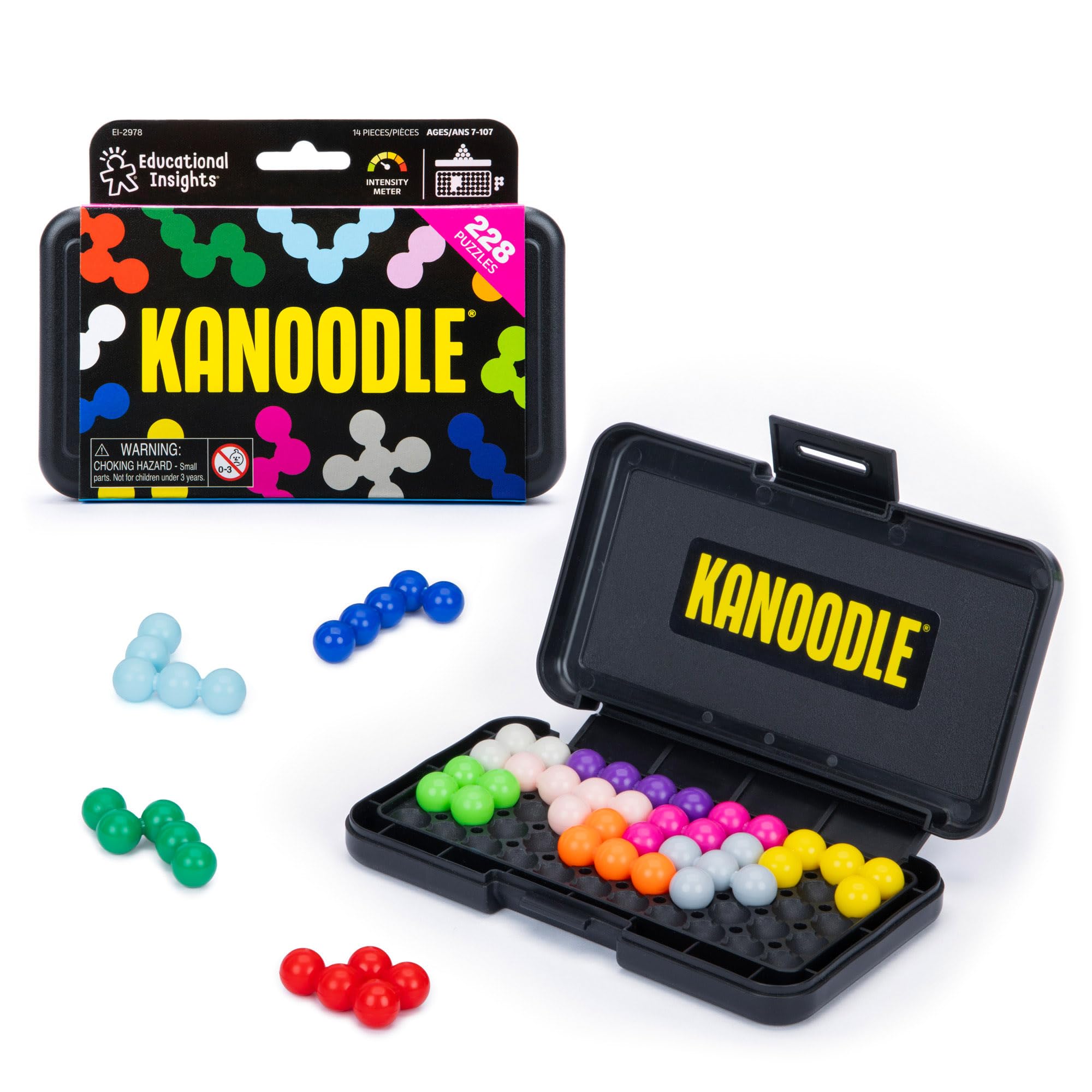
The case is why this works on a plane. It's a small plastic box — 5.75 by 3.25 by 0.75 inches — that flips open to become the play board and closes with all twelve pieces inside. Nothing rolls under a seat, the footprint fits a tray table, and at 3.2 ounces it disappears into a coat pocket. For our money it's the best-contained thing in this guide.

Inside is a small guide with 228 challenges, running from beginner to expert in both 2D and 3D arrangements. The ramp earns its keep: the opening puzzles teach the rules in a minute or two, and the last pages will hold an adult for a good while. A confident older child will find the first few cards too easy and skip ahead, which is a fair complaint but a short one.

It's a solo game, which is either the point or a dealbreaker. One child, one tray table, no sound and no screen — the quietest option here by a wide margin, and the only one an adult will genuinely play on a long flight. It suits seven and up; hand it to a four-year-old and you'll be the one placing the pieces.

Bottom line: We recommend it for the eight-year-old who has outgrown sticker books: 228 challenges, a case that holds every piece, no screen and no sound.

#6

Melissa & Doug Puffy Sticker Books

Melissa & Doug Puffy Sticker Books

Restaurant sticker play

Doodle Score 9.4/10
Check Price

Worth Noting

  • Stickers lose their grip after a few sessions
Size
8.2 x 0.6 x 11 in
Books
3 themed
Weight
9.6 oz
Stickers
65+ per book
Read the full review

What sells these is that there's nothing to drop. Each puffy piece presses onto a glossy fold-out scene and peels off again, so a four-year-old can dress and re-dress a mermaid without scattering a hundred bits across a restaurant floor. Three books — Dress-Up, Princess and Mermaid — with 65-plus pieces each, and a handle on every one.

The backgrounds fold out double-sided, which doubles the scenes without doubling the bag space, and the pieces are chunky enough for small fingers to place and move. Each book runs 8.2 by 11 inches, and the three together weigh 9.6 ounces, so this is a backpack item rather than a pocket one.

The catch is tack. Re-sticking holds well for the first few sessions, then the pieces stop gripping the glossy background and start sliding off the scene. That's fine for a trip — you'll get a holiday out of a set — but it isn't a toy that lives in the car for a year. Ages four and up; the little sandals and bows are not for a two-year-old.

Bottom line: We like these for the four-year-old at a restaurant table: three reusable sticker books, 65-plus pieces each, and nothing to pick up off the floor.

#7

Bluey Aqua Art

Bluey Aqua Art

Budget water reveal

Doodle Score 9.4/10
Check Price

Worth Noting

  • Brush pen needs a firm hand
Pen
Refillable water brush
Size
6 x 7.5 in
Pages
4 art, 4 story
Read the full review

This is the cheapest pick in the guide, and it doesn't feel like a compromise. An eight-page spiral pad — four picture sheets to reveal and four story sheets — plus a refillable water brush, all in a 6-by-7.5-inch book that slips into a diaper bag pocket and weighs almost nothing.

The pen is where the savings show. It's a brush tip rather than the fat pen on the Melissa & Doug pad, and it releases water stingily, so a child has to press and work at the page to pull color out. The pages still dry blank and reset like the pricier pads, and for a Bluey-obsessed kid the license is doing real work.

Our read: buy it for a fan, or as a spare that lives in the glovebox for unexpected waits, and accept that it's the second-best version of a good idea. If the water-reveal format is new to your child, the top pick is the sturdier first purchase.

Bottom line: We keep one of these in the glovebox: water-only Bluey pages that dry blank, in the smallest and least expensive package here.

#8

ALASOU Suction Cup Spinners

ALASOU Suction Cup Spinners

High chair entertainment

Doodle Score 9.4/10
Check Price

Worth Noting

  • Suction fails on textured or curved surfaces
  • Cup can separate from the spinner body
Spinners
3
Dimensions
5.52 x 3.47 x 5.2 in
Recommended Age
12 months and up
Read the full review

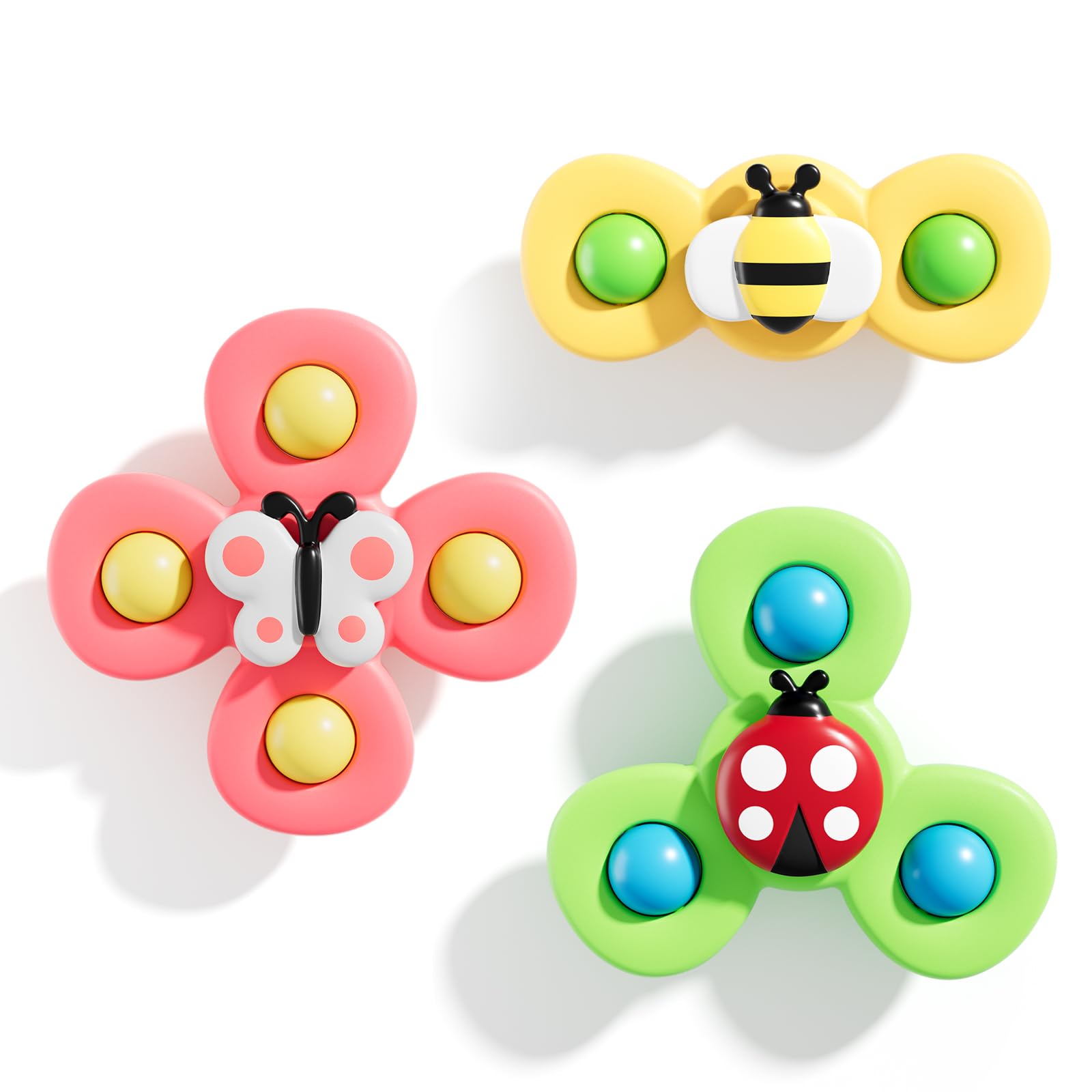
Three suction-cup spinners — butterfly, bee and ladybug — with rounded edges and a size built for a one-year-old's grip. Press one onto a high chair tray, a bathtub wall, a window or an airplane window and a baby can spin it while you eat with both hands.

The suction is the whole product, so it's the thing to understand. Smooth glass, tile and hard plastic hold well; textured, curved or dusty surfaces don't, and a drop of water on the cup improves the grip. The cup can also come free of the spinner body, so mount them where a fall lands on a tray or a floor rather than on a face.

For the 12-to-24-month crowd this is the only thing here that doesn't need a lap, a table or a parent's attention, which is why it earns a spot despite the finicky cups. Past two, the spinning stops holding them and you're better off with the peg of a sticker book.

Bottom line: This is the one we hand a one-year-old: three suction spinners for a tray or a window, and the only pick here that needs no lap.

How We Tested the Best Travel Toys

My team and I started with a shortlist of travel toys parents, teachers, and gift guides kept mentioning, then filtered out anything too bulky, too loud, or too screen-dependent. We narrowed it to 16 toys that packed small, had few loose pieces, and offered more than one way to play. Over four months, we rotated them through airport gates, back-seat drives, restaurant booths, and hotel rooms after bedtime with kids from toddlers to early elementary age.

We packed each toy into a tote with a snack cup and a change of clothes and noted whether it came back with all its pieces. A toy scored well if a kid could open, set up, and repack it alone; we timed that first solo attempt and watched for the moment the novelty wore off. On the return leg, we noted which toys got picked up again without prompting.

We dropped toys from table height, wiped them with baby wipes, and checked hinges, seams, and cards for fraying. We stuck suction cups and reusable stickers to tray tables, car windows, and restaurant tables, then checked whether they held through a snack and a bumpy ride. For electronic toys, we listened at the lowest volume in a quiet gate area and asked a seatmate if it carried. We also checked color appeal and whether the finish survived repeated wiping.

At the end, we compared how often each toy came back out against its cost relative to the rest of the group, and whether it arrived in packaging you could hand over as a gift without re-wrapping. The toys that made the list survived the trip, kept a kid engaged for more than ten minutes, and didn’t make me regret packing them.

How to Choose Travel Toys

Start With Mess, Not Features

A spill in a car seat turns into a roadside cleanup, and a marker line on a plane seat is worse. That's why water-reveal pads and clear-ink systems carry so much of this list: whatever happens, the damage stays on the toy. The trap is assuming any pad sold as mess-free works with any marker. Color Wonder ink only shows on Color Wonder paper, so a stray marker and a plain notebook are useless together.

If you're packing markers, pack the matching paper. If you're not, choose water — it's the one art supply that can't ruin the trip.

Check What Keeps the Pieces Together

Compact in a listing means it fits a backpack, not a seat-back pocket. Read the actual dimensions and compare them with the bag you carry and the space you'll really have. Then look at the closure, which is where take-along sets most often fail: a sorting case whose latch pops open is a footwell full of bricks, and a storage box with a lid that slides off is a puzzle on the floor.

If the case is merely a carry case, strap it or bag it before it goes in the trunk. We treat every clasp as a hint rather than a lock.

Match the Format to the Age

The age range on the box is the fastest filter and usually an honest one. One- and two-year-olds need something they can work alone — a suction spinner, a chunky book — with no small parts to swallow. Three to five is the sweet spot for water pads, clear-ink coloring and reusable stickers. Six and up can handle a logic puzzle or a brick set, which is where a toy like Kanoodle starts paying off.

Buying a seven-plus puzzle for a four-year-old doesn't make it a four-year-old's puzzle. It makes it yours.

Decide How Loud and How Social

A talking toy in a quiet cabin is a gamble even with a volume dial. If sound is part of the appeal, save it for the car or a busy restaurant. The second question is who's playing: a single-player puzzle keeps one child occupied while a sibling watches, whereas a brick case has enough pieces to split between two.

For two children close in age, two cheap pads beat one expensive set every time. We plan for the second player rather than hoping they'll share.

Budget for What Runs Out

The purchase is only part of the cost. Water pads reset and cost nothing after the first buy; Color Wonder paper and markers are consumables; battery toys need fresh cells before a trip; sticker sets lose their tack after a few sessions. A sensible travel bag holds one reusable item that never runs out and one consumable that's genuinely new.

That pairing covers a long delay without a shopping trip at the airport. We'd rather...

That pairing covers a long delay without a shopping trip at the airport. We favour one resettable activity plus one that gets used up.

Frequently Asked Questions

Final Verdict

Start with the Water WOW pad. It solves the three things that make travel toys fail — mess, loose pieces and a parent who has to hold everything — and it resets itself for the trip home.

If the child in question is seven or older, Kanoodle is the better buy: smaller, silent, and hard enough to matter. And where building beats drawing, the LEGO suitcase is the one to strap shut and take.