Games & Puzzles

Best Puzzles for Toddlers of 2026

Toddler puzzles tend to reveal their flaws quickly. Hand a 2-year-old a puzzle with pieces that are too small and you'll spend the afternoon fishing them out of a mouth; hand over one that's too easy and it gets solved twice and abandoned under the couch. The right one does something better — it buys you a quiet ten minutes while your kid works on a pincer grip, learns that a duck isn't a horse, and gets the small satisfaction of dropping the last piece into place. The wrong one is a chewing hazard with a picture on it.

I've watched a lot of puzzles pass through a lot of toddler hands, mine and my team's, and the rule that keeps holding up is that piece size beats piece count every time. We put 14 puzzles in front of kids from about 18 months to 3 years over four months, and the ones that earned repeat play were the ones a child could actually get their fingers around. A chunky 12-piece outperforms a dainty 24-piece at this age, and a matching picture underneath keeps a toddler in the game long after the novelty wears off. What follows survived the mouthing, the throwing, and the boredom.

#1

Melissa & Doug Farm Animals Chunky Puzzle

Melissa & Doug Farm Animals Chunky Puzzle

Ages 2–4

Doodle Score 9.8/10
Check Price

Worth Noting

  • Paint can chip with heavy chewing
Pieces
8 chunky pieces
Material
Engineered wood
Board Size
8.2 x 11 in
Recommended Age
2–4 years
Read the full review

The farm animals stand up on their own, and that is the detail that makes this puzzle more than a board. Eight chunky pieces fit into a wooden farm scene, with a full-color picture underneath each cutout so a 2-year-old can see where the cow or the tractor belongs. We like that the pieces keep working after the board is full: the cow, sheep, and pig can become play figures in a toy barn. That double duty is why it holds attention longer than a plain peg puzzle.

The grip is right for the age. The pieces are thick enough for a whole-hand grab, and the pictures underneath let a child self-correct without an adult hovering. We noticed the animals are colored like real animals, which gives you something to name and talk about while the puzzle is being solved. The board is a tabletop size, roughly 8 by 11 inches, so it fits on a highchair tray or a small table without taking over the room.

It is not a snap-together jigsaw; the pieces sit in cutouts and can spill if the board is tipped. That is normal for this kind of puzzle, and the trade-off is a board that is easy for small hands to reset. For a 2- or 3-year-old who has moved past heavy mouthing, the board and pieces are ready for daily use. It is also the rare toddler puzzle that gets played with after the pieces are back in the board.

Bottom line: This is the toddler puzzle we recommend first for a 2-year-old: eight chunky farm animals, matching pictures underneath, and pieces that stand up for pretend play.
#2

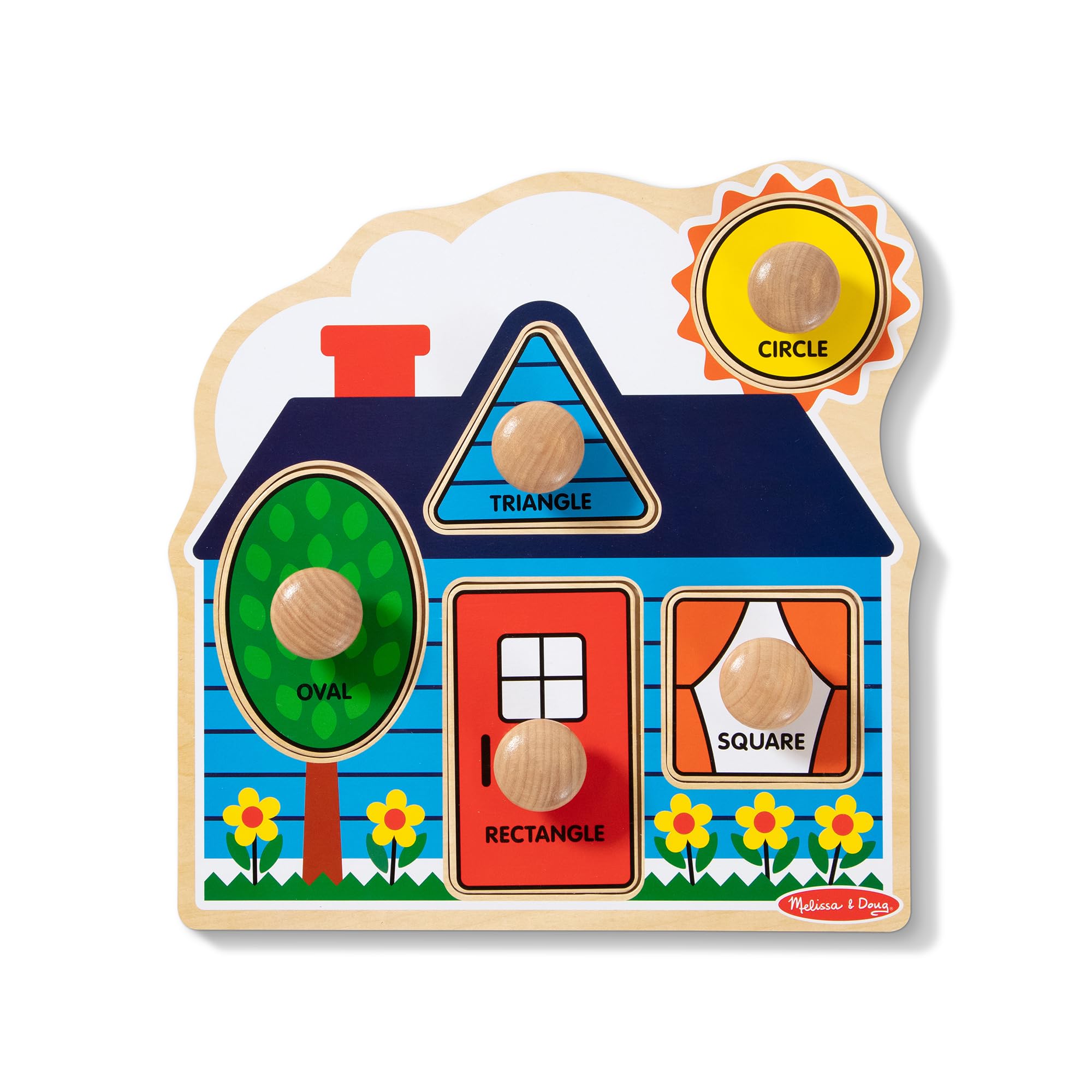
Melissa & Doug First Shapes Jumbo Knob

Melissa & Doug First Shapes Jumbo Knob

Ages 1–2

Doodle Score 9.4/10
Check Price

Worth Noting

  • Only five pieces, outgrown quickly
Pegs
Jumbo wooden
Pieces
5 jumbo-peg pieces
Material
Wood
Recommended Age
12–24 months
Read the full review

Most puzzle advice starts at age two. This one is built for the 12-to-24-month crowd, and the jumbo knobs are the reason it works. Five extra-thick shapes sit in a wooden board, each with a big wooden peg that a small hand can wrap around rather than pinch. The pictures underneath give a visual clue, but the real win is that a 1-year-old can pull a piece out and put it back without needing a perfect grip.

We like how quickly the puzzle can be finished. Five pieces is the right length for a child who is still learning that a puzzle has a beginning and an end, and the familiar circle, square, and triangle shapes keep it from becoming a test. The board is sturdy enough to take a bang or a drop, and the pieces are thick enough that they do not feel fragile in a toddler's hands.

The printed surfaces are the weak point. If your child is a heavy mouther, the decals can lift, so check the pieces after play and retire any that are peeling. For a child who mostly grabs, stacks, and drops, the puzzle holds up well. The five shapes are also a nice excuse to name colors and shapes during clean-up, which stretches the value beyond the board.

Bottom line: For a 1-year-old, the jumbo knobs and five thick shapes make this the easiest first puzzle here; watch the printed surfaces if your child mouths pieces.

#3

Bekayshad 6-Pack Animal Jigsaws

Bekayshad 6-Pack Animal Jigsaws

First jigsaws

Doodle Score 9.4/10
Check Price

Worth Noting

  • Pieces are smaller than expected
Pieces
34 total
Puzzles
6 animal jigsaws
Puzzle Size
5.8 x 5.8 in
Recommended Age
12 months–8 years
Read the full review

Six separate 5.8-inch animal puzzles come in one box, and that is the useful part: you can hand over one bear or one frog instead of dumping 34 pieces on the floor. We like the built-in progression. A child who is still learning how jigsaw pieces fit together gets a small puzzle with a few pieces, not a 24-piece challenge that ends in frustration.

The animals are bright and easy to name, and the pieces are thick enough for a toddler's grip. Each puzzle is small enough for a highchair tray or a restaurant table, and the set is light enough to carry in a bag. The piece count is less intimidating than it sounds because it is spread across six puzzles; you can keep the rest in the box and offer one at a time.

This is a 2-plus set in practice. A 1-year-old who still mouths toys should not be left alone with it. If your child is past that stage, the six puzzles give you a gentle step up from a chunky board without jumping straight to a big jigsaw. The set also makes a good travel rotation because you can pack two puzzles and leave the rest at home.

Bottom line: These six animal jigsaws are the best first-jigsaw rotation here for a 2-year-old, as long as you treat the pieces as a 2-plus toy rather than a 1-year-old one.

#4

Zeoddler Alphabet Puzzle

Zeoddler Alphabet Puzzle

ABC learning

Doodle Score 9.4/10
Check Price

Worth Noting

  • Letters can break under rough play
Letters
26 uppercase
Material
Wood
Board Size
8.7 x 11.7 in
Recommended Age
3+ years
Read the full review

Twenty-six uppercase letters across an 8.7-by-11.7-inch board is a lot of puzzle for a toddler, and that is the point: this is a preschool letter tool, not a first shape puzzle. We recommend it for the older end of the toddler range, when a child is starting to recognize their name and wants to match letters by shape.

The letters are cut to shape, so a child can feel the difference between an O and a Q while matching. The board is wide enough to sit across a lap, and the letters are big enough to pick up, though they are thinner than a chunky peg puzzle. That makes them better for a 3-year-old's pincer grip than a 1-year-old's fist. The colors are bright and the letter shapes are clear, which is what keeps a letter-obsessed child coming back.

The wood is the weak spot. A few boards arrive cracked or split, so check the edges before you hand it over. For a child who has mastered animal puzzles, it is still a useful step into letters. It is a puzzle to grow into, not one to pass down from a 1-year-old.

Bottom line: For a 3-year-old who is ready to name letters, this wide wooden ABC board makes matching tactile and satisfying; it is not a first puzzle for a 1- or 2-year-old.

#5

AugToy Shape Sorting Puzzle

AugToy Shape Sorting Puzzle

Shape sorting

Doodle Score 9.4/10
Check Price

Worth Noting

  • Some shape pieces can break
Boards
6 shape boards
Shapes
30 pieces
Board Size
5.7 x 5.7 in
Recommended Age
3+ years
Read the full review

Six separate shape boards is the reason this set works in a room with more than one toddler. You can hand out a flower board and a star board instead of refereeing one tray. We like that. The 30 shapes are split across the boards, so the piece count is less overwhelming than it sounds, and each board gives a child a clear finish line.

The shapes are colorful and the boards are small enough to move around a table. This is a 3-plus toy in our view, not a 1-year-old's first puzzle: the pieces are not jumbo, and a child who still mouths toys should not be left with them. For a 3-year-old who likes sorting and stacking, the separate boards make it easy to set up a shared activity without a fight over one puzzle.

The set is a good value for the amount of play it supports, especially if you have two children close in age. The separate boards also make clean-up a sorting game, which is a small bonus. It is a table toy, not a floor toy, and that is fine for a shape sorter.

Bottom line: This is the shape-sorting set we choose when two toddlers need to play at once: six separate boards and 30 shapes, with a durability caveat on the smaller pieces.

#6

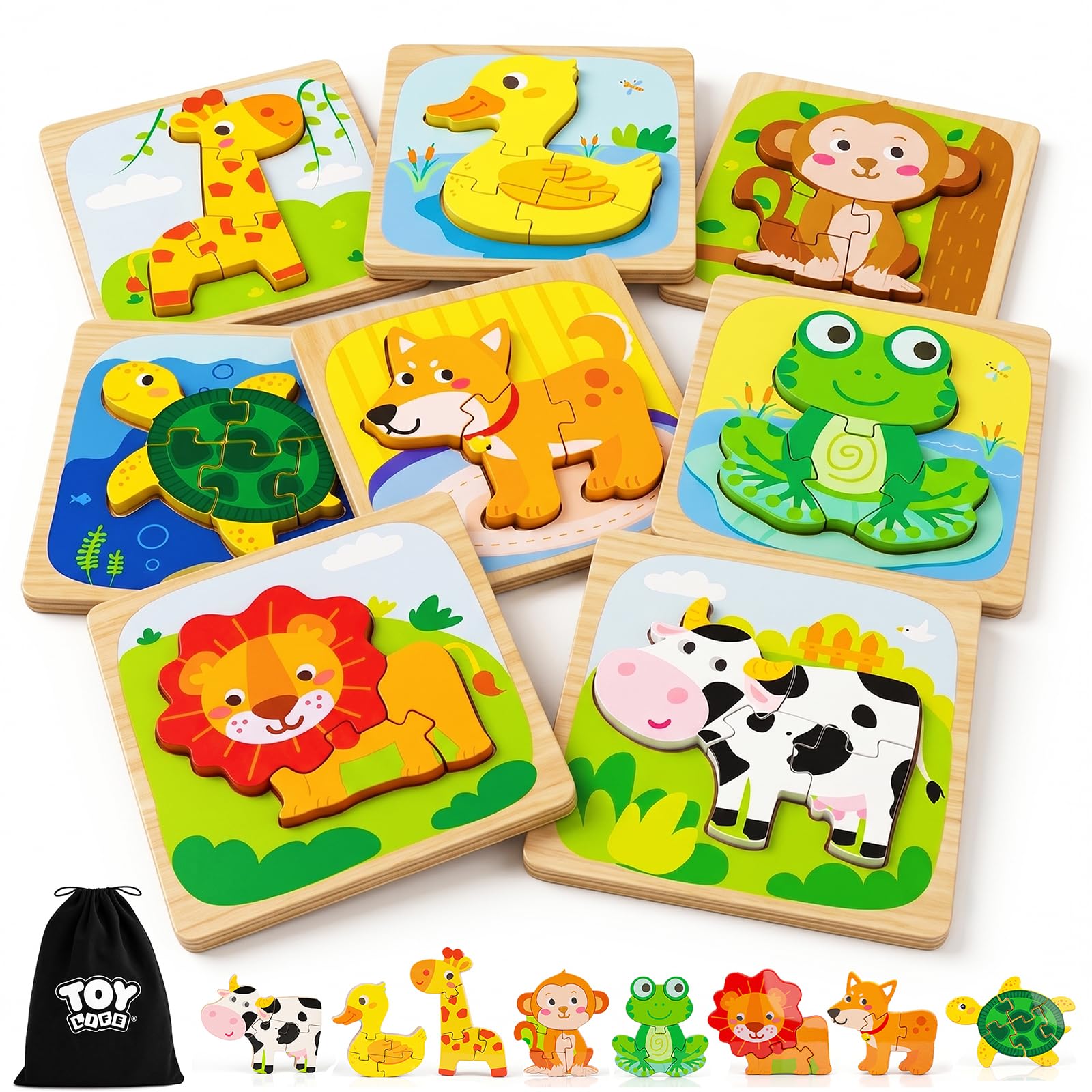
TOY Life 8 Animal Puzzles

TOY Life 8 Animal Puzzles

Animal lovers

Doodle Score 9.2/10
Check Price

Worth Noting

  • Pieces are small for 1-year-olds
Theme
Animals
Puzzles
8 animal puzzles
Material
Wood
Recommended Age
6 months–6 years
Read the full review

Eight separate animal puzzles in one box sounds like a lot, but each one is only a few pieces, so the set is really a stack of quick wins. We like it for the child who loses interest in a 24-piece jigsaw after two minutes. The animals are bright, the pieces are thick enough for little hands, and the set gives you a way to rotate themes without buying eight separate boards.

The puzzles are small, around 5.7 inches square, so they fit on a tray or a restaurant table. The difficulty varies by animal, which is useful for a child who is moving from two pieces to four; you can start with the simplest animal and add the others as their grip improves. This is also a set that can travel, because you can pack two puzzles and leave the rest at home.

The wide age range on the box is generous. The price is higher than a single-board puzzle, so it makes sense if you want a rotation, not if you want one puzzle. For a child who loves animals, the eight-puzzle format is the reason to choose it.

Bottom line: These eight little animal puzzles are a good rotation for a 2-year-old who wants to finish something quickly, with bright art and a simple first-jigsaw format.

#7

Yetonamr 6 Vehicle Puzzles

Yetonamr 6 Vehicle Puzzles

Vehicle fans

Doodle Score 9.2/10
Check Price

Worth Noting

  • Shallow cutouts let pieces lift easily
Puzzles
6 vehicle jigsaws
Material
Wood
Puzzle Size
5.7 x 5.7 in
Recommended Age
12 months+
Read the full review

Six vehicle puzzles in one box, each about 5.7 inches square, is a very specific pitch: a child who wants cars, trucks, and a puzzle that fits on a car trip. The set covers air, land, and sea vehicles, and the pictures are bright enough to hold attention.

The vehicle theme is the reason to choose it over the animal sets; if your child does not care about vehicles, the Bekayshad animals are a better first jigsaw. The pictures are bright, and the six puzzles cover air, land, and sea.

The compact format is the main trade-off. It is good for a restaurant or a car seat tray, but it is not a floor puzzle, and the pieces are smaller than a 1-year-old should handle. For a 2- or 3-year-old who is already comfortable with jigsaws, the small size is manageable.

We treat this as a supplement for a vehicle-obsessed toddler, not the only puzzle in the house. The six puzzles are easy to rotate, and the small format is easy to stash in a bag. It earns a place for the theme, not for the build.

Bottom line: A vehicle-themed set for the child who already loves cars and trucks; it is a supplement for 2- and 3-year-olds, not a first puzzle.

How We Tested the Best Toddler Puzzles

We started with puzzles from brands we already trust for toddler toys, then filtered by age label, piece thickness, and finish. Anything with a strong paint smell, rough edges, or pieces that looked like they'd sail through a choke-test tube came off the list before it ever reached a child.

The remaining 14 spent four months in real homes with kids between 18 months and 3 years. We handed them over during the pre-dinner fuss and the post-nap window, timing how long a child stayed with the puzzle, whether they solved it by picture cue or by trial and error, and whether they came back to it the next day. Every piece got measured with a ruler, dropped onto tile from counter height a dozen times, and soaked in water for an hour to see whether paint or laminate lifted. Baby wipes were part of the routine, which is how we caught the surfaces that went tacky or faded after a few weeks.

Difficulty rarely came down to piece count. A 12-piece with chunky pegs and a matching image underneath held a 2-year-old longer than a 24-piece with tiny knobs and no visual cue. We also noted how much setup each one needed out of the box — frames, boards, storage trays — and whether pieces still seated cleanly after months of being jammed back in by a toddler. Bright, high-contrast art got picked up first almost every time, and the puzzles whose color came from dyed wood rather than a printed surface were the ones still looking new at the end.

How to Choose Puzzles for Toddlers

Start with the grip, not the piece count

At 1, grip is the whole puzzle. Jumbo knobs and extra-thick pieces let a child pull a piece out and put it back before they have the fine motor control for a jigsaw. The First Shapes Jumbo Knob is the clearest example here: five pieces, big pegs, and matching pictures underneath. At 2, a chunky board like the Farm Animals puzzle still works because the pieces are easy to grab, but a simple jigsaw with four to eight pieces starts to make sense.

Be careful with the word compact. A multi-pack can say compact and mean a 5.8-inch puzzle, which is fine for a tray but small for a 1-year-old who mouths pieces. Check the puzzle size, not just the piece count, before you buy for the youngest toddler.

Match the challenge to the child, not the age on the box

Age labels are a starting point, not a promise. A 2-year-old who has mastered a chunky board may still need help with a 12-piece jigsaw, while another child will race through it. Multi-packs are useful because they let you stage the difficulty: the Bekayshad set gives you six small puzzles, and the TOY Life set gives you eight quick animal puzzles. Start with the puzzle that has the fewest pieces and add the next one when your child can finish without a prompt.

Alphabet and shape-sorter puzzles are a different kind of challenge. The Zeoddler alphabet board is a 3-year-old tool, not a first puzzle; 26 letters take patience and a pincer grip. If your child is still working on a four-piece animal, wait.

Durability lives in the pegs and the printed surfaces

Wood is a good sign, but it is not the whole story. The parts that fail are the pegs, the printed surfaces, and the thin pieces that take the most force. Before you buy, look at how the knobs are attached and whether the pictures are painted on or applied as decals. A puzzle with a lot of thin, decorative pieces will show wear sooner than a chunky board with simple shapes.

Storage matters too. A puzzle that spills every time it is moved does not get used. A board with a rim, a lidded box, or a tray that doubles as a puzzle surface all help. The Farm Animals board is easy to reset; a multi-pack needs a bag or bin to keep the pieces together.

Choose a theme your child already loves

Animals, vehicles, shapes, and letters are not interchangeable. A child who is obsessed with trucks will get more from the Yetonamr vehicle set than from a farm board, even if the farm puzzle is the stronger all-round pick. A child who is learning letters will get more from the Zeoddler alphabet board than from another animal puzzle. One theme they love beats a mixed set that never gets opened.

Keep the learning goal small. A toddler puzzle does not need to teach colors, shapes, animals, and counting at once. The best ones give a child one clear loop: pick up, match, finish, repeat. The Farm Animals puzzle does that with animals; the AugToy set does it with shapes.

Frequently Asked Questions

Final Verdict

The Farm Animals Chunky Puzzle is the one we recommend first for a 2-year-old: eight thick pieces, matching pictures, and animals that stand up for play after the board is full. If you need a 1-year-old option, the First Shapes Jumbo Knob is the better fit, with the printed surfaces worth checking. For a 3-year-old ready for letters, the Zeoddler Alphabet Puzzle is the step up.