Games & Puzzles

Best Mini Pinball Machines of 2026

A full-size pinball table needs a room, a dedicated circuit, and a friend with a truck. A mini pinball machine promises the same crack of the flippers and the same muttered curse when the ball drains, all in something you can set on a desk or a coffee table. The catch is that the category runs from genuinely well-built tabletop games to flimsy plastic shells that buzz, rattle, and send the ball straight down the middle no matter what you do.

I've played a lot of bad ones. Over the past four months, my team and I assembled, played, and lived with 11 mini pinball machines — some arrived as flat packs of parts, a couple were nearly ready to go out of the box. The ones worth keeping all had flippers with enough snap to actually aim the ball, and that turned out to be rarer than it should be. A few are genuinely fun; a few are the kind of gift that gets played twice and then parked on a shelf. The picks below are the former.

#1

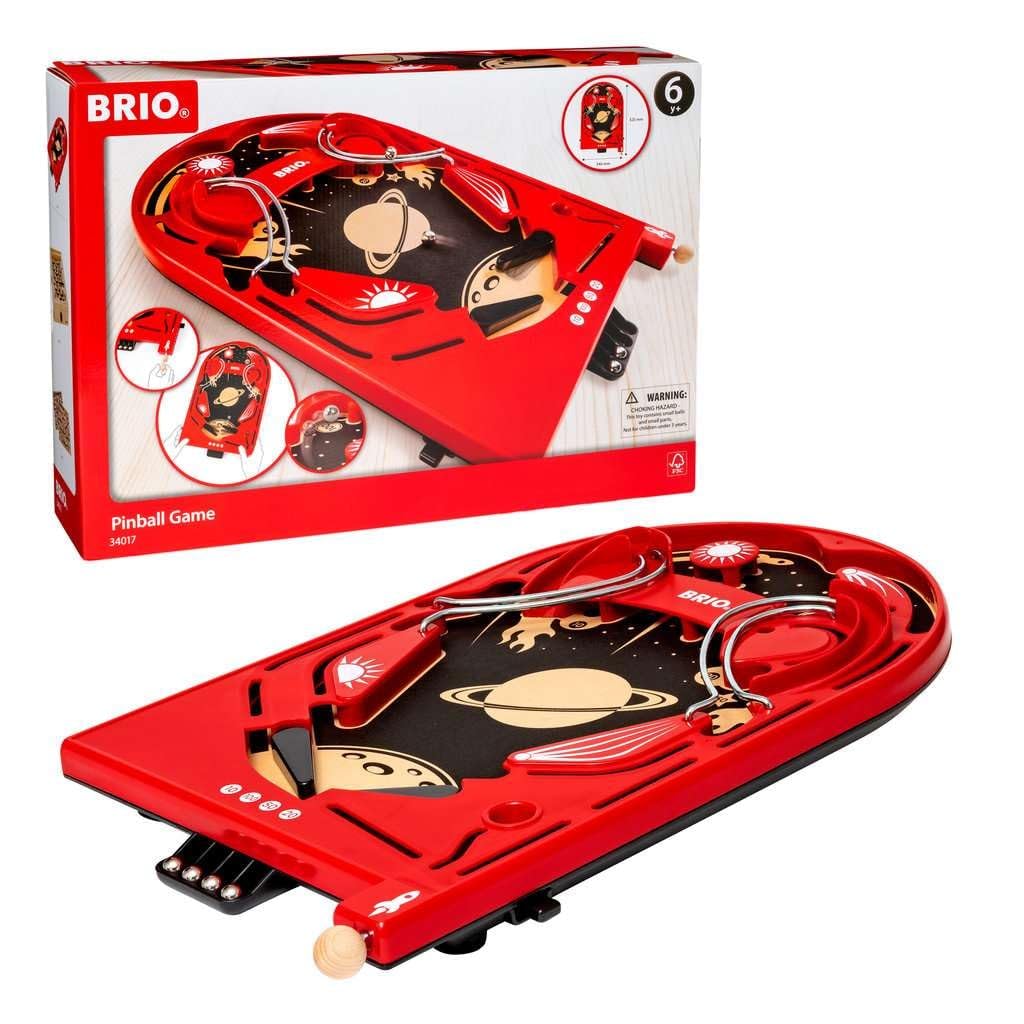
BRIO 34017 Pinball Game
BRIO 34017 Pinball Game

Family tabletop play

Doodle Score 9.2/10
Check Price

Worth Noting

  • No lights, sound effects, or automatic scoring
Power
Hand-operated, no batteries
Included
4 metal balls
Playfield Size
20.5 x 13.5 in
Recommended Age
6 years and up
Read the full review

Twenty and a half inches long, four steel balls in the box, and nothing to charge: the BRIO is the closest thing in this guide to walking up to a real machine, except it fits on a kitchen table. There's no build, no pairing, no app. You set it down, drop the balls in, and play.

That's why it's our top pick. The wood-and-plastic body has the heft of a real game rather than a novelty, and the ball has room to bank off the sides instead of bouncing straight back at you. Kids from about six can play unsupervised, adults still take turns after the kids have gone to bed, and there's nothing in it to wear out but the moving parts. BRIO backs the build with a lifetime warranty against manufacturing defects, which tells you how they expect it to be treated.

The honest caveat is noise. Steel balls on wood and plastic clatter, and in a small apartment you'll hear it through a wall; in a house with a playroom or a basement you won't think about it again. What you get in return is a machine with nothing electronic inside to fail — and it's built to take the knocks that reach it.

Bottom line: We recommend the BRIO to anyone who wants a pinball machine they can set down and play: it's the most solidly built here and needs nothing but four steel balls.

#2

ROKR 3D Wooden Pinball Machine

ROKR 3D Wooden Pinball Machine

Desk showpiece

Doodle Score 9.2/10
Check Price

Worth Noting

  • Many hours of expert-level assembly before play
Pieces
482
Scoring
Infrared sensors, lights, and sound
Skill Level
Expert
Recommended Age
14 years and up
Read the full review

The ROKR is the only machine here that keeps score for you. Infrared sensors read the ball across three elevated tracks, stars light up on the backboard when you hit a bumper, copper bells ring, and carved circus figures watch from the rails. It's a desk object that happens to play pinball, and it's priced like one.

482 laser-cut parts go into it, and the finished machine is the best-looking thing in this guide by a wide margin — warm integrated lighting, vintage carvings, a playfield people turn over in their hands before they play it. If the point of the purchase is something to leave out on a shelf and show off, nothing else here comes close.

What keeps it off the top of the list is how it holds up under play. It works — the electronics behave and the tracks are genuinely fun to shoot — but this is a delicate wooden machine taking repeated steel hits, and small parts work loose. Keep the spares the kit ships with and a little glue on the shelf, and expect to re-seat a bumper now and then. Buy it as a showpiece that plays, not as the game your kids will hammer every day.

Bottom line: For a shelf that deserves a showpiece, we rate the ROKR highest here — electronic scoring, lights, and bells, as long as you're ready for a long adult build.

#3

Smartivity DIY Pinball Machine

Smartivity DIY Pinball Machine

Builder families

Doodle Score 9.0/10
Check Price

Worth Noting

  • Ages 8 and up, with small parts during the build
Power
Manual, no batteries
Material
Laser-cut wood
Assembled Size
11 x 14.5 x 5.3 in
Recommended Age
8 to 14 years
Read the full review

Two to four hours, a flat table, and a kid who likes the idea of building something that works: that's what the Smartivity kit asks before you get to play a single ball. Put in the time and you get a real machine — spring launcher, flippers, scoring targets, and a wooden playfield that does what the physics lesson says it should. We think that's the best value in this guide for a family that wants the project as much as the game.

The build is where this kit earns its reputation. The manual is long and picture-led, the laser-cut parts fit the way they should, and a nine- or ten-year-old can handle most of it with an adult nearby for the fiddly bits. Set the flipper joints with care: they're the one part that punishes a rushed build, and a tight hinge turns a snappy shot into a mushy one.

As a toy it's wood, not armor. It holds up to ordinary play, but it isn't the machine you hand to a four-year-old or leave in a garage, and the 8-to-14 age range is honest about that. If nobody in the house wants to spend an afternoon with a manual, this is the wrong pick no matter how reasonable the price is — the BRIO is playable in five minutes and takes the knocks better.

Bottom line: We point families at the Smartivity kit when the build is half the gift: a few hours of real construction, clear instructions, and a wooden machine that plays afterward.

#4

Schylling Space Race Pinball

Schylling Space Race Pinball

Travel play

Doodle Score 9.0/10
Check Price

Worth Noting

  • One ball at a time caps the challenge
Power
No batteries required
Height
10 in
Material
Metal and plastic
Recommended Age
3 years and up
Read the full review

Ten inches tall and barely three-quarters of an inch deep, the Space Race goes in a backpack, a car door pocket, or a desk drawer without complaint. It's a lever-launched, metal-ball pinball game with a retro space print, and it costs less than anything else here.

The surprise is how much toy that buys. The back is metal, the plastic is thick, and the balls are real steel — more than the dollar-store pinball games it will inevitably be compared to can claim. The lever pulls easily enough for a preschooler, and the whole thing takes the handling of a car trip without much drama.

Where it runs out is depth. The playfield is fixed, the challenge is aim rather than strategy, and it's a five-minute game rather than a game night. That's a fair trade for something this small and this inexpensive, and for a travel toy or a first pinball machine it's the right one. The 3-and-up rating is honest, which makes this the one machine here a preschooler can genuinely work alone.

Bottom line: If the machine has to travel, this is the one we hand over — small, metal-backed, and playable by a preschooler without help.

#5

New Era Pinball Game

New Era Pinball Game

Lights and sound

Doodle Score 8.8/10
Check Price

Worth Noting

  • Very loud, with no volume control
Size
21 x 10 in
Power
Batteries required
Effects
8 sounds, 6 LED lights
Scoring
LED score display
Read the full review

The New Era is the machine for a household where nobody wants to build anything and everybody wants lights. It's 21 inches wide, runs on batteries, keeps score on an LED display, and throws eight sound effects and six flashing lights at every hit. Set it on a table or the floor and a mixed-age group works out what to do within about a minute.

We found the three-ball launch mattered more than the light show. Load one ball and the playfield feels empty; load three and it's the busiest game in this guide, which is exactly what you want when a five-year-old and a ten-year-old are taking turns. Build quality is mid-pack — plastic, decently put together, and not in the same class as the wooden machines.

Test the electronics the day it arrives. Scoring, lights, and sound are the parts that can fail on this one, and a dead board leaves you with a plain mechanical table and a battery bill. Run a full game, watch the score climb, and check the sound before the return window closes.

Bottom line: We suggest it when the lights and the three-ball launch are the point and the machine lives somewhere noise doesn't matter.

How We Tested the Best Mini Pinball Machines

We started with a long list of roughly 40 mini pinball machines from major retailers and hobby shops, then pared it down by size and price, cutting anything that looked like it was charging for a license rather than the build. That left 11 machines, which we bought ourselves and put through four months of use.

Assembly came first. I timed each build from opening the box to the first plunged ball, working alone and without pulling up a video, and noted whether the instructions were wordless diagrams, whether the hardware bags were labeled, and whether the one tool we needed was actually in the box. Two machines were playable in under ten minutes; one took the better part of an hour and a half and left me short a screw.

Then we played. Every table got at least 50 games — after dinner, on a coffee table, on a desk between calls, and at a birthday party where a nine-year-old and a twelve-year-old got to it before I did. We watched whether the ball traveled where the flippers aimed it, whether it drained straight down the middle untouched, and whether the whole machine walked across the table as we played.

Loudness got its own test, because a mini table in an apartment is a different object than one in a basement. We took decibel readings in a quiet room and kept a running note on whether the machine could be heard through a closed door. At the end of four months we checked for cracked plastics, loose screws, floppy flippers, and legs that had started to splay, then weighed each one against what it cost.

How to Choose Mini Pinball Machines

A Kit or a Finished Machine

Kits and finished games ask different things of you. The Smartivity goes together in a couple of hours with a child helping, the ROKR is a many-hour adult project, and the BRIO and the Schylling are playable as soon as the box is open. Builders remember the afternoon; players remember the high score.

A kit bought for a birthday tomorrow is a mistake, and so is a kit for a child under eight who wants to play rather than assemble. Match the purchase to the person, not to the photograph of the finished machine.

Match the Playfield to the Table

Mini runs from a 10-inch handheld to a 21-inch tabletop model, and the size changes the game rather than just the storage. At 20 inches the ball has room to bank off the sides and the machine reads as pinball; at 10 inches it's a five-minute fidget you keep in a bag.

Measure the table, then measure the shelf it will live on, because none of these fold flat. Compact in a listing means it fits on a shelf — it does not mean it plays like a smaller arcade.

Sturdiness Is About What Happens After the Ball Hits

Every game here takes repeated steel strikes in the same few places, so the real question is what holds the playfield together. Wooden kits rely on tension and joints, and the ROKR ships spares because parts work loose. The hand-operated machines have fewer things to break because there is no electronics board inside them.

Check the age rating against who will actually play. A display model and a child's toy are built to different tolerances, and the ROKR and the Schylling are at opposite ends of that scale.

Electronics, Noise, and Batteries

Scoring, lights, and sound effects cost you batteries and volume. The electronic machines here run on cells, and the loudest of them has no volume control at all — a detail that matters in an apartment and doesn't in a basement.

Mechanical games give you none of that: no scoreboard, no sound effects, no off switch, and nothing to charge. Decide where the machine will live before you decide what it should do.

Small Balls, Ages, and Safe Play

All of these fire small steel balls, and that fact should drive the age decision more than the box art does. The Schylling is rated 3 and up, the BRIO 6, the Smartivity 8, and the ROKR 14, and those numbers are about small parts and patience as much as difficulty.

In a house with a toddler, count the balls back into the machine after each session, store them with it, and keep the game on a surface the youngest can't reach.

Frequently Asked Questions

Final Verdict

Buy the BRIO 34017. It's the machine we point people to first: playable out of the box, sturdy enough for a seven-year-old, good-looking enough to leave out on the table, and free of batteries, scoreboards, and electronics that can fail.

Pick the Smartivity kit instead when the build is the gift, and the ROKR when you want lights, bells, and electronic scoring on a shelf. The New Era earns its place only if the three-ball launch is the point and the machine lives somewhere noise doesn't matter.