Games & Puzzles

Best Mini Foosball Tables of 2026

A mini foosball table is a compromise, and the good ones are honest about it. You trade the arcade lean of a full-size cabinet for something you can set on a counter, carry out to a patio, or slide under a bed — and what you get back is a genuine game in a footprint the size of a serving tray. The difference between a table you play every week and one that ends up in the garage rarely comes down to price; it's whether the ball stays on the table, whether the rods still turn smoothly in the tenth match, and whether the whole thing holds still when someone gets excited and yanks.

Assembly is where most of these tables lose people. I've opened boxes that promised a 20-minute build and took an hour with a hex key that stripped halfway through, and others that went together in ten minutes with a screwdriver. My team and I spent six months playing on 12 of them — kids, adults, a few grudge-match best-of-sevens — and we scored wobble, rod holes, and value as closely as we scored goals. The picks below are the ones still standing.

#1

GoSports 32-Inch Tabletop Foosball

GoSports 32-Inch Tabletop Foosball

Family game nights

Doodle Score 9.2/10
Check Price

Worth Noting

  • Only two balls in the box
Frame
Engineered wood
Weight
15.9 lb
Players
2-4
Dimensions
32"L x 20"W x 8.25"H
Read the full review

The rods arrive already threaded through the players, and that one decision tells you who this table is for: someone who wants to be playing tonight, not fitting twelve little men onto steel. What is left is a handful of screws for the legs and the score sliders, and then it is a game.

At 32 by 20 inches it takes a dining table or a playroom floor without swallowing the room, and the 15.9 pounds of engineered wood is why it plays properly. Light tables skate away from you when you spin; this one plants, and the ball comes off the walls with the sort of knock that makes the game feel bigger than it is. Sides take one or two players, and two balls come in the box.

The oak finish is the detail we appreciate most in a living room, because it looks like a small piece of furniture rather than a toy somebody left out. That also means the table earns a permanent spot instead of a trip to the closet after every game.

The cost is space. It needs a surface with clearance for the handles to swing past both ends, and at 15.9 pounds it is a two-hand lift when you clear the table for dinner. We think that is a fair trade for a table that plays this well, and it is why this is the one we recommend for a family room. Set it up once, and it becomes the thing everyone drifts back to between the meal and the dishes.

Bottom line: Our pick for most families: the 32-inch oak cabinet is heavy enough to stay put, the rods arrive ready to play, and it feels like a shrunken arcade table rather than a toy.
#2

TOMLEON Tabletop Soccer Game

TOMLEON Tabletop Soccer Game

Playrooms

Doodle Score 9.2/10
Check Price

Worth Noting

  • Handles will not take kids hanging on them
Weight
2 lb
Players
2-4
Scoring
Goal bell and score sliders
Included Balls
6
Read the full review

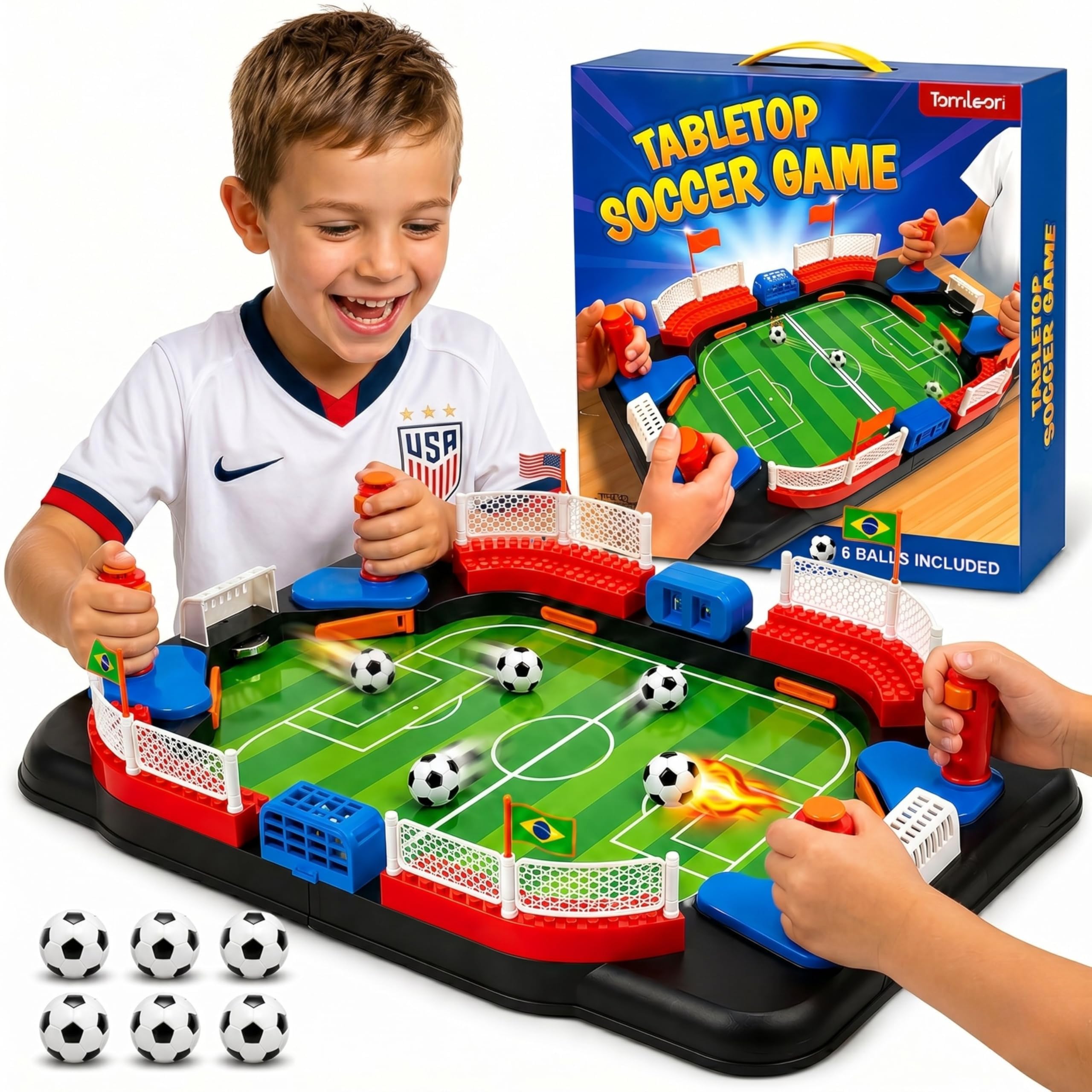
Every goal sets off a bell. It sounds like a gimmick until you have watched two kids argue about whether the ball crossed the line — the bell settles it, the manual sliders on the side keep the running score, and nobody has to hunt for a pencil. Six balls come in the box, which matters more than it sounds, because the game stops being fun the moment the only ball is under the sofa.

It snaps together without tools, so it goes from box to playing in the time it takes to clear a table, and at two pounds it moves between rooms without a second thought. The plastic is the whole story here: fine for a living-room game, less fine for kids who hang their weight on the handles, which is why we keep it as a playroom pick rather than the family-room centerpiece.

Bottom line: Six balls and a goal bell make this the playroom pick: nobody argues about the score, and there is always another ball within reach.

#3

SMILESSKIDDO Soccer Board Game

SMILESSKIDDO Soccer Board Game

Countertop play

Doodle Score 9.2/10
Check Price

Worth Noting

  • Only four balls included
Players
2
Controls
4 flippers, dual launch buttons
Dimensions
21.74"L x 12.45"W x 4.67"H
Included Balls
4
Read the full review

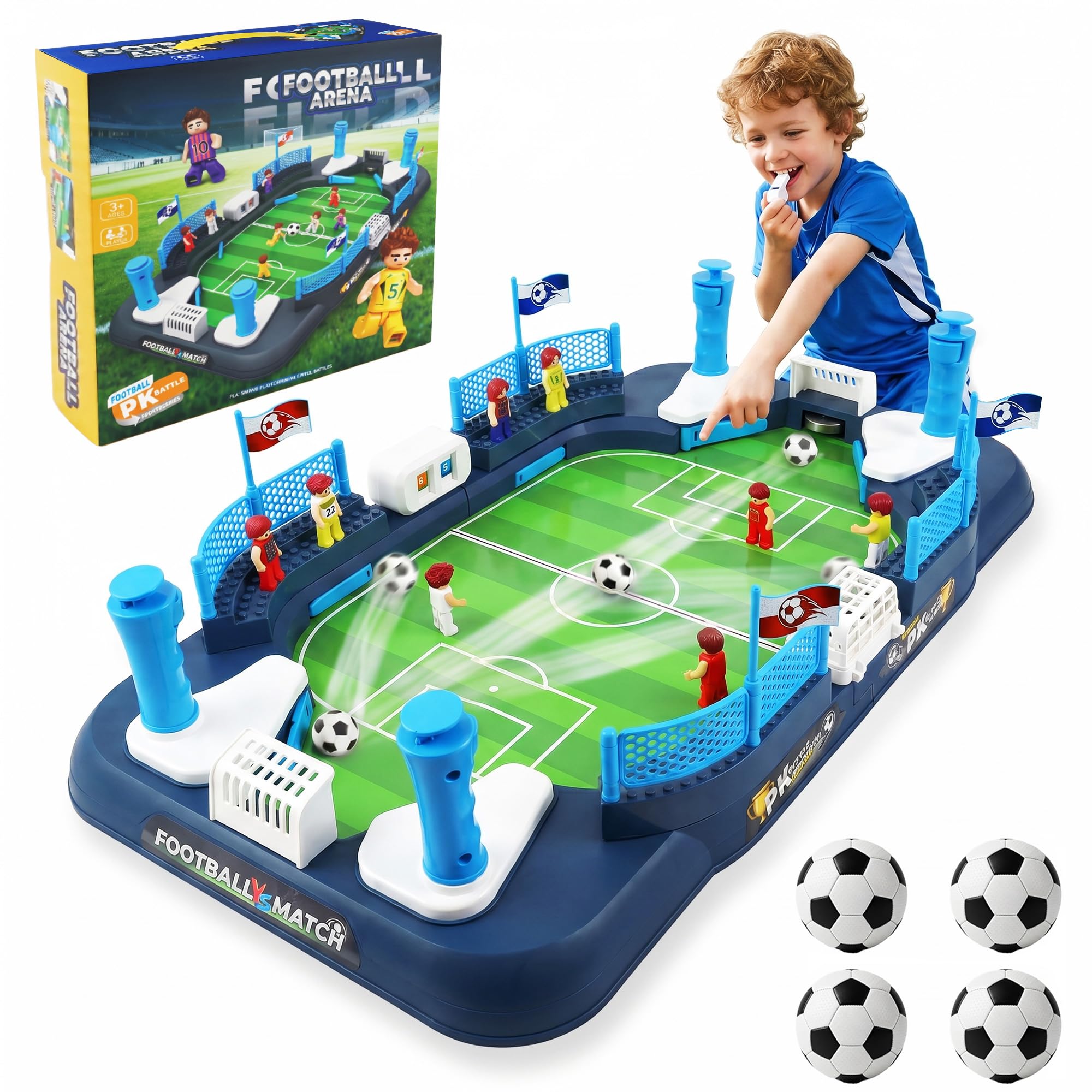
At 21.74 inches it lands in the same size class as the other plastic games, but it is the tidiest of them: ball storage is built into the frame, so the four mini balls live with the table instead of rolling around a drawer. On a kitchen counter it reads as a small appliance rather than a toy left out, and that tidiness is most of why we like it — it is the one here you can leave out without the room looking like a playroom.

Four flippers and dual launch buttons give it more control than the simplest button games, it goes together without tools, and the goals are walled in properly. What we cannot tell you yet is how it holds up: nothing we have seen suggests a problem, but the rods are the part to watch over a year of hard play, and four balls is a thin supply for a house that loses them.

Bottom line: A tidy first table for a kitchen counter: 21.74 inches, four balls with built-in storage, and controls that respond without much slop.

#4

Best Choice Products 40-Inch Tabletop

Best Choice Products 40-Inch Tabletop

Teens and adults

Doodle Score 9.0/10
Check Price

Worth Noting

  • Assembly takes an evening and a full tool kit
Frame
MDF
Weight
23.5 lb
Players
1-4
Dimensions
40"L x 33.5"W x 10"H
Read the full review

Forty inches is the number that decides this one. It is the longest table here, closer to a bar-game cabinet than to the coffee-table toys, and it plays that way: longer passes down the field, more room between the rods, and goals that feel earned rather than accidental. At 23.5 pounds it is also the heaviest table in the group, and that weight does real work when the rods are spinning.

The cabinet is composite wood with polished steel poles running the full width, and non-slip strips under the legs and panels keep it from walking across a smooth floor. Sides take one or two players each, and the legs come off when you want it out of the way. Watch the drilled holes in the build: if a screw will not seat, check for flashing before you force it, because a tight hole is a drilling problem and not a strength test.

Put the hour in and you get the most grown-up game in this group, one that teenagers and adults will happily play without feeling like they are humoring the kids. If it is going on a kitchen table for a six-year-old, the smaller wooden tables do the same job with far less fuss. This one wants a room, not a corner of a counter.

Bottom line: For teens and adults with a room to fill: 40 inches of table and polished steel rods give the closest thing to full-size play in this set.

#5

WIN.MAX 20-Inch Mini Foosball Table

WIN.MAX 20-Inch Mini Foosball Table

Small spaces

Doodle Score 9.0/10
Check Price

Worth Noting

  • Cramped for two adults at 20 inches
  • Rod fitting is fiddly during assembly
Rods
Stainless steel
Frame
Engineered wood
Weight
6.11 lb
Dimensions
20.1"L x 12.2"W x 3.8"H
Read the full review

Half the length of our top pick and a fraction of its weight, the WIN.MAX is the one that fits on a desk, a dorm shelf or the end of a kitchen counter. At 20.1 by 12.2 inches it is still a proper two-player game — four rods, twelve men, two scoreboards — just small enough to move with one hand, which is why it is the small table we recommend first.

The materials are what separate it from the plastic games at this size. The cabinet is engineered wood with a top just under half an inch thick, and the rods are stainless steel rather than iron or plastic, which is the part that takes the punishment in any foosball table. This is the upgraded version, with a thicker board and reshaped players, and the improvement shows when the ball stops rattling on a hard pass. Two balls come in the box and the score sliders sit at each end where you can reach them mid-rally.

Twenty inches means two adults' hands crowd the handles, and the rods take some patience to seat during assembly; this is a fiddly build rather than a snap-together one. Neither is a dealbreaker for a bedroom or an office, where the table is usually one person's project anyway.

Bottom line: The best small table here for a desk or a den: real wood, stainless rods, and a 20-inch playfield that still plays like foosball.

#6

COUOMOXA Mini Foosball Table

COUOMOXA Mini Foosball Table

Young kids

Doodle Score 8.8/10
Check Price

Worth Noting

  • Ball can bounce out over the low walls
Weight
1.98 lb
Players
2
Material
ABS plastic
Dimensions
21.85"L x 11.8"W x 5.12"H
Read the full review

This is the cheapest table in the group, and it does not pretend to be anything else: a 21.85-inch green field in a plastic cabinet, four rods, a ball, and two buttons on each handle that move a pair of flippers. At 0.9 kg it lifts with two fingers, a kid can carry it to a friend's house under one arm, and it arrives in a gift-ready box.

Cheap plastic usually means a game that fights you, and this one does not. The button-flipper controls let you pass and tackle instead of just shoving, assembly is a few minutes of clicking pieces together, and the whole thing feels like a toy designed by someone who has watched kids play. For a first foosball table, that is the right set of trades.

What you give up is stability. On a smooth table the cabinet slides when a game gets loud, and a non-slip mat or a folded towel underneath fixes most of it. The plastic has some flex, too — this is a table to play on, not to lean on, and that is the right expectation at this end of the range.

Bottom line: The one we hand to a family buying their first table: cheerful, quick to set up, and light enough that a kid carries it to a friend's house.

#7

joyddo Mini Foosball Table

joyddo Mini Foosball Table

Keeping the ball in

Doodle Score 8.6/10
Check Price

Worth Noting

  • Light plastic that will not take rough handling
Players
2
Controls
Dual flipper buttons
Fence Height
3 cm
Included Balls
8
Read the full review

The most annoying thing about tabletop foosball is not the plastic — it is the fetch. A low-walled board sends the ball across the kitchen every third shot. This one raises the fences to 3 cm, the tallest here, and the ball stays on the board, which quietly changes how long a game lasts and how often somebody is crawling under furniture.

The playfield is sloped so the ball keeps rolling instead of stalling in a dead corner, there is a bell on the goal, a manual scoreboard on the side, and eight balls in the box. Assembly is snap-together with no tools. One caution before you order: the footprint figures in the listing do not agree with each other, so measure the surface you have in mind rather than trusting a single number.

This is a floor game, not a furniture piece. It is light plastic, and a household with a toddler, a dog and a hard floor will get more out of the tall fences than out of any finish — which is exactly why it stays in our set for playrooms rather than dining rooms.

Bottom line: The tall-fence pick for a house where the ball always ends up under the couch: 3 cm walls and eight balls keep the game on the board.

How We Tested the Best Mini Foosball Tables

We started with every mini table we could find that was actually in stock and small enough to live on a counter or a small play table, then cut anything with a playing surface too cramped to pass a ball between the men, rods that flexed in the hand, or a price that made no sense next to an entry-level full-size table. That left 12 tables, which we bought ourselves and lived with for six months.

Each one got built at a kitchen counter using only the tools in the box. I timed every build, noted the steps where the instructions lost me, and counted how many times I had to back out a screw. Then we played: best-of-seven matches with adults, then the same with kids ages 6 to 12, plus a run of sessions in a dorm common room and a covered porch. We counted how often the ball jumped the walls, whether the goal boxes actually caught shots, and whether the score sliders moved without sticking.

The rods took the worst of it. I spun each one 200 times in a row, then checked the holes for plastic shavings, slop in the bushings, and that gritty feeling that says a table is already wearing out. For stability, we shoved the tables mid-game the way an excited nine-year-old does and watched how far they skated across a wood floor, then checked whether the feet could take a wobble out on an uneven patio. Durability meant leaving one set up in a humid garage for a month and rolling each rod across a counter to see if it had bent. For value, we asked whether the next price step up bought real rods and a sturdier cabinet or just a nicer sticker on the box.

How to Choose Mini Foosball Tables

Fit the table before you fall for it

Start with the surface, not the table. A 20-inch game needs a couple of feet of clear width plus room for the handles to swing past each end, and a 32- or 40-inch cabinet needs a dining table or a floor, because the rods and grips stick out beyond the listed length. Two people also have to face each other across it, so a table shoved against a wall becomes a solo toy within a week.

Measure the space, subtract handle room, then pick the largest playfield that still leaves somewhere to stand. A 20-inch table that gets used nightly beats a 32-inch one that lives in a closet.

Weight is the difference between a game and a shuffle

A 15.9- or 23.5-pound wood cabinet plants itself when you spin the rods. A plastic game under a kilo skates across a smooth table, and you end up steadying it with your free hand instead of playing. If you buy light, plan for it — a non-slip mat or a rubber-backed towel under the base solves most of the problem.

The reverse matters too: if the table has to come off the dining table every night, the light one wins on convenience. Decide which annoyance you prefer before you spend.

Fences, balls and sliders decide the evening

Ball chasing ends more games than bad play does. Walls that stand proud of the field keep the ball on the board, and the number of balls in the box matters more than it sounds: four is a minimum, eight means a lost one does not stop play.

Score sliders that sit flush are worth more than a fancy scoreboard, because loose plastic counters are the first thing to drop onto the field. In a house with young kids, spend on containment and spare balls before you spend on finish.

Rods, players and how much building you are signing up for

Metal rods outlast plastic, and rods that arrive already threaded through the players save the worst hour of any table build. Wood-composite cabinets feel more like a real foosball table and weigh more; ABS plastic is lighter, cheaper and easier to move from room to room.

The practical rule: a table that takes an evening to assemble gets used less than one that snaps together. If this is a birthday gift, check the setup before you buy rather than on the morning of.

Frequently Asked Questions

Final Verdict

The GoSports 32-inch is the table we point most families to. It plays like a shrunken arcade cabinet — heavy enough to stay planted, pre-built enough to be playing the same evening — and that combination is worth the step up from the plastic games.

If the players are teenagers or adults and the room is big, take the 40-inch Best Choice instead. If the only free surface is a desk, the WIN.MAX gives you real wood and stainless rods at half the length.