Games & Puzzles

Best Magic Kits for Kids of 2026

Every magic kit starts the same way: the box comes out at a birthday party or on a holiday morning, the wand gets waved, and then somebody has to actually learn a trick. That's the step where most kits quietly fall apart. The props are rarely the problem — kids love the cups, the coins, the vanishing box. What separates a kit that gets performed for the neighbors three weeks later from one that ends up at the bottom of the toy bin is whether a child can follow the instructions alone, at their own reading level, without an adult translating every other sentence.

We've spent the past four months living with 12 kits, testing them with kids from about 6 to 11, and the pattern repeated almost every time: the good ones hand a child one strong trick they can pull off by dinner, and that early win buys enough patience to work through the harder material. Below are the kits that cleared that bar, whether you're shopping for a birthday, a holiday, or a kid who has already worn out a deck of cards.

#1

Learn & Climb Mega Magic Kit

Learn & Climb Mega Magic Kit

First-time magicians

Doodle Score 9.2/10
Check Price

Worth Noting

  • Many small props to keep track of
Tricks
Hundreds, from 28 props
Lessons
DVD and booklet
Storage
Two-level magic box
Age Range
6-14 years
Read the full review

Almost every kids' magic kit dies the same death: the box promises a hundred tricks, the booklet explains three of them badly, and the kid drifts back to the tablet. The Mega Magic Kit is the one in this group that mostly dodges that fate. There are 28 props in a two-level box and hundreds of tricks claimed from them, but the real content is the teaching: a DVD plus step-by-step video walkthroughs.

That is why we hand this one to most families first. A seven-year-old can watch a trick, copy it, and be performing it for the family ten minutes later, and the different difficulty levels mean a ten-year-old does not feel talked down to. A kindergartner can start on the simplest pieces with an adult nearby. The printed booklet is the weaker half of the package, terse enough that it works best as a reminder after the video rather than a first explanation.

Twenty-eight props sounds like a lot until you see how the kit works. There is a vanishing box, cups and balls, a card deck, a wand, coin pieces and several self-working puzzles, and the same prop reappears across several tricks, which is normal for the category and worth knowing before you compare counts against a bigger set. What we appreciated is the two-level box: everything has a home, and a kit that goes back into its case is a kit that gets used again. Keep the small parts away from toddlers.

Against the wooden Melissa & Doug set, this is less keepsake and more engine: plastic props, far more tricks, a fraction of the money. That is the right trade for a first kit. What you give up is the weight and permanence of wood, and the sense of a set that will still be complete in five years. For the child who wants to perform this weekend, we take the plastic.

Bottom line: The best first kit for most kids: hundreds of tricks, video teaching a six-year-old can follow, and a case that keeps the props together.

#2

Melissa & Doug Deluxe Wooden Set

Melissa & Doug Deluxe Wooden Set

Keepsake quality

Doodle Score 9.2/10
Check Price

Worth Noting

  • No latch: the case can spill when carried
Case
Folding wooden case
Tricks
10 classic tricks
Material
Solid wood
Age Range
8-14 years
Read the full review

The Deluxe set is the only kit here that feels like it belongs on a shelf rather than in a toy bin. Ten tricks, solid wood, and a folding case that opens into a small stage, with painted details that make the props look like they came from a magic shop rather than a blister pack.

The effects are proper beginner classics, not puzzle-box reveals: a coin box, a disappearing ball, secret silks, a number prediction, a vanishing zone. Most of them need practice before they look effortless, which is the point at this age. The weak link is the printed guide, the vaguest in this group. A seven- or eight-year-old working alone will stall on two or three of the tricks; an adult who reads ahead the night before can bridge it in a couple of minutes, and so can a kid who is happy to experiment until something clicks.

We think the quality earns the premium. Wooden props survive being handled badly, the case does double duty as a performance space, and this is the set in the group most likely to still be complete when a younger sibling inherits it. Set against that, ten tricks is a short list, and a child who burns through them in a fortnight will be asking for more. The child who enjoys the ritual of setting up a show gets more from ten good tricks than from a hundred forgettable ones.

Bottom line: Buy this one for the wood: ten classic tricks in a case that becomes a stage, with a guide an adult should read first.

#3

National Geographic Epic Magic Kit

National Geographic Epic Magic Kit

Widest variety

Doodle Score 9.2/10
Check Price

Worth Noting

  • Some gimmicks and boxes feel flimsy for the price
Guide
Full-color learning guide
Tricks
75 magic plus 100 science
Lessons
75+ video lessons
Age Range
8 years and up
Read the full review

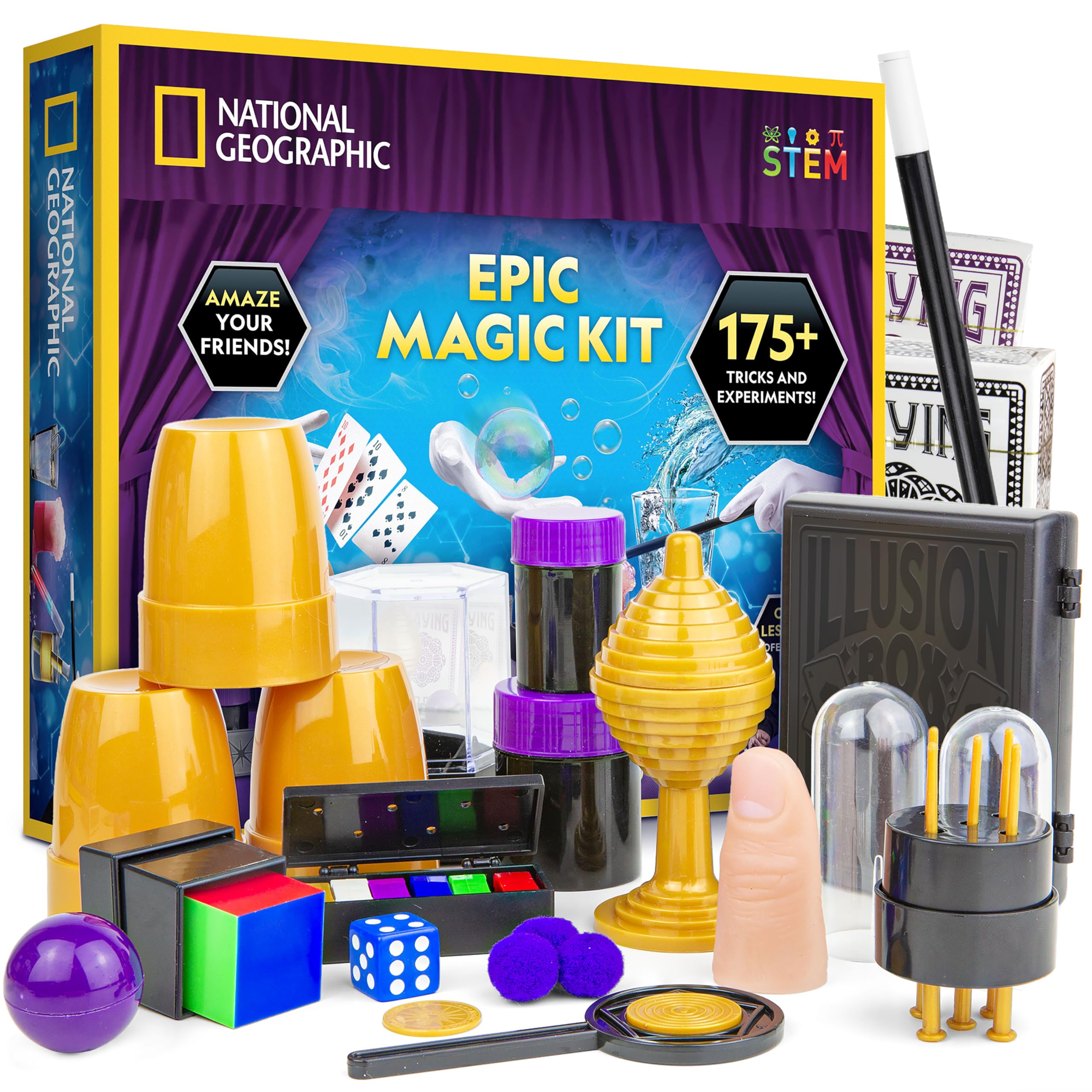
Open the box and it splits cleanly in two: 75 classic magic tricks with cards, coins and a wand on one side, and more than 100 science experiments on the other, from bending metal with water to making a test tube vanish. It is the only kit here with a second subject built in, and the split is honest rather than decorative.

Both halves are taught the same way, through a link to more than 75 video lessons performed by a professional magician plus a full-color learning guide. In practice the videos carry the magic, where watching a sleight is worth a page of description, and the guide carries the experiments, where you want the steps in front of you and both hands free. That division works.

It is an eight-and-up set and that feels right: the card work needs hands big enough to hold a break, and the science half assumes a child who can follow a sequence. Two costs come with the size. It is the biggest outlay here, and some props do not match the price, with the card gimmicks and folding boxes the parts to handle carefully. If your child only wants magic, a leaner kit does the same job for less.

Staying power is what convinced us. A kid who has exhausted the coin box at nine still has a hundred experiments waiting, and the science is real rather than filler, the kind of thing that comes back out when a friend sleeps over. This is the pick for the child who asks how the trick works before asking to borrow it. One caution: it is a big box, so clear shelf space before a birthday.

Bottom line: The biggest kit here, with 75 tricks plus 100 science experiments, a price and a box size to match. Best for curious eight-to-twelves.

#4

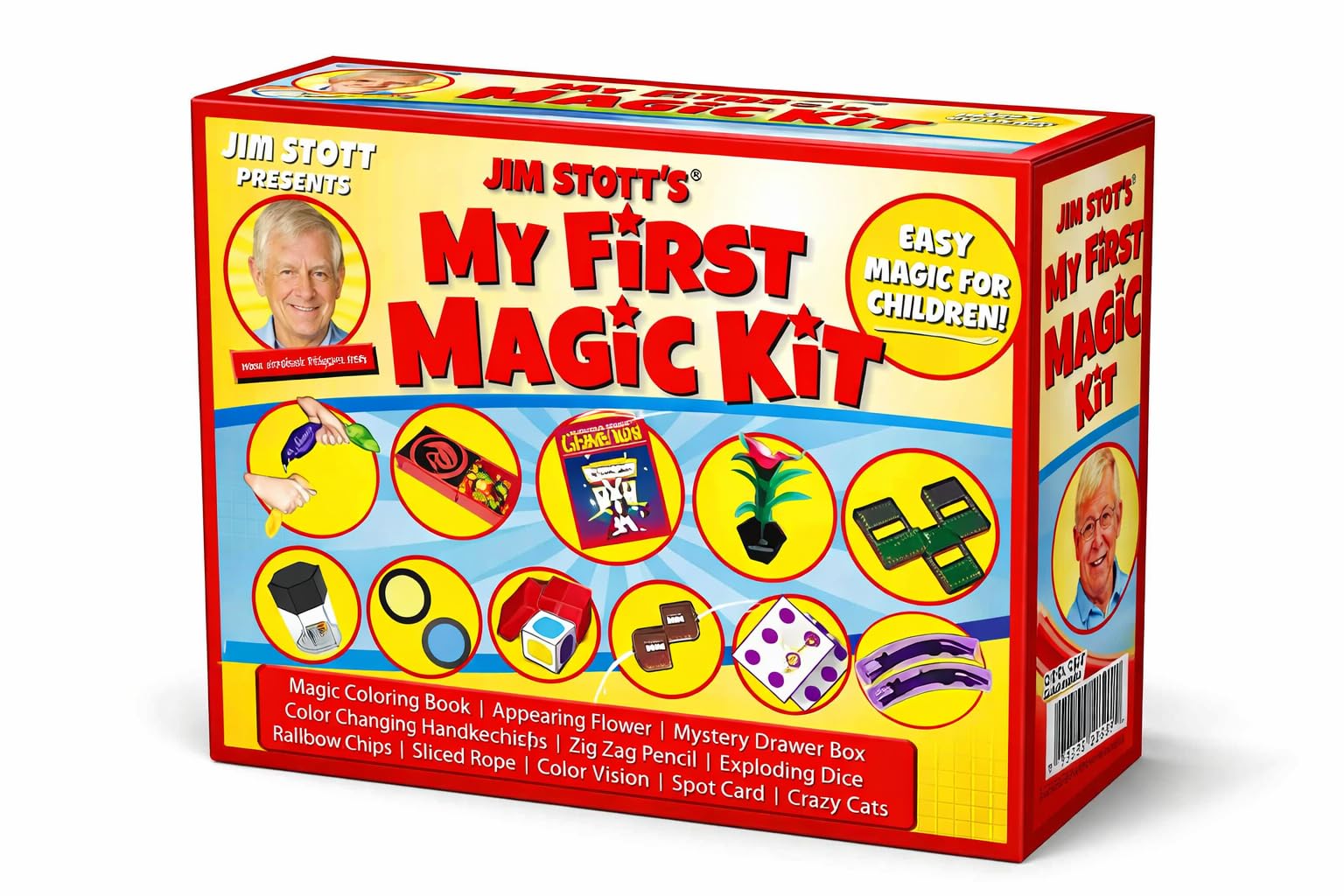
Jim Stott My First Magic Kit

Jim Stott My First Magic Kit

Young beginners

Doodle Score 9.0/10
Check Price

Worth Noting

  • Light plastic props are the weak point
Tricks
50+ easy tricks
Lessons
Video lessons
Age Range
5-12 years
Read the full review

Five- and six-year-olds are the hardest audience to buy magic for: old enough to want a real trick, too young to read a manual or palm a coin. Jim Stott's kit is built for that gap, with 50-plus tricks, a video lesson for each one, and props that mostly work themselves, so the payoff arrives on the first afternoon instead of after a week of practice. We were won over by how deliberately the difficulty has been kept low.

The trick list is chosen to fool a family rather than to teach technique: a coloring book, an appearing flower, exploding dice, a zig-zag pencil. That is the right call at this age, because what is being built is confidence, not dexterity. A child can carry three of these in a pocket and do a show at a restaurant table, which is where a lot of magic actually gets practiced.

The set stays useful up to about twelve, but the sweet spot is clearly the early years, and the video lessons are short enough to hold a five-year-old's attention without an adult translating every step. Against the Learn & Climb kit, you are paying for a gentler on-ramp and a smaller box rather than more magic, and for a child who freezes in front of a big set that is the better buy.

Bottom line: For a five- or six-year-old, start here: fifty-plus self-working tricks, each taught on video, in a box small enough to take along.

#5

Melissa & Doug Abracadabra Set

Melissa & Doug Abracadabra Set

Preschoolers

Doodle Score 9.0/10
Check Price

Worth Noting

  • Only ten tricks; outgrown in a year or two
Age Range
4-7 years
Skill Level
Beginner
Instructions
Illustrated guide
Read the full review

This is the kit to buy when the magician is four or five and someone else is still doing the reading. The Abracadabra collection is a small set of visual tricks, among them a rope cutter, a color-changing silk, zig-zag numbers, a long-and-short card and a wand, and the whole design assumes short attention spans and small hands.

We like it precisely because it does not try to be a hundred-trick box. Ten tricks a five-year-old can actually perform beat a hundred they cannot, and because most of the effects are wordless and visual, the performer does not need to read fluently to sell them. An adult reads the illustrated guide once, demonstrates, and then the child owns the trick outright.

The limits are the price of that focus. Ten tricks is the shortest list in this group, and the props are simple fabric-and-plastic pieces rather than anything worth keeping on a shelf. For a first set that a small child will outgrow in a year or two, that is exactly right, and the alternative is a bigger kit that sits unopened because the first trick was too hard.

Bottom line: Preschoolers get ten visual tricks they can really perform, and an adult only has to read the guide once.

#6

Klever Kits 180+ Magic Set

Klever Kits 180+ Magic Set

Budget buyers

Doodle Score 9.0/10
Check Price

Worth Noting

  • Compact box with correspondingly small props
Tricks
180+
Lessons
Video tutorials
Age Range
6 years and up
Read the full review

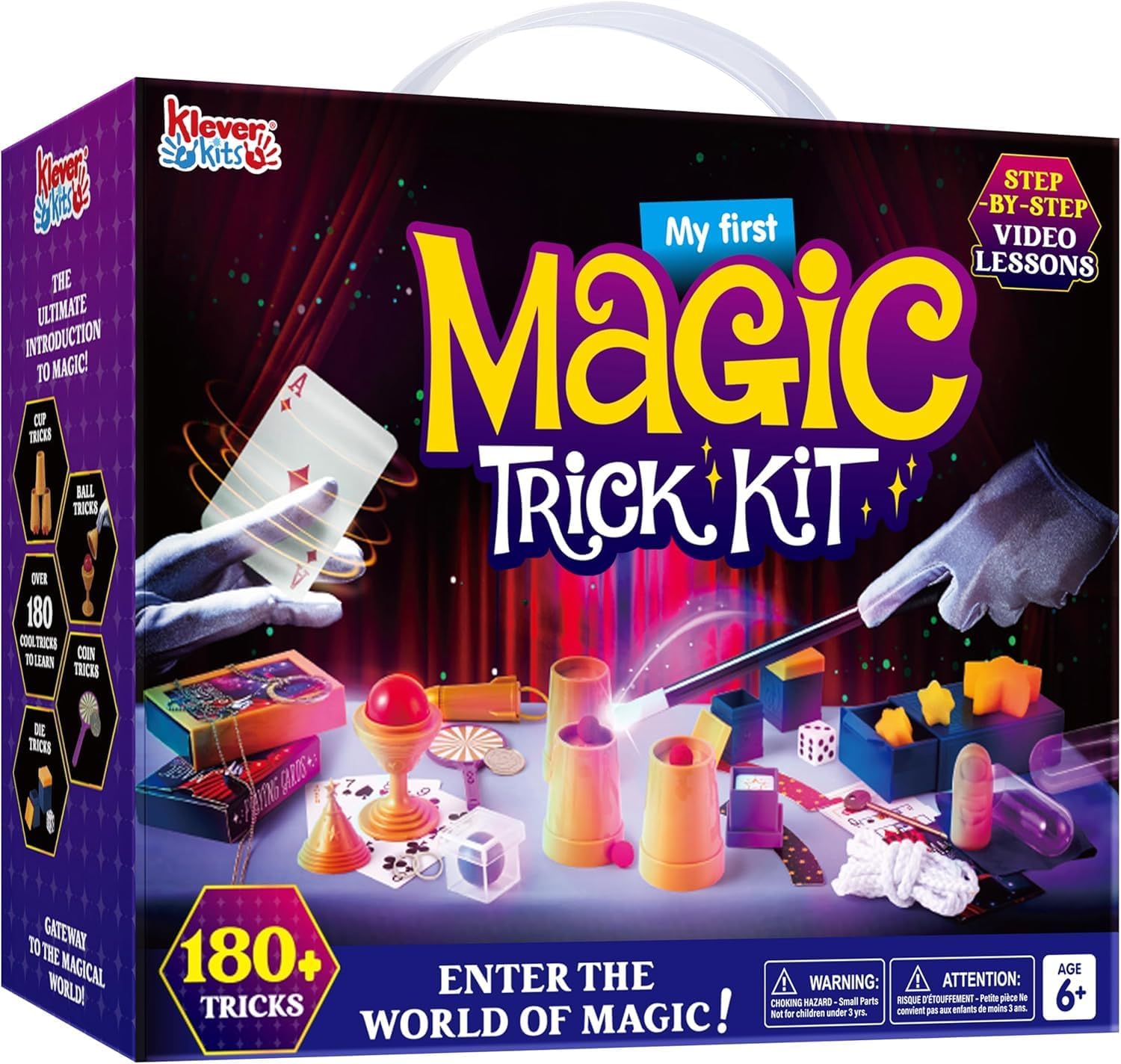
The cheapest route to 180-plus tricks is this small box, and the price is genuinely the argument. Inside is a compact set of classic props, among them cups and balls, a ball and vase, a coin case, a false thumb tip, a card deck and a wand, plus video lessons from working magicians. We rate it the budget pick of the group rather than the default, and the reasons are worth knowing before you order.

First, treat the 180 as routines rather than 180 separate effects. The props are the classic half-dozen put through variations, so the real variety is smaller than the number suggests, which is normal for the category and not a fault, but it does mean this kit and a 35-trick set can feel closer in content than the boxes imply.

Second, the printed directions are thin and the videos do most of the teaching, so a child who will not sit through a screen needs an adult to walk through the first few tricks with them. What is left is a lot of magic for very little money, a set that takes up almost no shelf space, and a genuinely low-risk birthday present for a kid who has already caught the bug.

Bottom line: The budget pick: 180-plus tricks from classic props, taught on video, and one of the lowest prices in this group.

#7

Marvin's Magic 50 Amazing Tricks

Marvin's Magic 50 Amazing Tricks

Card and coin

Doodle Score 8.8/10
Check Price

Worth Noting

Focus
Cards, coins, mind reading
Tricks
50
Age Range
8 years and up
Packaging
Gift tin
Read the full review

Cards and coins are where real magic lives, and this tin is the only kit here that leans into both. Fifty tricks covering card magic, coin work, mind reading and levitation, packed into a metal gift tin with 103 pieces.

It is an eight-and-up set, and the age is honest: these are skill tricks, not self-working gadgets. A child who wants a coin to vanish has to learn the vanish, and the levitation and mind-reading effects need a bit of presentation before they land. That is a feature if your kid is the type to practice in front of a mirror, and a fast route to the toy drawer if they want a show tonight.

The tin is a small pleasure we had not expected to care about. It is the only packaging in this group that survives being thrown in a bag for a weekend at a grandparent's house, and it makes the set feel like a gift rather than a toy, which counts for something when someone else is doing the buying. Fifty tricks is also a comfortable number to work through rather than a pile to feel intimidated by.

This is the tin for the child who has already seen a card trick and wants to know how it is done, the one who will repeat a single move until it is smooth. It is the opposite of the video-taught kits in this group, and that is the point: nothing here performs itself. If your kid needs a win in the first ten minutes, buy the Learn & Climb set instead; if they need to own a secret, this is the one.

Bottom line: For a kid who wants to know how card and coin tricks work, this fifty-trick tin is the most serious beginner set here.

#8

Thames & Kosmos Magic Hat

Thames & Kosmos Magic Hat

Putting on shows

Doodle Score 8.4/10
Check Price

Worth Noting

  • Some small props feel ordinary next to the hat
Props
44
Manual
20-page illustrated
Tricks
35
Age Range
6-12 years
Read the full review

The hat is the reason to buy this one. It is a proper top hat with a hidden compartment in the crown, and paired with the rabbit puppet it gives a kid the thing most magic kits never supply: an entrance.

Underneath it is a serious little kit: 35 tricks across 44 props, covering cups and balls, a coin box, rings, rope, a diamond tunnel and dice. The 20-page manual uses the same three-part layout for every trick, with what you need, the secret setup and the steps, which makes it far easier to flip back to mid-performance than the wall-of-text booklets in cheaper sets. Video tutorials back up the tricks that need to be seen rather than read.

We think it is the best pick here for a kid who wants to put on a show rather than collect tricks. The hat gives a performance a beginning and an end, and the mix of self-working props and simple sleight of hand is well judged for six-to-twelve. It also looks like a magic set, which sounds shallow until you watch a seven-year-old carry it into a room.

One warning: the hat is a prop, not a costume. It is heavy and structured, built to be lifted off a table rather than worn through an afternoon of trick-or-treating. Set it down, let the rabbit do the work, and the entrance is worth the setup.

Bottom line: The showiest set in the group: a real top hat with a hidden compartment, 35 tricks and 44 props behind it.

How We Chose and Tested the Best Magic Kits for Kids

For each price range, we started by pulling every kit we could find from the big toy retailers and a few specialty magic shops, then cut the list down to sets that included real apparatus rather than a booklet and a handful of plastic coins. We read every instruction booklet ourselves before handing anything over, since a kit advertising 75 tricks is usually five solid effects and 70 filler.

Twelve kits made it into the pool, and we kept them in rotation for four months. Testing looked like actual family life: a kitchen-table show for two parents, a sleepover where four kids tried to fool each other, a birthday party where the kit had to hold a room's attention, and a long afternoon with a grandparent — the toughest audience there is. We counted the tricks a child could perform unaided after a week, not the number printed on the box.

Along the way we were deliberately rough on the props, dropping the cups, shuffling the cards dozens of times, and packing everything back into the box for a trip to a cousin's house, noting which pieces bent, chipped, or lost their secret. We also handed each open box to a 7-year-old and left the room, timing how long it took before someone came looking for help. Kits that required an adult for every effect got marked down no matter how good the tricks were.

How to Choose Magic Kits for Kids

Trick counts are effects, not props

The headline number counts performances, not equipment, and one clever prop often carries a dozen of them. A 180-trick set and a 35-trick set can hold a similar pile of plastic, so compare the props themselves. A cups-and-balls set, a decent card deck and a coin box teach repeatable skills; twenty puzzle boxes are twenty one-time reveals.

Look for the classics named in the box: cups and balls, a coin box, silks, a vanishing ball. If the listing brags only about the count, expect variations on the same three or four secrets, and expect a child to work through them faster than the number suggests.

Match the kit to the hands, not the age sticker

Age ranges are a starting point, not a specification. A four- or five-year-old needs visual, self-working tricks and an adult to read the guide; a seven-year-old can follow a video and copy a simple vanish; a nine- or ten-year-old finally has the hands for cards and coins.

The mismatch to avoid is an eight-plus card set bought for a six-year-old who cannot yet hold a break. Buy fewer tricks the child can do rather than more tricks they cannot, and expect to upgrade once the first set is exhausted.

Video teaches young magicians faster than print

Printed instructions are where most kits fall down: terse, written by someone who already knows the secret, and pitched at a reading level a six-year-old does not have. Video fixes that, because a child can watch the effect at full speed and then copy it step by step.

The strongest kits here pair the two, using video for the first attempt and the booklet for the reminder a week later. If a kit offers only a printed guide, plan on an adult reading ahead and demonstrating the first performance.

Buy for the show, not the drawer

The kits that get used are the ones with a performance built in: a hat with a hidden compartment, a case that opens into a stage, a tin that holds everything. Storage matters more than it sounds, because loose props become lost props and a trick with a missing piece stops existing.

Props matter too. Wands, folding boxes and card gimmicks are the parts that give out first, and wooden pieces survive handling that thin plastic does not. A cheap set that stays complete beats a big one that does not.

Frequently Asked Questions

Final Verdict

For most families the Learn & Climb Mega Magic Kit is the one to buy. It gets a six- or seven-year-old performing on the first afternoon rather than reading, and the two-level box means the props are still together a month later.

Pay more for the Melissa & Doug wooden set only if you want a keepsake for an eight-year-old who will practice. Pay less for the Klever Kits set if video teaching and a small box are enough. For a four- or five-year-old, skip both and start with the Abracadabra set, where the tricks need no reading at all.