Games & Puzzles

Best Juggling Sets of 2026

Almost nobody quits juggling because they lack coordination. They quit because the set they bought was too light, too small, or too slick, and every drop felt like proof they weren't cut out for it. A good set removes that excuse: the balls arrive in your hands at a pace your eyes can follow, the surface grips instead of skittering away, and practice starts to feel like fun rather than a party trick you keep failing at. I learned that the slow way, chasing lacquered wooden balls around a garage for a month.

We spent three months with 14 sets — stitched beanbags, silicone balls, thud balls, and a couple of scarf-and-club kits — throwing them in living rooms, backyards, and one very patient office hallway. The keepers earned their spot on consistent weight from ball to ball, a texture that still gripped once our hands got sweaty, and seams that weren't shedding filler by week three. One thing worth knowing before you buy: go heavier than feels right, because a little mass slows the pattern down and gives your hands time to catch up.

#1

speevers Xballs

speevers Xballs

First three balls

Doodle Score 9.6/10
Check Price

Worth Noting

  • Heavier than mini sets, so small hands struggle
Diameter
6.2 cm
Included
3 balls and carry case
Shell Care
Machine washable
Ball Weight
4.2 oz
Read the full review

Pick one up and the first thing that registers is the mass: roughly 4.2 ounces across about 6.2 cm, closer to a small apple than to the featherweight beanbags most beginners start with. That weight is the whole argument for the Xball. A heavier ball hangs in the air a fraction longer and drops into the hand at a speed a nervous beginner can read, and the soft netted shell gives on the catch instead of pinging back out of the palm.

They also stay where they land. The fill kills the bounce, so a misthrow ends up at your feet rather than under the sofa, and the two-layer netting copes with hard-floor drops without the seams letting go, which is the failure that takes down several of the cheaper sets on this page. The detail we did not expect to care about is that they are machine washable: a session in a garage or on a beach ends with the balls in the drum rather than in the bin.

The listing lets you choose weight, density and colour, which matters if you are buying for someone whose hands are still growing. A carry case comes with the set, so the whole thing goes into a rucksack without three balls rolling loose around a water bottle.

Against the Covelico kit you are trading a printed guide for a better ball, and that is a trade we make every time. The Xballs are the set that survives the weeks when you are dropping them constantly, and those weeks are the whole game.

Bottom line: Our pick for anyone learning from scratch: four ounces of soft, no-bounce weight that slows the pattern down and survives the phase where you drop everything.
#2

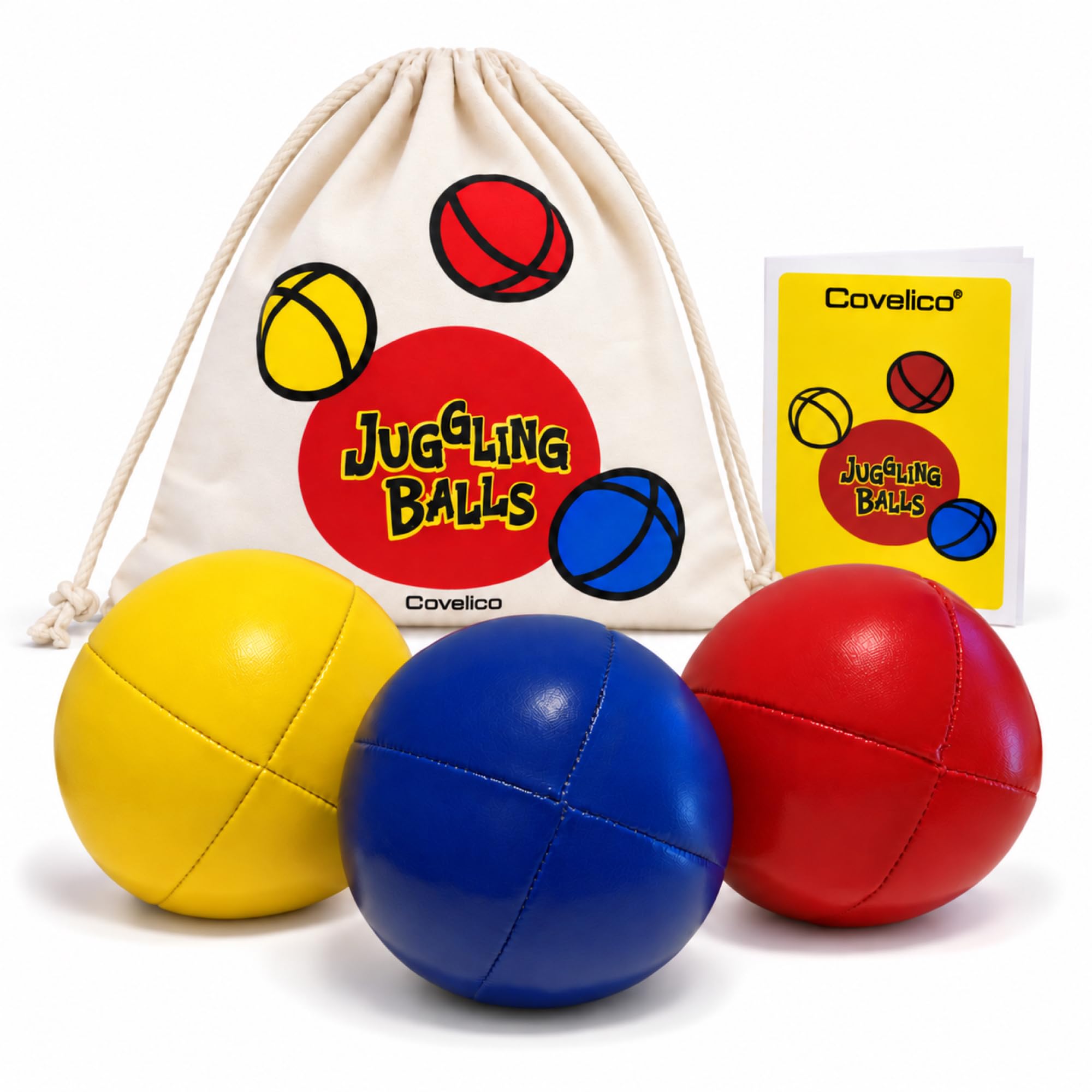
Covelico 3-Ball Learning Kit

Covelico 3-Ball Learning Kit

Guided first week

Doodle Score 9.4/10
Check Price

Worth Noting

  • Guide stops at three-ball juggling
  • No spare ball in the set
Colors
Red, blue and yellow
Included
3 balls, guide, cotton bag
Ball Size
2.4 in (62 mm)
Ball Weight
3.2 oz
Read the full review

The fold-out guide is what separates this kit from a bag of three balls. It works through one ball, then two, then three, with diagrams and short demonstration videos you can pull up on a phone. That sequence is exactly what a first-timer cannot reconstruct alone, because the first twenty minutes are when a three-ball cascade looks impossible, and a guide that keeps you on a single ball for a session or two is the fix.

The balls themselves are 2.4 inches and 3.2 ounces, lined synthetic leather over plastic bead fill, and noticeably softer in the hand than the vinyl balls that turn up in cheap sets. They are slightly flattened, a small design decision that matters more than it sounds, because a ball that lands stays landed instead of rolling under the radiator. Red, blue and yellow make each one easy to tell apart mid-pattern, and the cotton drawstring bag keeps the kit in one place.

The teaching material is the reason to buy it, not the hardware: the balls are good rather than exceptional. What this kit does better than anything else here is hold a beginner's hand through the stretch where juggling feels hopeless. If two people are learning together, though, the Patelai six-pack puts more balls in the room.

Bottom line: Buy this one when the person learning needs to be taught rather than simply equipped: the fold-out guide is worth more than a fourth ball.

#3

Zeekio Galaxy Juggling Balls

Zeekio Galaxy Juggling Balls

Experienced hands

Doodle Score 8.8/10
Check Price

Worth Noting

  • Premium price for a set of three
Fill
Millet
Shell
12-panel hand-sewn leather
Diameter
67 mm
Ball Weight
Approx. 130 g
Read the full review

These are the best-looking balls here and, for anyone past the flailing stage, the best-feeling ones too. Twelve hand-sewn leather panels wrap a millet fill into a 67 mm, 130 g ball that holds its shape in the palm; the stitching is even and visible, and the finish is a clear step above the printed vinyl everywhere else on this page.

Millet is the old-fashioned fill and it behaves the way a juggler wants: no bounce, a soft dead catch, and enough mass that the pattern feels deliberate rather than skittery. Spreading the load across twelve seams instead of four means each one takes less strain, and the leather softens and darkens as you use it. That is either patina or wear, depending on your temperament with nice things.

What you are paying for is feel and looks rather than indestructibility. Leather over millet wants an indoor floor and dry hands; take them out to a car park and the seams take a beating that a washable fabric ball shrugs off. Treat them as the set you graduate to after the first month, and the upgrade earns itself.

Bottom line: For jugglers past the flailing stage, these hand-sewn leather balls are the best-feeling set in this guide and the one that makes practice feel like a hobby.

#4

POITOI LED Juggling Balls

POITOI LED Juggling Balls

Night practice

Doodle Score 8.8/10
Check Price

Worth Noting

  • Electronics can fail and stop lighting up
  • Firmer shell than the soft beanbags here
Charging
Micro USB, 3-ball charger
Ball Size
2.68 in (68 mm)
Ball Weight
90 g (3.2 oz)
Light Modes
11 colors and modes
Read the full review

Eleven light modes, a rainbow cycle, and a triple-head charger that tops all three balls up at once: this set exists for the moment the lights go down. At 68 mm and 90 grams they are close enough to a standard juggling ball that the electronics do not change how they throw.

Evening practice is where these earn their keep, and not only as a novelty. A lit ball is much easier to track against a dark ceiling, which makes the glow a real training aid when you are working on height or on catching without looking down. The colour changes also give you a reason to keep going when the pattern is not clicking, which is worth more than it sounds in week one.

The weak point is the electrical side: balls that stop lighting up are the failure to watch for, sometimes shortly after a charge. Check that all three light up the first time you unbox them, while sending them back is still simple.

Bottom line: Evening practice is where these earn their keep: a lit ball is easier to track in a dark room, and the glow makes an extra twenty minutes appealing.

#5

Lawei 36-Pack Juggling Balls

Lawei 36-Pack Juggling Balls

Teaching a class

Doodle Score 8.8/10
Check Price

Worth Noting

  • Too small and light for real practice
Colors
4 colors per ball
Quantity
36 balls
Ball Size
2 x 2 in
Ball Weight
Approx. 1.5 oz (40-45 g)
Read the full review

This is not the set you buy to learn to juggle; it is the set you buy when twelve people are learning at once. Thirty-six 2-inch PU balls, four colours on each, around 1.5 ounces apiece: three each for a full class, with spares left over for the ones that disappear under a table.

For an introductory session they do the job well. Light enough that a misthrow does not sting, soft enough that it does not bounce away, and small enough for primary-age hands to wrap around. Four panels of different colours on every ball make them easy to sort back into sets when the hour is up, which matters more than you think when thirty-six of them are scattered across a hall floor.

What they are not is a ball to grow with. At 1.5 ounces the feedback is thin and an adult's pattern runs quick, so these are a first-try ball rather than a practice ball; the same reason we rate heavier sets for learning is why this one hands off quickly to something else. As party favours, though, they are hard to beat: three in a bag and a kid has a skill to chase all summer.

Bottom line: Our pick for teaching a roomful of beginners rather than learning yourself: thirty-six small, soft balls, enough for a class with spares to spare.

#6

Patelai 6-Pack Juggling Balls

Patelai 6-Pack Juggling Balls

Groups and classes

Doodle Score 8.6/10
Check Price

Worth Noting

  • Mini size and 1.9 oz weight suit kids more than adults
Colors
4 assorted colors
Quantity
6 balls
Ball Size
2 x 2 in (5 x 5 cm)
Ball Weight
1.9 oz
Read the full review

Six balls, four colours, and a stitched cloth shell over plastic pellets: the Patelai pack is the one to buy by the handful rather than by the set. At 2 inches and 1.9 ounces they are mini balls, and they are deliberately irregular in shape, so they sit where they land instead of rolling off a table and across the room.

Where this pack earns its place is anything involving more than one juggler: a classroom, a party, a family where three people want a ball in each hand at once. Six means nobody has to wait, and the soft cloth shells mean a bad catch stings nobody. What they are not is a serious learning ball for an adult, because at that weight the pattern runs fast and the hands have to be quick, the opposite of what a beginner needs. Which is fine, because the job here is group supply rather than solo progress.

Bottom line: We recommend this six-pack for classrooms and families rather than solo adults: more balls than you need, at a price that makes losing one painless.

#7

oazoxcx Complete Juggling Kit

oazoxcx Complete Juggling Kit

Prop sampling

Doodle Score 8.2/10
Check Price

Worth Noting

  • Rings are very light and hard to control
  • Clubs wear out faster than the balls
Ages
6 years and up
Included
3 balls, 3 scarves, 3 rings, 3 clubs
Material
Nylon
Set Weight
2.51 lb
Read the full review

Three scarves are the smartest thing in this box. Scarves fall slowly enough that you can practise the catch without the panic, and they are the one prop here that a young child and an adult can both use on the first afternoon. Most juggling kits skip straight to the balls; starting with something that floats is a genuinely better on-ramp.

The three balls are the part that earns the kit its place. Nylon shells over a soft fill, weighted enough to feel like juggling rather than batting, and clearly the best-made props in the set. From there the box walks you up to rings and clubs, the standard circus progression, and the mesh bag swallows the lot for storage between sessions.

As one purchase for a child who wants the whole circus at once, this is the box we point to, and the scarves alone justify it for a family with mixed ages. It is not the kit for an adult who simply wants to learn three-ball juggling, though; a dedicated three-ball set with better balls is the smarter spend for that.

Bottom line: The box we point to when a child wants to try scarves, rings and clubs as well as balls, all in one purchase with a bag to keep it in.

How We Chose and Tested the Best Juggling Sets

We started by gathering every set sold as a beginner-friendly kit, then narrowed the field by panel construction, listed ball weight and diameter, filler type, and price per ball. Sets that listed mismatched weights or packed balls under two inches got cut early, since those are the two most common reasons a first set ends up in a closet. That left 14 sets: stitched beanbags, silicone balls, thud balls, and a few scarf-and-club kits.

Over three months we threw them on a living-room rug, in a backyard, and in an office hallway, rotating in four coworkers who had never juggled before. We weighed every ball on a kitchen scale and noted the spread across each set, measured diameters against a quarter, and counted drops during each person's first ten minutes to see which sets let someone string three catches together fastest. Texture got its own sweaty-hand test: we warmed our palms, rolled each ball across a countertop, and noted which ones skidded.

Durability came from repeated drops on carpet and then concrete, plus a deliberate seam check — we counted stitches along each panel, gave every seam a firm tug, and watched the filler over several weeks for leakage or clumping. We also tracked cost per ball against how well each set survived, and asked testers which one they reached for when nobody was grading them, because a set that isn't fun to pick up doesn't get practiced.

How to Choose Juggling Sets

Match the ball to the hand, not the headcount

Most adult beginner balls sit somewhere between about 2.4 and 2.7 inches across and weigh between 3 and 4.5 ounces. That mass is doing real work: a heavier ball hangs in the air a little longer and arrives in the hand at a speed a beginner can read. The 2-inch, 1.5-to-1.9-ounce balls in bulk packs are a different tool, fine for children and classrooms and frustrating for an adult learning alone, because a light ball moves faster than an unpractised hand.

There is a trap in the wording here. Small and mini in a listing usually mean child-sized, not compact for travel, so a cheap multi-pack marketed at beginners can be the hardest set in the room to learn on. Check the ounce figure before you assume a bargain pack is a starter set.

Fill and stitching decide how long they last

Juggling balls fail at the seams. Bead or bean fill inside a stitched fabric or net shell is the beginner-friendly combination: it deadens the bounce so a misthrow drops at your feet instead of vanishing, and it gives on the catch. The stitching is what you are really buying, and it is the first thing we check. A ball that splits in the first week of daily practice is worse than useless, because the first week is exactly when the habit forms.

A ball with more panels spreads the strain across more seams, which is why hand-sewn leather and multi-panel designs cost more. It is worth the premium if the set will be used indoors for years rather than for a fortnight.

What comes in the box matters more than the ball count

A printed or video guide is worth more to a first-timer than a fourth ball. Sets that walk you through one ball, then two, then three give you a route through the stage where juggling feels impossible; a bag or case is a smaller convenience that keeps the kit together between sessions. Between the two, we take the guide.

Extra props are a sampler. Scarves slow the catch down enough to be genuinely useful for teaching, while rings and clubs bundled into a budget kit are usually the flimsiest things in the box. Buy an all-in-one set to find out which prop appeals, not to get a serious club set on the cheap.

Three balls, six, or thirty-six?

Three is the number you need to learn. Buy more only for a specific reason: six gives you spares and lets two people practise at once, and a large pack is the right answer for a class, a club or a party where balls will disappear under furniture. Buying a multi-pack to supply one learner usually backfires, because the small, light balls that make bulk packs affordable are the ones beginners find hardest.

Frequently Asked Questions

Final Verdict

The set we recommend to almost everyone is the speevers Xballs. Four ounces of soft, netted weight slows the pattern to something a beginner can read, and they take the floor drops that finish cheaper balls.

If structure matters more to you than heft, the Covelico kit carries a first-timer from one ball to three with diagrams, videos and a bag. Already juggling and want something that feels good in the hand? The Zeekio Galaxy leather set is where the money goes.