Games & Puzzles

Best Foosball Tables of 2026

A foosball table looks like a simple buy until you get it home: the box is heavy, the instructions can be a puzzle, and a wobbly frame turns every shot into a debate. I grew up playing on a table that rocked whenever someone celebrated, and that memory made me picky. Over the past 10 months, my team and I assembled, sized up, and played on 8 tables in a basement rec room, with kids, adults, and a few overly competitive after-dinner matches. The good ones made assembly tolerable, stayed steady during hard shots, and felt fun beyond the first week.

The bad ones were bulky, vague in the instructions, or too fragile for real play. What you're really buying is a stable, durable surface that fits your room and invites people to keep playing. The picks below are the ones that felt worth the space and the money.

#1

KICK Titan 55"

KICK Titan 55"

Serious home play

Doodle Score 9.4/10
Check Price

Worth Noting

  • Long build that takes two people
  • Premium price for a home table
Rods
Eight 5/8" solid steel, chrome plated
Weight
148 lb
Playfield
1/2" thick
Table Size
55" L x 30" W x 36" H
Read the full review

The Titan weighs 148 pounds, and that number is the table's whole personality. Set it down and it stops being furniture you shift and becomes furniture you arrange a room around — which is exactly what you want the first time a shot comes in hard and the cabinet neither slides nor rattles.

The detail we keep coming back to is control. Eight 5/8-inch solid steel rods turn in bearings rather than grinding through plastic holes, so a flick of the wrist moves the men instead of flexing the rod, and the counterbalanced players hang level until you decide to pass. On lighter tables every hard shot is a small gamble on whether the rod catches up; here the ball goes where you aimed it.

Everything around the play is done properly too: a half-inch playfield under a scratch-resistant coating, a reinforced cabinet, non-slip wooden handles that stay dry through a long game, and a gray finish that reads as game-room furniture rather than a toy. Six balls and both player sets ship in the box, so nobody has to hunt for a spare before the first match.

What you get over the 48-inch cabinets here is a table that never needs to be handled gently — the rods, the bearings and the half-inch surface are all specified for hard, regular play, and the cabinet carries a limited lifetime warranty. If the table has a permanent room and the players are serious about the game, this is the one that ends the search.

Bottom line: The best-playing table here, and the one to build a game room around: solid rods on bearings, counterbalanced players, and 148 pounds that stay where you put them.

#2

GoSports 32" Tabletop

GoSports 32" Tabletop

Small spaces

Doodle Score 9.2/10
Check Price

Worth Noting

  • No legs
Setup
Players pre-installed on rods
Weight
15.9 lb
Included
2 mini balls
Table Size
32" L x 20" W x 8.25" H
Read the full review

A 32-inch tabletop is a different purchase from a full-size cabinet, and the thing to be honest about is that it lives on top of something. Ours spent most of its life on a kitchen table and went back in the closet between games, which at 15.9 pounds is a one-person job. For an apartment, a dorm, or a house that won't give up a room, that trade is worth making.

The play is better than the size suggests. Four rows of players on metal rods, grips that fit adult hands, two balls and room for four people make it feel like foosball rather than a toy, and because the players come pre-installed on the rods, the build is mostly opening the box. There's a video for the rest.

The detail that surprised us is height. Eight and a quarter inches of cabinet sitting on a 30-inch dining table puts the rods near 38 inches off the floor — taller than the 31-to-36-inch full-size cabinets here. That's comfortable for adults and too high for a small child; move it to a coffee table and it drops to kid height.

Bottom line: A real foosball table for people without a spare room — 32 inches of rods and players that sets on a table and stores in a closet.

#3

Tornado Tournament 3000

Tornado Tournament 3000

Clubs and competitors

Doodle Score 9.2/10
Check Price

Worth Noting

  • Commercial price, several times the next table up
Weight
355 lb
Goalies
3 per side
Playfield
3/4" thick
Table Size
56" L x 30" W x 36" H
Read the full review

Tornado's Tournament 3000 is the table the national tours and the International Table Soccer Foundation play on, and the specification reads like it: a split cabinet that comes apart for access, a full 3/4-inch playfield, and three goalies on each side. It's the only table here built to survive a room full of strangers.

In play, that translates to a surface that stays true and men that hang level. The counterbalanced players are the detail we came away impressed by: they sit upright until you decide to pass, so one-touch play and quick reversals work the way they do on a tournament table. The abacus scorer and the bottle of silicone in the box are the small signs that someone who plays specified this.

The practical side asks something of you. It's 355 pounds, it wants a dedicated room with a floor that can take it, and it's a two-person job to place — after that the split cabinet lets you get at the inside without dismantling the room.

So who is it for? A club, an office with constant traffic, or a player who competes and wants the same table at home. What you get is a cabinet that plays the same in a busy room as an empty one, and the most consistent build quality in this guide. What you give up is any pretense that this is a family purchase.

Bottom line: The table the tours play on: a 3/4-inch field, counterbalanced men and three goalies, built for a club rather than a family room.

#4

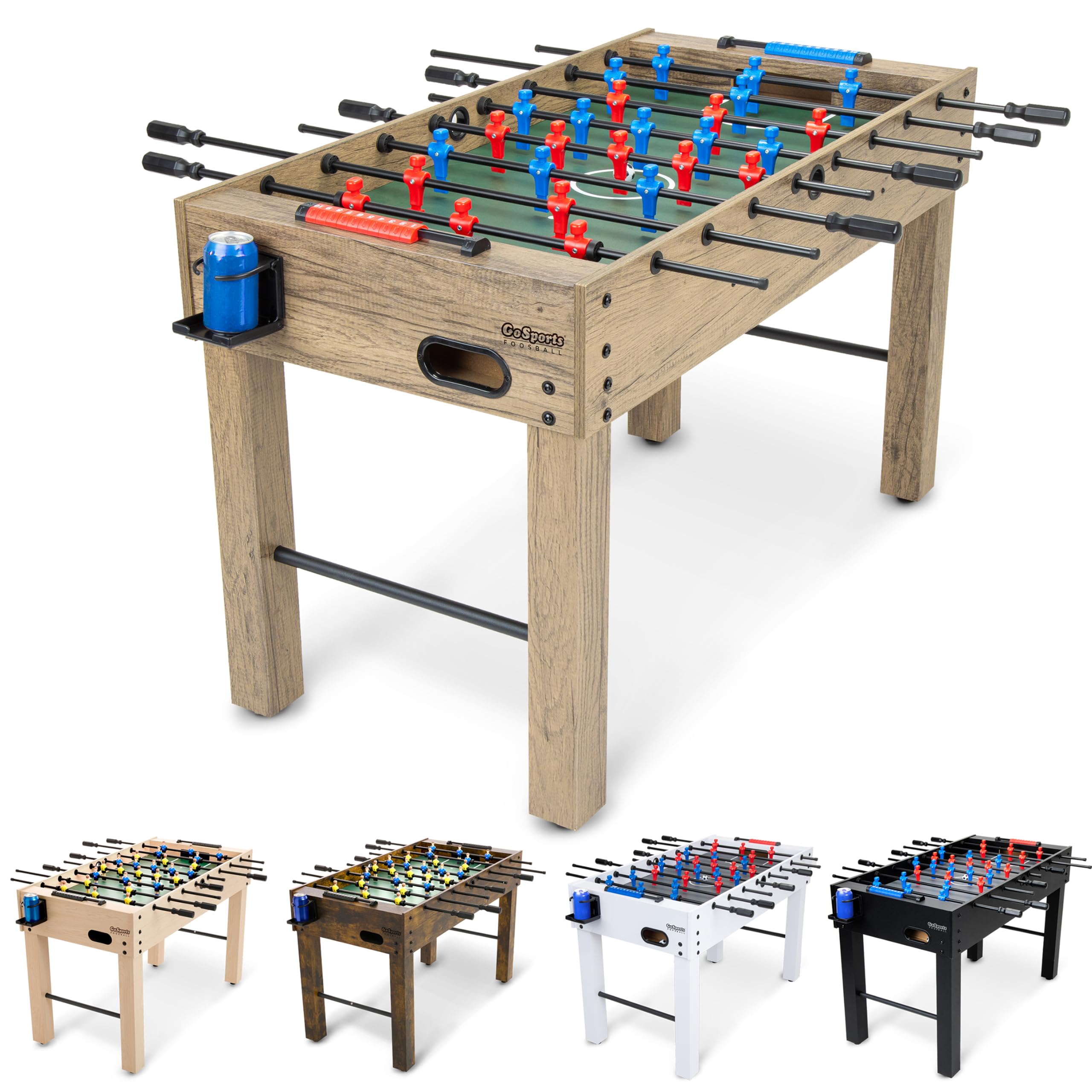
GoSports 48"

GoSports 48"

Finished family rooms

Doodle Score 9.0/10
Check Price

Worth Noting

  • Rods flex under a hard shot
Frame
Engineered wood
Players
Up to 4
Included
4 balls, 2 cup holders
Table Size
48" L x 38" W x 31" H
Read the full review

Assembly is what this table gets right, and it's the reason we reach for it ahead of the cheaper cabinets. GoSports ships illustrated steps backed by an installation video, and the frame goes together in one sitting without the usual wrestling match with the hardware.

In the room it's a nicer object than the money suggests: an oak finish, a low-friction playing field, red and blue players, two cup holders and four balls instead of the usual two. It's listed at 48 inches long and 38 across once the rods and cup holders are in place, so give it a wall rather than the middle of the floor.

Against the other cabinets here, this is the midrange one to beat. It costs a little more than the Best Choice 48 and less than the 54-inch model, and what the step up buys is a better finish and a build you don't spend an evening fighting. Four balls in the box also means you can lose two before anyone thinks about ordering replacements.

Bottom line: The easiest build here and the best-looking midrange cabinet, which makes it the pick for a family rec room where play stays friendly.

#5

WIN.MAX 20" Mini

WIN.MAX 20" Mini

Desks and gifts

Doodle Score 9.0/10
Check Price

Worth Noting

  • Two players only
Men
12 players
Rods
4 stainless steel
Included
2 balls, 2 score sliders
Table Size
20.1" L x 12.2" W x 3.8" H
Read the full review

Twenty inches long and under four inches tall, this is the smallest table in the guide and the only one that fits on a shelf. It sets up on a desk, a kitchen counter or the end of a dorm bed, and it takes less room than a board game.

Don't expect full-size physics. Four rods, twelve men and a score slider at each end give you the shape of the game in a two-player match, and the stainless rods are the upgrade that matters — they spin instead of sticking, and on a table this small a sticky rod turns every shot into a scramble.

We rate it as a gift rather than a substitute. Buy it for a kid who has been asking about foosball, for a dorm, or for an office desk, and it earns its place; buy it expecting to host a four-player tournament and it won't. Assembly is short, and the finished table is light enough to move off a desk when you need the desk back.

Bottom line: The mini we hand to desk-bound players and gift-givers: 20 inches, stainless rods that spin, and two score sliders.

#6

Best Choice Products 48"

Best Choice Products 48"

First family table

Doodle Score 8.8/10
Check Price

Worth Noting

  • Joints and hardware loosen with heavy use
Frame
Engineered wood (MDF)
Weight
45 lb
Included
2 balls, 2 cup holders
Table Size
48" L x 24" W x 32" H
Read the full review

This is the table we point at when someone wants a genuine foosball table, has a playroom, and doesn't have a tournament budget. Forty-eight inches long and 24 wide, with chrome-finished rods, two cup holders and two balls in the box, it does what most families actually need: a waist-high table four people can crowd around on a rainy Sunday. On value, it's the strongest pick here.

The 45-pound MDF cabinet explains both the price and the one behavior worth planning around. It's light enough for two people to shift and light enough that fast, hard play can walk it across a bare floor, and the playing surface can lift out of its groove if the table isn't sitting level. Carpet or a rug under the legs, the levelers set properly, and a wall behind it solve most of that.

Assembly is the other evening you'll spend. The steps are illustrated and one person can get most of the way through, but the player rows are the part to slow down for — line them up correctly on the rods the first time, because that's the mistake you only notice at the end. Two balls, two cup holders and a walnut finish complete a package that looks better in a rec room than it has any right to.

Bottom line: Buy this if you want a real 48-inch table for family play without tournament-cabinet money — just put it on a rug and level it.

#7

Best Choice Products 54"

Best Choice Products 54"

Four adult players

Doodle Score 8.8/10
Check Price

Worth Noting

  • Leg joints can fail before the first game
Frame
Wood composite
Weight
73 lb
Included
2 balls, 2 cup holders
Table Size
54" L x 28" W x 34.25" H
Read the full review

Six inches longer, four inches wider and 28 pounds heavier than the 48-inch Best Choice table in this guide. Those numbers describe a different table: the 73-pound cabinet sits still in a way the lighter one doesn't, and the 34.25-inch rail puts the playfield at a comfortable height for grown-ups.

The extra size earns its keep. A 54-inch cabinet is four inches broader across than its sibling, which gives four adults room to stand without hips colliding, and the longer run means the ball spends more time in transit — which is where the passing game lives.

Assembly is an evening with two people and the directions are readable, which is more than the cheapest tables here manage. Two balls and two cup holders come in the box, and the walnut cabinet reads as furniture in a basement rather than a toy in a spare room.

If four adults are going to play, this is the Best Choice model to buy: the extra weight fixes the wandering that the lighter table asks you to work around, and it still costs a fraction of a tournament cabinet. The contoured handles are the detail we noticed last — hour two is when cheap grips start to bite, and these don't.

Bottom line: For four adults who actually play, this is the Best Choice model to buy: heavier, wider and steadier than the 48-inch version.

#8

GIANTEX 48"

GIANTEX 48"

Entry-level full-size

Doodle Score 8.6/10
Check Price

Worth Noting

  • Lightest full-size cabinet here at 26.5 pounds
Weight
26.5 lb
Included
2 balls, 26 players
Levelers
Four 1.5"
Table Size
48" L x 24" W x 31" H
Read the full review

At 26.5 pounds this is the lightest full-size cabinet in the group, and that number explains most of the lower price. It's 48 by 24 inches with a leveler at each corner, a scorer at both ends, anti-skid grips on the rods and 26 players — the same basic layout as the tables that cost more.

It's a starter table, and a fair one, provided you accept what a thin cabinet means. The levelers are the feature that saves it: a light table on an uneven floor is a bad game, and four corners that adjust make the difference between a table that rolls true and one that doesn't. This is not the cabinet to lean on when a match gets heated.

Assembly is the weak link. The hardware and the illustrated steps are both there, but the instructions are thin on the order of operations, so lay the parts out first and don't tighten anything until the frame is square. Two balls come in the box, and what you get for the money is a genuine 48-inch table rather than a toy.

Bottom line: The least expensive way into a 48-inch table here — good for casual family games on a level floor, as long as nobody leans on the rods.

How We Tested the Best Foosball Tables

We began with research, comparing footprints, frame materials, rod and bearing setups, and what came in the box, then narrowed the field to eight foosball tables that covered different sizes and playing styles. Each table lived in a basement rec room for 10 months, where it had to survive after-dinner matches, kids' sleepovers, and a few loud adult rematches.

Assembly was the first real test. We timed each build, counted how often we had to backtrack because of unclear instructions, and noted whether one person could manage or a second set of hands was essential. We also measured each table's footprint and checked how hard it was to shift once built, since size and weight matter as much as the game itself. During play, we leaned on the corners, bumped the frame, and took hard shots to see which tables rocked or slid.

Over the months, we watched for wear at the rods, bearings, goal boxes, and joints, and noted whether the finish held up to sweaty palms and stray balls. We tracked gameplay details like ball return, dead spots, and how smoothly the rods moved, then factored in how well each table suited kids versus adults. Finally, we compared what each table included against its cost. The eight that made the cut are the ones that stayed stable, kept play fun, and felt worth the space.

How to Choose Foosball Tables

Full-size, tabletop, or mini

A full-size cabinet runs 48 to 56 inches long and is the only version that plays like the game you remember, but it needs a room rather than a corner. A 32-inch tabletop gives you real rods and real men on a table you already own. A 20-inch mini is a desk game that happens to keep score. Match the format to your space first; every other decision gets easier after that.

The trap is the published length. A 48-inch table measures the cabinet, not the footprint: add the rods, the handles and the space players stand in and it spreads much wider — GoSports lists its 48-inch table at 38 inches across with the rods and cup holders on. Leave three feet at each end for the players, and measure the wall before you fall for a finish.

Weight is the stability spec

The most useful number for predicting how a table feels is its weight. Our lightest full-size cabinet is 26.5 pounds and our heaviest is 355; a 45-pound table and a 73-pound table behave exactly as the numbers suggest, and the heavier the cabinet, the less it walks across the floor when someone shoots hard.

Weight isn't everything, because a light table on a level floor with its levelers set right plays better than a heavy one on a slope. Put it on carpet or a rug if you can, set the levelers when you build it and again after the first few games, and lift rather than shove when you move it.

Rods, bearings, and players

Solid steel rods turning in bearings are what separate a table that plays from one that fights you. Hollow or thin chrome rods flex on a hard shot, and once a rod bends the men stop hanging level and the table is never quite right again. Counterbalanced players hang upright until you pass, which is why tournament tables use them, and three goalies per side is the layout competitive players expect.

The Titan here uses 5/8-inch solid steel rods on bearings; the cheaper cabinets use lighter rods that give under pressure. If you can't inspect a table in person, ask whether the rods are solid steel and whether replacements are sold — a table with no spare rods has a short life once one bends.

Assembly and where it goes

Every full-size table here arrives flat and takes an evening, so pick the room before you open the box. A 148-pound cabinet is not something you relocate on a whim, and even the 45-pound tables are easier to build where they'll stand. Sort the hardware into cups, fit the players on the rods before you close anything up, and check the frame for square before the final tighten.

A dry room matters as much as a big one. Most cabinets here are engineered wood or MDF, which swells when it takes on moisture, so an unheated garage or a covered patio is a risk in humid months. A carpeted basement or a spare room is the safer home for any table you want to keep flat.

What to spend

The bottom of this group buys a light cabinet and a genuinely playable table for kids and casual games. The middle adds weight, better finishes, and instructions you can follow without a video. The top buys bearings, counterbalanced players and a cabinet that doesn't move — worth it only if the table will be used hard and often.

Spend on stability before features. Cup holders and scorers are pleasant, but a wobbling table is the thing you notice every single game, and no accessory makes up for it. If the budget only stretches to a light cabinet, put the money you save toward a rug and a level floor.

Frequently Asked Questions

Final Verdict

For a home game room where the table stays put, our pick is the KICK Titan. The rods run on bearings, the counterbalanced players pass cleanly, and 148 pounds means hard play doesn't move the table an inch.

If the budget won't stretch that far, the Best Choice 48-inch table delivers casual family foosball for a fraction of the money — put it on a rug, level it once, and it holds up. Buy the Titan if the table gets a room; buy the Best Choice if it gets a corner.