Dolls & Figures

Best Dollhouses for Toddlers of 2026

Last spring, I watched a two-year-old grab a wooden dollhouse by the roof and try to carry it like a handbag. The roof came off. She was fine; the dollhouse wasn't. Toddlers don't play gently — they sit on walls, slam doors, and treat tiny chairs like snacks. The right dollhouse fixes that with fewer choke-size pieces, sturdier construction, and little-hand-friendly features, all while looking cute enough to leave out in the living room.

Over the past eight months, my team and I have lived with 11 dollhouses, from foldable plastic sets to heirloom-wood styles, and the differences are not subtle. The ones that earned a spot in our playroom survive being leaned on, come with accessories that don't scatter to the four winds, and don't cost a fortune for something a child will outgrow in a couple of years. A dollhouse that takes two hours and a drill to assemble will sit in the box. The picks below are the ones we kept reaching for during playdates, after daycare, and on rainy Saturdays, long after the novelty faded.

#1

Fisher-Price Surprise & Sounds Home

Fisher-Price Surprise & Sounds Home

First dollhouse

Doodle Score 9.6/10
Check Price

Worth Noting

  • Fits Little People figures only
  • Outgrown by about age five
Storage
Handle; pieces store inside
Age Range
12 months - 5 years
Figures Included
3 Little People figures
Sounds, Songs And Phrases
50
Read the full review

Twelve months is the number that decides this one for us. Every other house in this guide is rated three and up, which means a two-year-old spends a year watching an older sibling play with the good toy. This one is built for the child who is still working out how doors open: the figures are too big to lose, the furniture stays where it is put, and the whole house folds shut with a handle on top.

Fifty songs, sounds and phrases is a lot, and where they hide is the clever part. The oven and fridge doors set them off, the toilet seat lifts and flushes, the radio plays, and a bird slides back and forth for peek-a-boo with the cat and a weather report. The toilet is usually the first thing a toddler finds, which tells you how this toy actually gets played with.

It opens flat, so two children can play from opposite sides, and closed it's about five inches deep — thin enough to slide down beside the sofa instead of living in the middle of the floor. Two AA batteries come in the box, so it works straight out of the wrapping.

What you trade away is longevity. It's a shallow house with simple furniture, and it won't hold a five-year-old the way a dollhouse with staircases and a balcony does; by school age it's a hand-me-down. For the two or three years it owns, it's the house we recommend without hesitation.

Bottom line: This is the one we hand to a two-year-old without a second thought: it opens flat, survives being carried by the handle, and everything goes back inside.

#2

Bluey Mega Bundle House

Bluey Mega Bundle House

Bluey fans

Doodle Score 9.6/10
Check Price

Worth Noting

  • Stickers can peel with play
  • One bedroom for four characters
Rooms
4 plus fold-down patio
Pieces
20
Age Range
36 months - 15 years
Figures Included
4 poseable
Read the full review

The best part of this Bluey house is outside. The patio folds down from the front, Bandit gets a grill, and the picnic table takes sausages and salad — a small thing, but it's the bit children act out first, because it's the bit they remember from the show. Inside there are four rooms, and the beds for Bluey and Bingo are the detail a four-year-old will point out before anything else.

All four Heelers come in the box and they're poseable, which is why this earns its place: most character playsets hand you the main character and make you buy the family separately. It folds shut with the pieces inside for travel, though the bottom latch is the weak point and can let go mid-carry — a strap or a wide rubber band sorts that out for good.

Set against the rest of this group it's a lot of small plastic, and there's one bedroom for four characters, which a child will notice before you do. Buy it for a child who already knows the show; for anyone else, the wooden houses further down this page do more for the money.

Bottom line: Buy it for the child who already shouts the catchphrases: four poseable Heelers and a fold-down patio do more for a Bluey fan than any wooden house will.

#3

Peppa Pig Big Family House

Peppa Pig Big Family House

Peppa Pig fans

Doodle Score 9.6/10
Check Price

Worth Noting

  • No Mummy or Daddy Pig figure
  • Small accessories suit three and up
Rooms
7 across 2 floors
Width
Over 2.5 ft (80 cm)
Accessories
11 plus sticker sheet
Figures Included
3, including Baby Evie
Read the full review

You open this house with a key. Turn it in the side and the whole thing swings wide to about two and a half feet, which is the sort of mechanism that sells a toy on its own — a three-year-old will open and close it far more often than she plays inside it. There are seven rooms across two floors, and Peppa, George and Baby Evie each have their own bedroom.

The baby is the best-value part of the set. Evie comes with a rocking cradle that flips into a crib, a bouncer that actually moves, and a high chair — real baby-care play, which is what a lot of two- and three-year-olds are actually interested in. The stairs flip over into a slide, the toilet opens, the fridge opens, and there's a sticker sheet for decorating.

What's missing is Mummy and Daddy Pig. For a child who wants the whole family in the house, that's a real gap and an extra purchase. Otherwise it's well made, it stores tidily on a shelf, and near the bottom of the price range it's a lot of play for the money.

Bottom line: For a Peppa-obsessed three-year-old, the key-turn opening and Baby Evie's cradle are the whole show in one box.

#4

Barbie Chelsea Pop-Up House

Barbie Chelsea Pop-Up House

Travel play

Doodle Score 9.6/10
Check Price

Worth Noting

  • Not every piece stores inside
  • Tiny accessories are easy to lose
Pieces
20
Includes
Chelsea doll and pet pup
Open Size
17 x 13 inches
Folded Size
8.5 x 9.3 inches
Read the full review

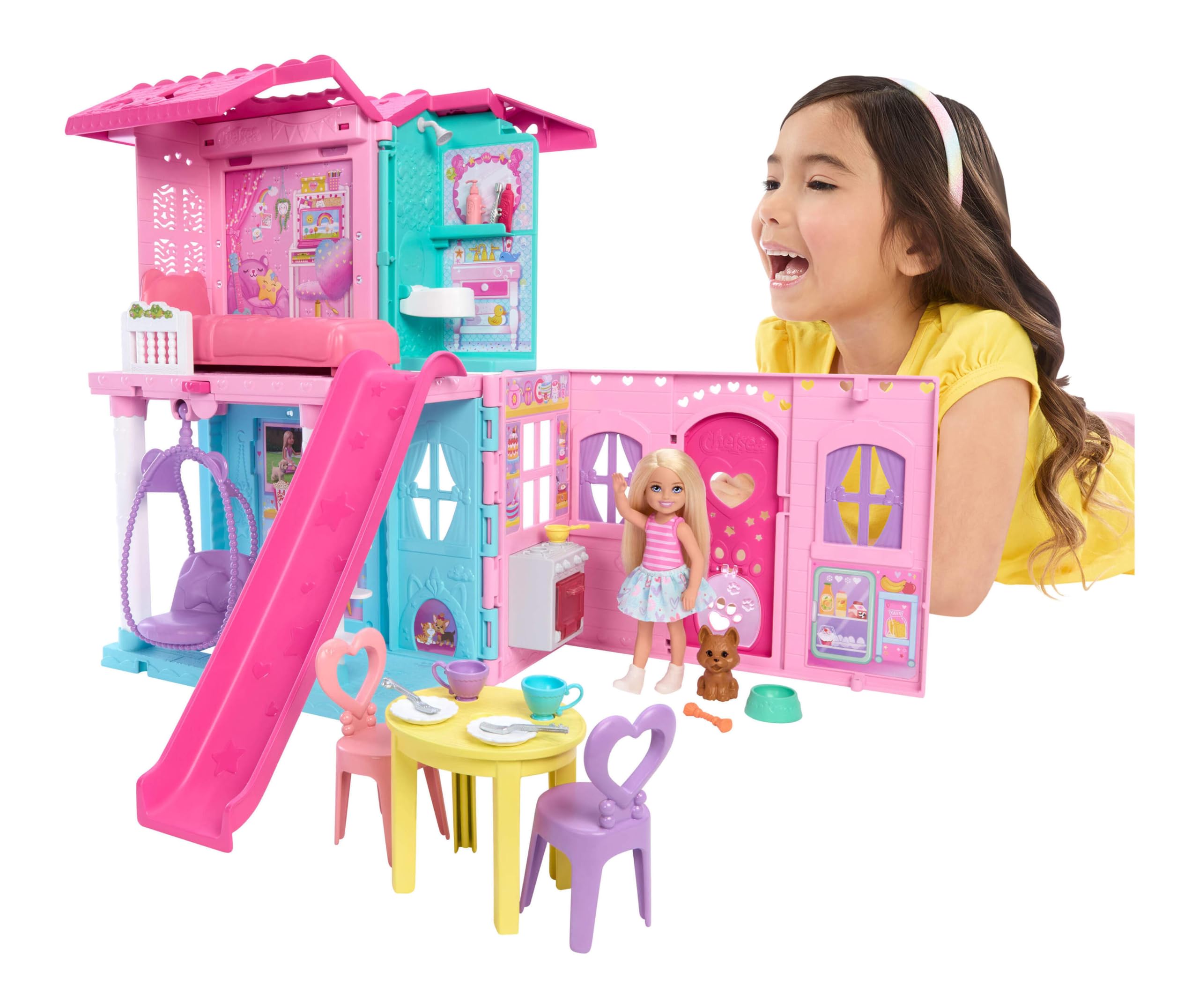
Closed, this is 8.5 by 9.3 inches — smaller than most picture books — and it opens out to 17 by 13 with a slide, a bedroom, a kitchen and a bathroom. The transformation is the toy. A child used to a dollhouse that stays in the corner will carry this one to the car, to a restaurant, to a grandparent's kitchen, and set it up on the table.

Chelsea and her pup come in the box, along with a bed, a hanging chair and a dining table with heart-shaped chairs, and the whole thing weighs two pounds. Of the small sets here it's the one we take out of the house, because it opens into a real play space rather than a folded-up compromise. Most of the pieces store inside when it's shut — not all of them.

It's a small doll in a small house, so the accessories are genuinely tiny and a three-year-old is the youngest sensible owner. As a second dollhouse, the one that lives in a bag, it does a job nothing else in this guide does.

Bottom line: The travel dollhouse we keep reaching for: it disappears into a bag and opens into something a child actually wants to play with.

#5

Hape All Seasons Dollhouse

Hape All Seasons Dollhouse

Long-term play

Doodle Score 9.4/10
Check Price

Worth Noting

  • The priciest house in this group
  • Small furniture suits three and up
Roof
Reversible summer and winter
Levels
3 stories
Material
FSC birch, maple, rubberwood
Furniture
Four room sets
Read the full review

The roof is the party trick. It flips over, summer on one side and winter on the other, and the stairs lift out and move between floors — a three-year-old will do that forty times in the first week. It's wood, so there are no sounds or lights; the season change is the interactive part, and it holds attention longer than a button does.

Four furnished room sets come in the box, with a grandfather clock and the small dressing that makes a room look lived in. The material is Baltic birch, maple and rubberwood from FSC-managed forests, finished with water-based paint — worth knowing because the furniture will end up in a mouth at some point, and because this is the house here most likely to be handed down.

The sides are open, so two children can stand at opposite walls without elbowing each other, and at 28.9 inches tall it's low enough that a child kneeling on the floor reaches the top storey. The furniture is on the small side, though; the kitchen and bathroom pieces are the ones that vanish under the sofa.

It's the priciest thing in this guide and we still point wooden-house buyers at it, because the money goes into material that gets climbed on and a shape that's still in use at eight. Wait for the third birthday and it's likely the last dollhouse you buy.

Bottom line: Our pick if you want one wooden dollhouse to last a decade; just wait until the child is three before you hand it over.

#6

Tiny Land Wooden Dollhouse

Tiny Land Wooden Dollhouse

Sibling play

Doodle Score 9.4/10
Check Price

Worth Noting

  • Top floor out of reach for a two-year-old
Rooms
6
Scale
1:12
Height
31 inches
Furniture
31 pieces
Read the full review

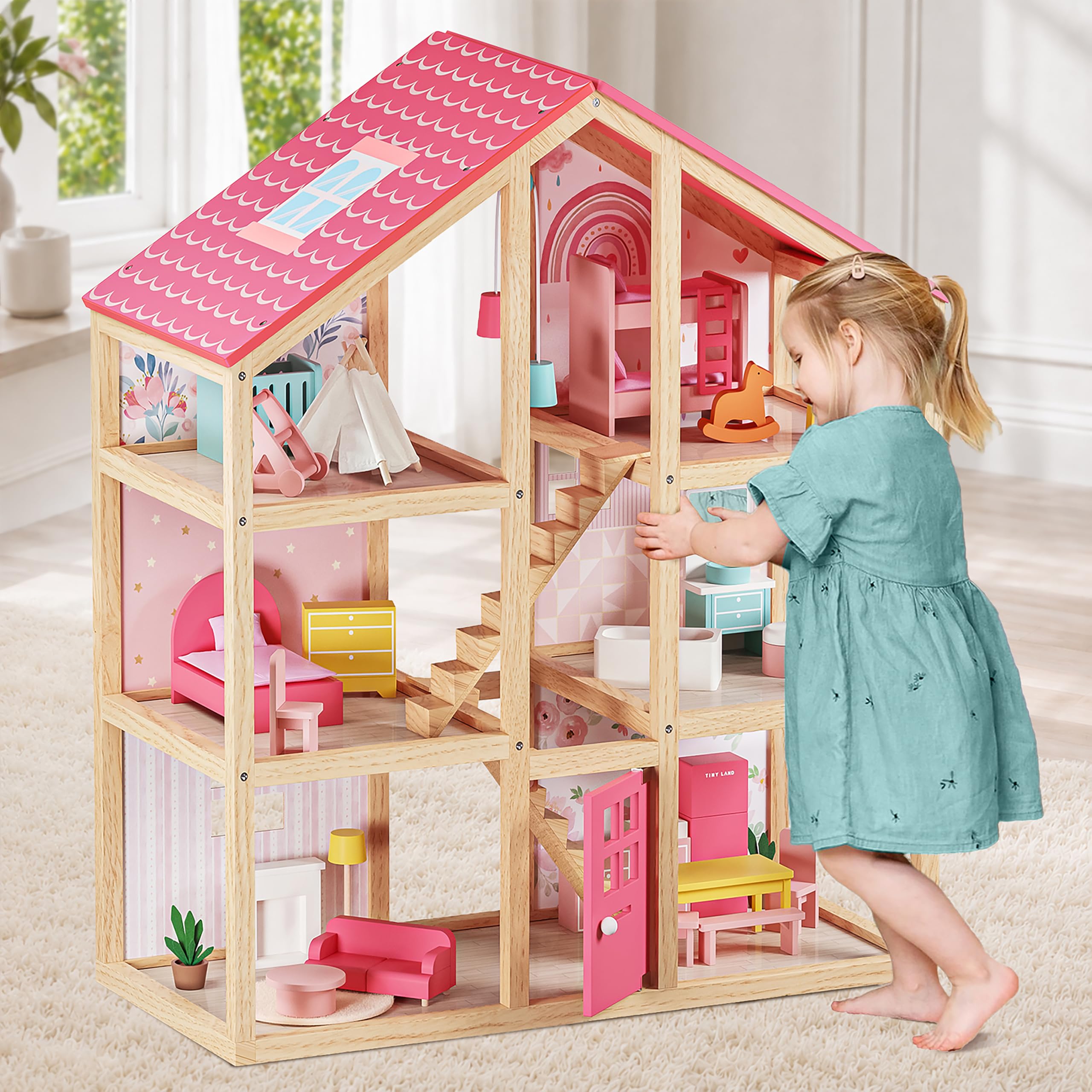
Six rooms, and two of them are bedrooms: a children's room and a baby room. That sounds like a small thing until you've watched two children argue over the one bed, and the second bedroom is what makes this house work for siblings rather than for one child at a time.

Thirty-one pieces of furniture come with it, the most in this group, plus six printed wallpapers so the kitchen doesn't look like the bathroom. At 1:12 scale it takes standard dollhouse dolls, and it doesn't come with any, so the family is a separate purchase worth making at the same time as the house.

It's engineered wood and it goes together with screws rather than dowels. The wood is soft enough that over-tightening is the way these go wrong, so snug each one and stop. It stands 31 inches tall and it's open on every side, which is what lets two children play without a back wall to fight over.

At the top of the price range here it earns its place on furniture and layout rather than material. A two-year-old can't reach the top floor standing up, and the small pieces are a 3+ proposition, so it's a house for a three-year-old who will still be using it at seven.

Bottom line: Worth the money if you want a furnished wooden house that two children can play at once without a fight over the only bed.

#7

Melissa & Doug Fold & Go Dollhouse

Melissa & Doug Fold & Go Dollhouse

Small spaces

Doodle Score 9.4/10
Check Price

Worth Noting

  • Only two figures included
Rooms
4
Furniture
11 pieces
Dimensions
12.5 x 7.5 x 10 inches
Figures Included
2 wooden figures
Read the full review

At 12.5 by 7.5 by 10 inches this is the one that fits on a shelf, and among the wooden houses here that's a distinction worth having. It opens into four rooms with 11 pieces of furniture and two small wooden figures, and it closes back up with the furniture inside.

The catch is the hinge. The house splits down the middle and there's nothing holding the two halves together, so picking it up by the handle can tip the whole thing open and scatter the contents. A short strap or a hook-and-loop tie around the middle fixes it permanently, and once that's on, the fold-and-go idea works the way it was meant to.

What you get for the compromise is wood at a size a toddler can manage, with furniture that suits the rooms and two figures that bend at the waist. Two is not many — most children want a third person — and the pieces sit loose rather than clipping down. For a small flat, or a house where the dollhouse has to disappear between plays, this is the one that keeps its place on the shelf.

Bottom line: A good little wooden house for a small flat — add a strap for the fold and a third figure, and it earns its shelf.

#8

KidKraft Chelsea Doll Cottage

KidKraft Chelsea Doll Cottage

Small-doll play

Doodle Score 9.2/10
Check Price

Worth Noting

  • No dolls or figures included
  • Takes a couple of hours to assemble
Rooms
5 across 3 floors
Doll Size
Up to 5 inches
Furniture
16 pieces
Dimensions
25 x 13 x 28 inches
Read the full review

This is the least expensive way into a wooden dollhouse, and it doesn't feel like a compromise: three storeys, five rooms, two staircases and a terraced balcony, with shutters and a front door that really open and close. Working doors are a bigger deal than they sound — a toddler who can put a doll through a doorway and shut it behind them is getting the whole point of a dollhouse.

It's built for five-inch dolls, which turns out to be a good match for small hands and for the figures most toddlers already own. The 16-piece furniture set includes real fabric details — a squishy couch cushion, bunk beds — and those soft bits are what children reach for. Assembly is the cost: a couple of hours of screws and small fittings before anyone plays with it.

Two things to know before you order. No dolls come in the box, so plan on a family as well, and the five-inch scale means a standard fashion doll won't fit through the doors. Within those limits it's the cheapest wooden house here, and the one we choose for a child who already has a shoebox of small dolls.

Bottom line: The wooden house we point to when the budget is tight — as long as the dolls in the house are small ones.

How We Tested 11 Toddler Dollhouses (and What We Looked For)

We began with more than 30 dollhouses labeled for ages 1 to 3, then cut the list by checking age recommendations, the size of every included piece against a choking-hazard tube, and whether the set folded flat or claimed a permanent spot on the floor. We ruled out anything that required more than basic tools or had instructions longer than a board book. That left 11 models: fabric pop-ups, foldable plastic sets, and solid wood houses with working doors.

For eight months, those dollhouses lived where toddlers actually play — living room rugs, playroom corners, and the kitchen floor during dinner prep. We timed assembly from unboxing to first play, noted whether a second adult was needed, and then watched 1-, 2-, and 3-year-olds during playdates and after daycare. We counted every accessory before play, then again a week later, and checked whether dolls and furniture fit through doorways without tipping. We also shook each house gently, leaned on the roof, and dropped it from coffee-table height to see what cracked.

Sturdiness showed up in small ways: hinges that stayed tight after fifty door slams, roofs that didn't pop off when a toddler tried to carry the house like a suitcase. We tested closure by filling each house with accessories, latching it shut, and carrying it across the room — some latches gave way before we reached the sofa. Foldability mattered for smaller homes, so we folded and unfolded each collapsible model three times and checked whether it stayed flat in storage. We tracked enjoyment by noting which houses drew the longest independent play. For appearance, we asked whether we'd leave it in the living room, and for value, we compared accessory count, assembly time, and how the finish held up after a month of daily play.

How to Choose Dollhouses for Toddlers

Start with the age rating

Twelve months and three years are different toys, not different maturity levels. A house rated from 12 months comes with figures too big to swallow and very little loose trim; everything rated 3 and up has small furniture, small doors and small people. For a two-year-old, that single line on the box narrows this whole guide to one house. If the child is already three, ignore the rating and choose on everything else.

Height decides reach, width decides the room

Dollhouses are played with on the floor, kneeling, which makes the height of the top floor the number that matters. The wooden houses here run from 28 to 31 inches, so a small child can reach the top storey from a kneeling position; a full-size fashion-doll house is four and a half feet tall and turns its upper floors into decoration.

Keep the house on the floor rather than a table so the child can walk around it, and measure the wall before you order. A 25-inch house needs 25 inches of clearance, and open sides need room to stand at, so a corner is the worst place for one.

Look for a handle, then check the latch

Dollhouses get carried, sat in and used as a garage. The plastic sets here close with everything inside and a handle on top, which is why a two-year-old can fetch and put away their own house. Wooden houses fold or split in half instead, and the weak point is the catch: the Melissa & Doug has none, and the Bluey house can let go mid-carry. A short strap costs almost nothing and fixes both, but check for the latch before you buy.

Furnished but empty is the common surprise

Most of the wooden houses here arrive with beds, sofas and a kitchen but nobody to live in them, and a house with no people in it gets played with far less. Buy a family at the same time as the house rather than a week later. The character sets go the other way: the Bluey and Peppa houses include their figures, which is part of what the license costs you.

Assembly is a grown-up's evening

Flat-pack is the hidden cost of wood. The plastic houses are out of the box in minutes; the wooden ones arrive as panels, screws and illustrated instructions, and a couple of hours is realistic for the KidKraft Chelsea, with the larger houses taking longer. Build it the night before a birthday, on the floor of the room where it will live, and keep the instructions in a drawer — the furniture comes loose and needs reattaching for years.

Frequently Asked Questions

Final Verdict

For a toddler — a real one, under three — the Fisher-Price Little People Surprise & Sounds Home is the house we recommend first. It's the only pick here that works before the third birthday, the only one a child can carry, close and put away alone, and it costs less than most of the group.

If you have a three-year-old and want one wooden house that survives to eight, the Hape All Seasons is worth the premium. And if the show is already a fixture at home, the Bluey bundle is the one they'll ask for; add a strap to the latch and it travels.