Building & Blocks

Best Gear Toys for Kids of 2026

Gear toys work on one simple idea: turn a crank and a chain of interlocking cogs carries the motion across the table until something on the far end spins. What separates a set that gets played with for years from one that gets abandoned mid-build usually isn't the piece count — it's whether the gears actually mesh in a six-year-old's hands. I once watched a perfectly good-looking set die on the living room floor because one peg fit a hair too tight and nobody could get the crank to turn.

Over the past six months, my team and I have built, cranked, knocked over, and rebuilt 12 gear sets with kids ranging from preschool through early elementary. The ones that earned their floor space all share a habit of teaching cause and effect without ever announcing that they're teaching anything, and they hold together well enough to survive a younger sibling. A gear toy should feel like a toy first and a gift you feel good about handing over second, and the picks below are the ones that manage both.

#1

Gears! Gears! Gears! Super Building Set

Gears! Gears! Gears! Super Building Set

Ages 3+

Doodle Score 9.6/10
Check Price

Worth Noting

  • Highest price of the four sets here
Pieces
150
Storage
Tub included
Gear Drive
Hand crank, no batteries
Recommended Age
3 years and up
Read the full review

One gear on its own is a fidget. A hundred and fifty of them, clicked onto pillars and plates, become a machine a four-year-old can crank and watch: turn the handle at one end and every gear in the chain moves, including the ones they placed themselves. That is the whole case for this set and the reason we made it our top pick — the payoff is big enough to see from across a room and immediate enough to hold a preschooler's attention.

Age 3 is the right gate for the mechanism. Pressing a gear onto a pillar takes a firm push, and the first few frames will need adult hands; after that, swapping gears and turning the crank is well within reach. Because the gears interlock, a misplaced one announces itself — the chain stops, and the fix is visible rather than explained. Nothing here comes with a picture of the finished build, and we count that as a feature: the build is whatever the child decides it is, which is why this set outlasts the instruction-led kits in a house with more than one child.

Scope is what the price buys. There are enough gears for two children to build separate machines at the same table, and the whole lot goes back into the tub it arrived in, which turns cleanup into a sweep instead of a hunt. It's the most expensive set here, and the case for the money is the number of years it stays in use rather than the number of pieces in the tub. Buy it for a household with a few years of gear play ahead; a family buying for one four-year-old can spend less and still get a working gear toy.

Bottom line: The gear set we recommend first: 150 pieces, ages 3 and up, and enough scope that it's still being rebuilt years later — worth the higher price if the budget allows.
#2

Melissa & Doug Caterpillar Gear

Melissa & Doug Caterpillar Gear

Toddlers

Doodle Score 9.6/10
Check Price

Worth Noting

  • Outgrown by about age three
  • Six gears keep builds small
Base
Solid wood
Gears
6 interchangeable
Batteries
None required
Recommended Age
18 months to 3 years
Read the full review

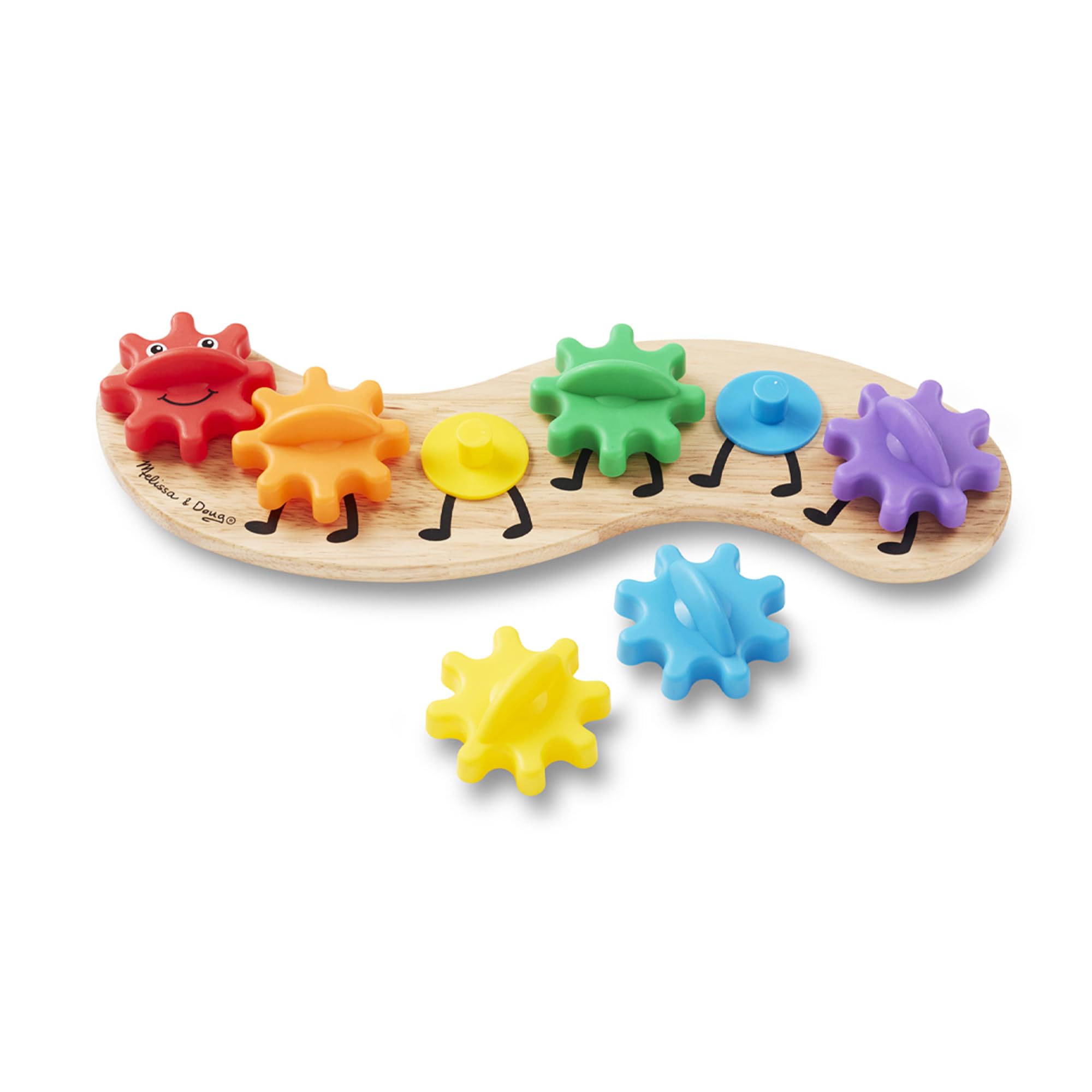
The board is the part you notice: solid wood, painted caterpillar feet, a smiling face on the red gear, and six chunky gears in six bright colors riding on matching-color pegs. Nothing needs pressing, snapping or lining up, so a toddler can strip the whole thing down and rebuild it on the floor without a hand from you.

That is what makes it the best first gear toy here. At this age the game is take-apart-and-put-back, and this board is built for it: gears lift off, go back on and spin in any order. The color matching does more work than we expected — pegs and gears correspond, so a child who has lost interest in spinning can sort instead, and the toy changes jobs without changing shape.

The looseness that makes it toddler-friendly is its limit as well: spin a gear hard and it can ride up off the peg, and a gear that comes off under the sofa stays there. That's the right trade at 18 months, where the chunky pieces are easy to grab and easy to find. It's the toy you can hand over without saying anything, which is the highest compliment available at that age.

Bottom line: The best first gear toy: a wooden board, six chunky gears and nothing to press together, which means a toddler can play it alone from about 18 months.

#3

Gears! Gears! Gears! Robots in Motion

Gears! Gears! Gears! Robots in Motion

Robot fans

Doodle Score 9.4/10
Check Price

Worth Noting

  • Picture-only instructions are a lot for a five-year-old
Builds
Robots with treads and wheels
Gear Drive
Hand crank, no batteries
Compatibility
Other Gears! Gears! Gears! sets
Recommended Age
5 to 9 years
Read the full review

If the request was specifically for robots, this is the set to get. Treads, wheels and connectors sit alongside the gears, so the build has a job rather than just a shape — a machine that twists, turns and drives. That framing does real work with a child who loses interest in an abstract gear chain, and it's why we keep this one in the guide despite its narrower brief.

It's rated 5 to 9, and the mechanism is the familiar friction-fit system: gears and connectors press onto pillars, and whether a build survives its first turn of the crank depends on how firmly every connector is seated. Push each one fully home before handing it over — a partly seated connector is the difference between a robot that walks and one that loses its head mid-step.

Where this one earns its place for us is as an add-on. It's compatible with other Gears! Gears! Gears! sets, so a house that already has a tub of gears gets robots rather than a rival collection, and the pieces extend what's already there. On its own it's the narrowest pick here: fewer pieces than the big set, one theme, and a first build that goes better with an adult at the table. If robots are the whole point, none of that matters.

Bottom line: Buy this one when the request is specifically robots: treads, wheels and connectors turn the gear chain into a machine that drives, and it plugs into an existing Gears! collection.

#4

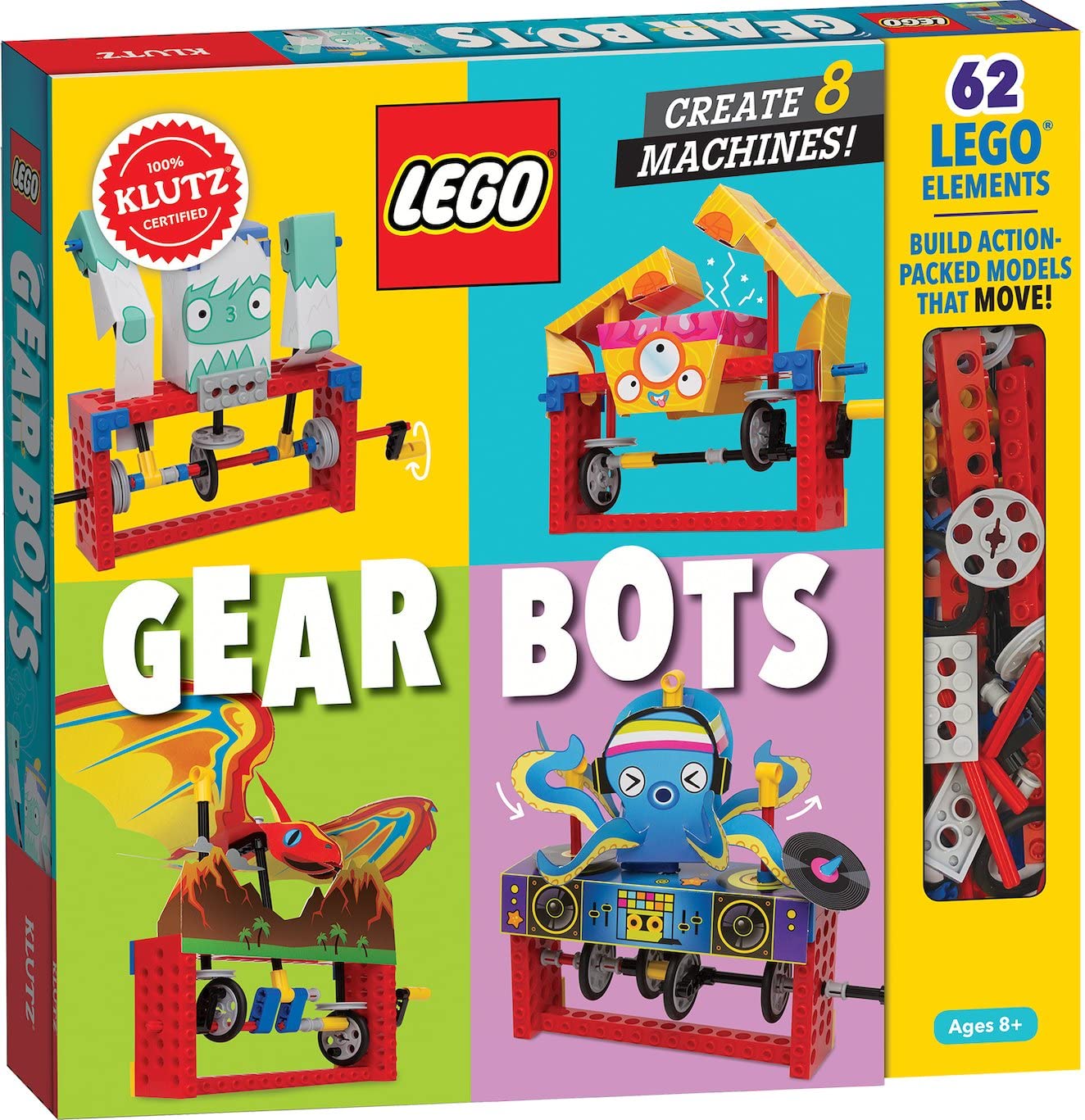
Klutz LEGO Gear Bots

Klutz LEGO Gear Bots

Ages 8-12

Doodle Score 9.2/10
Check Price

Worth Noting

  • One model at a time; each build comes apart for the next
Includes
62 LEGO elements and 10 papercraft sheets
Guide Book
64 pages
Models To Build
8
Recommended Age
8 to 12 years
Read the full review

A 64-page book inside a toy box usually means the toy needs an adult. Here it's the part that makes the kit worth buying. Alongside the step-by-step builds, it explains axles, cams and cranks and points at the everyday machines that use them, so a child who reads it comes away knowing why the creature moves rather than only that it does.

The build itself is the most interesting idea in this group: LEGO Technic does the mechanical work and folded papercraft supplies the body, so the finished creature has a real cam-driven gait instead of a spinning sticker on a brick. The first time a crank turns and the paper thing appears to walk, we were genuinely surprised — the motion reads as alive. Eight different creatures come out of one box, the instructions are clear enough for a nine-year-old to work alone, and the whole kit is hand-powered. For the 8-to-12 crowd this is the best build experience here.

What it isn't is a playset. The finished bot is light and paper-bodied and best parked on a shelf; the paper is what suffers first if a younger sibling picks it up, so treat the age range as a floor rather than a suggestion. Buy it for a child who likes a project with a finish line and a book to go with it — the fun is in the building, and the model is the receipt.

Bottom line: The best pick for a builder aged 8 to 12: eight Technic-and-paper creatures, a book that explains the mechanics, and a project to finish rather than a toy to store.

How We Tested the Best Gear Toys for Kids

We started by rounding up every gear set sold widely enough that a shopper could actually find it, then filtered by age rating, piece count, and whether the set included a hand crank or motor versus pure hand-spinning. Anything with a piece count far beyond its stated age range got cut, as did sets with illustration-only instructions and no labels. That left 12 sets, which we built and rebuilt across after-school evenings and rainy Saturday mornings over six months.

Each set got timed from box open to first crank turn, with a kid building solo and an adult only watching. We wrote down where kids stalled, whether the picture instructions matched the pieces actually in the box, and whether a stuck step ended in a request for help or a walk away. Then we cranked hard the way a seven-year-old does, dropped bases off the coffee table, and checked a few weeks in whether the gears still turned smoothly or had begun to slip, strip, or wobble. We also ran a hand over every edge and connector, noting burrs, thin plastic, and pegs that were snug versus pegs that fought back.

The real test was repeat play. Every set stayed on a shelf at kid height, and we tracked which ones came back out without anyone suggesting it. We watched for the moment a gear chain first moved end to end — the sets that got a kid yelling for someone to come see were the ones that scored highest on fun and playability. For the gift question, we looked at whether a child could reach a working model without an adult pre-building it, whether it needed batteries on hand, and whether the thing survived being opened in front of a birthday party crowd.

How to Choose Gear Toys for Kids

Match the set to the hands, not the birthday

When a gear toy fails, it usually isn't the gears — it's the grip. Peg boards let a toddler drop a gear on and lift it off. Snapping sets need a firm push to seat a gear on a pillar, and a child who can't manage that alone will hand the box back to you. Kits that add folding and Technic parts ask for finer fingers again. Test before you buy: watch your child press a chunky puzzle piece home. If that takes two hands and a grunt, start with a peg board. If it's easy, a snapping set will last years longer.

Piece count buys length, not attention

More pieces means longer chains, taller frames and room for two children to build at the same table — that's the real argument for a big set, not the number printed on the box. The count that matters more is how many builds can exist at once. Open-ended sets let one machine stand while the next goes up; instruction-led kits share a single frame, so each model comes apart before the next begins. For siblings, buy open-ended and big. For one child who likes following plans, a smaller kit with good instructions can hold attention longer than a tub of parts.

If there's already a gears set in the house, check whether the new one is designed to connect to it before you buy a second collection.

Stiff joints, slipping gears, and what holds

Gear toys fail in two opposite ways. Pieces that seat tightly hold a tall frame together but defeat small hands, which is why the first few base plates are usually an adult's job. Gears that sit loosely spin easily and ride up off the peg mid-turn — on a toddler board that's the game, on a building set it's a build that stops dead. Neither is a defect; they're different fits for different ages. Before a first build, seat every connector fully home and turn the crank once yourself to check the chain.

Storage and the pieces you will lose

Gears are the first thing to disappear, and a set that has lost a third of them builds noticeably shorter chains. Keep whatever the set arrived in, or give it a shallow lidded box a child can reach into; a deep tub adults have to dig through is where toys go to be forgotten. Photograph the parts list before the packaging goes out with the recycling, so you know what you're short of and can tell a missing gear from a missing pillar.

Frequently Asked Questions

Final Verdict

Buy the Learning Resources Super Building Set for most kids: 150 pieces, rated from age three, hand-cranked, and open-ended enough that the same box is still in use years later. If your child is two, get the Melissa & Doug board instead — chunky gears, nothing to press together, and a fraction of the price. And if the child is nine and wants instructions and LEGO, the Klutz kit is the better gift, as long as everyone understands that each creature comes apart to make room for the next.