Baby & Toddler

Best Activity Cubes of 2026

An activity cube has one job: keep a toddler busy long enough for you to finish a cup of coffee. The trouble is that plenty of them are louder than they are engaging—plastic songs on repeat, beads that jam, and a footprint that swallows half the playroom. What you actually want is a toy that earns its floor space: sturdy enough to survive a pull-to-stand, educational enough to revisit without boredom, and quiet enough that you don’t hide it in a closet by Thursday. That balance of build quality, sound control, real play value, and price is what separates a keeper from a resale pile.

Over seven months, my team and I tested 11 activity cubes—assembling each one solo, measuring how much room it took up on the rug, and watching toddlers return to them during playdates and quiet mornings at home. We noted which music and sound effects wore thin, which activities got ignored after a week, and which cubes still felt solid after being climbed on. The picks below are the ones that kept earning their place.

#1

VTech Sort and Discover Cube

VTech Sort and Discover Cube

A first birthday

Doodle Score 9.6/10
Check Price

Worth Noting

  • Only four blocks for the sorter
  • A lot of songs and phrases for adults
Age Range
9 months to 3 years
Activities
Seven activities plus two electronic panels
Play Sides
5
Assembled Size
8.66 x 9.25 x 9.65 inches
Read the full review

Set this cube beside the wooden floor models here and the difference is range. Nine months to three years is the widest recommended span in this group, and it is covered by two kinds of play at once: seven hands-on activities across five sides, plus two electronic panels with a five-key piano, a turning book page and a spinner that lights up.

The shape sorter is what settled it for us. Four chunky blocks and a hole that only accepts one answer gives a one-year-old something to get right, which is why the sorter is the side they come back to once the lights stop being news. The electronic half carries the rest: animal names and sounds on four light-up buttons, colors and numbers on the piano, two nursery rhymes on the book page. For most families that combination is more useful than a cube that is all lights with no shape to fit.

Height is the compromise. At 9.65 inches tall it is a tabletop cube, sitting below a cruising toddler's hands, so it will not do the pull-up job the Battat manages at 17.72 inches. What you get instead is 2.4 pounds of plastic you can move from the playroom to the kitchen one-handed, and a toy that gets knocked over rather than broken.

Two AA batteries come in the box for demonstration only, and given how much this thing talks, a pack of rechargeables pays for itself. The piano keys are the part adults end up hearing most. The book page is the sleeper: two nursery rhymes a toddler can trigger without help is a lot of repeat play out of one hinge.

Bottom line: Our default for a first birthday: five sides, a real shape sorter, and a nine-month-to-three-year span that covers more stages than anything else here.

#2

Battat Wooden Activity Cube

Battat Wooden Activity Cube

Standing and cruising

Doodle Score 9.6/10
Check Price

Worth Noting

  • Hinges and doors are the breakage point
  • 13.2 pounds keeps it in one room
Weight
13.2 lb
Batteries
Not required
Play Sides
5
Assembled Size
13.4 x 11.81 x 17.72 inches
Read the full review

Seventeen and three-quarter inches is the number that decides this one. It puts the bead maze at a cruising toddler's chest, and with a 13.4-inch footprint and 13.2 pounds of wood underneath, the cube stays where it is put when somebody leans on it. Of the floor-standing picks here, this is the one we trust most under a child who is still finding their feet.

Five sides of farm-themed play carry the rest: loop-the-loop bead wires on top, peekaboo doors, spinning animal blocks, a zig-zag race down one side and mix-and-match animals on another. The palette is a shade deeper than the primary plastic on most cubes, which we appreciate in a room where the toy will sit in the open rather than get packed away. Nothing needs batteries, ever.

The upper age range runs to eight years, and the top maze genuinely holds an older sibling while a one-year-old works the doors at floor level. The weight cuts both ways: 13.2 pounds makes this furniture that gets moved once and then stays, and the price is furniture-shaped too. Corners are rounded and everything is reachable from a crawling height, so it earns that placement.

Bottom line: Buy this one if you want a wooden cube a toddler can pull up on: it is the most stable thing here on the floor, and it never needs a battery.

#3

VTech Busy Learners Cube

VTech Busy Learners Cube

Babies 6-12 months

Doodle Score 9.6/10
Check Price

Worth Noting

  • Repetitive songs and animal sounds
Weight
1.4 lb
Play Sides
5
Assembled Size
6.22 x 6.22 x 6.46 inches
Interactive Features
14
Read the full review

Lift this cube and it starts talking. A motion sensor triggers sounds whenever the toy is moved, which is either the smartest thing on the shelf or the reason it is chirping from inside the bag on the way home.

What is inside six inches: five sides, four light-up buttons that name animals and shapes, moving parts to bat at, 25 songs and melodies, adjustable volume and an auto shut-off. It runs on two AAA batteries, included for demo, and weighs 1.4 pounds.

Where it earns its place is the youngest end of this group. A baby who can sit but not crawl gets the whole toy within reach: the buttons are big, the lights sit where a baby is already looking, and nothing needs fine fingers. We noticed the motion sensor doing more work than any single button, because the cube reacts to being picked up, and that is exactly the cause and effect a nine-month-old is testing.

The lifespan is the real catch. The sides are shallow, and a two-year-old who has worked out every button moves on quickly, so this is a first-year toy rather than a three-year one. A second child will get it back out, and at 6.22 inches it fits in a changing bag for a restaurant.

Bottom line: We keep this one for the six-to-twelve-month stage: it is the smallest, the least expensive and the easiest of these to carry from room to room.

#4

Hape Country Critters Play Cube

Hape Country Critters Play Cube

A living room

Doodle Score 9.4/10
Check Price

Worth Noting

  • Paint can chip along the edges
Batteries
Not required
Play Sides
5
Assembled Size
13.78 x 13.78 x 19.57 inches
Included Pieces
10
Read the full review

The most expensive cube here is also the quietest: Baltic birch and maple, no batteries, no lights, and ten pieces — three wooden balls, six wooden shapes and the cube itself.

We think the money buys two things. The first is mass. At 19.57 inches tall and 6.09 kg, it does not walk across the floor when a toddler leans on it, and the wire on top is a proper bead run rather than a couple of loops. The second is runway: the four activities and the animal friends leave room to get better at something, which is what keeps a toy out of the donation bag in year three.

One thing to know before you buy: the three balls can jam where the track narrows, and a child mid-flow will hand the whole cube over to you to sort out. It is a small interruption in a toy that otherwise runs itself, and it is the sort of thing that happens less once a child learns to tip it.

Assembly is the easy part, since the top screws on in a few minutes and everything else arrives put together. Of everything here, this is the one that looks like furniture rather than a toy, which matters more than it sounds when the cube is going to stand in a room you actually use.

Bottom line: If the cube is going to sit in a living room for a decade, this is the one worth the money: solid birch and maple, no batteries, ten pieces to work through.

#5

Bravmate 8-in-1 Wooden Activity Cube

Bravmate 8-in-1 Wooden Activity Cube

Small apartments

Doodle Score 9.4/10
Check Price

Worth Noting

  • Tabletop footprint rather than a floor cube
Material
Rubber wood
Bead Maze
Lifts off and stores inside
Activities
8
Assembled Size
8.6 x 7.36 x 7.5 inches
Read the full review

The top of this cube comes off on purpose. The bead maze lifts out to be played with on a lap, then flips and drops inside the box, which is the neatest storage trick in this group and the reason it can live on a shelf between playtimes instead of owning a corner of the room.

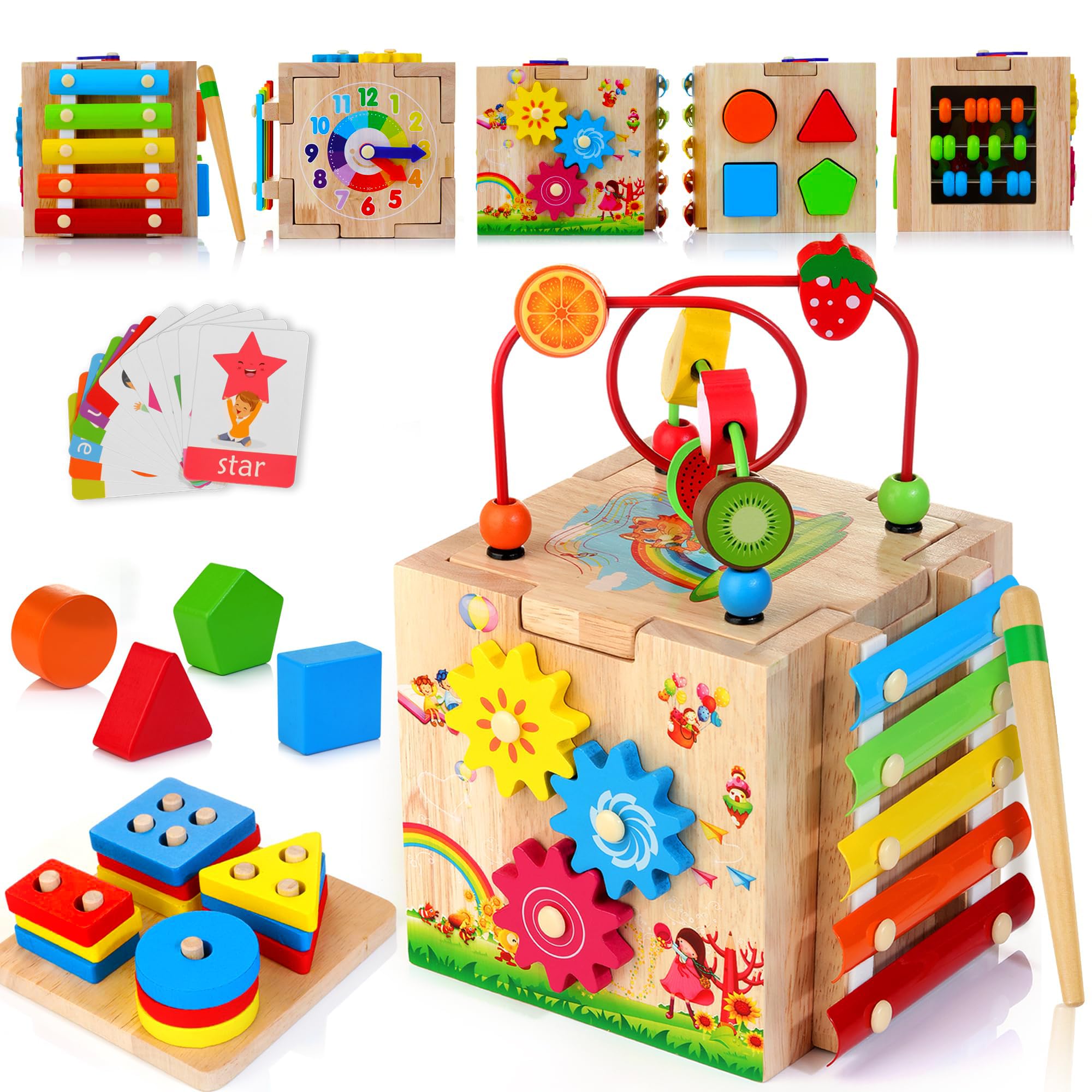
Underneath sits the rest of the eight: a working xylophone, a learning clock, a shape sorter, an abacus, spinning gears and a sorting game, in rubber wood with rounded edges and a water-based finish. It measures 8.6 inches across, weighs 1.55 kg, and is sold from 12 months up.

A one-year-old will use two of the eight. The shape sorter and the bead maze are the ones within reach of a first birthday, and the rest are there waiting when the reach gets longer, which is the argument for buying eight activities rather than three.

For a small apartment the arithmetic works: it comes out, it gets played with hard for twenty minutes, and it goes back on the shelf with the beads contained. The detachable top is what makes that possible, and it is why this one earns a place over cubes that only work as floor furniture.

Bottom line: Eight activities and a bead maze that packs down inside the box, for families with more shelf space than floor space.

#6

Manhattan Toy Tree Top Adventure

Manhattan Toy Tree Top Adventure

Walkers and standers

Doodle Score 9.2/10
Check Price

Worth Noting

  • Assembly is fiddly and unforgiving
Weight
10.6 lb
Age Range
12 months to 5 years
Batteries
Not required
Assembled Size
18 x 18 x 22.5 inches
Read the full review

This is not a cube. It is a 22.5-inch wooden tree standing on an 18-inch base, and the shape changes the play: a toddler works it from standing, both hands free, rather than sitting over a box on the floor.

We like it best for the child who is already walking. Gliders, springy flaps, spinning dials, bead runs and a shape-recognition side are packed onto four faces, and the graphics run all the way around, so there is something to look at from whichever side a toddler ends up on. It is sold from 12 months to five years, and the height is what buys that span — a two-year-old still fits it comfortably.

The base is the part to think about. At 10.6 pounds on an 18-inch footprint, it can go over when a child pulls hard on the top, so park it in a corner or against a wall until you have watched how your own child uses it, and keep it off hard flooring for the first few weeks. That is a placement decision, not a reason to skip the toy.

Assembly is where patience runs out: the parts go together in an order that is not obvious, and a wobbly build makes the tipping worse. Do it once, on a table, with the instructions flat, and check every fixing before it goes into the playroom.

Bottom line: The best standing-height center here for a toddler already on their feet — just site it against a wall before you let them haul on it.

#7

TOYVENTIVE Wooden Activity Cube Set

TOYVENTIVE Wooden Activity Cube Set

A gift

Doodle Score 9.2/10
Check Price

Worth Noting

  • Bead maze sits on top without locking
  • Recommended range stops at two years
Included
Cube, stacking cups, board book
Age Range
12 months to 2 years
Activities
5
Assembled Size
7.48 x 7.09 x 7.48 inches
Read the full review

Two things come out of this box that do not come out of the others: a set of stacking cups and a first-words board book, packed with the cube in a gift-ready box. For a birthday you are handing over rather than setting up, that is most of the decision made.

The cube is the same pattern as the other wooden ones here — bead maze, shape sorter, abacus, spinning gears and a learning clock — in a smaller package. The maze lifts off and stores inside, which keeps the set to one tidy object between plays, and the wood has smooth edges and a child-friendly finish.

Size is where expectations go wrong. At 7.48 inches this is a tabletop cube and the photographs read larger, so it is not the big first-birthday centerpiece. As a gift with extras it makes more sense: the cups are the part a one-year-old grabs first, and the book gives an adult something to do with the child the moment the paper comes off.

Two years is the top of its recommended range, which is short. That fits the framing — this is a first-birthday present with a second birthday's worth of use in it, and it should be chosen as that rather than as the toy a family keeps for a decade.

Bottom line: Our pick when the cube is a present rather than a purchase: it arrives gift-boxed with stacking cups and a board book, and the cube itself is small.

How We Chose and Tested the Best Activity Cubes

We started with a shortlist of 11 activity cubes sold by brands with a track record in toddler toys, filtering by price, footprint, and the number of activities on each face—shape sorters, bead runs, gears, latches, and music panels. We skipped cubes that were too tall to be stable or too wide for a typical living room, and we made sure the mix included wooden classics, plastic all-in-ones, and convertible models.

Each cube was assembled solo at my kitchen table, with a stopwatch running, and then moved to the living room rug for seven months of daily use. I measured the footprint against a coffee table and a playpen, checked whether the cube slid or tipped when a toddler pulled up on it, and noted how loud the music and sound effects got—plus whether there was a volume switch or off button. I also wiped each one down after snack time and checked for loose screws, chipped paint, and beads that stuck.

During playdates and quiet mornings, I watched kids from about 12 months to 3 years circle back to each cube and recorded which activities they returned to after the first week. A good cube kept them engaged without me resetting it every two minutes; a lesser one got ignored once the novelty wore off. We also compared the price against how many features actually got used, and we noted which cubes still felt solid after being climbed on, dropped, and dragged across the floor.

How to Choose Activity Cubes

Count the activities, not the sides

Every cube here claims five sides, and most of them mean it. What separates them is how many of those sides a baby can work without an adult. A door that opens, a bead that slides, a block that drops through one hole: those are activities. A printed farm scene is decoration, and a title that says eight-in-one is usually counting a clock face and an abacus that are two-year-old work.

We look for at least three sides that give a one-year-old an outcome they can repeat. If the cube is for a nine-month-old this month, favour the sorter-and-bead end of the range and treat the clock and abacus as something waiting for later.

Tabletop cube or floor-standing center

This is the choice that most often goes wrong. A cube of seven to nine inches sits on the floor for a baby who can sit but not stand, and it plays at arm's length. A cube of seventeen to twenty-two inches is furniture: a toddler grabs the top and hauls up, which is a different toy with a different job.

The trap is the photography. Small cubes are shot to look like floor models, and the wooden cube here listed at 8.6 inches reads much larger in the pictures. Read the height figure before you order, then decide which stage your child is actually in.

Batteries, songs and your noise budget

An electronic cube gives more cause and effect per dollar: press, and something happens. A wooden cube gives you silence, no battery bill and a toy that survives being left in a sunny window. Neither is better in the abstract, but the room matters. A cube that lives in a shared living room is easier to live with when it makes no sound.

If you do go electronic, two features matter more than the song count: adjustable volume and an auto shut-off. Both are on the VTech cubes here, and both are what keep a toy in the rotation instead of on a high shelf.

The pull-up test and the first week

Before a toddler uses a floor cube to stand, push the top corner yourself and watch the base. The Battat, at 13.2 pounds on a 13.4-inch footprint, barely moves. A lighter stand like the 10.6-pound Manhattan Toy center on its 18-inch base can go over under a hard pull, so put it against a wall at first.

The same week, check the small parts: wires anchored at both ends, pegs that do not twist, doors that stay on their hinges. Loose beads and pegs are a choking hazard on any toy sold from six months, and this is the check worth doing before a baby does it for you.

Loose parts and putting it away

Blocks and balls roll, and a shape sorter without a catch ends up as a box of loose shapes under the sofa. Cubes with a detachable bead maze handle this best: the Bravmate top flips over and stores inside the body, and the TOYVENTIVE maze stows in the same way.

The counter-trap is a top that lifts off but does not lock back down. That is fine for shelf storage and annoying in play, and it also means a parent's foot finds the maze on the floor after bedtime. Decide whether you want one object or two.

Frequently Asked Questions

Final Verdict

Our pick is the VTech Sort and Discover. It covers more of the first three years than anything else here, and the shape sorter gives a one-year-old the one thing a light-up button never does: something to get right.

If you want wood in the room instead of plastic, buy the Battat. It is the cube here that a toddler can genuinely pull up on, and it will still be standing when the batteries in everything else have gone flat.