Arts & Crafts

Best Ukuleles for Kids of 2026

A kids' ukulele has one job: stay in tune long enough for a child to play an actual song. That sounds like a low bar until you've watched a 6-year-old strum a chord that curdles halfway through "Twinkle Twinkle" — plenty of cheap models go flat within minutes, and the kid puts it down before the song ends. A good one holds its pitch, has a neck small hands can wrap around, and doesn't leave fingertips stinging after ten minutes.

The first ukulele I bought for my niece came from a souvenir shop and was unplayable by dinner. I've been fussy about this category ever since, and over the past four months my team and I have lived with 12 of them, from toddler-sized sopranos to concert models for older beginners. Here's what first-time buyers don't know: size matters more than anything printed on the headstock. Most kids under 8 do better on a soprano; a concert starts making sense once their hands grow into it. The picks below are the ones that survived daily use.

#1

Enya Nova U Concert Ukulele
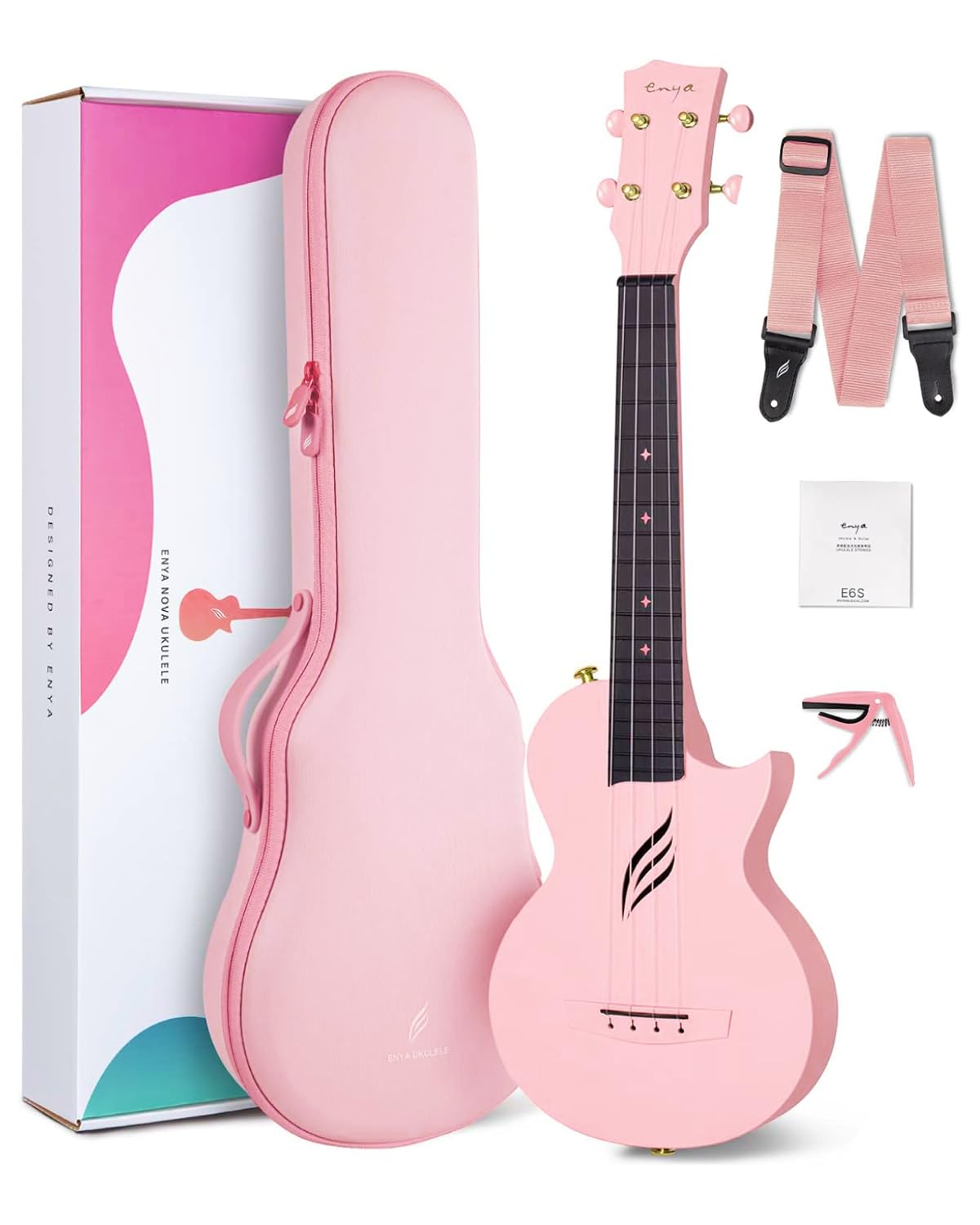
Enya Nova U Concert Ukulele

Older kids, travel

Doodle Score 9.4/10
Check Price

Worth Noting

  • No tuner in the box, only a capo
  • The most expensive pick in this group
Body
Carbon fiber
Size
23 inches
Weight
1.3 lb
Strings
Fluorocarbon
Read the full review

Carbon fiber rather than wood is what makes the Nova U the outlier in this group. It does not care about humidity, it will not crack if it sits near a radiator, and a knock against a table leaves a scuff rather than a split; the manufacturer also calls the body waterproof. For an instrument that will live in a backpack, that is not a gimmick.

It is a 23-inch concert, so it suits older children and anyone with longer arms, with wider fret spacing and more volume than the sopranos. A side sound hole facing the player adds projection and lets a small player hear themselves, and the fluorocarbon strings feel smooth under the fingers. At 1.3 lb it is light enough to carry all day.

Where it stumbles is the start-up kit: a padded case, a strap, a capo and a spare set of strings, but no tuner. A capo barely earns its place in beginner playing, and a tuner is the one accessory a beginner cannot work around, so put one in the basket. Paying the most in this group buys the instrument that survives the beach, the bus and the little brother, and if that is the life it will lead, the money is well spent.

Bottom line: For an older kid or a uke that will travel, this is the tough one: carbon fiber shrugs off knocks and weather, though you need to add a tuner.

#2

Donner DUS-1 Soprano Ukulele

Donner DUS-1 Soprano Ukulele

First real ukulele

Doodle Score 9.2/10
Check Price

Worth Noting

  • Heavier than the mini and budget sopranos here
Body
Mahogany
Size
21 inches
Frets
18
Weight
2.69 lb
Read the full review

Twenty-one inches is the size that fits most children from about six upward, and the Donner soprano is the one we point to first. Mahogany top, back and sides, a bone nut and saddle and a rosewood fingerboard put it a step above the basswood kits that make up much of the budget end here. The body has some weight to it and the neck feels like a small guitar's rather than a painted stick.

What settled it for us is the box, not the body. Alongside the ukulele you get a padded gig bag, a clip-on tuner, a strap, a spare set of Aquila strings, four picks, a cloth and access to Donner's beginner video lessons. The tuner earns its place more than it sounds: a child who can see the note name on a small screen tunes without waiting for an adult, and that independence is most of what keeps a beginner practicing. Expect to retune constantly for the first week or two while the new nylon strings stretch. That is settling rather than a fault, and it levels off.

At 1220 g it is the heaviest soprano in this group, and a five-year-old will feel it after ten minutes of holding the instrument up; the Kmise below is the better fit for a small child. If your kid is ten or eleven with big hands, the same Donner kit is sold in a 23-inch concert, and either way a two-year warranty backs the instrument.

Bottom line: Our pick for most families: a proper mahogany soprano with a tuner, spare strings and lessons in the box, sized to last from about six to ten.

#3

Kmise 17-Inch Mini Ukulele

Kmise 17-Inch Mini Ukulele

Small hands

Doodle Score 9.2/10
Check Price

Worth Noting

  • Only 12 frets, so range runs out as skills grow
Body
Mahogany
Size
17 inches
Frets
12
Weight
1.06 lb
Read the full review

Seventeen inches and 480 g is small even by soprano standards, and that is exactly why the Kmise ends up in the hands of the youngest players we buy for. A five- or six-year-old can wrap an arm around the body and reach the first fret without stretching, which is simply not true of a 21-inch instrument on a small frame.

It is not a toy, though. The body is mahogany, the strings are Aquila and the tuners are geared 18:1 rather than the friction pegs that let a cheap uke slip the moment a child touches them. It plays like a real instrument: warm and surprisingly full for the size, and easy on small fingertips. It arrives with an electronic tuner, a gig bag, a patterned strap, a spare set of strings and a short instruction booklet, which is about as complete as a first kit gets.

The trade-off is range. Twelve frets cover the first songs and not much beyond, and the short scale crowds some chord shapes for an older child. Treat it as a two- or three-year instrument for a young beginner, and as a genuinely good travel uke for the adult in the house once the child moves up to something longer.

Bottom line: The right first uke for a small child: light, short-scaled and geared properly, so small hands can hold it and it still plays in tune.

#4

AODSK Soprano Ukulele

AODSK Soprano Ukulele

Tight budgets

Doodle Score 9.2/10
Check Price

Worth Noting

  • Three-month warranty, the shortest here
  • Strap is thin and fiddly to adjust
Body
Sapele
Size
21 inches
Weight
16 oz
Strings
Nylon
Read the full review

When a family is not sure the interest will last past January, we suggest the AODSK. It is the least expensive ukulele here that we are still happy to call an instrument: a sapele body, a rosewood fingerboard, a resin nut and saddle, and 16 ounces on the scale, light enough for a seven-year-old to hold through a whole practice session.

The bundle covers a gig bag, a strap, a spare nylon string and four picks. What the listing does not spell out is a tuner, so check the box before the first session and add a clip-on if it is missing. Tuning is the honest weak spot: pitch drifts more than on the Donner, especially in the opening weeks, and it helps to stretch the new strings gently by hand before tuning up.

The instrument looks better than its position in this group suggests, with a clean wood finish and a soundhole rosette that photographs well. It is the pick for a kid who has asked for a ukulele twice and might forget it by March: good enough to learn on properly, modest enough that a forgotten instrument is not a family argument.

Bottom line: Our budget pick: a light sapele soprano for a kid who is testing the waters, provided you add a clip-on tuner if the box lacks one.

#5

Winzz Soprano Ukulele

Winzz Soprano Ukulele

Color and looks

Doodle Score 9.0/10
Check Price

Worth Noting

  • No lesson package, just a chord card
Body
Basswood
Size
21 inches
Tuners
Die-cast
Strings
Aquila nylon
Read the full review

The blue-green top is hand-polished, and that finish is why a lot of kids reach for this one: it looks like something chosen rather than issued. Underneath it is basswood, the plainest wood in this group, but the hardware is better than the body suggests, with Aquila strings and die-cast machine heads that turn smoothly and stay where you leave them.

We rate it the best-looking soprano here and a solid second to the Donner on hardware, which is a good combination for a child who needs the instrument to feel like theirs. The kit is generous: padded waterproof bag, clip-on LED tuner, strap, spare Aquila strings, fingerboard sticker, cleaning cloth, storage bag and a chord card. What it does not include is a lesson package, so pair it with a beginner video series or a teacher; the chord card gets a child strumming, not much further.

Bottom line: Pick this one when color seals the deal: a hand-polished soprano with Aquila strings, die-cast tuners, a tuner and a padded bag in the box.

#6

Hape Wooden Toy Ukulele

Hape Wooden Toy Ukulele

Toddlers

Doodle Score 8.8/10
Check Price

Worth Noting

  • Strings break under rough toddler play
Strings
Nylon
Material
Baltic birch and maple
Recommended Age
3 to 6 years
Read the full review

Hape's red ukulele is a wooden toy strung with nylon, sized for a three- to six-year-old: Baltic birch and maple, a non-toxic finish, a body short enough for a toddler to carry by the neck. It is tunable in the sense that the pegs turn and the strings change pitch, which puts it ahead of the plastic lookalikes.

It is not a learning instrument, though. Pitch drifts while a child plays, so a song comes out sour and a beginner cannot tell whether it is them or the ukulele. If your child is five and asking for lessons, buy one of the real sopranos above instead; this one will not carry them to a first chord.

As a toy for a three- or four-year-old, we think it earns its place. It takes being dragged around the house, it matches the shape of the instrument the big sister is learning on, and it is the least expensive way here to find out whether the interest is real. Keep an eye on the strings, which are the first part to give out.

Bottom line: The right wooden toy for a three- or four-year-old who wants to copy an older sibling, and tough enough to survive the copying.

How We Tested 12 Kids' Ukuleles

We started with a list of roughly 40 ukuleles sold for kids and cut anything that wasn't a real instrument: proper scale length, tuners you could actually adjust, nylon strings, a bridge that sat flat against the body. Price and availability narrowed it to 12, spanning small sopranos to a couple of concerts. Every one was tuned out of the box with a clip-on tuner, and we noted how far off it arrived.

Testing ran four months with a rotating cast of kids ages 4 to 10 — living room strumming after school, the back seat on the drive to soccer, a few first lessons. Tuning retention was the measurement that mattered most: we checked pitch at the start and end of every 20-minute session during the first week, then weekly after that, and logged which ones drifted flat mid-song.

Playability got hands-on scrutiny. We pressed each string at the first fret to see how much finger pressure a small hand needed, wrapped a 5-year-old's arm around each body to check depth, and ran a thumb along the fret ends for sharp edges. For sound, we strummed open chords and listened for whether the tone was full or thin and plinky. Beginner suitability was easy to judge: we handed each one to a kid who'd never played and counted how long it took to get a clean-sounding C chord. We also noted which ones they picked up again without being asked — enjoyment counts as data.

Value came down to what was in the box. A gig bag, a spare set of strings, and a strap can be worth as much as the instrument itself, and a ukulele that needs a tuner and case bought separately isn't the bargain it looks like.

How to Choose Ukuleles for Kids

Start with the scale, not the color

The 17-inch mini is for the smallest players, roughly four to six, because a small child can reach the first fret without hauling an oversized body around. The 21-inch soprano is the default for six to nine and the size most first lessons assume. Above that, a 23-inch concert gives bigger hands more room between frets and more volume, which starts to matter once a child plays with other people.

If your kid sits between two sizes, take the smaller one. A body that is too big pushes the neck out to arm's length and teaches a cramped, hunched posture that is hard to unlearn. The cost of going small is range: a 12-fret mini runs out of notes sooner than an 18-fret soprano.

Tuning gears are where cheap ukuleles fail

Every new ukulele with nylon strings drifts out of tune for a week or two while the strings stretch. That part is normal, and it is why a tuner matters more than any other accessory. What separates a usable instrument from a maddening one is whether it comes back to pitch and then holds for a whole session.

Geared tuners, whether 18:1 or die-cast machine heads, hold far better than the plain friction pegs on the cheapest kits. Slipping pegs are the single most common reason we pass on a budget uke, and they matter more for a child, who cannot hear that the instrument, not the fingers, is out of tune.

Check what's actually in the box

A starter kit should include a clip-on tuner, a gig bag and a spare set of strings. A strap helps if the child likes to stand and play, and picks are optional since most beginners strum with a thumb. Free online lessons are a real bonus for a family starting from zero.

The trap is the all-in-one bundle that ships a capo and skips the tuner. A capo does almost nothing for a beginner working through first-position chords; a tuner is the one thing they cannot work around, so budget for one if the kit leaves it out.

Toys, lookalikes and real instruments

Not everything sold as a kids' ukulele can be tuned. Plastic toy guitars with four strings running to one peg, or strings joined in pairs, will not hold pitch no matter how patient you are, and they teach a child that the instrument sounds bad. Check for individual tuning pegs, real frets and separate nylon strings.

A wooden toddler toy is a reasonable introduction for a three-year-old who wants to copy an older sibling, but from about five, buy something with geared pegs and a fretboard. Material matters less than the hardware at this level: carbon fiber is the toughest, mahogany and sapele sit at the top of the wooden kits, and basswood is the plainest.

Frequently Asked Questions

Final Verdict

The Donner soprano is the one we recommend to most families. It is a real instrument rather than a decorated prop, it arrives with the tuner and spare strings a beginner needs, and 21 inches carries a child from about six to ten.

If your kid is smaller than that, buy the Kmise mini and accept the shorter range. If the uke will be thrown in a bag and dragged to the beach, the carbon-fiber Enya is worth the premium, and you should add a tuner to the order.