Arts & Crafts

Best Keyboards for Kids of 2026

A kids’ keyboard has to survive a very particular kind of enthusiasm: small hands mashing every key at once, a favorite demo song on repeat, and the occasional bump against the coffee table. I’ve watched a child’s face fall when a keyboard sounded thin or its buttons were too fiddly to work without an adult, and I’ve seen a well-made one become the thing a kid returns to after school. The right keyboard makes early music feel immediate; the wrong one turns “Twinkle, Twinkle” into a patience test.

Over four months, my team and I tested 12 beginner keyboards with kids ages 4 to 10, watching for sound quality, sturdiness, and whether a first-timer could make music within minutes. We also considered size on a coffee table or bedroom floor, appearance in a family room, and value that held up after daily play. The picks below are the ones kids returned to without prompting and parents didn’t mind leaving out.

#1

Yamaha PSR-E283

Yamaha PSR-E283

Learning properly

Doodle Score 9.2/10
Check Price

Worth Noting

  • No stand, stool, or headphones included
  • Plain black cabinet beside the colorful options here
Keys
61 full-size
Weight
8.8 lb
In The Box
Music rest and power adapter
Headphone Jack
6.35mm
Read the full review

Sixty-one full-size keys is the first thing we check on any keyboard with a child's name on it, and it is what separates this Yamaha from most of the boards here. Mini keys are fine for a four-year-old banging out a tune; a child taking lessons needs the same key width as the piano at school, or the fingerings they learn do not transfer. The PSR-E283 has that, plus a piano tone that sounds like a piano rather than a doorbell.

The learning tools are what push it ahead. Quiz mode turns ear training into two listening games, Smart Chord builds a full-sounding chord from one finger, and the Portable Grand button jumps straight to the good piano sound. We rate panel buttons over apps for beginners, because a child can sit down and use them without asking for a phone. Nothing here needs a subscription, and nothing stops working when the Wi-Fi does.

What you do not get is furniture: no stand, stool or headphones, just a music rest and the power supply, so add a stand to your order. The headphone socket is a full-size 6.35mm, which means the earbuds already in the house need an adapter — worth knowing on a board bought for quiet evening practice. On reliability this is the strongest of the full-size picks here, and for a family buying a first instrument that is the difference between a one-year toy and something a second child inherits.

Bottom line: For a child who might actually learn, this is the one we recommend: full-size keys, learning tools that work without a phone, and the best reliability record among the full-size picks.

#2

The ONE Color 61

The ONE Color 61

Reluctant beginners

Doodle Score 9.2/10
Check Price

Worth Noting

  • Some of the song library costs extra
  • Light-up lessons need a phone or tablet
Keys
61 full-size, light-up
Power
Adapter or 4 AA batteries
Weight
7.7 lb
Connectivity
Bluetooth and USB MIDI
Read the full review

Load a song in The ONE's app and the next key to play lights up red on the board, then the next one. That single trick is why this is our pick for a child who needs a reason to sit down at a keyboard: following lights feels like a game, and the notes are being learned anyway. The keys are full-size and there are 61 of them, so nothing about the layout has to be unlearned when the novelty of the lights wears off.

At 7.7 pounds it is the lightest full-size board here, and it runs on four AA batteries as well as the supplied adapter, which makes it the one that can go to a grandparent's house or in the back of the car. It comes in seven colors, including a lavender we liked far more than the usual black, and a child who picks their own color is a child who plays it.

The app is where it gets uneven. The library is enormous — thousands of pieces and around a hundred instructional videos — but parts of it are paid add-ons, and the games and interface are the least polished thing in the package. We still choose it for the lights. Go in expecting a few purchases inside the app and the value question answers itself; expect everything to be free and it will irritate you.

Bottom line: We choose it for the child who needs a game to sit down at all: light-up keys and app songs do that better than anything else here, provided you accept some paid extras.

#3

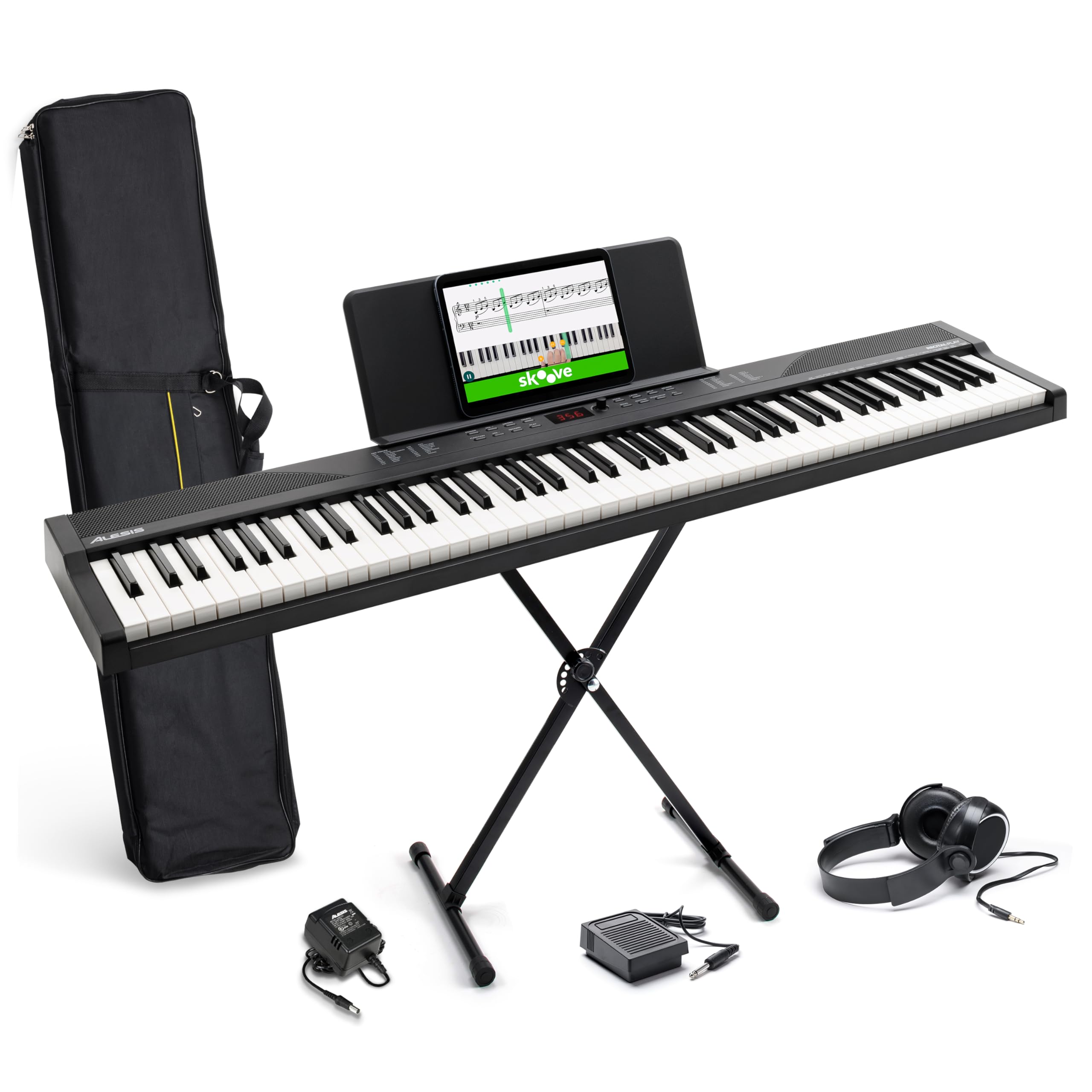
Alesis Recital Play 88

Alesis Recital Play 88

Piano lessons

Doodle Score 9.2/10
Check Price

Worth Noting

  • Keys can stop responding over time
Keys
88 touch-sensitive
Sounds
480
Weight
12.1 lb
In The Box
Stand, sustain pedal, headphones, carry bag
Read the full review

Just under 50 inches wide. That is the number to settle before anything else about the Recital Play, because 88 keys is furniture: it will not sit on a child's desk and it will not tuck into the corner of a small bedroom. Give it a wall and it is the most instrument you can put in front of a child for the money here — full-size keys, a sustain pedal and a stand, all in one order.

The reason to want all 88 is touch sensitivity. The keys respond to how hard they are played, so a child learns that loud and soft are choices rather than accidents, which is the thing a five-octave board never teaches. Split and lesson modes let a parent or teacher take the lower half while the child works the upper, and the record and metronome functions are the sort of thing that quietly becomes a habit.

The bundle is what makes the money make sense: stand, sustain pedal, headphones, carry bag, tablet stand and power supply, plus lessons from Skoove and Melodics and USB-MIDI for recording. Price those separately and a bare board plus a stand and a pedal lands close to the same place. For a family that already knows the child is sticking with it, that is the sensible way to buy.

Two things to accept. The case is plastic and feels it, though the money went into the keys and a child will not notice. Keys that stop responding are the fault to know about, and they are the reason we would keep the receipt and play every key in the first week. We recommend it with that caveat, for the child whose lessons make touch and a pedal worth having.

Bottom line: Our pick once lessons are on the calendar: 88 touch-sensitive keys, a sustain pedal and a stand, as long as you have the wall space for it.

#4

Casio SA-51

Casio SA-51

Small hands

Doodle Score 9.2/10
Check Price

Worth Noting

  • No power adapter in the box
  • Mini keys won't carry a child into lessons
Keys
32 mini
Power
Battery powered
Tones
100
Weight
2.2 lb
Read the full review

Seventeen and a half inches wide and a shade over two pounds: a five-year-old can carry this from the living room to the garden with one hand, and will. Of everything here, it is the board we hand to the youngest child without worrying about it, and the one that survives being put on a shelf between sessions.

The 32 mini keys are sized for small hands, and that is the whole trade: perfect for a four- or five-year-old, too narrow for a nine-year-old's lesson. What Casio gets right is the buttons. Piano, trumpet and drum set each have their own key, so a child who cannot read a menu can still change the sound, which is the difference between playing and hunting. Add 100 tones, 50 rhythms and 10 songs and there is more here than the size suggests.

The annoyance is power. It runs on batteries and no adapter comes in the box, so add one to the order or get used to buying AAs. Build is plastic and the keys are the part that wears, so treat it as a two-to-three-year instrument rather than an heirloom. As a first real keyboard, with sound clearly above the toy tier and a footprint that fits on a shelf, it earns its place.

Bottom line: We hand this to a four- or five-year-old before any other board here: small enough to carry, easy to work, with real instrument sounds and no menu to get lost in.

#5

JIKADA 61-Key

JIKADA 61-Key

Full kit on a budget

Doodle Score 9.2/10
Check Price

Worth Noting

  • Durability is the least proven here
Keys
61, light-up
Tones
255
Dimensions
36.4 x 13.4 x 3.5 inches
In The Box
Stand, stool, headphones, microphone
Read the full review

On paper it is the fullest box here: 61 light-up keys, three teaching modes, note stickers, an LCD, a stand, a stool, headphones, a microphone, a music rest and the power adapter, for less than the Yamaha. That is a lot of kit for the money, and the bundle is the reason to look at it in the first place.

The teaching modes are the part that earns it. One-key, follow and ensemble modes walk a beginner from pressing anything at all to playing along, and the light-up keys show where the hand goes without a phone in the room. We prefer that combination to an app for a seven- or eight-year-old, because the feedback is immediate and nothing needs charging before practice can start.

The tone is the compromise. It reads as an electronic keyboard rather than a piano — clear enough for a first year, thin next to the Yamaha's — and that is the honest limit of a full kit at this price. Everything else about it, down to the LCD and the stickers, is there to get a beginner playing in the first week, which it does well.

Bottom line: A lot of kit for the money and the teaching modes genuinely help, but the tone and the long-term odds keep it behind our main picks.

#6

RockJam RJ561 Kit

RockJam RJ561 Kit

One-box setup

Doodle Score 9.0/10
Check Price

Worth Noting

  • Keys or speakers can fail early
Keys
61
Weight
19.8 lb
Rhythms
100
In The Box
Stand, bench, headphones, note stickers
Read the full review

The first ten minutes with this kit are spent opening boxes. Keyboard, X-stand, bench, headphones, note stickers, music rest and a guide to the Simply Piano lessons all arrive together, which is the entire argument for it: one order, one delivery, nothing else to research. For a grandparent buying a first keyboard, or a parent who does not want four separate purchases arriving on four days, that is worth real money.

The note stickers are the low-tech feature we rate highest. A beginner can find a melody in the first ten minutes without an app, a login or a parent's phone, and 100 rhythms and 50 tones mean there is always a different button to press when attention drifts. The tone is serviceable rather than lovely — it reads as an electronic keyboard, not a piano — but for a first year of messing about it does the job.

The stand is the part to watch. An X-frame with a bench at this level is basic, and it is the piece most likely to wobble under an enthusiastic player, so the corner it lives in matters: pushed against a wall, it behaves far better than it does in the middle of a room. Set it up that way and the kit holds together. Buy it for the complete setup and the low-stakes introduction, not for the furniture.

Bottom line: The one-order solution for a family that wants the stand, bench and headphones sorted at once — a complete first setup in a single delivery.

#7

Love&Mini 37-Key

Love&Mini 37-Key

Toddler play

Doodle Score 8.8/10
Check Price

Worth Noting

  • Much smaller than the photos suggest
  • Microphone and stand break easily
Keys
37
Dimensions
8.9 x 16 x 23 inches
In The Box
Stool, microphone, music stand
Recommended Age
3 years and up
Read the full review

The gap between the photos and the box is the story here. It is a small toy: 16 inches across the keyboard, 23 inches to the top of the stand, and it takes up less floor than a dining chair. For a two- or three-year-old that is perfect. For a five-year-old who has seen a real piano, it is a disappointment waiting to happen, which is why we would not buy it for one.

What it does, it does with enthusiasm. Thirty-seven keys, 22 demo songs, four rhythms, four tones, two speakers, a microphone and a stool, and the keyboard detaches so it can go on the floor or in the car. The microphone is the star: a toddler who will not touch a piano key will sing into a microphone for twenty minutes, and that counts as a musical afternoon.

Fragility is the catch. The microphone and its stand are the parts that give way first, and this is a toy in the honest sense — it will not survive being sat on, dropped down the stairs, or handed to a four-year-old with a younger sibling. As a first taste of making noise rather than a first instrument, it does its job cheerfully.

Bottom line: Buy it for a two- or three-year-old who wants a microphone, not for a child starting lessons, and expect the microphone stand to be the first casualty.

How We Tested the Best Keyboards for Kids

We started by reading parent reviews and comparing specs for beginner keyboards, then narrowed the field to 12 models across a wide price range—no tiny toy keyboards, no full-size digital pianos. Over four months, we rotated them through after-school practice, weekend living-room concerts, and quiet bedroom play with kids ages 4 to 10. We watched first-timers try to start a song on their own, timed how quickly they found a sound they liked, and noted which keyboards they came back to without a parent suggesting it.

Sound quality got checked with fresh ears: we listened for thin or tinny notes, pressed chords to see whether the sound muddied, and tested whether demo songs or volume jumps drowned out a child’s playing. For beginner suitability and functionality, we asked kids to switch voices, use record-and-playback, and follow any learning modes; if an adult had to rescue them every few minutes, that counted against the keyboard. We also sized each one on a coffee table, a bedroom floor, and a child’s lap, and checked whether the keys felt comfortable for small hands.

Sturdiness and durability came from real use: keys were pressed hard, knobs and buttons were turned, and each keyboard was carried, set down, and bumped through four months of daily play. We noted wobbling keys, stuck buttons, power hiccups, and anything that felt loose or flimsy, then compared that wear against what each keyboard asked families to spend. Finally, we left the survivors in real living rooms and asked parents whether they minded the look—and we tracked enjoyment by seeing which ones kids chose for fun rather than a prompt.

How to Choose Keyboards for Kids

Toy or instrument? Start with the key size

Mini keys are the giveaway. A 32- or 37-key board with narrow keys and a microphone is a toy that makes music, and for a three- or four-year-old that is the right purchase — the Casio SA-51 and the Love&Mini sit at different ends of that category. From about six, and certainly if lessons are being discussed, buy full-size keys. A child who learns on narrow keys has to rebuild their hand position later, and 61 full-size keys will carry them until they need pedals and touch sensitivity.

Choose the key count by where it will live

Key count is a space decision as much as a musical one. A 61-key board is around three feet wide and sits on a desk, a stand or a shelf; an 88-key piano is closer to four and becomes furniture — our Alesis pick is just under 50 inches across. Measure the wall, the doorway it has to come through, and the height of whatever the child sits on. A player perched too high or too low on a kitchen chair plays badly and blames the keyboard.

Weight decides whether it moves between rooms at all. Eight or nine pounds travels; twenty pounds stays where you put it.

What's in the box, and what you'll still be buying

An all-in bundle saves a second order and often a second disappointment. The weak point in most kits is the X-frame stand, which is the piece we expect to replace first; a stand pushed against a wall behaves far better than one standing in the middle of a room. Power is the quieter trap — several boards here run on AA batteries and ship without an adapter, so add one to the basket or plan on batteries. And if evening practice has to be quiet, confirm a headphone jack on the model you pick before you order it.

Learning aids that survive the novelty

Light-up keys, note stickers and app songs all remove the first wall, which is not knowing which note to press, and they are worth having. Stickers are the cheapest and the longest-lasting: the RockJam kit's cost nothing to run and work for years. Light-up keys tied to an app, as on The ONE, suit a child who wants a screen involved, though the app usually asks for money eventually. Built-in teaching modes, on the Yamaha and the JIKADA, are the most self-contained — no tablet, no subscription, no password.

Frequently Asked Questions

Final Verdict

The keyboard we point most families to is the Yamaha PSR-E283. Full-size keys mean a child does not relearn their reach in two years, the quiz and chord tools work without a phone, and it is the full-size pick with the least to go wrong.

If your child needs lights and an app before they will sit down, The ONE does that better than anything else here. If lessons are booked and there is 50 inches of wall going spare, the Alesis Recital Play's touch-sensitive keys and sustain pedal justify the step up.