Arts & Crafts

Best Jewelry Making Kits for Kids of 2026

A jewelry making kit is a gift that promises a quiet, creative afternoon — until a clasp gives way and beads scatter across the kitchen floor. What separates a good kit from a frustrating one is rarely the box art. It is whether the beads are pretty enough to wear, varied enough to keep kids designing, and sturdy enough to survive being worn, dropped, and stuffed back into the case. The best kits also make assembly easy for small hands and come gift-ready without a pile of adult prep.

We handed 14 kits to families over four months, watching kids open them, build, and actually wear the results. The pattern was clear: a huge bead count means little if the alphabet assortment is missing common letters, and a cute charm loses its charm when the clasp won't stay closed. My favorite kits were the ones kids reached for again the next day, not the ones with the most stuff inside.

#1

Melissa & Doug Bead Bouquet
Melissa & Doug Bead Bouquet

First bead kit

Doodle Score 9.6/10
Check Price

Worth Noting

  • Rough spots inside some bead holes
Beads
220 wooden beads
Cords
8 lacing cords
Storage
Wooden tray
Age Range
4 and up
Read the full review

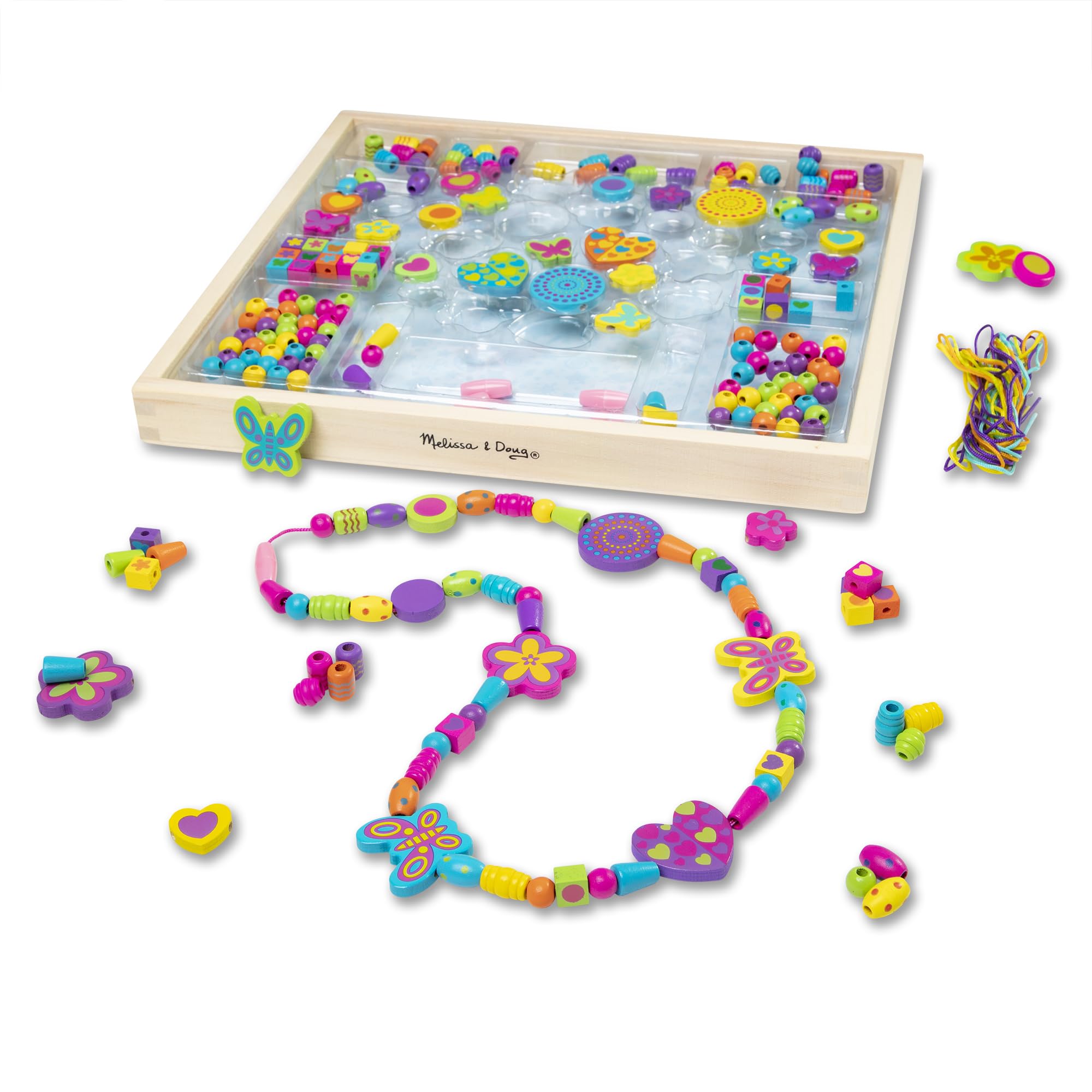
The laces in this set end in stiff plastic tips, and that single detail decides whether a four-year-old can bead alone. A frayed cord is the enemy of a first necklace; a rigid tip goes through the hole and the child carries on. Melissa & Doug pairs those laces with 220 chunky wooden beads in hearts, flowers and butterflies, plus a wooden tray to sort them in.

This is the kit we hand to the youngest serious beader in the family. The beads are big enough for a preschooler to pinch, the holes are generous, and with eight cords two children can work at the same time. A three- or four-year-old can thread an entire necklace unassisted and needs an adult only at the final knot, which is the division of labor you want at that age.

It is wood rather than plastic, and a finished necklace reads as real kid jewelry instead of a toy — the beads are painted in bright water-based colors and the shapes are cut thick. The tray is the storage: shallow enough for a shelf, sturdy enough to survive being dropped.

Rated from four to eight, it sits at the premium end of this group, and it earns that for a first kit in a way a 5,000-bead box does not. There is no sorting to do before you start and no technique to master before a necklace exists. A ten-year-old will be bored in an hour.

Bottom line: Our first-kit pick: stiff-tipped laces and big wooden beads let a four-year-old thread a whole necklace, with an adult only for the knot.

#2

Rainbow Loom Mega Combo

Rainbow Loom Mega Combo

Ages 8-12

Doodle Score 9.6/10
Check Price

Worth Noting

  • Bands can snap while looping
Bands
7,000+ in 21 colors
Clips
300 C-clips
Storage
Organizer case with divided compartments
Age Range
7 and up
Read the full review

This is a different craft from bead stringing — a loom, a metal hook and rubber bands worked into bracelets, rings and charms. That matters when a child has already made a dozen bead bracelets and lost interest, because the loom asks for a technique and there are weeks of skill in it. The Mega Combo carries 7,000-plus latex-free bands in 21 colors, 300 C-clips, a loom board, a hook, 12 gift bags and step-by-step instructions.

The organizer is what we appreciate most. Seven thousand loose bands are a nightmare; the same bands sorted into a compartment case with a lid are a hobby. At 13.77 by 8.66 inches and a little over two pounds it lives on a shelf and comes out for sleepovers rather than traveling in a school bag.

The learning curve is real. The printed instructions cover the basics, and a seven- or eight-year-old needs one session with an adult before the looping clicks — after which they will be teaching you. One bracelet takes noticeably longer than stringing beads, which is the point for a child who wants a project and the frustration for one who wants a result in ten minutes.

It is rated seven and up, and the 12 gift bags do quiet social work: trading and giving away finished bracelets is half the appeal at that age. When the bands run out the loom and hook stay useful, so buy a bag of refills rather than a whole new set.

Bottom line: The right buy for an eight- to twelve-year-old who wants a skill rather than another bracelet; a compartment case keeps 7,000 bands usable.

#3

Melissa & Doug Sweet Hearts Set

Melissa & Doug Sweet Hearts Set

Two kids

Doodle Score 9.6/10
Check Price

Worth Noting

  • Clasps are fiddly for small hands
  • Fewer small spacer beads than expected
Beads
250+ wooden beads
Cords
5 cords per set
Extras
Clasps included
Storage
Two wooden trays
Read the full review

Two wooden trays, one full of hearts and one full of butterflies, each with more than 120 wooden beads and five color-coordinated cords — this bundle is designed to be split. Two children get a tray each, or one child gets a gift that looks like a proper present rather than a bag of beads.

The beads are the same chunky painted wood as the Bead Bouquet, which means the same big holes, the same easy grip and the same stiffness in the finished necklace. Clasps are included, which puts it a step beyond the laced-only sets.

What you are paying for is presentation and the doubling-up: two trays that double as storage, and a ready-made answer for siblings close in age. A younger child takes the butterflies while an older one keeps the hearts, and neither notices they are sharing a gift.

We choose it over the single Bead Bouquet in exactly two situations: two children, or a gift where the box matters. For one child the Bouquet does the same job with less packaging. The trays are the storage as well — shallow, stackable, and far more likely to be reused than a cardboard box.

Bottom line: Choose this when two children will share the gift or the presentation matters; for one child, the single-tray Bead Bouquet does the same job.

#4

Redtwo 5100 Clay Bead Kit

Redtwo 5100 Clay Bead Kit

School-age kids

Doodle Score 9.4/10
Check Price

Worth Noting

  • Some beads arrive thin or with blocked holes
Beads
About 4,600 clay beads, 18 colors
Age Range
3 and up
Bead Size
6 mm with 2 mm hole
In The Box
Scissors, tweezers, cord, clasps, storage box
Read the full review

Most bead kits send you home with a bag of beads and a length of elastic and call it complete. The Redtwo box arrives with the small tools the job actually needs — scissors, tweezers and a set of lobster clasps — tucked in beside roughly 4,600 flat clay beads and 500 charms, and that is why it is our default. A bracelet gets finished the same afternoon it is opened rather than waiting for a trip to the craft shop.

The beads are 6 mm flat heishi discs with a 2 mm hole, in 18 colors. It is the look of the bracelets kids trade at school, and the flat shape stacks neatly enough that a first attempt still looks deliberate. Alongside the colors there are gold, black and multicolored letter beads, numbers, hearts, fruit, and a handful of gold starfish and shell charms — enough to spell a name and still have plenty left for a second bracelet.

Six millimeters is the dividing line. A second-grader threads these without thinking about it; a four-year-old will hand you the bead and ask you to do it, so start this kit around six and point younger children at the snap beads or the wooden laces further down. The one supply we add before the wrapping comes off is elastic — the box includes a single cord, and a spare spool turns a broken bracelet into a five-minute repair rather than the end of a hobby.

The whole thing packs into a box about nine inches square and well under an inch deep, so it slides onto a shelf instead of colonizing the kitchen table. The beads are water-resistant and the colors are fade-resistant, which matters more than it sounds, because these bracelets get worn in the bath.

Bottom line: This is the kit we hand to most families: everything needed to finish a bracelet, including the scissors and clasps, is in the box, which matters most for a six- to ten-year-old.

#5

Disney Princess Necklace Case

Disney Princess Necklace Case

Disney fans

Doodle Score 9.4/10
Check Price

Worth Noting

  • Only 150 beads and five cords
Beads
150 beads
Cords
5 necklace cords
Charms
5 princess charms
Age Range
3 to 10
Read the full review

Five princess charms, 150 beads, five necklace cords and a carry case that opens like a book — the format is the point here. A child strings a necklace, wears it around the house, then pulls it apart and builds a different one, and that loop is what keeps the set in use past the first afternoon.

The charms are Belle, Ariel, Cinderella and friends, and they are the reason to buy this over a generic bead kit: a princess-obsessed four-year-old will thread beads for a charm she recognizes when a plain disc would not hold her. The beads themselves are simple plastic shapes; the characters do the work.

Buy it for a Disney fan between three and six, with expectations set about the clasps. Worn hard, the necklaces can come undone and scatter, so treat the finished piece as dress-up jewelry rather than something for nursery school — the making is the activity, and the cord is there to hold the work together while it is admired.

The case measures 2 by 8.18 by 9.7 inches, small enough for a car trip and structured enough that the beads stay in their compartments. It is rated from three to ten, though the sweet spot is the younger half of that; a seven-year-old will finish five cords and look for the next thing.

Bottom line: A three- to six-year-old Disney fan gets real mileage from the remake-again necklaces, as long as the finished piece is treated as dress-up.

#6

Dowsabel Pony Bead Kit

Dowsabel Pony Bead Kit

Kandi bracelets

Doodle Score 9.4/10
Check Price

Worth Noting

  • Letter beads run short for names
Beads
About 300 pony beads, 12 colors
Extras
Clay beads, letter beads, cords
Age Range
6 to 12
Bead Size
9 mm with 4 mm hole
Read the full review

Pony beads are the fat, round beads with a 4 mm hole that kandi bracelets are built from, and this is the kit here that goes all in on them: about 300 in 12 colors, plus roughly 90 shaped clay beads — smiley faces, animals, fruit, flowers — letter beads and cords in a small case.

The 9 mm size is the practical difference. A 4 mm hole takes a thicker cord and a fatter knot, and it is noticeably easier for a five- or six-year-old to hit than the 2 mm hole in our top pick. If your child has outgrown snap beads but still finds flat heishi fiddly, this is the natural next step.

This is the one that goes to a sleepover. The case is compact, the beads are chunky enough not to vanish into carpet, and the smiley faces are the current look — finished bracelets read as something made on purpose rather than a craft project. It is rated six to twelve, and the sweet spot is the bottom half of that.

What it lacks is scale. Three hundred pony beads makes a handful of bracelets, so this is a personal kit rather than a party one; if two siblings will work at the same table, one of the larger clay kits goes further.

Bottom line: We recommend it for a five- or six-year-old moving up from snap beads: fat 4 mm holes make threading easy, and the chunky look is current.

#7

Gionlion 6000 Clay Bead Kit

Gionlion 6000 Clay Bead Kit

Sibling groups

Doodle Score 9.4/10
Check Price

Worth Noting

  • Gold-tone beads lose their shine quickly
  • Some beads arrive chipped or uneven
Cord
Two 5 m elastic rolls
Beads
About 5,520 clay beads, 24 colors
Age Range
6 and up
Bead Size
6 mm with 2 mm hole
Read the full review

Twenty-four colors is six more than our top pick, and that is the reason to look at this one: about 5,520 flat clay beads, roughly 550 charms, and a palette that fills a compartment box with shades an 18-color set does not have. Same 6 mm heishi shape, same 2 mm hole, same bracelet at the end.

The extras are generous in some places and thin in others. You get two rolls of elastic at five meters each — twice the string in the Redtwo — plus scissors and a lobster clasp. You do not get tweezers, and the box is narrower at nine by seven inches.

The elastic is the weak link: thin enough to snap when a knot gets pulled tight, and a heavier spool costs very little and saves a bracelet. Twenty-four colors also mean more sorting when the box gets shaken up, which is the hidden cost of the bigger palette.

Where it earns its place is a group — 24 colors split across four children at a table, and enough beads for a birthday afternoon. For one child's first kit the Redtwo's tools and wider box still edge it. Gionlion's own age guidance starts at six, and that is worth taking seriously: if the child is four, the difference between this and a snap-bead set is the whole decision.

Bottom line: The color-maximum clay kit: pick it for siblings or a party table where 24 shades and about 5,500 beads will actually get used.

#8

FUNZBO Pop Beads

FUNZBO Pop Beads

Ages 3-5

Doodle Score 9.2/10
Check Price

Worth Noting

  • Case latch can break and spill the beads
  • Pieces can crack if forced apart
Extras
8 bracelets, 4 headbands, 10 rings
Pieces
520+ snap beads
Storage
Carry case with handle
Age Range
3 to 8
Read the full review

A four-year-old cannot tie a knot, and asking one to try is how a craft afternoon ends in tears. Pop beads take the string out of the equation: the pieces snap together, so a child builds a bracelet, wears it for ten minutes, pulls it apart and starts again. The FUNZBO set is 520-plus pieces, with eight bracelets, four headbands, ten rings and a guide in a case with a handle.

Snapping is the whole skill, and it is not free. The beads have to meet at the right angle and take a firm push, which some four- and five-year-olds manage straight away and others need a few tries at. We take that trade: once the click lands, a child works independently for an hour with no adult holding a knot, and that independence is why this is our pick for the youngest children in this group.

Headbands and rings are what make it more than a bracelet kit. A child who is tired of stringing can build something big enough to wear on her head, and the layered case gives each type of piece its own tray.

It is rated for three to eight, and the top of that range is honest: a seven-year-old will enjoy the snapping for an afternoon before wanting something with more technique. The handle and the gift-ready packaging make it the one that travels to a restaurant or a grandparent's house, which for a lot of families is the difference between a kit that gets used and one that stays on a shelf.

Bottom line: Buy it for a three- to five-year-old who cannot tie yet; the beads snap, so the child finishes a bracelet alone and rebuilds it without help.

How We Tested the Kids' Jewelry Making Kits

We started by surveying the kids' craft aisle and parent reviews, then narrowed a long list by age range, bead variety, clasp type, and whether the kit came in packaging that could be handed over as a gift. We eliminated kits with tiny parts that seemed mismatched to their stated age and kits whose instructions relied on adult-level knot tying. The final group was 14 kits, which we tested over four months in ordinary homes rather than a craft room.

The first session was always the same: kids opened the box themselves, sorted the beads, and tried the project pictured on the front without help beyond reading the instructions aloud. I noted whether they needed an adult to thread the first bead, whether the cord frayed, and whether the clasps actually clicked or hooked shut and stayed that way after a gentle tug. We counted bead types and colors, then checked alphabet sets for missing letters and enough vowels to spell names. Each finished piece went home with a kid and came back after a week of wear, so we could see whether knots held, beads chipped, or charms lost their finish.

Over rainy Saturdays, birthday parties, and after-school playdates, we watched which kits got pulled out again and which sat untouched. We also paid attention to the finished look: whether the colors worked together, whether the charms felt cute rather than cheap, and whether a kid was proud to wear the result. Durability mattered most in storage — we packed each kit back into its case and checked for cracked beads, bent clasps, and tangled cord. The kits that rose to the top were the ones that stayed fun after the first project and still looked good enough to gift.

How to Choose Jewelry Making Kits for Kids

Start with the hands, not the bead count

A bead count tells you how many bracelets a kit can make and nothing about whether your child can make one. The mechanism does: snap beads for three- to five-year-olds, chunky wooden beads on stiff-tipped laces for four- to six-year-olds, 6 mm flat clay beads for six and up, and a loom for the eight-plus crowd who want a technique to learn.

The trap is the word compact in a listing — it describes the case, not the beads. A small box can hold the same 6 mm discs as a big one. Choose the mechanism first, then the style, then the quantity.

What holds the piece together, and who ties it

Every kit ends with a knot, and for the first few years that knot is yours. Elastic is the most forgiving for everyday wear because it stretches over a hand and shrinks back; satin cord looks better and slips more; a metal clasp on a child's bracelet is the part most likely to fail.

Assume you are finishing every piece for a year, and put a spare spool of elastic in the basket when you buy the kit. The cord in the box is sized to get started, not to last.

Storage decides whether the kit survives the month

A bead kit dies by spill. Five thousand 6 mm discs on a carpet are gone, and a case whose latch pops open in a backpack will do exactly that. Look for a lid that clicks shut and compartments that separate colors, or decant the whole thing into a small tackle box.

Trays work at a table and travel badly. A handle and a latch are what make a kit portable, and the kits that stay in rotation are the ones a child can carry to the car and open on their lap.

Buy for the group, then budget for refills

A 150-bead case is one rainy afternoon for one child; 5,000 beads is a summer, or a birthday table of four. If siblings will share, buy the bigger kit once rather than two middle-sized ones.

Then plan for the parts that run out: elastic, clasps and letter beads. Kids go straight for names, and no kit here ships with a balanced alphabet. A bag of letter beads and a spool of cord turn a birthday gift into something that comes back out in March.

Frequently Asked Questions

Final Verdict

For most families with a child between six and ten, we point to the Redtwo kit. It is the one that arrives with the tools to finish a bracelet, and the flat clay beads match the bracelets kids are already trading at school. If the child is four, skip it and take the Melissa & Doug Bead Bouquet, whose stiff-tipped laces let a preschooler thread alone; for a child who cannot tie anything yet, the FUNZBO snap beads remove string from the equation entirely.