Arts & Crafts

Best Crayons for Toddlers of 2026

The first time my toddler tried a regular crayon, it snapped in half before the paper came off—and then it went straight into her mouth. That is the real job of a toddler crayon: it has to be big enough for a clumsy grip, tough enough to survive being dropped and stepped on, and pleasant enough that a small artist actually wants to keep scribbling. The right set fixes the usual frustrations—broken tips, faint color, and crayons that are too skinny to hold—without turning craft time into a cleanup project.

Over the past three months, my team and I put 14 crayon sets through daily coloring sessions, snack-table scribbles, and the inevitable bottom-of-the-diaper-bag test. We paid close attention to barrel size and grip, how evenly the color went down, whether tips survived a toddler's death grip, and if the scent was mild enough to ignore. The best ones were not always the biggest box—value mattered most when the crayons held up and the colors stayed rich, not when the set came with a sharpener nobody needed. Below are the sets that earned a spot on our art shelf.

#1

Crayola Washable Large Crayons

Crayola Washable Large Crayons

First toddler crayons

Doodle Score 9.4/10
Check Price

Worth Noting

  • Can snap if dropped or pressed hard
Size
Large
Colors
8
Safety
Non-toxic
Washability
Washable
Read the full review

The best toddler crayon is the one you can leave within reach, and Crayola's large washable eight-pack is the set we trust for that job. The proposition is deliberately plain: eight basic colors, a thick round body, and a washability claim aimed at nonporous surfaces. That is exactly the right scope for a first box. You are not buying a color library; you are buying the crayons that can live on the coffee table without turning every scribble into a cleanup project.

The large body gives small hands more to hold than a standard crayon, and the round shape is familiar enough that a toddler can switch hands without rethinking the grip. Eight colors cover naming, matching, and the basics of a drawing. We prefer that to a 24-color set where half the sticks stay untouched, especially when the crayons are likely to be dropped, sat on, or carried around in a fist.

Washability is the reason this box sits at the top. Crayola says warm water and a sponge lift marks from most nonporous surfaces, which is the realistic target for a high-chair tray, tile, or tabletop. Fabric is a different job, and no washable crayon should be treated as a guarantee against every stain. We care less about a perfect claim than about not treating every mark as permanent.

Eight crayons and a small box are also easy to keep in a kitchen drawer or art caddy, so the set is more likely to come out than a large case that lives on a high shelf. What we like most is that the set keeps the decision simple: thick enough to hold, washable enough to relax around, and limited enough that a toddler can actually use it.

Bottom line: The Crayola large washable eight-pack is our default toddler crayon: thick, simple, and easy to wipe down when coloring leaves the paper.

#2

Cra-Z-Art Jumbo Crayons

Cra-Z-Art Jumbo Crayons

Budget preschool packs

Doodle Score 9.4/10
Check Price

Worth Noting

  • Can snap under heavy pressure
Size
Jumbo
Count
8
Body Shape
Round
Age Guidance
3 and up
Read the full review

The Cra-Z-Art jumbo eight-pack is the budget answer, and it makes the case plainly: eight chunky colors, a simple cardboard box, and enough wax to get through a preschool afternoon. It is the least expensive way here to put a handful of larger crayons in front of a child, and that is the reason it earns a place.

The size is the catch. These are larger than standard crayons, but they are not as fat as a true jumbo. That makes them a reasonable step for a 3-year-old who has some control, and less forgiving for a 1-year-old who needs the thickest grip available. We prefer them as a backup box, a travel set, or the crayons that can get lost without a search party.

Color is bright and smooth enough for everyday drawing, and the eight-color range is easy to manage. The simple box is also light enough to toss in a tote bag for a restaurant or waiting room. For a first box, we still point to Crayola's washable large set; for a spare set that can live in a bag, this one is easy to say yes to.

Bottom line: Cra-Z-Art's eight-pack is the budget box we keep for spare scribbling: chunky enough for a preschooler, simple enough to replace.

#3

Crayola Extra Jumbo So Big

Crayola Extra Jumbo So Big

Heavy-handed toddlers

Doodle Score 9.4/10
Check Price

Worth Noting

  • Round body rolls off tables
  • No washability claim from Crayola
Size
Extra jumbo
Count
12
Thickness
25% thicker than classic
Body Shape
Round
Read the full review

Crayola's Extra Jumbo So Big crayons are 25 percent thicker than the classic line, with a round body and 12 colors. The extra wax gives a small fist more to hold and puts more material between a hard press and the paper. The box is aimed at children who need a larger grip, not at the smallest first scribbler.

We like the extra thickness for the 2- and 3-year-old who snaps standard jumbos. A thicker crayon is heavier in the hand and can be harder to maneuver for a child who is still learning to lift the tip. For a child who already presses down hard, the trade is worth it: more wax under the fingers, a broader line, and less need to bear down on a thin stick.

The round shape is familiar and easy to teach a standard grip on. Twelve colors cover the basics, and the box is small enough to keep in a drawer. We reach for it when a hard grip is the main problem, and the extra size is easy to tell apart from a sibling's standard crayons.

Bottom line: Crayola Extra Jumbo So Big is our choice for heavy-handed toddlers who snap thinner crayons; the extra thickness buys real leverage.

#4

MASSRT Triangle Jumbo Crayons

MASSRT Triangle Jumbo Crayons

No-roll table use

Doodle Score 9.2/10
Check Price

Worth Noting

  • Can still snap after a hard throw
Count
18
Cleanup
Washable
Body Shape
Triangular prism
Crayon Diameter
0.51 in
Read the full review

A triangular crayon earns its keep at the edge of a table. MASSRT's 18-color set uses a triangular prism body, so a crayon set down on a flat surface stays where it lands instead of rolling toward the floor. That sounds like a small thing until you have watched a toddler's favorite color disappear under the sofa for the third time.

We like the shape for the 2- and 3-year-old who is still deciding how to hold a crayon. The three flat faces give little fingers a place to rest, and the broad body is easier to control than a thin stick. The set also skips paper wrappers, which removes one more thing to peel and discard. Eighteen colors is enough to keep a small artist interested without turning the box into a project.

The color is bright and the crayons feel substantial in the hand. The 18-color range gives more variety than the basic eight-color boxes without becoming a giant set that is hard to store. What it does well is make tabletop coloring less interrupted; if your toddler treats crayons like rolling pins, the triangular body is the feature that changes the session.

Bottom line: We recommend the MASSRT triangle set for toddlers who send crayons off the table; the shape stays put and the 18 colors cover naming and drawing.

#5

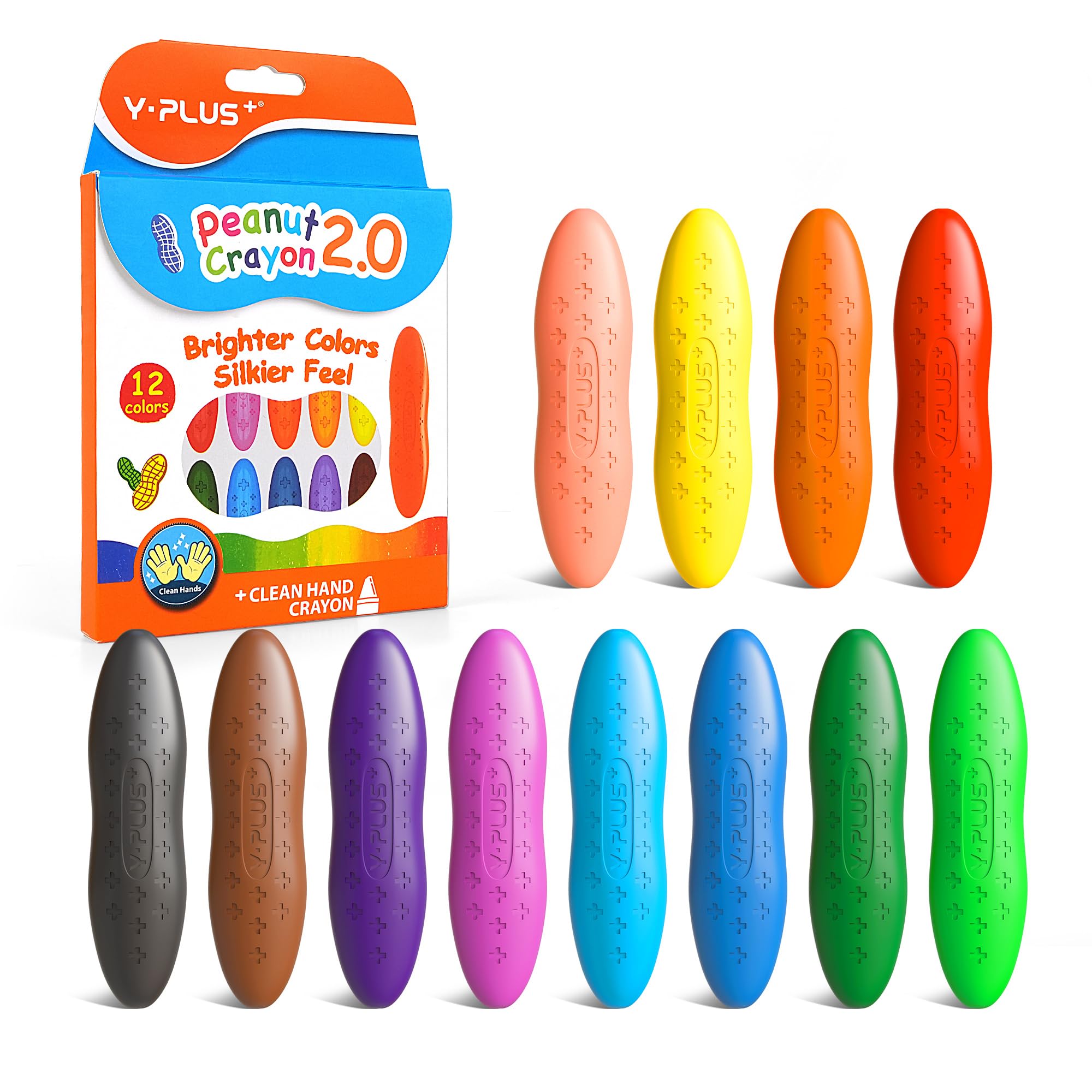
YPLUS Peanut Crayons

YPLUS Peanut Crayons

Ergonomic first grip

Doodle Score 9.2/10
Check Price

Worth Noting

  • Can snap if dropped on a hard floor
Count
12
Shape
Peanut
Age Guidance
1-3
Crayon Diameter
12 mm
Read the full review

The peanut shape is not just a cute detail. YPLUS gives each crayon a narrow waist and two fatter ends, which gives small fingers a natural place to pinch while keeping the color core thick enough to survive a typical toddler grip. The set comes with 12 washable colors and a storage case, and the shape is the reason to consider it over another round jumbo.

We like these for the 1-to-3 range because a child can wrap a fist around the middle or hold one end like a handle. The crayons sit comfortably in a small hand and don't present the same smooth surface as a round stick. For an older preschooler who already holds a crayon with a tripod grip, the shape can feel fussy; that is the boundary of what this set is for.

The color is smooth and bright on paper, and the crayons leave less waxy residue on fingers than many basic wax sticks. Washability is decent on hard surfaces, though darker colors can need a second pass. If you want the most natural grip for a very young toddler, this is the box we reach for; if you need the brightest possible line, Crayola is still the safer bet.

Bottom line: YPLUS Peanut Crayons are our pick for small hands that need a natural pinch point; the waist makes a round stick feel clumsy by comparison.

#6

TinyGeeks Jumbo Crayons

TinyGeeks Jumbo Crayons

Wide color range

Doodle Score 9.2/10
Check Price

Worth Noting

  • Washability varies by color
Count
18
Storage
Cardboard case
Washability
Washable
Crayon Dimensions
4.1 x 0.55 in
Read the full review

The TinyGeeks set puts 18 jumbo crayons in a sturdy cardboard case, with each color labeled. The case is the practical part: it keeps the set together in a drawer or backpack and gives a toddler a clear place to put the crayons back. That matters more than the color count when the crayons are shared.

At 4.1 inches long and 0.55 inch thick, these sit in the same size range as many toddler jumbos. They are not as fat as Crayola's Extra Jumbo, so a 2-year-old can manage them but a 1-year-old may still do better with a thicker stick. The 18 colors are the draw for a family that colors often or has more than one child at the table.

Color payoff is strong for a basic wax crayon, and the tips hold up to normal use. The 18-color range gives more variety than a basic eight-pack without becoming a giant set. The storage case is also sturdy enough to live in a bag, which is more than we can say for a thin cardboard sleeve.

What settles it for us is the balance of range and storage. The set is bright enough for everyday drawing, the case keeps the colors together, and the size works for a 2-year-old. We choose it for a shared art basket, where extra colors are useful and a tidy case saves the end-of-session scramble. The labels also help a child ask for a color by name instead of dumping the whole box.

Bottom line: TinyGeeks is the set we choose when a family wants a wide color range in one tidy case; it earns its place in a shared art basket.

#7

Honeysticks Originals

Honeysticks Originals

Mouthy toddlers

Doodle Score 9.0/10
Check Price

Worth Noting

  • Premium price for a 12-crayon set
Count
12
Material
100% New Zealand beeswax
Age Guidance
1+
Crayon Diameter
0.8 in
Read the full review

Honeysticks Originals start with a different material story: pure New Zealand beeswax and food-grade pigments rather than a paraffin wax base. That matters most at the stage when a crayon goes from hand to mouth as often as it goes to paper. The crayons are chunky, 0.8 inch across, and sold in a 12-color set for ages one and up.

We like these best as a first crayon for a mouthy 1- or 2-year-old, not as the family's all-purpose box. The short, fat body gives a fist something to wrap around, and there is no paper wrapper to peel or chew. The beeswax also gives the crayon a different feel and a honey-like scent, which is pleasant if you notice it and irrelevant to a child who is busy scribbling.

Color is the compromise. The line is softer and less saturated than Crayola's, so light scribbles can look faint and a toddler may need to press harder to get a bold mark. That is a fair trade for some families and a dealbreaker for others. If your child wants instant, bright color on the page, our top pick is the easier choice.

The set comes with 12 colors rather than a jumbo rainbow, and the crayons suit small hands and small storage spaces. We also appreciate the absence of paper wrappers, which keeps the box tidier and removes one more thing for a toddler to peel apart. A simple box and a distinct material choice make this the natural pick when the crayon is likely to meet a mouth.

Bottom line: For a mouthy 1- or 2-year-old, we choose Honeysticks Originals: a chunky beeswax crayon with no paper wrappers to peel.

How We Tested Toddler Crayons

We started with a shortlist built from manufacturer specs, parent reviews, and the crayons already scattered across preschool art tables, then narrowed it to 14 sets that were marketed for toddlers and sold in a range of prices and pack sizes.

For three months, we kept a rotating set at our home art table, in a restaurant bag, and on the floor during supervised play. We watched how each crayon felt in a toddler's fist, whether the barrel encouraged a tripod grip or forced a closed-fist clutch, and whether the paper wrapper stayed put or peeled into a soggy mess. We drew thick scribbles on cardboard and printer paper to see if color went down smoothly or required repeated passes, and we sniffed each crayon right out of the box and after a week of use to catch waxy or chemical smells.

Durability got its own round of rough handling: we dropped crayons from table height, stepped on a few in socks, and left them in a sunny car cup holder for an afternoon to see if they slumped or crumbled. We also noted whether each crayon was large enough to be comfortable—and safer—for small hands, and whether tips were rounded or easy to break off. At the end, we compared what each set included against how it actually performed, with extra colors and sharpeners counting only if they earned their space.

How to Choose Crayons for Toddlers

Grip Shape Matters More Than the Word Jumbo

Jumbo is not a standardized size. A box can be only slightly thicker than a standard crayon and still use the label. For a 1-year-old, look for a body thick enough to fill a fist; for a 3-year-old, a slightly narrower jumbo can be easier to control. Shape is just as important. A triangular crayon like the MASSRT set stays put on the table, a peanut shape like YPLUS gives a natural pinch point, and a round crayon is familiar but rolls. Pick the shape that fits your child's stage, not the biggest number on the box.

Washability Is Color by Color and Surface by Surface

Washable crayons are formulated to release from nonporous surfaces, not to vanish from every fabric. Dark colors and soft waxes are usually the ones that leave a ghost. Before you hand over a new box, make a small mark on a hidden corner of the table or a washable mat and see how it lifts. Warm water and a sponge handle most hard surfaces; if the mark has been pressed into a porous surface, expect more work. If washability is the main reason you are buying, our top pick is the simplest place to start.

Durability and Pigment Pull in Opposite Directions

A softer crayon lays down color with little pressure, which is what a toddler wants, but soft wax also snaps more readily and can leave a waxy film. A harder crayon survives more drops but may make a child press harder to see the color. That is why a thick body helps: it puts more wax around the tip without asking the child to change grip. If your child breaks everything, choose extra-thick or triangular; if your child gets frustrated by faint lines, choose a smoother wax like Crayola.

Safety, Paper, and the Real Value of a Set

Non-toxic is the baseline, not a bonus. For a child who still mouths things, a beeswax formula like Honeysticks can be worth the premium, but it is not automatically better at making bright marks. Paper wrappers are another small daily cost: they peel, get chewed, and leave debris. A set with no wrappers or a sturdy case is easier to live with. Buy the number of colors your household will actually use; a small box that gets used beats a huge one that stays on the shelf.

Frequently Asked Questions

Final Verdict

After comparing the set, Crayola's large washable eight-pack is the one we recommend first. It gets the two daily jobs right: a thick body a toddler can hold and a washable formula that makes cleanup less of a negotiation. Choose Honeysticks Originals instead if your child still mouths crayons and you want a beeswax formula; choose MASSRT's triangle set if rolling crayons are the problem. The Crayola box is the default because it covers the most ordinary coloring sessions with the fewest complications.