RC & Vehicles

Best Remote Control Trains of 2026

A remote-control train should be a whole-evening toy: kids crouch at eye level, adults adjust the speed, and someone builds a tunnel from couch cushions. The catch is that plenty of sets look charming in the box, then derail at every joint, chew through batteries, or lose signal under the sofa. Over six months, my team and I ran 12 sets through living-room loops, carpet crossings, and after-dinner sessions. The keepers were easy enough to set up that the train came back out the next day.

What separated them was reliability more than speed. I watched first-time users fumble with remotes, listened for motor whine during quiet play, and checked couplers after repeated use. Appearance and cuteness earned a spot on the shelf, but quality, playability, and value kept a set in rotation—the difference between a train that gets one lap and one that gets a whole afternoon. The picks below are the ones I'd hand over without a warning list.

#1

LEGO City Express 60337

LEGO City Express 60337

Families, ages 7+

Doodle Score 9.4/10
Check Price

Worth Noting

  • AAA batteries aren't included
  • Battery life is the weak spot
Control
Handheld remote or app
Batteries
AAA
Track Pieces
24
Recommended Age
7+
Read the full review

There are 764 pieces in the box before anything moves, and that's the honest measure of this set: it's a building project that turns into a working railway. The 24 track pieces make a loop with room for the station platform, the two coaches hook up behind a bullet-nose locomotive with dimmable headlights, and six minifigures — passengers, a driver, a restaurant worker — give the platform scene something to do. You drive it with the handheld remote in the box or from a phone running the LEGO Powered Up app.

For a family that wants one train to do everything, this is the one we point at. The remote is a real controller rather than a phone-only arrangement, so a kid can run the train without borrowing an adult's device, and the lights dim low enough for a quiet evening run. It runs smoothly on its own track and the track holds together, which is not a given in a category where derailments are the standard complaint. And when the layout gets boring, it gets rebuilt.

The build is the trade-off. At 764 pieces this is an afternoon or a weekend rather than a five-minute setup, and the 7+ rating is there for a reason: a five-year-old will need an adult beside them for most of it. What you get back is a restaurant car, a passenger coach, a bike, a wheelchair, a briefcase — the sort of detail that keeps a child coming back after the novelty of the remote has worn off.

Give it a hard floor or a short-pile rug with space for a loop, because the track wants a flat run and there's no point laying a railway on deep carpet. The 24 pieces build a loop big enough for the station scene, and the layout can be extended with extra track when the room allows it. It is not a set that tidies back into the box between sessions, so pick a corner that can stay a railway for a week.

Bottom line: Our default for a family buying one train: remote, track and cars arrive together, and it's the only pick here a 7-year-old can rebuild into a different railway.
#2

Thomas & Friends R/C Thomas

Thomas & Friends R/C Thomas

Toddler beginners

Doodle Score 9.2/10
Check Price

Worth Noting

  • No track or cars in the box
  • Six AAA cells across engine and remote
Weight
10.4 oz
Control
Handheld remote, large buttons
Batteries
6 AAA (3 train, 3 remote)
Recommended Age
18 months and up
Read the full review

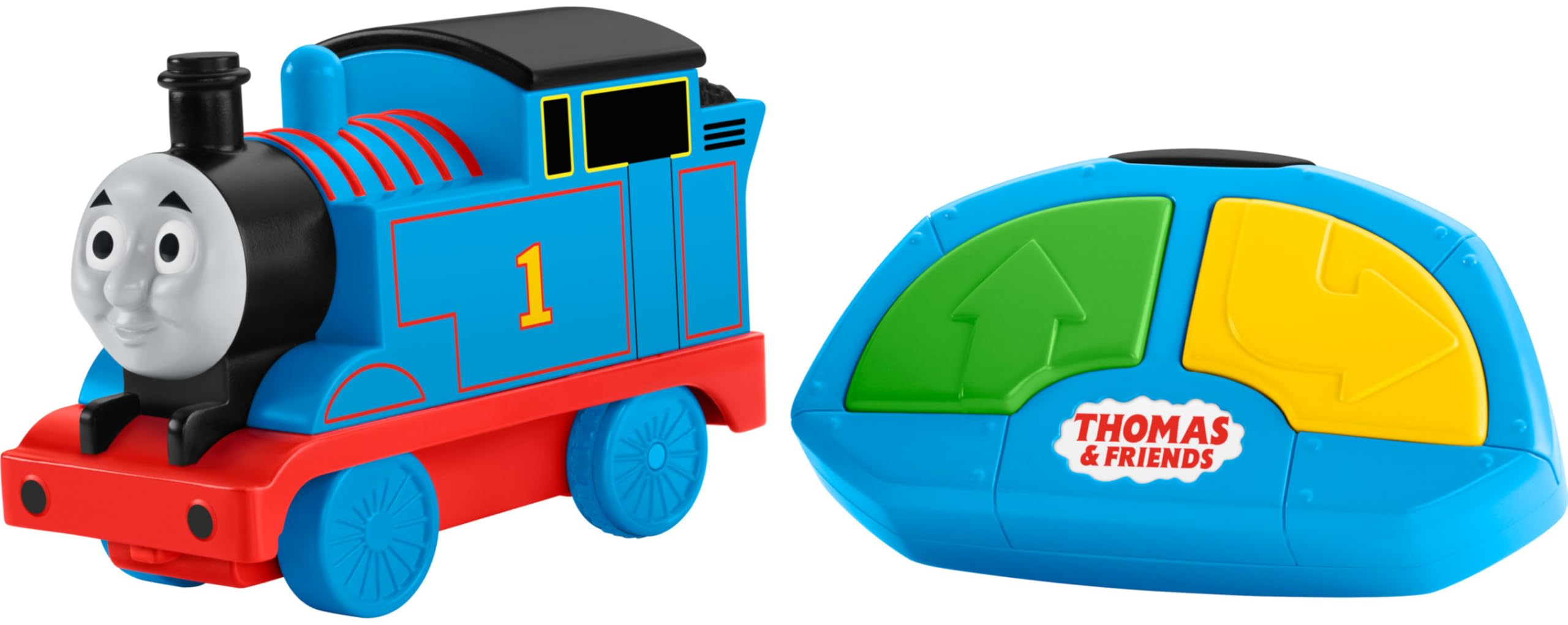
The remote is the whole idea here, and Fisher-Price got its shape right: two large directional buttons, forward and reverse, and nothing else to decode. A two-year-old works it out in about a minute, which is the point — and that makes it the first remote control train we hand to a toddler without hovering. The engine says Thomas phrases and makes train noises while it trundles around the floor, which is either the reason to buy it or the reason to leave it on the shelf, depending on who is in the room.

What it isn't is a set. There's no track and no cars in the box, so it lives alongside a wooden railway rather than on it, and it's a chunky thing — better than ten ounces and the best part of a foot long — which makes it happily at home on carpet and clumsy on a tabletop layout. The sounds are clear enough to be worth having and there's a real engine underneath them, so it survives being dropped, sat on and driven into skirting boards for a season. For a Thomas fan under three, that's the whole job.

Bottom line: The simplest remote in this set: two big buttons, forward and reverse, and a Thomas that takes the knocks a two-year-old deals out.

#3

Liberty Imports Toddler Train

Liberty Imports Toddler Train

Small hands

Doodle Score 9.2/10
Check Price

Worth Noting

  • The remote can stop talking to the train
Control
Steering-wheel remote, two buttons
Train Length
About 5 inches
Recommended Age
18 months to 3 years
Read the full review

About five inches long and three tall, this is a cartoon train small enough for a one-year-old to hold in two hands. The remote is shaped like a steering wheel with two large buttons, the conductor figure lifts out of the cab for pretend station stops, and there's a horn, train noises and a flashing smokestack light. Nothing about it needs explaining: press, and the train goes.

For the 18-month-to-three stretch, this is the one we hand over. The buttons are big enough for uncoordinated hands, the train is light enough to be carried around by the chimney, and it runs on carpet as happily as on hardwood, which is more than most track trains manage. It's cheerful plastic rather than tough plastic — a first train, not something that gets handed down — but for something a toddler will drop daily, that's a fair trade at this money.

Bottom line: Our pick for the smallest kids: a five-inch train and a two-button remote an 18-month-old can work without help.

#4

Hape Remote Control Engine

Hape Remote Control Engine

Wooden track owners

Doodle Score 9.0/10
Check Price

Worth Noting

  • Bluetooth pairing can drop out
  • Charging port is the weak point
Battery
Rechargeable, charging cable included
Control
Bluetooth app or onboard buttons
Dimensions
4.65 x 1.5 x 1.97 inches
Recommended Age
3 to 10 years
Read the full review

No cell count, no drawer of spare batteries: this engine charges from the USB cable in the box and runs for days of on-and-off play between charges. That sounds like a small thing until you've had a train sit dead for a fortnight because nobody remembered to buy AAAs. For something a preschooler plays with daily, it's the difference between a toy and a chore.

The engine itself is tiny — under five inches long — with a free Bluetooth app that adjusts speed and triggers five sounds, plus two buttons on its back for a child too young to be handed a phone. It fits Hape's own track and IKEA's, and it has enough pull to climb the inclines on a proper layout rather than stalling at the first rise. For an older child, driving by screen is genuinely more appealing than a plastic handset.

Where there's already wooden track in the house, this is the engine we'd add to it: rechargeable, quick, and small enough to live in a drawer between sessions. The catch is the control. There is no handheld unit, so the remote is a phone, and pairing drops out often enough to notice — the two buttons on the engine cover a small child, and for everyone else budget for the occasional re-pair mid-session. The charging port is also the part to be gentle with, since it's what the whole toy depends on.

Bottom line: If you already own wooden track, this is the engine we recommend adding: rechargeable, quick, and driven from a phone or the buttons on its back.

#5

Z MAYABBO Motorized Train

Z MAYABBO Motorized Train

Budget track upgrade

Doodle Score 8.8/10
Check Price

Worth Noting

  • No track included, so you need a railway
Size
4.3 x 4.1 x 2.8 inches
Remote
2.4GHz radio
Recommended Age
3 to 12 years
Track Compatibility
Fits six major wooden-track brands
Read the full review

Here's the thing that makes this train look broken: once the batteries are in, you have to hold the power button for a couple of seconds before anything happens. A short press does nothing at all, and that one instruction probably accounts for a share of the dead-on-arrival verdicts that follow any budget train around. Get past it and you have the cheapest route to remote control on track you already own, and it works.

Four pieces: a locomotive, magnetically coupled cargo cars, and the remote. The link is 2.4GHz radio rather than infrared, and that matters more than the spec suggests — infrared controllers need a clear line of sight, so the signal dies the moment the train passes behind a chair or under a bridge, while this one keeps working around the corner of a layout. There are working lights and train sounds, and it's rated for ages three and up.

It's small, at 4.3 inches, so it reads as the junior engine next to full-size rolling stock, but it is the broadest fit here: Thomas, Brio, Chuggington, Melissa & Doug, KidKraft and IKEA track all take it. At this money it's the one to buy if you want to find out whether a remote actually changes how your child plays before spending set money on the question.

Bottom line: The cheapest way to put a remote in a child's hand on track you already own, and it earns the money — just hold the power button down.

#6

Lionel Polar Express Set

Lionel Polar Express Set

Holiday displays

Doodle Score 8.6/10
Check Price

Worth Noting

  • Cars can come uncoupled on a curve
  • Six C cells to buy before it runs
Control
Bluetooth app or three-position switch
Batteries
6 C cells
Track Pieces
32 (24 curved, 8 straight)
Recommended Age
4 years and up
Read the full review

Thirty-two track pieces, a locomotive, tender, coach and observation car, and a dropper bottle for the smoke: this is a display piece as much as a toy, and it's priced like one. The smoke is water vapor rather than oil, the headlight works, and the sound package includes the film's announcements plus a bell and a whistle. At 1:24 scale it's a big, good-looking train under a tree.

Control is where it parts company with the rest of this list. There's no handheld remote: you drive it from the Lionel Cab3 app over Bluetooth, or with a three-position switch on top of the engine for forward, stop and reverse. The app is fine, and the switch means a child can still run it without a phone, but neither is the one-hand operation a proper controller gives you. Setup is a project too — about half an hour, six C cells, and a smoke unit to fill before anything moves.

Buy it for the holiday layout and the movie, then. The announcements and the water-vapor smoke do something no other train here can, and the 32 pieces build three different track plans, so the display changes from year to year. The Bluetooth is the part that lets it down — it can go in and out mid-run — and the switch on the engine is the fallback that keeps an evening from ending badly. It's the most atmospheric train here and the least convenient.

Bottom line: Buy it for the holiday display and the movie soundtrack, not for the remote — it's app and switch control, and it wants a patient adult on setup.

How We Tested Remote-Control Trains

We started with a shortlist of about 30 remote-control train sets and cut anything with vague scale information, track joints that looked likely to pop apart, or a remote that needed an app for basic controls. We filtered by track size, expansion options, replacement parts, and what came in the box for the money, then tested 12 sets over six months.

Testing happened where trains actually live: living-room floors, low-pile carpet, hardwood, and a dining table. We timed setup solo, then handed the controller to someone who hadn't read the manual and watched whether they could start, stop, reverse, and change speed without coaching. We walked the remote behind a couch and into the next room to find where the signal broke, and listened both across the room and beside the track to judge motor whine and speaker volume.

Fresh batteries went in at the start of each session; we ran until the train slowed or the sounds distorted, noting how long that took and whether the controller gave any warning. We coupled and uncoupled cars repeatedly, let trains bump chair legs and take small derailments, then checked wheels, couplers, seams, and shells for cracks. We left the best-looking sets on a shelf for a week to judge paint, proportions, and tiny details, and watched whether kids returned to a set after the first surprise wore off. At the end, we compared each box's track, cars, and controller against what it delivered for the money; the sets that rose to the top stayed fun after the third or fourth setup and didn't need rescuing every few minutes.

How to Choose Remote Control Trains

Start with the control, not the train

Three ways to drive a train turn up in this set: a handheld remote, a phone app, and buttons on the engine itself. The LEGO set gives you a remote and an app; the Hape engine gives you an app and physical buttons on its back. Which matters depends on the child. Under three, count buttons — two is right and eight is not. For everyone else the question is whether the phone stays with the train or wanders off with an adult.

The trap is the wireless type. Infrared controllers need a clear line of sight, so the signal dies the moment the train passes behind a chair or under a bridge, and remotes that only work up close usually trace back to it. Radio and 2.4GHz links don't care where in the room the train is.

A complete set or an engine for track you own

Two different purchases hide under the same name. A complete set brings its own track, and you are then inside that maker's system — LEGO's 24-piece loop, Lionel's 32-piece layout — which is fine, and limits what you can add later. An engine is a locomotive sized to run on wooden track from Thomas, Brio, Chuggington, Melissa & Doug, KidKraft and IKEA.

The trap: an engine with no track is a floor toy until you own track, and a set that isn't wooden won't accept the railway already in the toy bin. Already own a bin of wooden track? Buy an engine. Starting from nothing? Buy a set.

How much floor the layout takes

A 24-piece loop wants a clear patch of floor or a low table, and it wants it flat. Wooden track laid over deep carpet flexes at the joints, and joints are where cheap engines derail; a hard floor or a short-pile rug is the difference between a train that circles and one you keep rescuing. Sets with 30-odd pieces can build a bigger loop or a long straight with a curve at each end.

Work out where the layout lives before you buy, and whether it can stay up for a few days. A train that has to be dismantled every evening gets run a lot less than one that doesn't.

What actually breaks

The parts that fail are the parts that connect: couplers, wheels and charging ports. Magnetic couplers are more forgiving than fixed knuckle types and much easier for small hands, though they let go under a long load. Pulling power matters if your layout has a rise in it — a budget engine with three wagons behind it will stall on the ramp it climbed happily on its own.

Buy for the layout you have. On flat track almost everything here works; with a bridge or an incline, keep the load light and the grade shallow.

Frequently Asked Questions

Final Verdict

Most families should buy the LEGO City Express. It's the only train here that arrives as a complete railway — track, cars, figures and a handheld remote in one box — and it's the one a seven-year-old can pull apart and rebuild into a different line. The premium is real, and it buys the parts that usually go missing.

If the child is two, buy the Thomas engine instead: two buttons, nothing to build, and no track to trip over. If wooden track is already in the house, add the Hape for rechargeable running or the Z MAYABBO engine if you want the cheapest way to find out whether a remote changes how your child plays.