RC & Vehicles

Best RC Transmitter and Receiver Combos of 2026

A transmitter is only half a radio system, and it's the half that gets all the attention. The receiver buried in the fuselage or the truck chassis is doing the quiet work: holding the link, triggering failsafe, deciding what happens when the signal thins out at the far end of the field. What separates a pairing you forget about from one that fights you usually comes down to protocol compatibility, programming you can learn in an evening, and a link that stays solid when the model is small in the sky.

The spec sheet won't tell you any of that. A 20-channel radio with mixing menus buried three submenus deep is harder to live with than an eight-channel set you can program at the bench in ten minutes, and a receiver that draws more current than it should will cut a flying day short no matter how fresh the transmitter battery is. We've spent eight months with 12 transmitter-and-receiver combos, and the picks below are the ones that earned a permanent spot in the case.

#1

Flysky FS-GT5

Flysky FS-GT5

All-round surface use

Doodle Score 9.6/10
Check Price

Worth Noting

  • Range not specified
  • LiPo pack and charger not included
Channels
6
Receiver
FS-BS6
Drive Modes
Gyro, ABS, crawl
Model Memory
20 models
Read the full review

Twenty model memories on a surface radio at this level is the detail that made the FS-GT5 our default. We can set up a crawler, a basher, and a boat, name each one, and switch without rebinding. The six channels cover steering and throttle and still leave room for a winch, lights, or rear steer, which is the kind of breathing room most drivers actually use.

The feel is more polished than the budget radios in this set. The ABS shell has a solid weight, the screen makes the menus readable, and the wheel does not fight your thumb. We like the gyro and SVC modes because they give a loose-surface car a straighter line without turning it into a different vehicle. The crawl mode is the one we kept coming back to for slow, technical driving.

Range is the one spec Flysky leaves quiet, so the long-range crown goes to Radiolink. The GT5 is a club-and-backyard radio first, and the AFHDS 2A link held up for the running we did. It runs on a LiPo pack rather than AAs, and the pack is not part of the box, so add a suitable battery and charger.

For most car and boat drivers, that is the right set of compromises: enough channels to grow, enough memory for a fleet, and a menu that does not require a manual every time. It is the one we reach for when we want the radio to disappear and the model to be the interesting part.

Bottom line: Our default for most car and boat drivers is the Flysky FS-GT5: six channels, 20-model memory, and useful gyro modes cover a whole fleet.

#2

Radiolink RC6GS V3

Radiolink RC6GS V3

Long-range surface runs

Doodle Score 9.4/10
Check Price

Worth Noting

  • Deep menus take time
  • Battery life can disappoint
Channels
7
Receiver
R7FG with gyro
Model Memory
30 models
Stated Range
1,900 feet
Read the full review

The RC6GS V3 leads with a number that matters if you run speed cars or big boats: a stated 1,900-foot control range. That is the longest claim in this group, and the telemetry screen adds vehicle voltage and signal strength so you can see trouble before it becomes a long walk.

We found it earns the long-range slot, but not as the simplest radio here. The seven channels and 30-model memory are generous, and the R7FG receiver's gyro is handy on loose surfaces. The catch is the menu: it is deep, and the path to some settings is not obvious, so expect a setup session before the first run.

Battery life is the mixed part. The radio can run from a battery tray or a pack, and the tray can be thirsty; a rechargeable pack makes more sense for regular use. Binding was usually straightforward, though the receiver can be fussy about the exact version, so confirm what you are buying before you start chasing a fault.

For a driver who values range and telemetry over plug-and-play simplicity, it is a lot of radio for the money. The gyro and seven channels make it a natural step up for a crawler with lights and a winch, or a speed car that needs a longer leash.

Bottom line: The Radiolink RC6GS V3 earns our long-range pick with a 1,900-foot claim and live telemetry, though its deep menu asks for patience.

#3

Dumborc X6PM-350

Dumborc X6PM-350

Mini crawlers

Doodle Score 9.4/10
Check Price

Worth Noting

  • Not a full-size grip
Battery
4 AA batteries required
Channels
6
Receiver
X6FG with gyro
Dimensions
2.56 x 5.12 x 7.09 inches
Read the full review

The X6PM-350 is the radio for the build that has no room for a full-size transmitter. It is a mini six-channel set with the X6FG gyro receiver, and the small body is designed for one-handed driving: you can hold it in your palm, work the wheel with a thumb, and keep the other hand free for a camera or a trail gate.

We noticed the size is the point, not a compromise. The menu is simpler than the bigger Dumborc, the throttle limit is still there for younger drivers, and the six channels leave room for lights or a winch on a small crawler. It will not suit someone who wants a full-size wheel, but for a 1/24 or 1/18 build it feels right.

The receiver is compact enough for tight chassis, but it is not the one to dunk; keep it dry unless you seal it. The power options are flexible, with AA, USB, or a 2-to-3-cell LiPo socket, though the smaller body means the battery choice affects balance more than it does on a full-size radio.

As a second radio for a small-scale fleet, it makes a lot of sense. It gives up the big screen and full-size grip of the bigger radios, but it fits where they do not, and that is worth more on a mini crawler than another menu.

Bottom line: The Dumborc X6PM-350 is the mini radio we choose for small builds and one-handed driving, where compact size beats a bigger screen.

#4

Dumborc X6

Dumborc X6

Budget bashers

Doodle Score 9.2/10
Check Price

Worth Noting

  • AA batteries add running cost
Battery
4 AA
Channels
6
Receiver
P6FG with gyro
Stated Range
400-500 meters
Read the full review

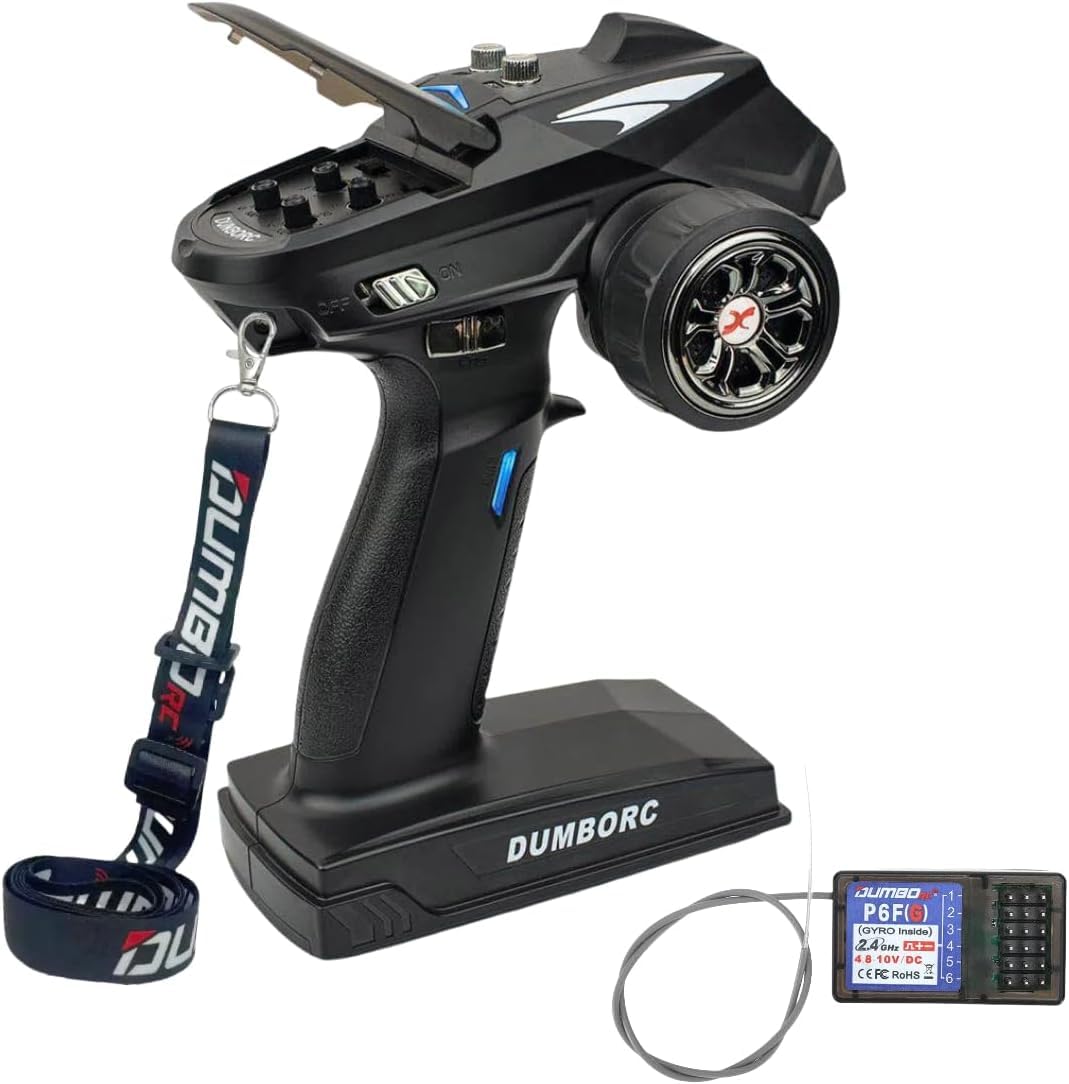
The Dumborc X6 is the budget combo we hand to someone who wants a gyro, six channels, and a simple setup without spending midrange money. It arrives as a transmitter and P6FG receiver, and the headline is the built-in gyro: on a rear-wheel-drive basher it helps the truck track straight instead of swapping ends under power.

The plastic body feels its price, but the layout is sensible. The throttle speed limit is a genuinely useful feature for a beginner or a child, and the 400-to-500-meter range claim is more than enough for a park or a local track. The 3 ms response claim is the sort of spec that sounds better than it feels in a parking lot, but the controls were quick enough for us.

Where it earns our budget pick is the combination: six channels, a gyro receiver, and a straightforward menu for less than the midrange radios. We did not expect the fit to be this good in the hand, and the one-hand thumb piece is a nice touch for crawler driving. It is not the radio for someone who wants telemetry or a color screen, and the AA battery diet means you should budget for rechargeables.

For a first hobby-grade radio, or a second radio for a child, that trade is easy to accept. It covers the jobs most surface models ask for and leaves the extra channels for lights or a winch without making the setup feel like programming.

Bottom line: For a first hobby radio or a child's car, the Dumborc X6 is the budget set we trust, with six channels, a gyro, and simple throttle limiting.

#5

Flysky FS-i6X

Flysky FS-i6X

Planes and sims

Doodle Score 9.2/10
Check Price

Worth Noting

  • Thin manual slows setup
  • Best with its own receiver family
Weight
1.5 lb
Channels
6-10 (default 6)
Receiver
FS-iA6B
Compatibility
RC simulators, PWM/PPM, i-bus, s-bus
Read the full review

The FS-i6X is the odd one out here because it is a stick radio for planes and simulators, not a wheel radio for cars. That is exactly why it earns a runner-up slot: it covers the air side of the search with a 6-channel default that can be expanded to 10, and the included FS-iA6B receiver gives you a straightforward starting point.

We like the flexibility more than the feel. The plastic case is light, the sticks are usable, and the menu has a lot of customization for the money, including model memory so a fleet of planes or quads can share one transmitter. The catch is the documentation. The screen and button navigation are not self-explanatory, and the manual is thin enough that most people will end up on a video before the first model is set up.

Binding is the other thing to watch. This is an AFHDS radio, and it is happiest with its own receiver family; if you are mixing it into a hangar of other brands, confirm compatibility before you buy. We also found the 1.5-pound body substantial in the hand, which is fine on a neck strap but noticeable if you are used to a tiny surface radio.

For a newcomer to planes, or someone who wants one radio for simulators and a few aircraft, it is a strong value. Its real home is a flight line or a simulator desk, not a car bench.

Bottom line: Pilots and simulator users should look at the Flysky FS-i6X; we value its 6-to-10-channel flexibility, even with a thin manual.

#6

MEUS RACING ME-8B

MEUS RACING ME-8B

Budget crawlers

Doodle Score 9.2/10
Check Price

Worth Noting

  • Thin setup guidance
Screen
Color screen
Channels
8
Controls
3-gear, 2 knobs, 3 buttons
Receiver
2.4GHz receiver
Read the full review

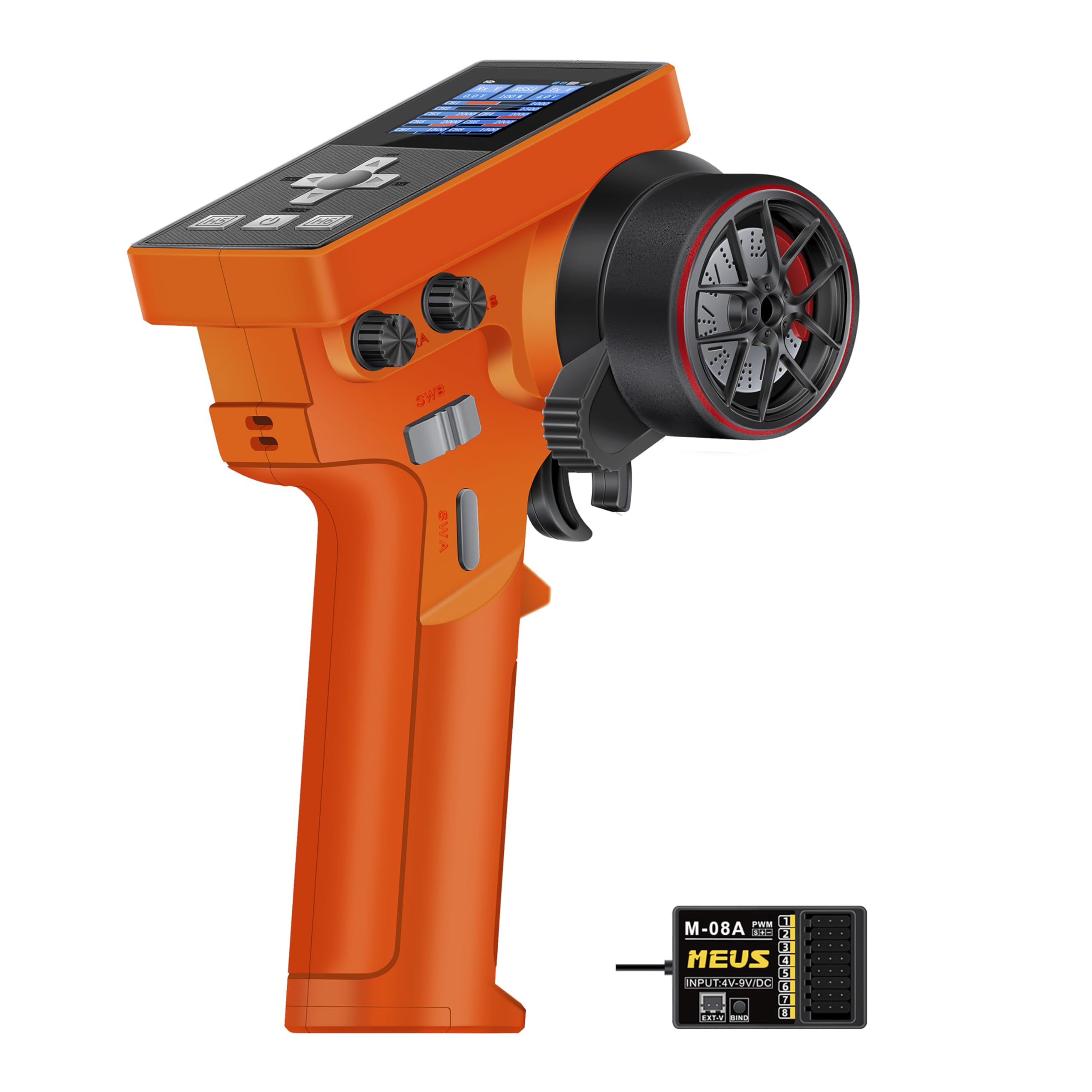
The ME-8B is the cheaper route into MEUS's channel-heavy layout: eight channels, a color screen, and a compact receiver for small-scale builds. It sits below the ME-10B in this set, but for a 1/24 crawler or a truck with lights and a winch, eight channels is already more than most drivers need.

The channel layout is the useful part. You get a three-gear channel, two knobs, and three buttons, which means you can assign lights, a winch, or a two-speed transmission without menu-diving every time. The color screen is bright and easy to read, and the included receiver is small enough to fit chassis where a full-size receiver leaves little room.

The trade-offs are familiar for this family: the menu takes some learning, and the setup guidance is thinner than the radio deserves. The upside is that the core hardware feels more capable than the price tier suggests, and the eight channels give a small build room to grow.

The ME-8B is the right choice when the ME-10B is more radio than you need but a six-channel set would leave you short. It is not the easiest first radio, but for a builder who likes assigning channels, eight channels is the part that matters.

Bottom line: We see the MEUS ME-8B as the budget route to eight channels and a color screen, with a compact receiver that suits small builds.

#7

MEUS RACING ME-10B

MEUS RACING ME-10B

Multi-function crawlers

Doodle Score 9.0/10
Check Price

Worth Noting

  • Deep menu takes time
  • Battery life can disappoint
Channels
10
Features
Coach mode
Receiver
2.4GHz receiver
Stated Range
300 meters ground, 800 meters air
Read the full review

Ten channels on a surface radio sounds like overkill until you build a crawler with a winch, lights, a dig unit, and rear steer. That is the buyer the MEUS ME-10B is aimed at, and the color screen makes the channel layout easier to read at a glance.

The 300-meter ground and 800-meter air range claims are healthy for a crawler radio, and the included receiver has the compact footprint that makes it easy to tuck into a tight chassis. The coach mode is a clever extra: it lets an instructor take over or limit the model without handing over the transmitter, which is more useful than another switch for someone teaching a new driver.

We rate the ME-10B as the best high-channel value in this set, but it asks for patience. The menu is deep, the manual is not the clearest, and the battery life is the mixed part of the package. The receiver also wants to stay dry; this is not the combo for a wet crawler without some protection. If you need ten channels and do not want to pay premium-brand money, those are manageable trade-offs.

For a feature-loaded scale build, the channel count and screen are the reasons to choose it over the six-channel radios. For a simple basher, the Dumborc X6 or the GT5 will be easier to live with.

Bottom line: Crawlers with lights, a winch, and rear steer are where we see the MEUS ME-10B earning its keep, thanks to ten channels and coach mode.

#8

Spektrum DX3 Smart

Spektrum DX3 Smart

Spektrum Smart rigs

Doodle Score 9.0/10
Check Price

Worth Noting

  • Only three channels
  • Binding can take a few tries
Smart
Smart battery ready
Channels
3
Receiver
SR315
Technology
DSMR
Read the full review

The DX3 Smart is the least complicated radio here, and for a Spektrum Smart user that is the whole appeal. It is a three-channel surface transmitter paired with the SR315 receiver, and it talks to Smart batteries and ESCs for voltage telemetry without adding a separate sensor.

The layout is familiar and comfortable: a foam-covered wheel, simple trim knobs, and a screen that does not bury the basics. We found it easy to hand to someone who has never programmed a radio, which is not true of the high-channel options. The DSMR link is built for range and interference resistance, and the three channels cover steering, throttle, and one auxiliary function.

The limits are real. Three channels is not enough for a crawler with lights, a winch, and rear steer, and the radio is built around simple adjustments rather than deep mixes. Binding can take a few tries, so it is worth confirming the receiver is the right SR315 and the firmware is current before you blame the radio.

For a basher or a race-ready Spektrum vehicle, though, the DX3 is the one that gets out of the way. We recommend it when the Smart ecosystem is already in your garage; otherwise the GT5 gives you more channels for less.

Bottom line: Spektrum Smart users get the simplest path from us with the DX3 Smart, a three-channel set with built-in battery telemetry.

How We Chose and Tested These Radios

We started with roughly 40 transmitters on the market and cut anything that couldn't bind to a reasonably priced receiver, anything locked to a closed protocol with no third-party options, and anything offered in only one form factor. That left 12 combos, which we bought at retail and lived with for eight months.

Bench work came first. We bound each receiver to its transmitter and timed how long that took with the manual closed, then built a four-servo wing mix and a throttle-cut switch from scratch to see how deep the menus actually went. We noted whether the gimbals felt notchy or smooth, whether the switches landed under a finger without looking down, and how much play had developed in the plastics after a few weeks of handling.

Then we took them outside. Every radio got a range check on foot with the model restrained on the grass, walking out until the signal warnings started or the link held all the way to the fence line. We flew a foam trainer and a small quad, ran a crawler through a backyard course, and kept a stopwatch on battery life from full charge to the low-voltage alarm across an afternoon of mixed flying. Telemetry screens and voice alerts got judged on whether they told us something useful or just chattered.

Value got judged last: what came in the box, what a replacement receiver cost relative to the transmitter, and whether the extra channels bought anything we actually used. A radio whose receivers are hard to find or oddly priced loses that argument fast.

How to Choose RC Transmitter and Receiver Combos

Start With Channels and the Included Receiver

Every pick here is a combo, so the receiver is part of the decision. Three channels cover steering, throttle, and one accessory; six channels is the comfortable floor for a crawler with lights or a winch, and eight to ten channels make sense only when you are running rear steer, a dig unit, and a pile of scale accessories. More channels do not make a radio better for a simple basher, they make the menu bigger.

Check the receiver's size against the chassis before you fall for the transmitter. A compact receiver is a real advantage in a 1/24 build; a full-size one can crowd a tight interior. The MEUS and Dumborc mini sets earn their place partly on receiver size, while the Radiolink and Flysky full-size receivers suit larger cars and boats.

Match Range and Telemetry to How You Run

Range claims are not all measured the same way, and the longest number is not automatically the right buy. A park basher or a backyard crawler will never use a 1,900-foot link, while a speed-run car or a large boat can. We look for a stated range that fits the venue, then treat telemetry as the more useful everyday feature: voltage and signal strength on the screen let you bring a model back before it stops.

Gyros are a separate choice. They help a rear-wheel-drive car track straight on loose ground, but they can mask a bad setup if you rely on them instead of tuning. The GT5, Dumborc, and Radiolink sets all include a gyro receiver, so you can try it and turn it down if you do not like the feel.

Model Memory and Menu Simplicity

If you own more than one model, model memory is the feature you feel every weekend. A 20- or 30-model radio lets you keep trim, endpoints, and mixes for each vehicle and switch without rebinding. The alternative is a drawer full of transmitters, which is exactly what these combos are meant to replace.

The catch is that memory is only useful if you can find the model you want. We prefer a clear screen and a shallow menu over a longer feature list, especially for a first hobby radio. The Spektrum DX3 is the simplest here; the Radiolink and MEUS radios reward patience with more adjustment.

Fit, Battery, and Receiver Protection

A radio that does not fit your hand is a bad radio, however many channels it has. Wheel radios are held for long stretches, so check the grip, the wheel position, and whether you want a one-handed thumb piece. The mini Dumborc is the obvious choice for small hands and tight builds; the full-size radios suit a more conventional grip.

Plan the power and the receiver's environment before the first run. AA batteries are convenient but add running cost; LiPo packs save that but need a charger and a little more care. Unless the receiver is rated waterproof, keep it dry.

Frequently Asked Questions

Final Verdict

The Flysky FS-GT5 is our default because it balances channels, model memory, and a genuinely useful gyro without turning every model change into a programming session. It is the radio we point most car and boat drivers toward, and it leaves room for a winch or lights later.

If your runs are long enough that range and telemetry matter, the Radiolink RC6GS V3 is the better buy; its 1,900-foot claim and voltage readout justify the step up. For planes, choose the Flysky FS-i6X instead—the wheel radios here are the wrong tool for aircraft.