RC & Vehicles

Best RC Boats of 2026

The worst moment in RC boating isn't the crash — it's the silence. The boat is 40 feet out, the motor quits, and you're weighing a shoe-off wade against writing the whole thing off. What a good radio-controlled boat actually fixes is that specific dread: it gives you enough speed and steering to be worth watching, plus the battery and reliability to bring it back to the bank. When those line up, an ordinary afternoon at the water turns into two hours of everybody arguing over whose turn is next.

My team and I spent four months with 12 boats, from palm-sized pool toys to hobby-grade models that will genuinely touch 30 mph, and the fastest one wasn't the one anyone wanted to keep driving. Two things separate the good ones: a 2.4GHz transmitter, which lets several boats run at once without cutting out, and a water-cooled motor, which is the difference between a fifth run and a dead boat in ten minutes. The picks below earned their spot in the trunk — a couple of them are still living there.

#1

BEZGAR TX123

BEZGAR TX123

Pools and lakes

Doodle Score 9.0/10
Check Price

Worth Noting

  • Prop and shaft exposed to debris
Hull Length
14.16 in
Maximum Speed
32 kph
Claimed Runtime
Up to 40 min
Batteries Included
2 x 1200 mAh
Read the full review

The hard-shell case is what we noticed first, and it's what put this boat in the car more often than the others. The hull, transmitter, both battery packs and the charger drop into molded slots with mesh pockets alongside, so nothing rolls around the trunk and nothing gets left on the tailgate. For a 14-inch boat that is a bigger convenience than it sounds.

On the water, the TX123 is the best all-rounder of the ones we covered. Thirty-two kilometers an hour is quick enough to feel lively on a lake and still controllable in a pool, and the tumbler-shaped deck rolls the boat back over after a flip without anyone reaching for a button. Two 1200 mAh packs give up to 40 minutes between them, roughly double what several boats here manage, and the transmitter warns you before the battery dies or the boat drifts out of range.

Where it gives ground is the drivetrain. The prop and shaft sit exposed at the stern, so a branch, a weedy shallow or a gravelly launch can end the run early, and we treat the last few feet before the water as carefully as the water itself. Beyond that there isn't much to argue with: the size works on a lake and still fits a large pool, and the case turns the whole kit into one object you grab on the way out.

Bottom line: Our pick for most people: two packs for a long session, a hull that rolls itself back over, and a case that keeps the whole kit together.
#2

BEZGAR HJ818PRO

BEZGAR HJ818PRO

Adult speed runs

Doodle Score 8.6/10
Check Price

Worth Noting

  • Too much boat for a backyard pool
Motor
Brushless
Hull Length
16.06 in
Control Range
656 ft
Maximum Speed
55 kph
Read the full review

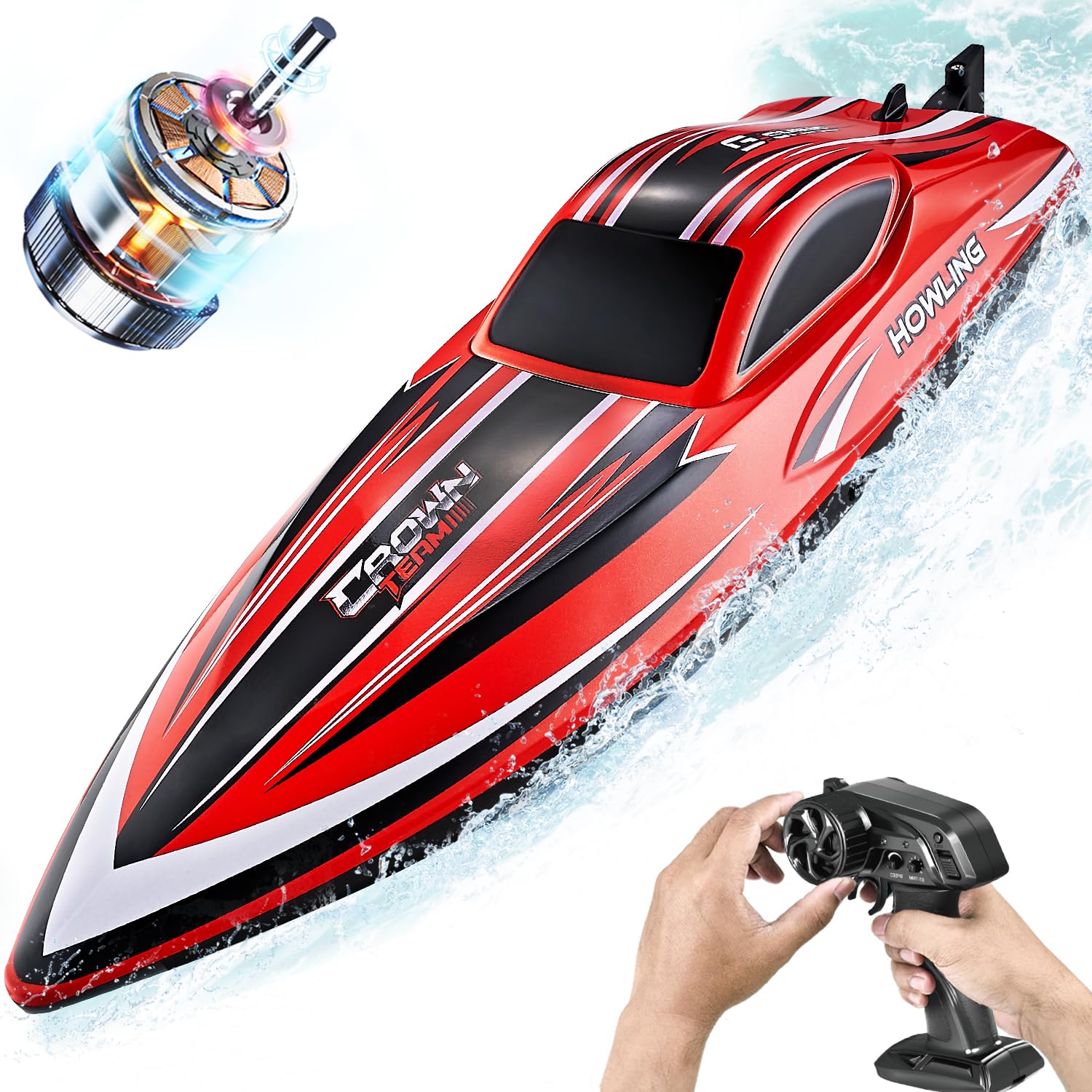
Fifty-five kilometers an hour is not a pool number. The 2212 brushless motor and water-cooled cabin put this a class above the brushed boats in this group, and the 16-inch hull is long enough to stay pointed when you open the throttle. On a lake it looks like a proper hobby boat. In a backyard pool it mostly looks like a mistake.

The supporting figures are generous: a 656-foot control range, low-battery and out-of-range warnings, a one-click flip when it goes over, and an eight-shape demo mode that takes the sticks so you can watch it carve circles. There is trim on the transmitter for steering and throttle, which matters far more on a boat this quick than on a pool toy.

Our caution is about the driver as much as the water. Pushed hard, the hull can run nose-high until you trim it flat, and the steering rewards small inputs rather than big ones — of everything here, this is the one we keep for adults and teenagers. It also wants the exposed hardware treated kindly: the same rocks that chip a small boat will take a bite out of a fast one.

Bottom line: For adults with open water and a taste for speed, this is the fastest boat here: 55 kph from a brushless motor, with the range to use it.

#3

CAPTAER HJ825A

CAPTAER HJ825A

Two-kid racing

Doodle Score 8.6/10
Check Price

Worth Noting

  • 196 ft range rules out big water
Hull Length
10 in
Control Range
196 ft
Boats Included
2
Batteries Included
4 x 1200 mAh
Read the full review

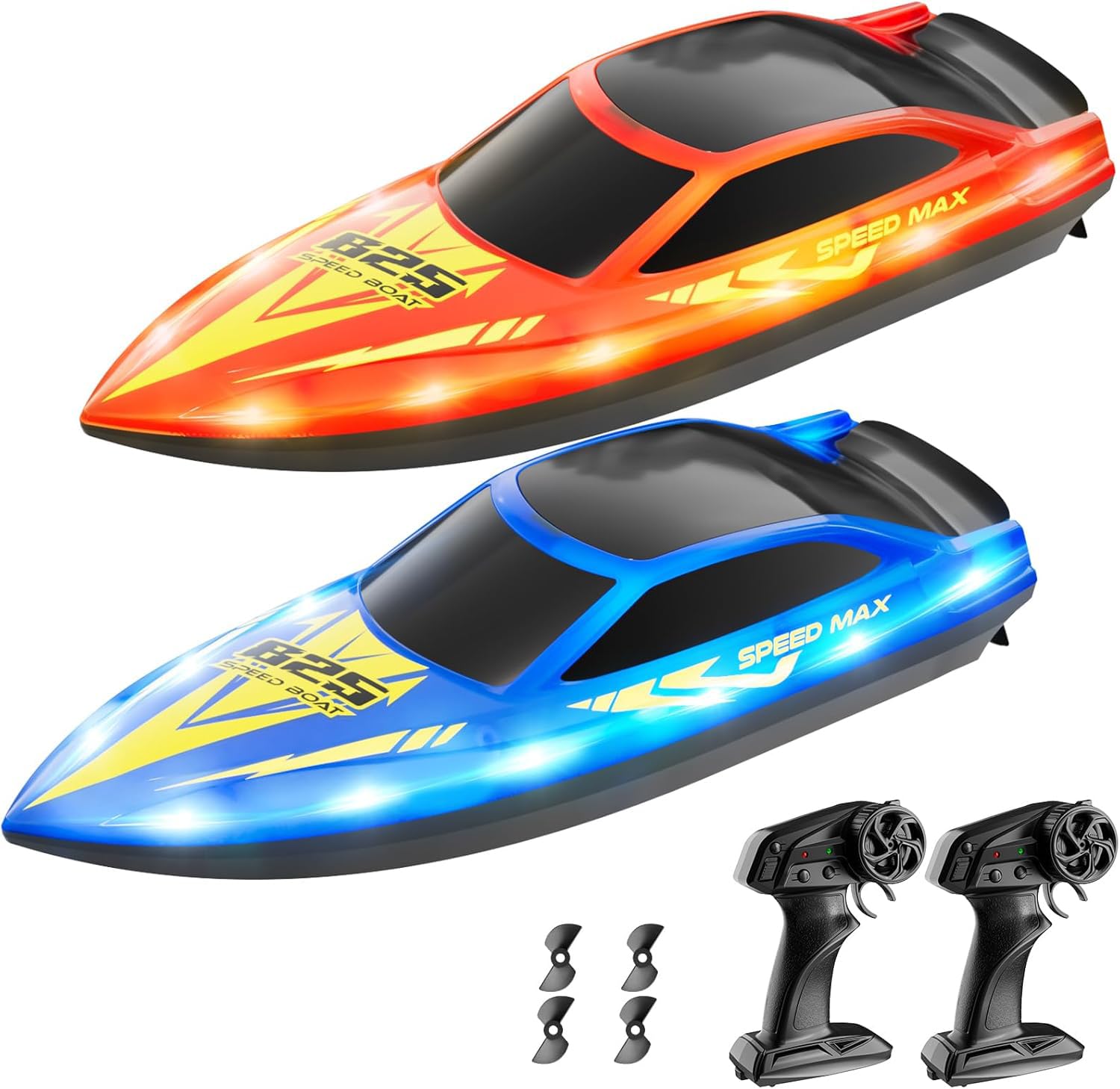
A second controller is the whole point here. Two boats and two non-interference 2.4 GHz transmitters mean both children drive at once, and one throttle doesn't move anyone else's boat — a thing we rate above another kilometer an hour of top speed after watching a child wait their turn.

Each boat is 10 inches with two speed modes, a self-righting hull and LED strips down the sides; the pistol-grip controllers are shaped for smaller hands and simple enough to learn in a lap or two. You get four 1200 mAh packs, two per boat, so both can run, swap and run again without one child sitting out a charge cycle.

The trade-off is scale. Ten inches and 196 feet of range are pool and pond equipment — on a big lake you'll be driving near the bank. Runtime claims are also optimistic; the long figures come from low speed with the lights off, and a pack goes quicker than the number suggests. Two complete boats for the price is what makes this one worth it.

Bottom line: The set we point at families: two boats, two controllers and four batteries, so two children race instead of taking turns.

#4

jogpun H138

jogpun H138

First fast boat

Doodle Score 8.6/10
Check Price

Worth Noting

  • One battery in the box
  • Props are easily damaged
Hull Length
11.9 in
Speed Modes
3
Control Range
394 ft
Maximum Speed
30 kph
Read the full review

Seven lighting modes on an 11.9-inch boat is faintly ridiculous, and it's also the reason children gravitate to it. Two light strips are inlaid along the hull sides and the transmitter controls them, so you can run dark during the day and light the thing up at dusk when the water goes flat and the pool empties out.

Strip the lights away and this is still the strongest budget pick here. Thirty kilometers an hour is close to what the top pick manages, three speed modes let a new driver start slow, range is a respectable 394 feet, and one key rights it after a flip. The transmitter also carries a demo mode that traces figures of eight for whoever is still learning the controls.

Two things we noticed. It ships with one battery, and 20 minutes disappears fast when everyone wants a turn. And the propeller is the part that suffers: a knock against a pool wall or a stick can blunt it, and a bent prop turns a quick boat into a wandering one. Neither is a reason to skip it at this price, but both belong in the plan.

Bottom line: Thirty kilometers an hour, seven light modes and a self-righting hull at a budget price — the cheap boat here that doesn't feel like a compromise.

#5

DEERC 2008

DEERC 2008

Big open water

Doodle Score 8.4/10
Check Price

Worth Noting

  • Drive shaft and prop suffer on rocks
  • Packs run closer to 20 minutes
Hull Length
14 in
Control Range
492 ft
Maximum Speed
20 mph
Batteries Included
2 x 1200 mAh
Read the full review

Four hundred and ninety-two feet is the number that decides this one for us. On a pond it's more range than you need; on a lake or a wide river it's the difference between driving a boat and guessing where it went. The radio is proportional rather than a switch, so a beginner can hold half throttle instead of alternating between stopped and flat out.

The 14-inch racing hull is the other half of the argument. It sits higher and stays visible in chop, and the water-cooled motor is built to run continuously rather than in short bursts. Two 1200 mAh packs come in the box, and the hull rights itself without a button press — a small thing until the boat is 300 feet out and upside down and nobody wants to swim.

Our reservation is about shallow water. The drive shaft and prop are the parts that meet a rock first, and a hard grounding can take the boat out of service, so keep it away from gravel ramps, weedy shallows and pool walls. In open water, though, this is the boat we reach for when a pool simply isn't big enough.

Bottom line: Choose the DEERC when your water is a lake: nearly 500 feet of range keeps it steerable long after smaller boats here turn into dots.

#6

Fullware Spider Hero

Fullware Spider Hero

Younger children

Doodle Score 8.4/10
Check Price

Worth Noting

  • 164 ft range suits pools only
  • 15 minutes per battery pack
Control Range
164 ft
Batteries Included
2
Runtime Per Battery
15 min
Water-sensing Cutoff
Yes
Read the full review

The motors won't turn until the hull is wet. That water-sensing cutoff is the detail we appreciate most on a boat aimed at children — no propeller whirring on the carpet, and no burned-out motor after someone tests it on the kitchen floor. It's the kind of small safeguard that decides whether a toy survives its first week.

The rest is aimed squarely at fun: a themed hull with LED lighting, a spray nozzle triggered from the transmitter, two rechargeable packs at roughly 15 minutes each, and a recovery function you work by pressing the button until the boat rolls upright. It runs on 2.4 GHz, so a second boat can run alongside, and the controller flashes red and sounds an alarm when the pack runs low.

What it isn't is a lake boat. The 164-foot range is the shortest here — fine across a pool, frustrating across a pond — and 15 minutes a pack means a session ends quickly. The hatch is the part to watch: seat it properly every time, because water inside the hull is what ends these boats early.

Bottom line: A pool toy before it's a race boat: the motors only spin in water, the transmitter sprays a jet, and the price suits a first boat.

How We Chose and Tested 12 RC Boats

We started with a list of more than 30 boats and cut it down by price, whether replacement batteries and propellers were actually in stock, and whether the hull was built for real water rather than a bathtub. That left 12, which we ran for four months — from the first warm weekend in late spring through a few chilly October afternoons.

Most of the testing happened where these boats actually live: a neighborhood pond with a concrete edge, a lake dock on a weekend trip, and a backyard inflatable pool for the smallest models. We timed top speed on flat morning water with a GPS unit taped to the deck, then ran that same boat through a two-buoy slalom to see how much of the speed survived a turn. We flipped each one on purpose and timed how long it took to right itself or get netted back in. Ease of use went to the people it's meant for — we handed the transmitter to a 10-year-old and to a grandparent and counted the minutes until each was driving confidently.

Battery life came from running each boat at full throttle until it stopped, then repeating the run at half throttle, and we ran pairs side by side to check for signal cutouts. We carried every boat down to the water by its handle and noted which ones bit into fingers. After a month we checked hull seams, decals, and hatches for cracks and water inside the hull, and priced out a replacement battery and propeller for each to judge value. The boats that held up are the ones below.

How to Choose RC Boats

Start With the Water, Not the Speed

A backyard pool is 20 to 30 feet across, and a boat that tops 50 kph crosses that in about a second before bouncing off the wall. For pools, 10 to 12 inches and 25 to 30 kph is the sweet spot, and 200 feet of range is plenty. A lake changes the brief: 14 inches and up stays visible in chop, and range starts to matter. Treat quoted range as line-of-sight over open water — a dock, a bank or a house behind you cuts it, whatever the box says.

Count Batteries, Not Runtime Claims

Runtime figures assume low speed, lights off and flat water. Expect 15 to 25 minutes from a pack on the boats here, and read the battery count as the real specification: one pack is a short turn, two is a session, and four across two boats keeps two children moving. Choosing between a faster boat with one battery and a slower one with two, take the second battery — the fast boat spends half its life waiting.

Recovery Is the Feature You'll Use Most

Every boat in this group claims some form of recovery, but they are not the same thing. A tumbler hull rolls back over on its own within a second or two, which is what you want at 300 feet out. A button-press recovery needs you working the transmitter while the boat sits upside down, and it works best close in. A boat with neither means wading. It's the specification we check before speed, because a rescue swim ends the afternoon for everyone.

The Two Things That End a Boat Early

Water inside the hull and a damaged prop account for most of the disappointment in this category. A hatch that seats cleanly and a rubber nose bumper matter more than another LED mode, so look at both before you buy. Keep the boat off gravel ramps and weedy shallows, and store it with the hatch open so the hull dries. A bent or lost prop turns a fast boat into a wandering one.

One Boat or a Two-Boat Set

A second controller is worth more than a few extra kilometers an hour when the boat will be shared. Two 2.4 GHz radios don't interfere, so two children can run at once instead of taking turns, and a set with its own transmitters and packs is the simplest route. If the boat is for one adult, skip the pair and put the difference into spare batteries.

Frequently Asked Questions

Final Verdict

For most buyers, the BEZGAR TX123 is the easy answer: a 14-inch hull that behaves in a pool and on a lake, two packs that together buy a long session, a case that keeps the whole kit in one place, and a hull that rolls itself back over. It is the one we take when we don't know what the water will be like.

If your water is a big lake, the DEERC's 492-foot range is worth the sideways step. If two children will share the boat, buy the CAPTAER set and settle the arguments before they start.