RC & Vehicles

Best Race Track Toys of 2026

Every race track looks fast on the box. What the box doesn't tell you is whether the thing will still be set up on the living room floor in three weeks or jammed in a bin with two pieces missing and a car that won't stay on the loop. I've stepped on more plastic track than I care to admit, and I've watched a set that took 40 minutes to assemble lose its shine in about six. A good one fixes all of that at once: it goes together without a fight, the joints hold through a hundred laps, and kids come back to it after the novelty wears off.

The flashiest sets aren't always the ones kids keep racing, either. We've had 12 of these living in our homes for three months, looping through living rooms and down basement stairs, and price barely predicted fun — a couple of inexpensive sets beat out bigger, pricier ones. What mattered was whether the track held together lap after lap, whether the cars survived a drop, and whether anyone still wanted to play on day ten. The picks below earned their floor space.

#1

Hot Wheels Roll Out Raceway

Hot Wheels Roll Out Raceway

Storage and travel

Doodle Score 9.6/10
Check Price

Worth Noting

  • Rolling it back up takes practice at first
Lanes
5
Weight
1.72 lb
Manufacturer Age
4 years and up
Storage Capacity
Up to 80 cars and 5 track pieces
Read the full review

Unroll it and the Roll Out Raceway becomes five lanes, with a fair-start gate at one end that releases all five cars together and a finish line at the other that shows which lane got there first. Roll it back and it's a fabric bucket with a handle, holding up to 80 die-cast cars and five track pieces in the middle.

The bucket is why this one earns a place. The failure mode for a track set is that it gets built once, played with for an afternoon, and then lives in pieces under a sofa; here putting it away takes seconds, and a four-year-old can carry the whole thing to a cousin's house. There's no assembly at all — the five-minute setup on the box is really just finding a floor.

What it isn't is a long track. Five short lanes decide the race in a couple of seconds, by the gate rather than by momentum, which suits a four-year-old and will bore a nine-year-old. It connects to other Hot Wheels sets, so the bucket can become the start line of something longer, and at 780 grams it moves around the house without a fight.

Bottom line: We recommend it for any house where the track gets put away, since it rolls into a handled bucket that swallows 80 cars.
#2

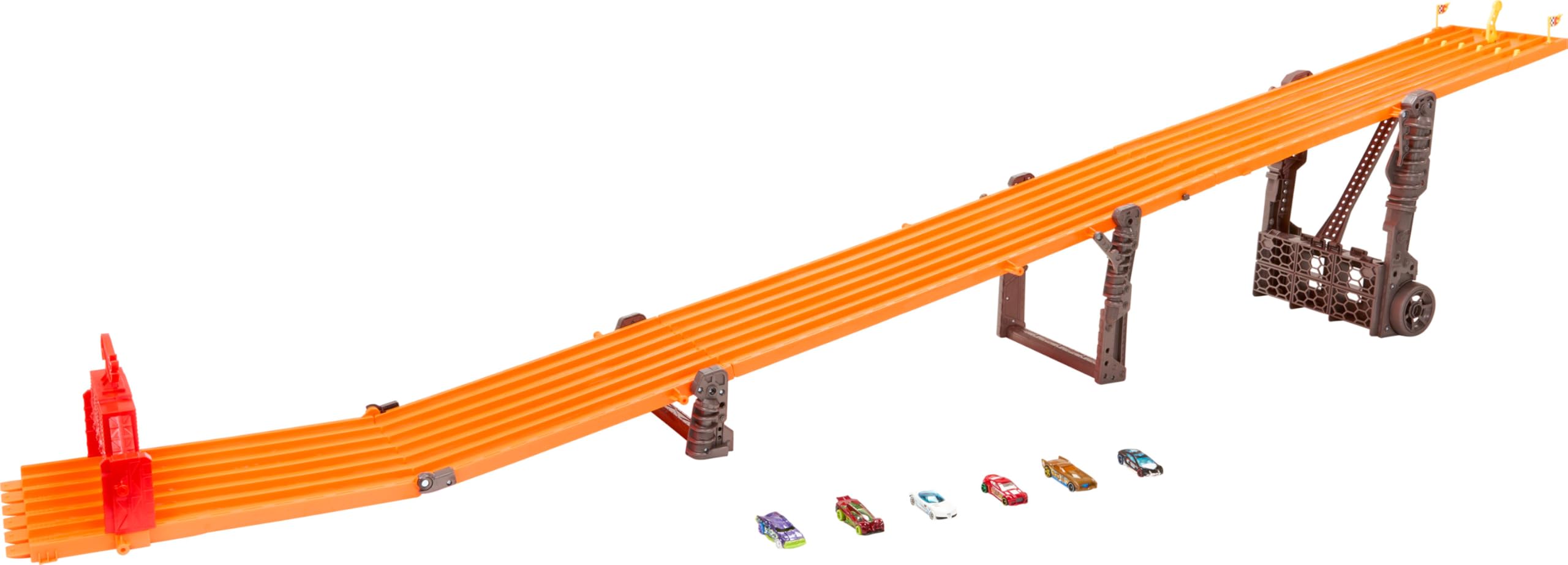
Hot Wheels Super 6-Lane Raceway

Hot Wheels Super 6-Lane Raceway

Family showdowns

Doodle Score 9.6/10
Check Price

Worth Noting

  • Wants about eight clear feet of floor
  • Folding it flat takes practice
Lanes
6
Batteries
3 AA batteries required
Track Length
8 feet
Cars Included
6
Read the full review

Six lanes turns racing into an event. Line six cars up behind the fair-start lever, drop it, and the set calls the race: the winning lane lights up and an announcer says which number won. The format is what keeps a mixed-age group in the game, because nobody has to sit out a heat.

Eight feet of track makes the run long enough to be worth watching, and six 1:64 cars come in the box. That matters more than it sounds, since most sets here ship with one car and expect you to supply the field. It folds flat for storage, which is the difference between a raceway that lives in the playroom and one that lives in a cupboard.

The catch is the price, which is the highest of anything here by a wide margin. We think it earns the money in a house where racing is the main event and there are siblings or cousins to fill six lanes. For a single child, the Crash set gives more racing per dollar and folds into a corner instead.

Bottom line: Six kids, six cars, one lever — we keep this one for the days when the whole family is racing.

#3

Simplay3 Carry & Go Track Table

Simplay3 Carry & Go Track Table

Toddlers

Doodle Score 9.6/10
Check Price

Worth Noting

  • No cars or trains in the box
Weight
6.5 lb
Play Sides
Car track and train table
Assembled Size
35.37 x 17.75 x 3.88 in
Manufacturer Age
18 months to 3 years
Read the full review

There is nothing to build. The Carry & Go is one molded piece of double-wall plastic, 35 inches long and about 6.5 pounds, with a handle grown into the edge; you apply the decals and it's ready. One side is a car track with dips and obstacles, the other is a train table with a pond to chug past.

Flipping it over is the party trick. At 6.5 pounds a preschooler can turn it without help, so the same toy is a race track in the morning and a train layout after lunch. It's under four inches thick, which is thin enough to slide beneath a bed or stand behind a dresser, and light enough that a three-year-old can haul it by the handle.

This is, we think, the sturdiest thing in the group by a distance. Double-wall plastic, no connectors, no loose pieces: nothing snaps, nothing gets lost, and it doesn't mind being knelt on, dragged, or climbed over. What it won't do is race — cars are pushed by hand along a flat surface, with no downhill run and no booster — and for a two-year-old that isn't a compromise, it's a fair description of what a two-year-old can actually do.

Bottom line: If the racer is still in diapers, we point you here: one molded piece, two play sides, and nothing to snap together.

#4

Hot Wheels Super Loop Fire Station

Hot Wheels Super Loop Fire Station

No-battery play

Doodle Score 9.6/10
Check Price

Worth Noting

  • Thin assembly instructions
Lift
Hand-powered, 3 heights
Pieces
17
Batteries
None required
Assembled Size
7.09 x 13.78 x 12.6 in
Read the full review

The elevator is hand-powered. A kid drives the fire truck onto a lift, raises it to one of three heights, and lets go, and gravity takes the car through a loop and out of a translucent waterfall. No batteries, no booster to stall, nothing to switch off and forget.

Seventeen pieces make a small fire station: a hose that swings on its hydrant, a swing gate, a garage door and parking spots for the cars that aren't running. It clips onto other Hot Wheels City sets, so on its own it's a self-contained loop and inside a bigger layout it becomes a corner of a city.

Single-lane racing is the honest boundary. One car goes at a time, which makes this a stunt set rather than a race, and the three lift heights are what give it replay value — a low release is a gentle roll, the top one is a proper drop. The parking spots matter more than they sound, since they give the rest of the fleet somewhere to wait instead of the carpet.

We keep this one for the parent who is done with battery checks. It's the least expensive pick here, it works every time without a fresh cell, and at 4 and up it's the set we hand a four-year-old who wants to run the whole thing himself. The instructions are the weak point; plan on a few minutes of working out where the supports go.

Bottom line: This is our pick for the parent who's finished buying batteries: the car climbs on a hand-cranked lift and the loop costs nothing to run.

#5

Hot Wheels Criss-Cross Crash

Hot Wheels Criss-Cross Crash

All-day motorized racing

Doodle Score 9.4/10
Check Price

Worth Noting

  • Takes roughly 29 inches of floor
Batteries
4 D batteries required
Footprint
29.13 x 29.13 x 7.87 in
Car Storage
Built-in parking spaces
Manufacturer Age
5 years and up
Read the full review

A booster is the difference between a track a kid plays with and a track an adult keeps rebuilding. This one feeds cars up a ramp on its own, sends them into four intersections and a hairpin, and lets them meet in a crash zone at the bottom. We switched it on and then did nothing for the next half hour except watch, which is the entire point of a motorized set.

The intersections do the real work. Cars arrive from different directions, so runs don't repeat, and the collisions read as a win rather than a malfunction. Setup is short — a base, a few track sections, a feeder ramp — and the set carries its own parking spaces, so the cars have somewhere to sit besides the middle of the floor.

Four D batteries are the running cost of the booster, and rechargeables turn that into a one-time purchase instead of a habit. It also wants a hard, flat floor, because the feeder ramp is unforgiving on carpet. For a five- or six-year-old who already owns a shoebox of cars, this is the set here that sustains play with the least adult input.

Bottom line: Our top pick because the motorized booster keeps the race restarting itself, and the crash intersections are what a five-year-old actually wants to watch.

#6

Hot Wheels Fuel Can Stunt Box

Hot Wheels Fuel Can Stunt Box

Custom builds

Doodle Score 9.4/10
Check Price

Worth Noting

  • Connectors are stiff to pull apart
  • Only one car included
Loop
24-inch loop track
Pieces
14
Storage
Fuel-can case
Included Car
1 Hot Wheels vehicle
Read the full review

It looks like a jerrycan, and that's the storage. Open it up and you get 14 pieces — five low-wall straights, turns, a 24-inch loop, a flipper and a launcher — plus one car, and the case itself becomes part of the course rather than something you throw away.

What we like is that it's a kit, not a layout. There's no printed base telling a kid where things go: build a straight run into the loop, decide the flipper belongs at the bottom instead of the top, rebuild. Every piece is compatible with other Hot Wheels track, so this is the box that extends a set they already own instead of replacing it.

Two things to know before you buy. The loop needs a hard, straight launch, and heavier cars won't stay in it — the included car will, a chunky truck won't — so run the cars in the house through it first. And the connectors grip hard enough that pulling a course apart is closer to an adult job than a kid job. Setup is rated at fifteen minutes, which feels about right the first time.

Bottom line: This is the set we hand to a kid who takes things apart: 14 pieces that rebuild into a new course every afternoon.

#7

Hot Wheels City Transforming Race Tower

Hot Wheels City Transforming Race Tower

Small spaces

Doodle Score 9.2/10
Check Price

Worth Noting

  • Connections loosen during enthusiastic play
Modes
Single lane and two-lane race
Height
26 inches in single-lane mode
Included Car
1 Hot Wheels car
Manufacturer Age
3 years and up
Read the full review

Twenty-six inches of tower, one lane, and a two-sided elevator that carries the car to the top. Drop the fair-start gate and it runs down through twists and turns to the base. That's single-lane mode, and it's the mode a three-year-old will use first.

Then it opens out. A hinge splits the tower into two lower lanes, the elevator serves both sides, and two cars can race head to head. Switching takes seconds and nothing has to be rebuilt, and we found the two-lane mode is the one that stays in use — a race with a loser is more interesting than a solo run.

Nine by 21 by 14 inches is the reason we pick it. This is the set for a bedroom where the floor is already spoken for: it grows upward instead of outward and still gives a preschooler the drop-and-repeat loop that a full raceway does. One thing to check before a birthday — some cars sit too tall for the gate, so run the cars you already own through it once.

Bottom line: We like it where floor space is the constraint: the tower stands 26 inches tall and folds from one lane to two.

How We Tested 12 Race Track Toys (and Kept Playing)

We started with about 40 race track sets on the market and narrowed by price, piece count, and whether the brand sells expansion packs and replacement cars — a set you can't add to or fix has a short life. That left 12, and they've lived in our homes for three months, played with by kids from 3 to 10.

Assembly came first: one adult, a timer, and only what was in the box. We noted where the illustrated steps didn't match the pieces in front of us, how long it took to reach the first lap, and whether batteries were included or turned into an errand. Then we ran them hard — launched cars off tables, knocked whole tracks onto carpet, stepped on stray pieces, and broke down and rebuilt each set five times to see whether the joints still clicked tight or started slipping.

Track quality got the most laps. In ten-lap sessions we counted stalls, derailments, and places where the track popped apart mid-race, then checked whether boosters, launchers, and loop connectors did what the box promised. We also mixed pieces between sets and expansion packs to see if they truly fit, and ran any app or Bluetooth feature twice — at setup and again two weeks later — to catch drops in pairing.

Fun was the one thing we couldn't fake. We logged which sets kids pulled out unprompted in week one and again in week eight, and whether they raced each other or just watched the cars go around. That fed our value call: a set with 80 pieces played with twice lost to one with 30 that came out every afternoon.

How to Choose Race Track Toys

Power: batteries, hands, or gravity

A motorized booster keeps a race running on its own, which is the difference between half an hour of play and five minutes of it. The trade is D cells, and rechargeables turn that into a one-time purchase rather than a running cost. Hand-powered sets make the kid the engine: a lift or a launcher means a four-year-old can run the same loop fifty times without asking for help, and nothing dies mid-race.

Gravity ramps suit the youngest racers, who mostly want to watch a car appear at the bottom. If your child is under four, skip the booster entirely — the lift-and-release sets get used more, and they never need a battery check before a playdate.

Measure the floor, not the box

Footprint is where track sets surprise people. An eight-foot six-lane raceway needs eight clear feet of hard floor; the crash set wants a square of about 29 inches; a tower grows upward and takes a couple of feet of wall instead. The storage figure and the play figure are different numbers, and a listing usually gives you the second one in its photos and neither in its title.

That is the trap: folding or rolling makes a set easier to put away, not smaller while it is out. Pace out the run before you buy — a hallway, a spare-room floor, a piece of hard flooring that isn't the living-room carpet.

Match the set to the child

Box ages are a starting point, not a promise. Under three, the track that gets used is a one-piece surface with no loose parts to lose or mouth; ramp racers that arrive with fingernail-sized die-cast cars put a small part in front of a child who still puts everything in their mouth, whatever the box says. Around four, hand-powered lifts and launchers let a kid run the whole thing alone, which is most of the appeal.

From five or six, a motorized booster and a fair-start gate add the thing they actually want: a race with a result. If two children will share it, count the lanes before anything else — a set with one lane is a solo toy no matter how good it looks.

Setup is really about teardown

Assembly runs from nothing at all to about a quarter of an hour, and none of these sets is difficult to build once. The question that decides whether it gets played with is what happens afterwards: a raceway that rolls into a bucket is away in ten seconds, while a course of loose connectors ends up in a bag under the sofa.

Stiff connectors and thin instructions are the two things that turn setup into a chore. Build it once with your child, watch which parts they can manage alone, and then decide whether it lives out or goes into a bin.

Frequently Asked Questions

Final Verdict

Buy the Criss-Cross Crash set. Of everything here it asks the least of an adult: switch it on and cars keep climbing, crossing, and colliding while a kid watches, which is why it holds attention long after a plain ramp has been abandoned.

If storage is the constraint rather than floor space, the Roll Out Raceway trades length for a bucket that swallows 80 cars and a whole afternoon's mess. And if the racer is still two, skip both and get the Simplay3 table — it survives being sat on, and it has nothing to lose.