RC & Vehicles

Best Finger Bike of 2026

A finger bike is a tiny, fully articulated BMX bike you ride with your index and middle fingers. It sounds like a novelty, but the good ones are built like real machines—metal frames, rubber tires, wheels that actually spin—and that's what makes them worth keeping on your desk. The cheap ones show up looking right in photos, then reveal themselves: stiff axles, crooked handlebars, decals that lift at the corners. For a toy this small, construction is everything.

Over the past four months, I've rolled, flicked, and (more than once) sent 16 finger bikes skidding across my desk. My team and I compared how they felt in hand, how freely the wheels spun, and whether the details—grips, brake lines, paint—held up after daily use. The differences are not subtle. A well-made finger bike tracks straight and has a satisfying weight; a bad one wobbles, snags, or loses a wheel. Below are the ones that survived.

#1

Berry President 1:8 Bike

Berry President 1:8 Bike

Desk display

Doodle Score 9.2/10
Check Price

Worth Noting

  • Not built for hard trick play
Scale
1:8
Material
Zinc alloy and plastic
Dimensions
17.5 cm x 5.5 cm x 11 cm
Moveable Parts
Handlebars and pedals
Read the full review

The 1:8 scale is the first thing you notice. At 17.5 centimeters long, it has enough presence to sit on a desk without looking like a party favor, and the zinc alloy frame gives the body a more substantial look than the plastic-heavy alternatives. The support stand keeps the bike upright when you are not rolling it, so it works as a shelf piece between handling sessions.

We think the size is the sweet spot for a display-first finger bike. The handlebars turn, the pedals move, and the wheels roll, which is enough articulation to pose it and push it a few inches across a mousepad. The detailing holds up at this scale, too; the frame, tires, and cockpit read as a real mountain bike rather than a generic toy. It is the one we kept on our own desk after the first round of handling.

The polished finish is the part we noticed most on the shelf; it catches light without looking glossy or cheap. The bike sits at a natural angle on its stand, so you can see the frame and wheels rather than a jumble of parts. For a desk piece that gets handled now and then, that combination of detail and stability is why it kept its spot when the other models came and went.

Bottom line: We recommend the Berry President for anyone who wants a detailed 1:8 finger bike that looks good on a desk and holds up to light handling.
#2

Kakalote 1:10 Finger Bike

Kakalote 1:10 Finger Bike

Tight shelves

Doodle Score 9.0/10
Check Price

Worth Noting

Size
17.8 x 6 x 10.8 cm
Scale
1:10
Weight
6.7 oz
Material
Metal and plastic
Read the full review

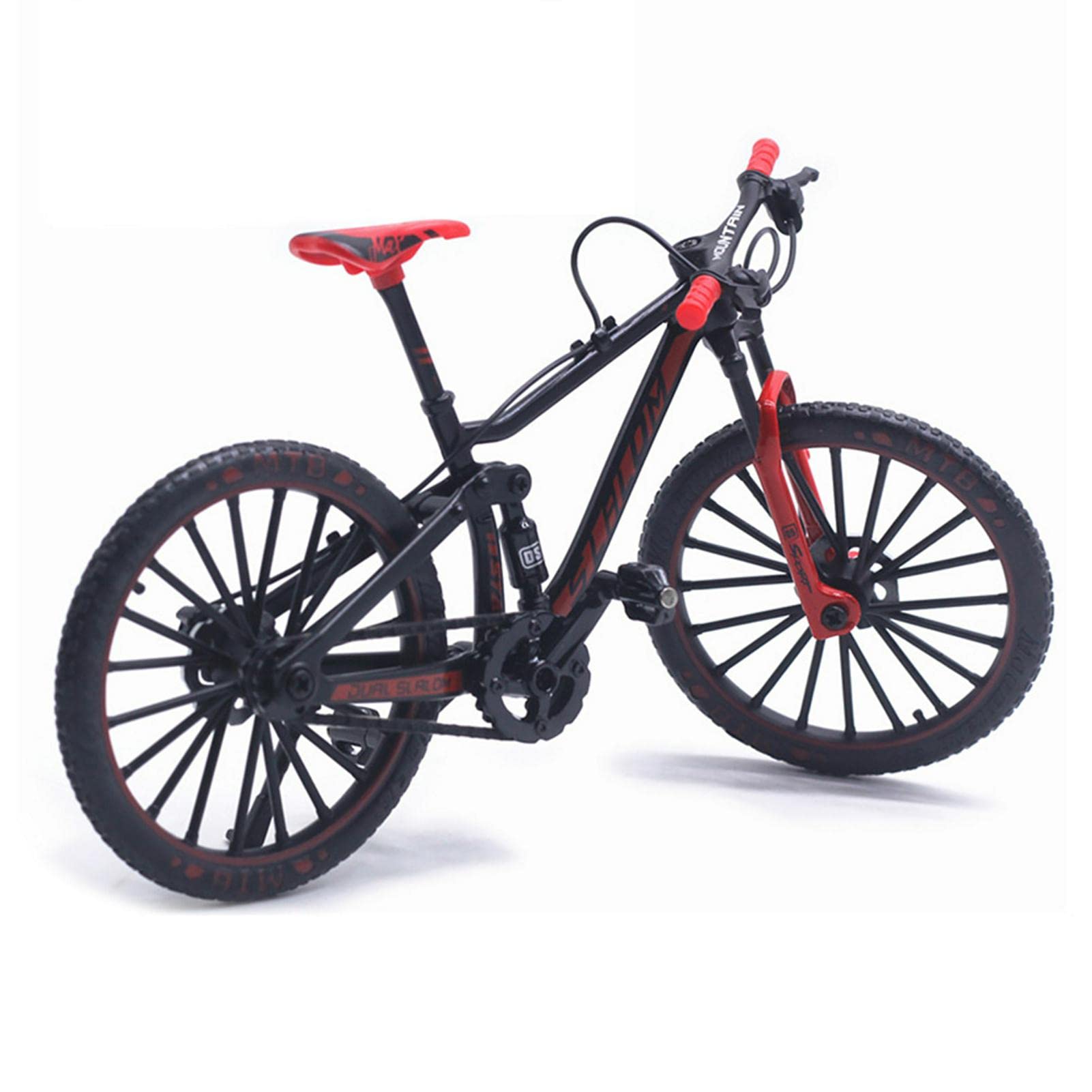
The Kakalote's 1:10 scale is the reason to notice it. It is a smaller desk object than the 1:8 models here, and on a crowded shelf that difference is the whole point: it tucks into a gap without asking you to clear a display zone. We liked how clean the proportions look at that size, with a realistic frame and a red finish that reads as a mountain bike rather than a generic toy.

The alloy and plastic body has a detailed look, and at 0.19 kg it is light enough to move from desk to shelf without feeling clumsy. The bike comes in an independent color box, which makes it easy to give as a gift. What it does not include is a stand, so plan on leaning it against a shelf or setting it on a small display base. That is a small inconvenience, but it is the kind of thing you want to know before it arrives.

We kept coming back to the size as the deciding factor. If you have a dedicated display shelf, the 1:8 models have more presence; if you are working with a narrow ledge, a crowded desk, or a gift box that has to stay compact, the Kakalote makes more sense. The finish is neat enough to leave out, and the small footprint means it does not have to be the center of attention to earn its spot.

Bottom line: The Kakalote is our pick for a small desk or tight shelf, where its 1:10 footprint and clean detailing matter more than trick-ready toughness.

#3

Ailejia BMX Finger Bike

Ailejia BMX Finger Bike

BMX-style display

Doodle Score 8.8/10
Check Price

Worth Noting

  • Recommended for ages 14 and up
  • Premium price for a similar scale
Scale
1:8
Material
Alloy steel and plastic
Moveable Parts
Handlebars, wheels, pedals
Recommended Age
14 years and up
Read the full review

The red BMX version of Ailejia's 1:8 model is the one for anyone who wants the bike to look fast even when it is parked. The alloy steel and plastic body has a more aggressive stance than the Berry President, with a support bracket that holds it upright on a shelf. We liked the look immediately; it reads as a BMX bike rather than a generic mountain bike.

The moving parts are the reason to choose it. The handlebars, wheels, and pedals rotate, so you can pose it for display and roll it across a desk. The 1:8 scale gives it presence, and the red finish makes it easy to spot on a crowded shelf. It is not a pocket toy; this is a piece with enough size to be the focal point of a small display.

We paid close attention to the stand because a bike this shape will not stay upright on its own. The support bracket does its job, and the frame has a solid, planted look when it is on the shelf. The detailing is sharp enough that the bike reads as a miniature BMX rather than a toy-shaped approximation. That BMX stance is the detail that separates it from the more generic mountain-bike models here.

Bottom line: We like the Ailejia for its BMX-specific look and poseable parts, especially if the bike is going on a display shelf.

How We Tested Finger Bikes

We began by scanning collector forums, hobby shop shelves, and rider reviews, then filtered for metal frames, replaceable wheels, and printed—not sticker—graphics. We ordered 16 models across a range of styles, from stock BMX replicas to mini dirt-jump builds. Testing ran for four months, mostly on a desk, but also on kitchen counters, a coffee table, and a piece of cardboard propped on a book as a ramp.

Construction was the first checkpoint. I tightened every visible screw with a mini screwdriver, wiggled each handlebar and fork, and rolled each bike across a cutting board to see if it tracked straight or pulled to one side. Then I spun the wheels and listened—a clean, quiet spin with no grinding was the goal; any wobble or catch got noted.

Design and appearance matter as much as function here, because these bikes spend most of their lives on display. I checked proportions against real BMX geometry, looked at whether grips and seats were molded cleanly, and ran a thumb over decals to see if edges lifted. After four months of daily handling, I noted which paint chipped, which plastics yellowed, and which bikes still looked sharp enough to leave out.

How to Choose the Right Finger Bike

Scale and desk presence

Scale changes what the bike is for. A 1:8 model like the Berry President is long enough to show off the frame, tires, and cockpit, so it works as a small display piece. A 1:10 model like the Kakalote takes up less shelf space and is easier to tuck beside a monitor. Neither is automatically better; the right choice depends on how much room you want to give a miniature bike.

Measure the spot before you buy. If the bike will live on a shared desk, a smaller 1:10 footprint is easier to live with. If it is going on a shelf with other models, the extra presence of a 1:8 bike is usually worth the space.

Materials and moving parts

Diecast alloy and plastic are the usual materials. A metal frame adds heft and a more realistic look, but it does not mean every part is metal; handlebars, pedals, and small pivots are often plastic. Check which parts actually move, because that is what you will handle most.

A support stand is not a luxury on a bike with a kickstand-free shape. The Berry President and Ailejia both include one, which keeps the bike upright and makes it easier to display. If a model does not include a stand, plan on adding a small base or leaning it against something stable.

Play style and durability

Finger bikes sit somewhere between toy and model, and the split matters. Gentle rolling and posing put little stress on the small parts; repeated trick play, drops, and hard flicks put much more strain on handlebars, wheels, and joints. The fragile parts are usually the ones that make the bike look realistic.

Decide who will use it before you choose. A display-first model is the better fit for a desk or a collector's shelf. If the bike is going to a child who wants to perform tricks, look for a purpose-built trick bike and accept that it is a different purchase from a display model.

Age and small parts

Age recommendations vary widely across finger bikes, from young-child ranges to 14-and-up. Treat the manufacturer's rating as the starting point, not a suggestion to ignore. Small wheels, pedals, and handlebars can come loose, and they are a choking hazard for children who still put things in their mouths.

For a young child, a display model kept out of reach is safer than a plaything. For an older kid or an adult collector, the main check is whether the bike will be handled gently or used hard; that answer points you to the right build.

Frequently Asked Questions

Final Verdict

For most buyers, the Berry President 1:8 is the finger bike we point to first. It has the detail, moving parts, and support stand that make a desk model feel worth handling, and its construction is the most convincing in this set. If the BMX look is the reason you are shopping, the Ailejia is the more characterful pick; if space is tight, the Kakalote's smaller footprint is the better fit.