Pretend Play

Best Toy Shopping Carts of 2026

If you have ever tried to steer a toddler past the miniature carts parked just inside a grocery store entrance, you know the magnetic pull they have. A toy shopping cart brings that same errand-day thrill home, where it becomes hours of pretend restocking, checkout beeping, and very serious trips down the hallway. What it fixes is simple: it hands a kid a piece of grown-up business that is entirely their own, and it keeps the game running long after the real groceries are put away.

The tricky part is that these carts take a beating. I have watched a flimsy one fold at the handle under a three-year-old's grip, and seen wheels go square after a month of carpet, tile, and driveway. Over the past six months my team and I have assembled, loaded, and pushed 10 carts through playrooms, kitchens, and a few actual grocery aisles. The ones worth buying share a few things: a frame that doesn't flex, wheels that track straight, and a handle that fits the kid pushing it today and the one who will inherit it next year.

#1

Melissa & Doug Shopping Cart

Melissa & Doug Shopping Cart

Everyday pretend shopping

Doodle Score 9.6/10
Check Price

Worth Noting

  • Metal frame can mark baseboards and doors
Weight
11.1 lb
Age Range
3+ years
Assembled Size
14.5 x 15.75 x 20.75 inches
Frame Material
Metal
Read the full review

The metal frame is the first thing you notice, and it is the reason this cart earns our top pick. A wire basket on a metal chassis reads as a grocery cart in a way molded plastic never quite does, and the pivoting front casters are the part that matters once a child is actually pushing: a toddler can steer around the kitchen island instead of dragging the cart sideways over the carpet.

Everything else is scaled to match. The fold-open seat at the front takes a doll or a stuffed passenger, the basket swallows a full play-grocery haul, and the cart sits low enough that a preschooler leans into the handle rather than reaching up for it. It is also the most rigid cart here by a wide margin; the frame does not flex when a child puts their weight on the bar halfway around a corner.

The catch is 11.1 pounds. For a three- or four-year-old that weight reads as solidity and the cart goes where it is pointed; for a just-walking toddler it is a lot of cart to shove, and that is the point where we reach for a lighter plastic one. Assembly is a few steps with the tools in the box, and the price lands in the middle of this group, above the Little Tikes and below the Radio Flyer.

Bottom line: We recommend it to anyone with a three-year-old who pushes hard: the metal frame and pivoting casters make this the most convincing and most planted cart in the group.

#2

Step2 Little Helper's Cart

Step2 Little Helper's Cart

Tight spaces

Doodle Score 9.6/10
Check Price

Worth Noting

  • Arrives in pink only
Weight
5 lb
Material
Double-walled plastic
Age Range
24 months to 8 years
Assembled Size
21.5 H x 13 W x 18.5 D inches
Read the full review

Thirteen inches wide and 21.5 inches tall, the Step2 is the cart that lives in a hallway without becoming an obstacle. That footprint is why it is our pick for apartments and small playrooms: it slots beside a bookshelf, and the double-walled plastic shrugs off the knocks that come with indoor play instead of showing them.

We were also impressed by how little fuss it takes to own. It snaps together in minutes rather than needing a session with an axle, it wipes down with a household cleaner after a snack-heavy afternoon, and the basket takes a 12-inch doll and a 15-inch one without either of them dangling over the side.

The light body is the trade-off. It is easy to shunt around a rug, but it will not feel as planted as the metal Melissa & Doug when a child leans hard on the handle, and a determined preschooler can get it moving quickly across a hard floor. For most small-space families that is the right deal: a cart that stores out of the way and survives being dragged.

Bottom line: The Step2 does more with less room than anything else here, and we think the extra outlay is fair for the floor space it gives back.

#3

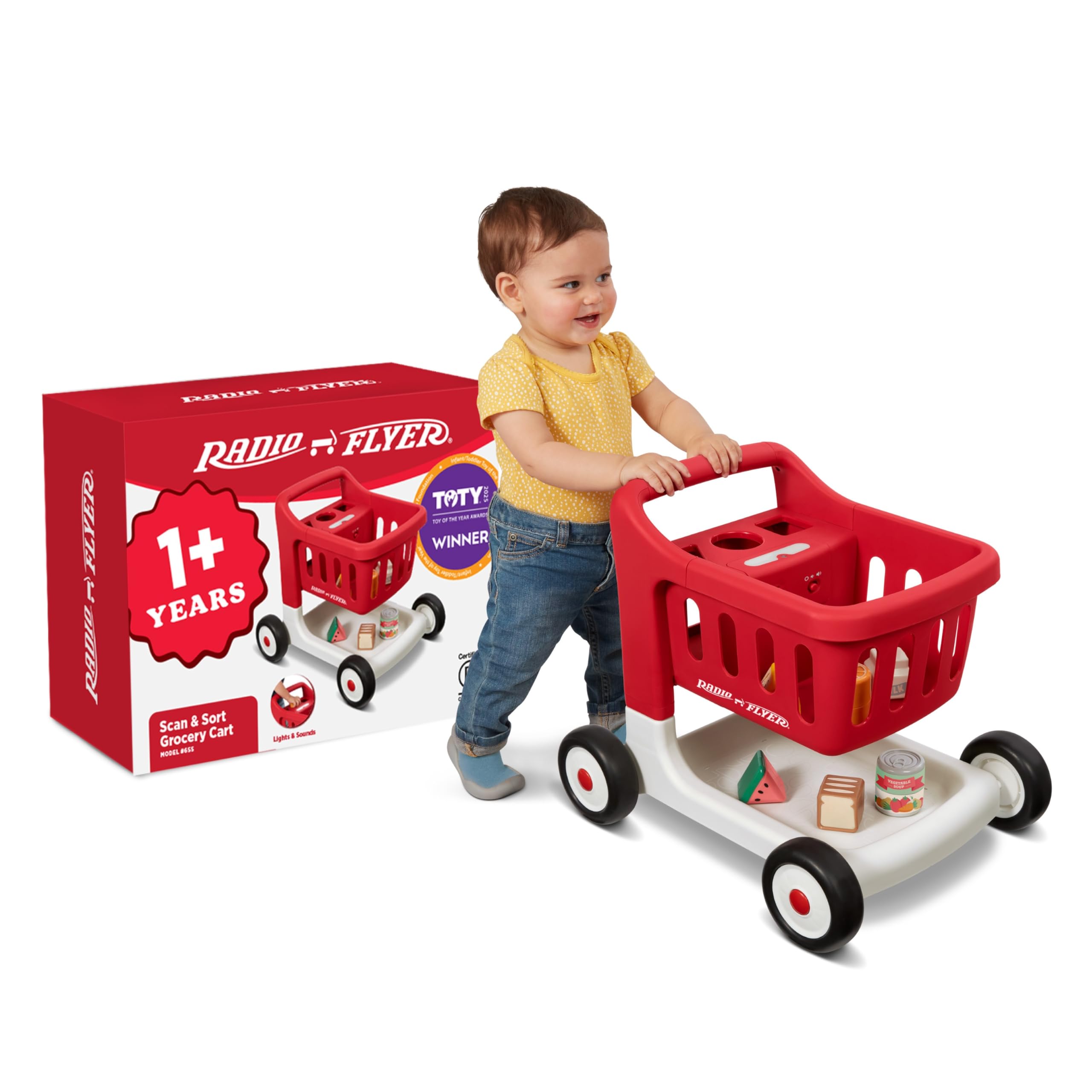
Radio Flyer Scan & Sort Cart

Radio Flyer Scan & Sort Cart

New walkers

Doodle Score 9.6/10
Check Price

Worth Noting

  • The priciest cart in this set
Handle
Three height settings
Included
Six play food pieces
Age Range
12 months to 6 years
Assembled Size
20.86 x 18.5 x 14.37 inches
Read the full review

A scanner that beeps, six play-food pieces that double as shapes, and a handle that moves through three heights: the Scan & Sort is the only cart here designed for a child who is still finding their feet. The resistance clickers add drag at the wheels so the cart moves at a walker's pace, and the handle comes up as the child does.

The scanner is the part that earns its keep. A toddler loads the basket, swipes a box past the sensor, and gets a beep and a spoken phrase back, which turns a lap of the living room into an errand. That is the fiction a two-year-old wants, and it is why this cart holds attention longer than the others when a child has no interest yet in dolls.

The wheels track straight, so tight turns around the coffee table take practice, especially with the handle at its lowest setting, which is a fair trade for the drag that keeps a new walker steady. The scanner is loud in the way battery toys are loud, and after a few afternoons you will know the phrases by heart.

Bottom line: If your one-year-old is already cruising the furniture, this is the cart we hand over first: the clickers and three handle heights turn a cart into a walker.

#4

Little Tikes Shopping Cart

Little Tikes Shopping Cart

First cart for toddlers

Doodle Score 9.4/10
Check Price

Worth Noting

  • Fixed handle sits low for taller preschoolers
Weight
7.2 lb
Material
Plastic
Age Range
24 months to 5 years
Assembled Size
22 x 15.88 x 9.5 inches
Read the full review

At 7.2 pounds, this is a cart a two-year-old can shove across a rug without an adult steadying it, and it is the least expensive one here. The plastic body is light without feeling floppy, and the basket has real walls rather than a token lip, so a load of play groceries stays in when the cart takes a corner too fast.

What sold us is how little there is to get wrong. A fold-down seat up front carries a doll, there is storage under the basket for everything that does not fit inside it, and the stance stays planted when a child leans over the handle to reach something on the floor. For a first cart, that is worth more than a longer feature list.

The wheels are where it asks for patience. Most of the cart goes together easily, but seating the wheels on their axles takes muscle and a second pair of hands, and a wheel that goes on crooked will wobble from the start. Once it is together, it stays together, and the basket holds more than the light body suggests it should.

Bottom line: For a first cart on a tight budget, this is the one we keep coming back to: a two-year-old can push it alone and you will not wince watching.

How We Tested Toy Shopping Carts

We started by gathering every cart we could find that was genuinely sized for a toddler to push on their own, nothing that needed an adult to steer it from behind, then filtered by price, frame material, basket depth, published weight limits, and whether the handle height could move as a kid grew. That left us with 10 carts, which we built, loaded, and pushed over six months.

Assembly came first, since a cart that takes 45 minutes and a hex key is a cart that stays in the box. We timed each build solo using only the included hardware, then handed the finished carts to families with kids between two and six and watched what happened over the following weeks. Every cart got loaded with play food, wooden blocks, and a five-pound bag of flour to see whether the basket floor sagged or the whole thing tipped when a kid hauled it around a corner at speed.

We rolled them across hardwood, low-pile carpet, and the lumpy transition strip between the two, then checked the wheels for wobble and flat spots after a month of daily use. Handles got a hard yank while the basket was full, and we listened for creaks at the joint and watched for flex in the plastic. On adjustability, we recorded the full height range, whether it changed without tools, and whether a tall five-year-old and a small two-year-old could both reach comfortably. We also noted which carts got grabbed again the next morning without any prompting, and which ones quietly ended up in a corner.

How to Choose Toy Shopping Carts

Casters, Wheels, and the Floor Underneath

Pivoting front casters are the biggest handling difference in this category. A cart with casters rotates around its front wheels, so a toddler can turn out of a corner; fixed wheels want to go straight, and on carpet the child ends up dragging the cart sideways to compensate. Only the Melissa & Doug has the pivoting set.

The trap is the phrase easy-roll, which usually describes a hard floor. A light cart with small wheels can bog down on deep pile, so watch your own rooms rather than the listing photo. If most play happens on a carpeted floor, pay for casters or expect a shorter runway.

Weight, Stability, and Who Can Push It

Heavier carts feel planted and track where they are pointed; light ones are easier for a small child to shove but slide when a child leans on the handle. The lightest cart here weighs less than half what the heaviest does, and that is roughly the gap between a cart a two-year-old manages alone and one built for a three- or four-year-old.

Press down on the handle yourself before you commit. A cart that tips when you lean on it will tip for a toddler too, and the plastic carts here are more stable than their weight suggests. Then check the handle height: only the Radio Flyer adjusts.

Basket Depth and the Passenger Seat

Decide whether the cart is a grocery hauler or a doll stroller. Most children swap between both in an afternoon, but the two need different things: a basket with real walls keeps a load in through a fast corner, while a token lip dumps it on the rug.

The front seat is the other draw, and it is sized around 12-inch dolls and plush, so bring the doll you actually own if the passenger matters. Check whether that seat folds flat or flips up; a fixed one takes basket space permanently.

Assembly, Footprint, and Living With It

Assembly ranges from a handful of snaps to a wrestling match with four wheels, and the difference shows up on a birthday morning. If you would rather not own an axle-pressing job, the Step2 is the simplest build here and the Melissa & Doug is close behind it.

Footprint is the next check: the Step2 is 13 inches across and the rest are wider, which is the difference between a cart that lives in a closet and one that lives in the middle of the floor. Expect metal baskets and hard wheels to mark baseboards, so pick where the cart lives before a child picks for you.

Frequently Asked Questions

Final Verdict

The Melissa & Doug cart is the one we point most families to. Its metal frame is the only one here that stays rigid when a child leans into a turn, and the pivoting front casters do more for a toddler's steering than any other single feature in this group.

If floor space is tight, the Step2 does the job in a much smaller footprint and wipes clean in seconds. If your child is still finding their feet, the Radio Flyer's clickers and adjustable handle are the reason to spend more than the Little Tikes.