Pretend Play

Best Play Food Sets of 2026

The first time a toddler hands you a wooden strawberry and waits, dead serious, for you to eat it, you understand why play food earns its spot in the toy rotation. A good set turns a play kitchen into a restaurant, a grocery store, a birthday party. The trouble shows up three weeks later: paint chipping off a wooden carrot, felt toppings gone bald, a velcro tomato that won't stick. That gap between how these sets photograph and how they hold up on the playroom floor is what this list is about.

I've bought a couple myself, including a very cute wooden crate that shed paint within a month. Over the past six months my team and I have lived with 12 sets, and the keepers share two things: pieces that survive being chewed, dropped, and stepped on, and enough open-ended food that kids invent the game without an adult. One lesson from my own bad purchase: fewer sturdy pieces beat a 100-piece bargain, because the tiny ones live under the sofa by day three.

#1

Learning Resources Farmer's Market Set
Learning Resources Farmer's Market Set

Toddler sorting play

Doodle Score 9.8/10
Check Price

Worth Noting

  • Produce-only set lacks meal staples
Baskets
5 sorting baskets
Material
Soft rubber-like plastic
Food Pieces
25 play food pieces
Recommended Age
18 months to 10 years
Read the full review

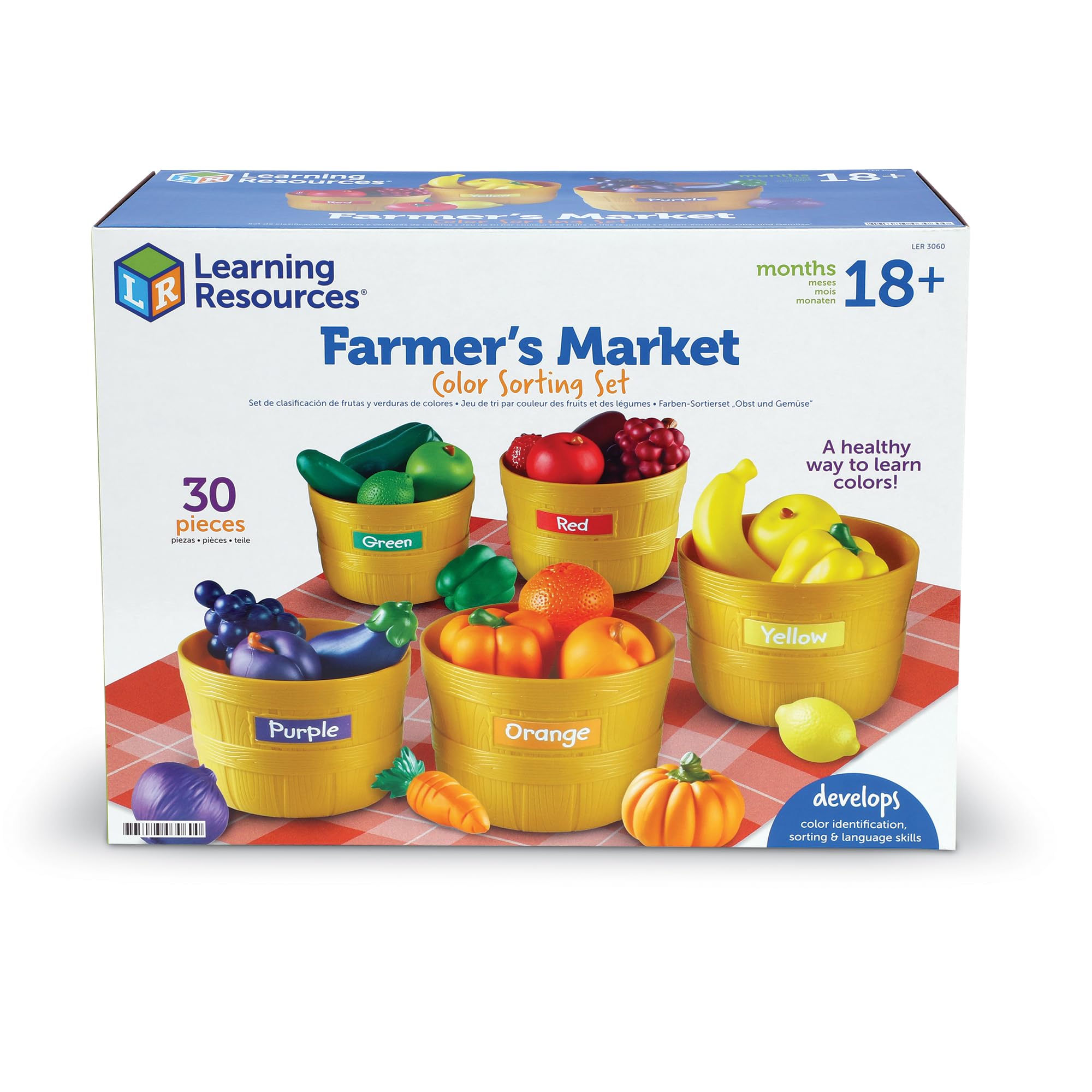
Pretend play starts early, and the Learning Resources Farmer's Market set is built for the stage when a toddler is more interested in grabbing, sorting, and naming food than in plating a balanced meal. The 25 fruits and vegetables are chunky enough for small hands, and the five color-coded baskets give a young child a clear job: put the red pieces together, then the yellow, then dump them out and start again. The soft rubber-like plastic has enough give that a dropped piece does not crack like brittle plastic.

We recommend it as the best overall play food set because it does two jobs at once: it stocks a pretend kitchen with recognizable produce and gives a preschooler something to count, sort, and talk about. The baskets make cleanup part of the game, which is rarer than it should be. It is a midrange set here, but the durable material and open-ended play earn the difference.

The limit is variety. This is a produce market, not a full grocery basket, so there is no bread, cheese, or protein to round out dinner. That matters if your child already has a play kitchen and wants to cook complete meals; this set works best as the fresh-food half of a larger collection. For a first set, the narrower focus is a feature: fewer categories mean a toddler can actually master the sorting game before the pieces migrate under the sofa.

We also appreciate that the pieces are easy to handle and the baskets keep the set together, so cleanup is quick. It is the one we reach for when a child is ready for pretend play but not quite ready for a complicated play set.

Bottom line: We recommend this as the best first play-food set: it is durable, easy for small hands, and turns color sorting into pretend cooking.

#2

Melissa & Doug Ice Cream Counter

Melissa & Doug Ice Cream Counter

Themed store play

Doodle Score 9.8/10
Check Price

Worth Noting

  • Ice-cream-only theme limits meal play
Pieces
28-piece set
Material
Wood
Counter Size
13.4 x 8.7 x 7.7 inches
Recommended Age
3 to 6 years
Read the full review

The wooden counter is the reason this set works. It gives the ice cream pieces a home, turns scooping into a behind-the-counter routine, and keeps the small toppings from disappearing into the toy bin. We think it is the best themed play set here for a simple reason: it gives a child a sequence to follow — take the order, scoop, add toppings, hand over the cone, take the play money — and that sequence is what keeps pretend play going after the novelty wears off.

The pieces are sturdy and sized for preschool hands. Eight wooden scoops, six toppings, two cones, a cup, scooper, tongs, spoon, menu, and six bills add up to plenty of combinations, and the reusable menu gives a pre-reader a way to point and order. We appreciate that the counter doubles as storage; cleanup is part of the play rather than a separate chore.

The set is bulky, though. At 13.4 inches wide it needs a shelf or a floor spot, and it is not the toy you tuck into a drawer. That is the trade-off for a counter that keeps the pieces together, and for a child who plays store every day it is an easy one to make.

Nothing about the construction feels fussy. The wood is solid, the scooper works with the scoops, and the play money and menu add a layer of store play without turning the set into a lesson. It is a premium pick here, and it earns that through the completeness of the ritual.

Bottom line: We think this is the best themed play set here: the wooden counter turns scooping, topping, and paying into a complete routine worth the shelf space.

#3

Battat Farmers Market Basket

Battat Farmers Market Basket

Cutting practice

Doodle Score 9.6/10
Check Price

Worth Noting

  • Many loose halves to corral
Tools
2 knives and 2 cutting boards
Pieces
37-piece set
Cut-apart Food
16 fruits and vegetables
Recommended Age
2 years and up
Read the full review

The first thing a toddler does with the Battat basket is pick up the knife. That is the point. The 16 fruits and vegetables come apart at hook-and-loop seams, so a two-year-old can saw through a carrot or pull a strawberry in half without needing much hand strength. The two cutting boards and two knives let a sibling or a friend join in, and the basket carries the whole set to the table.

The pieces are chunky and bright, with enough detail to name the produce but not so much that they look like collectibles. We like the way the cutting action turns snack prep into a game; it is the kind of toy that gets played with on the floor, then moved to the play kitchen, then ignored for a week, then pulled out again. The plastic wipes clean easily, which matters for a set that will see a lot of hands and the occasional mouth.

For the money, this is the best chopping-focused set here. It gives you more pieces than the wooden picks here and enough cutting tools for two children, and the learning is built into the action rather than bolted on. The hook-and-loop pads can peel away with heavy play, so check them and press them back down; if a pad is fully detached, remove that piece from play rather than leaving a small part loose. That is maintenance, not a reason to skip the set.

We keep coming back to it for the age when a child wants to do what you are doing in the kitchen. It is not the set for a full meal, but it is the one we hand over when the request is 'let me cut.'

Bottom line: For a toddler who wants to chop, this is the set we reach for: it is easy to cut, bright, and sturdy, with plenty of pieces for shared play.

#4

Melissa & Doug Food Groups

Melissa & Doug Food Groups

Balanced meal play

Doodle Score 9.6/10
Check Price

Worth Noting

  • Paint can chip at the edges
Pieces
21-piece set
Storage
4 wooden crates
Material
Wood
Food Groups
Five food groups
Read the full review

Four wooden crates do more for this set than the label suggests. They turn a pile of play food into a sorting game — dairy here, produce there, grains and proteins in their own boxes — and they give a child a reason to put the pieces back when the meal is over. The 21 pieces cover the five food groups, which makes this the most complete wooden food set here for balanced-meal pretend play.

We recommend it for the family that wants a classic wooden set and a broad meal. The pieces feel solid in the hand, the printing is bright, and the crates make it easy to explain a balanced plate without turning snack time into a lecture. It is also one of the better values here, especially if you are building a play kitchen from scratch.

The crates are the part to treat gently. They are storage first, not building blocks, and a stepped-on crate can split. The food itself is the more durable half of the set, and the wood gives it a satisfying weight that plastic pieces do not match. If your child is still in the throwing stage, that weight is worth considering before you hand over the whole box.

Compared with the Learning Resources set, this one gives you a wider meal and a more traditional wooden feel. The trade-off is that it is less forgiving of rough handling. For a preschooler who is ready to talk about food groups, that is a worthwhile swap.

Bottom line: We recommend this for the family that wants a broad wooden meal set: the crates make sorting and storage easy, and the five food groups invite real conversation.

Six Months of Play Kitchen Duty: How We Tested

We started with the sets that keep surfacing on baby registries, in parent group chats, and on classroom wish lists, then narrowed by materials, piece count, listed age range, price per usable piece, and whether the maker sells replacements. Twelve sets made the final cut.

Paint and finish came first, because it's the thing a product photo can't tell you. We wiped every piece with a damp cloth 50 times, scratched the painted edges with a fingernail, and noted whether the color sat under a clear seal or straight on bare wood. Sets that went home with families of kids still in the mouthing stage came back for a second look at the rims and corners.

Then we turned them loose. Each set lived in a play kitchen, got served at weeknight restaurants, hauled around in grocery baskets, and dumped out during playdates with four kids between 2 and 6. We dropped pieces from table height onto hardwood, stepped on them in socks, and pulled the velcro apart a hundred times to see when it stopped gripping. Notes went on which sets kids reached for unprompted in week four and which ones sat untouched unless an adult set up the game.

Value was the last pass and the least about sticker price: we counted the pieces kids actually played with and set aside the filler. We also kept a thoroughly unscientific cuteness tally of which pieces adults picked up first and which ones kids fought over. The sets that scored highest are the ones we'd buy again with our own money, and a few are still in rotation now.

How to Choose Play Food Sets

Match the set to the play pattern

Watch what your child does with a toy kitchen before you buy. If they like sorting and naming, a produce set with baskets, like the Learning Resources Farmer's Market, gives them a game to repeat. If they want to cut, a hook-and-loop set such as the Battat basket is more satisfying than a pile of whole pieces. If they want to run a store, a counter set with a menu and play money earns its space. Buying against the play pattern usually means a set that gets sorted once and then ignored.

Choose a material you can live with

Wood feels substantial and usually survives drops, but it is heavier, and painted edges can chip. Soft plastic is easier to wipe and gentler when a toddler tests a piece with their teeth. Cardboard is light and inexpensive, but it wears at the corners and does not like water. For a first set, we lean toward soft plastic or finished wood; for a child past the mouthing stage, wood is a satisfying upgrade. Whichever you choose, check the edges and fasteners after heavy play.

Check the age grade and the small parts

Age labels are not arbitrary. A set rated for 18 months is built around larger, softer pieces; a set rated for three and up can include smaller toppings, coins, or fasteners. If you have a mixed-age household, buy for the youngest child who will play with the set, then put the smallest pieces away until the older child can use them. Check hook-and-loop pads, lids, and painted edges regularly, and remove any piece that is cracking or shedding.

Plan for storage before you buy

Play food multiplies. A basket, crate, or counter is not just packaging; it is the difference between a set that gets used and a set that lives in a drawer as loose parts. The Learning Resources set uses five baskets, the Food Groups set uses four crates, and the ice cream counter stores its own pieces. If you do not want another container in the playroom, choose a set whose storage is part of the toy rather than a bag you have to hide.

Frequently Asked Questions

Final Verdict

Start with the Learning Resources Farmer's Market set. It is the best default here because it is durable enough for toddlers, broad enough for sorting and pretend cooking, and simple enough to clean up without a fight. If your child is past sorting and wants to chop, the Battat basket is the better fit. Match the set to the play your child already repeats, and you will get more use from fewer pieces.