Pretend Play

Best Doctor Kits for Kids of 2026

The week my niece came home from a checkup, every stuffed animal in the house got a diagnosis and a bandage made from a coffee filter. What she wanted was a kit of her own, and shopping for one turned up mostly disappointment: thin plastic, a stethoscope that's just a decorated tube, and a case that dumps its contents the second a kid picks it up. A good doctor kit solves precisely that. It hands a child the real tools of the game, things that click and beep and fit in a small hand, so the pretending survives past Tuesday.

I've now watched my way through a dozen of these. My team and I spent three months with 12 kits, from five-piece starter sets to full cases with working stethoscopes, and the gap between a kit that gets played with for a year and one that's abandoned by dinner comes down to unglamorous stuff: whether the pieces survive a drop, whether the sounds are bearable from the next room, and whether a 4-year-old can open the case without help. The one thing I'd tell a first-time buyer is that piece count lies, a working stethoscope is the piece kids check first, and a kit without molded slots for everything becomes a floor full of junk. The picks below are the ones the kids asked for again the next morning.

#1

Melissa & Doug Get Well Doctor Kit

Melissa & Doug Get Well Doctor Kit

First full kit

Doodle Score 9.6/10
Check Price

Worth Noting

  • Open-topped fabric tote tips over in the car
  • Stethoscope earpieces separate with rough play
Extras
Activity cards, ID badge, bandages
Storage
Fabric tote
Set Size
25 pieces
Age Range
3-6 years
Read the full review

A doctor kit earns its place by whether it can carry a whole appointment, and this one can. Stethoscope, blood pressure cuff, rolling thermometer, syringe, otoscope, reflex hammer, bandages and a tray to lay everything out on — the pieces map onto the checkup a four-year-old is imitating, step by step. That is why it's our top pick. Not the piece count on the box, but the fact that nothing in the sequence is missing.

The extras are what kept catching our attention. There's an ID badge to clip on, activity cards that hand an older sibling a script to read from, and little bottles with lids so the medicine part of the visit gets its own moment. None of those are the reason a child asks to play doctor. They're the reason the game runs for half an hour instead of five minutes.

Melissa & Doug rates it for 3 to 6 years, and that tracks. The pieces are chunky enough for a three-year-old to grip and light enough that a five-year-old can run the whole exam solo. Past six, most kids start wanting something that looks less like a preschool toy, which is where the wooden sets and the dental hybrids come in.

It's the priciest pick here, and it's still where we start for a first or only kit. What the money buys is a set a child grows into across three years rather than out of in three weeks — a different calculation from the one you make on a toy that gets played with twice.

Bottom line: Our top pick for most families: 25 pieces cover a full checkup, the tools suit preschool hands, and it's the set we recommend before any other.

#2

EFO SHM 34-Piece Doctor Kit

EFO SHM 34-Piece Doctor Kit

Realistic play

Doodle Score 9.4/10
Check Price

Worth Noting

Storage
Canvas storage bag
Set Size
34 pieces
Age Range
3-10 years
Stethoscope
Working, picks up a heartbeat
Read the full review

The stethoscope in the EFO SHM set works. Fit the earpieces, press the chest piece against a wrist, and you get a heartbeat — muffled, a little faint, unmistakably real. That's the piece most kits fake with a button, and it changes the whole game: a child who can actually hear something has a reason to come back and listen again.

Thirty-four pieces makes this the biggest kit we're recommending, and the mix is unusually sensible for the size. There's a doctor's coat and a nurse's cap for the costume side, a blood pressure cuff that pumps and releases, medicine tubes with magnetic caps that stay together, a thermometer that lights red, plus scissors, a tray and a syringe. We expected filler. Most of it earns its place in the bag.

One thing to check before you hand it over: the soft covers on the stethoscope's earpieces can work loose, so press them firmly onto their posts and keep an eye on a toddler who still mouths things. Otherwise the set behaves, and the canvas bag swallows all 34 pieces without a fight.

Bottom line: Buy this one if realism is the point: a stethoscope that picks up a real heartbeat, the widest accessory spread here, and a costume to go with it.

#3

Fisher-Price Doctor Playset

Fisher-Price Doctor Playset

Small spaces

Doodle Score 9.4/10
Check Price

Worth Noting

  • Stethoscope comes apart at the earpieces
  • Thermometer can stop working
Storage
Fabric doctor bag
Set Size
7 pieces
Age Range
3-6 years
Interactive
Sick-to-well thermometer, spinning gauge
Read the full review

Seven pieces and a fabric doctor bag: the Fisher-Price kit is the smallest, least expensive way into this category, and it doesn't pretend otherwise. Stethoscope, blood pressure cuff, thermometer, otoscope, syringe, bandage cuff — the spine of a checkup and nothing hanging off it.

The two interactive pieces are worth the money on their own. Press the thermometer button and the reading flips from sick to well; squeeze the blood pressure bulb and the gauge spins. That's most of the appeal for a three-year-old, who cares about cause and effect far more than about having eight tools to choose between.

Longevity is where it loses ground. Seven pieces mean a five-year-old runs out of things to do sooner than with a 25- or 34-piece set, and there's no costume to stretch the game. As a first kit, a car kit or a spare at a grandparent's house, that's a fair trade — this is the one we hand a three-year-old before anything bigger.

Bottom line: The best small kit here: seven pieces, a spinning gauge and a sick-to-well thermometer, for the family who wants a first doctor set without the sprawl.

#4

Lehoo Castle Wooden Doctor Kit

Lehoo Castle Wooden Doctor Kit

Wooden toys

Doodle Score 9.4/10
Check Price

Worth Noting

  • Some parts come apart with rough play
Storage
Medical bag
Includes
Coat, hat, stethoscope, organ cards, eye chart
Material
Wood
Age Range
3-8 years
Read the full review

Most of this kit is wood. The tools are smooth painted wood rather than molded plastic — the stethoscope, the blood pressure meter, the medicine capsules — and it changes the feel of the thing: cooler in the hand, quieter on a table, and much less like the disposable clutter that fills a playroom.

It's also the most schoolroom of the sets here. Instead of a body puzzle, there are human organ identification cards, an eye chart, a check-up sheet and a blindfold, so an older child can run an actual examination and fill in a form afterward. We liked that the stethoscope is a serious size rather than a stub, and the little headlamp is a nice piece of theatre.

The small organ cards are the part to think about before buying. They're a mouthing size for a child who still puts things in their mouth, and they'd be the first thing lost behind a sofa cushion. Take them out for a three-year-old and bring them back at five, and the set suits the whole stated range. The stethoscope's earpiece is the other piece to check — press it firmly onto its post before play.

That stated range, 3 to 8, is what earns it a place here. It's the one kit in this group a seven-year-old won't feel silly holding, and the wood is the reason it still looks like something worth keeping by then.

Bottom line: The pick for a house that prefers wood: smooth, quiet tools, organ cards and an eye chart, and an age range that stretches to eight.

#5

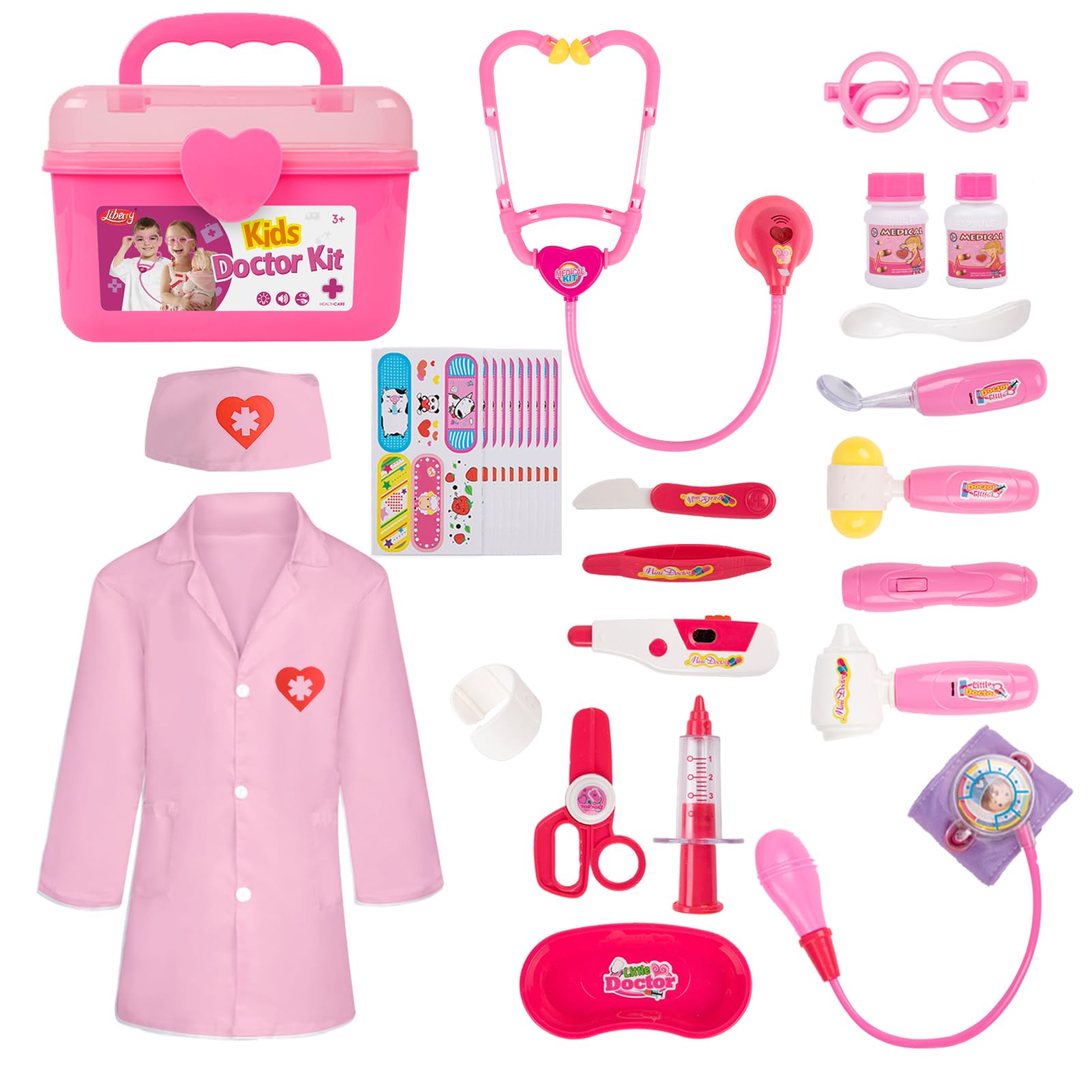
Liberry Doctor Kit (Pink)

Liberry Doctor Kit (Pink)

Dress-up play

Doodle Score 9.2/10
Check Price

Worth Noting

  • Light and sound effects stop working
  • Smaller tools feel thin in the hand
Effects
Light and heartbeat sound
Includes
Coat, cap, glasses, stethoscope
Age Range
3-5 years
Storage Box
8.5 x 6.3 x 6.1 in
Read the full review

A white coat, a matching cap, a pair of glasses and a sticker sheet: the Liberry set leans harder into dress-up than anything else here, and for a certain four-year-old that is the entire point. The exam is the excuse. The costume is the game.

The tools back it up. Press the electronic stethoscope and you get a heartbeat sound, the blood pressure cuff straps onto a small wrist, and the flashlight and several of the instruments light up. On a grey afternoon those lights do real work, because the tools seem to respond to the child rather than just sit there. Everything packs into a storage box about the size of a shoebox.

What makes it worth a place is the combination: a costume, working lights and a heartbeat for less than the biggest kits here cost. It is aimed squarely at 3- to 5-year-olds, and that is the window where dress-up still carries a pretend game. By six the coat is short in the sleeve and the lights have stopped being the interesting part.

Bottom line: Our pick for kids who want to dress the part: coat, cap and glasses plus a heartbeat stethoscope, in the middle of the price range here.

#6

Kidzlane Doctor Kit

Kidzlane Doctor Kit

Tidy storage

Doodle Score 9.2/10
Check Price

Worth Noting

  • Stethoscope volume is faint
  • Cell phone buttons can stick
Sounds
Heartbeat and cough, phone tones
Storage
Snap-latch carrying case
Set Size
12 pieces
Age Range
3 years and up
Read the full review

The Kidzlane kit arrives in a plastic case with snap-lock latches, and after a month of being dragged between rooms, that case is the reason it still gets used. Twelve pieces, one box, no hunting under the sofa for the thermometer. The latches are stiff enough that a younger toddler needs help opening it, which we count as a feature more often than a fault.

The stethoscope is the electronic kind: press it against a chest and it plays a heartbeat, with a cough sound on another press, and there's a toy cell phone with its own tones. The phone is the piece that gets grabbed first, because it turns a checkup into a call to the hospital and gives a shy kid something to do with their hands.

Twelve pieces is modest next to the 34-piece sets here, and the selection is deliberately plain: stethoscope, phone and the basics of a checkup in plastic that wipes clean with a damp cloth. For a three-year-old who mostly wants to press buttons and listen, that's enough. A bigger kit would mean more pieces on the floor and a longer clean-up.

Where this one wins is the routine it makes possible. The case closes, the latches hold, and the kit lives on a shelf instead of spreading across the playroom — the difference between a toy that comes out weekly and one that comes out once.

Bottom line: The one we recommend when you want a kit that stays tidy: a hard case, twelve pieces, and a stethoscope that plays a heartbeat and a cough.

#7

Meland Doctor Kit with Puppy

Meland Doctor Kit with Puppy

Puppy patients

Doodle Score 9.2/10
Check Price

Worth Noting

  • Small moving parts break early
  • Case can be stiff for small hands
Storage
Carry case
Includes
Plush puppy, costume, medical tools
Material
Plastic
Age Range
3-6 years
Read the full review

Most kits give you a patient to imagine. This one gives you a patient: a small plush puppy that comes in the box and gets examined, bandaged and fussed over along with everyone else in the room. For a child who is a bit wary of the real thing, that's a clever piece of design.

It works, too. A four-year-old who won't sit still for a checkup will happily hold a puppy still for one, and the doctor-and-nurse costume gives the game a second gear once plain examining gets boring. The tool spread is broad, the pieces are child-sized, and the whole thing packs into a case with a handle — which matters more than it sounds when the play moves from bedroom to living room.

Build is the weak spot. The small moving parts are the first to give out, and the case can be stiff for a small child to open alone. Neither has stopped the play in any lasting way, because the puppy and the costume carry it, but this is a kit to buy for the idea rather than for the long haul.

Bottom line: Our pick for kids who'd rather doctor a puppy than a sibling: a plush patient, a costume and a broad tool set in a carry case.

#8

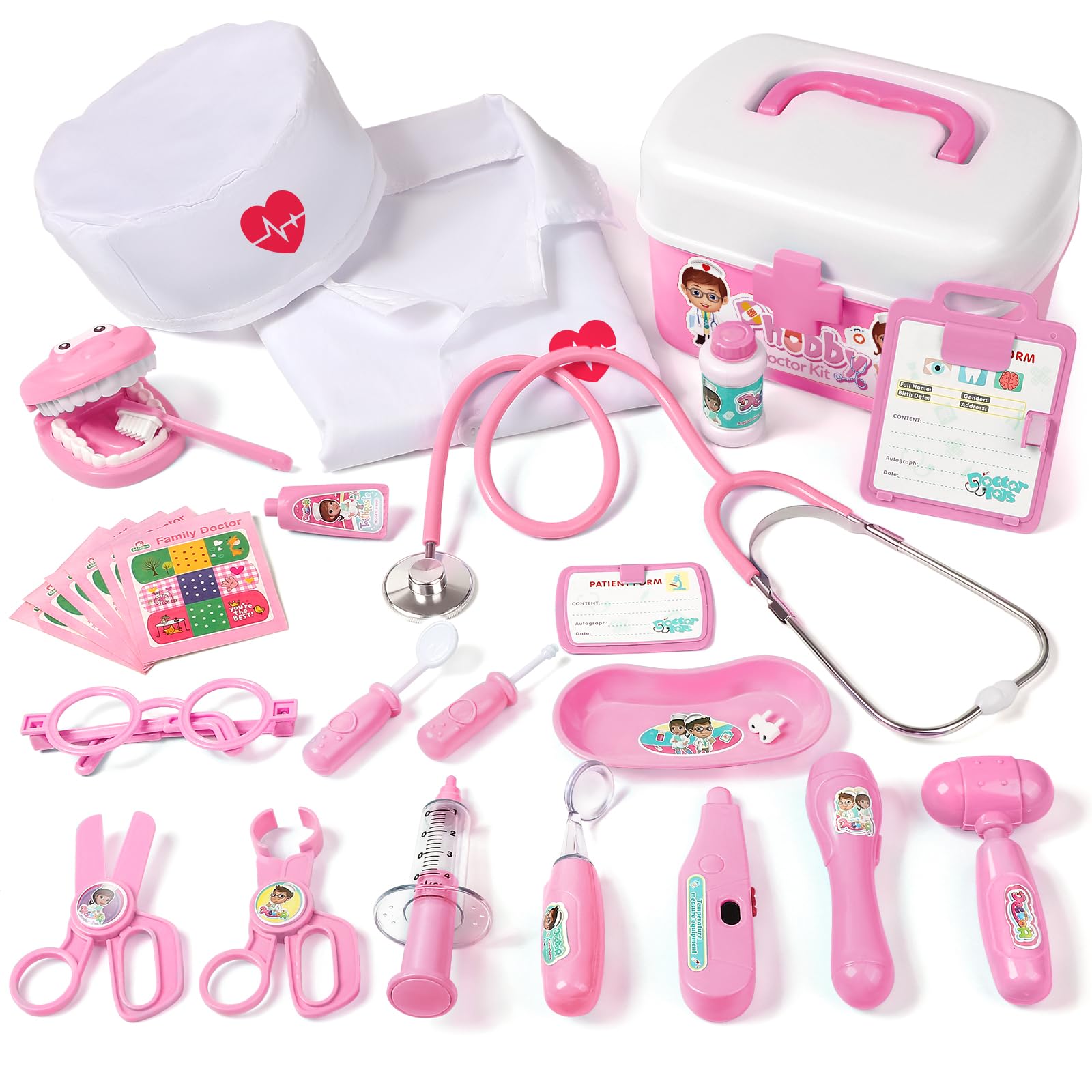
Phobby 27-Piece Doctor Kit

Phobby 27-Piece Doctor Kit

Dental play

Doodle Score 9.2/10
Check Price

Worth Noting

  • Front clip can pop off the case
  • Small tools break after hard drops
Extra
Pretend teeth and dental tools
Set Size
27 pieces
Age Range
3-8 years
Stethoscope
Working, hears a real heartbeat
Read the full review

Pretend teeth and a toothbrush sit next to the stethoscope in this 27-piece kit, which makes it the one to look at if your child's interest runs to both ends of the appointment. The mouth full of teeth is the detail that sells it: it's a piece to borrow, examine, brush and put back, and it invites a kind of play the standard kits ignore.

The other half is a genuinely working stethoscope. You can hear a heartbeat through it, which is the feature we look for first in any kit, and between that and the dental tools the box covers more kinds of checkup than anything else here. Twenty-seven pieces fit into a handled storage box a child can carry.

Two things to know. The front clip on the storage box can pop off, and it's small enough that you'll want to find it straight away. The smaller tools — syringe, dental mirror — are the parts that go first when a kit gets dropped on a hard floor, so this isn't the set to buy if it will live on a tiled kitchen floor.

For the right child, none of that matters much. A kid who has been to the dentist and come home wanting to be one will get more out of this box than out of another 34-piece medical set, and the 3-to-8 range means it stays useful well past the preschool phase.

Bottom line: The pick for a kid who wants both kinds of checkup: 27 pieces, a working stethoscope, and a set of pretend teeth and dental tools.

How We Tested the Best Doctor Kits for Kids

We started by gathering more than 30 kits: the ones that kept surfacing in parent forums and preschool wish lists, plus well-reviewed sets from brands we already trust for play food and dress-up. We cut anything whose piece count was padded with flimsy extras, anything whose age range didn't fit the 3-to-6 crowd, and anything priced so high that losing one thermometer would sting. That left 12, which we tested over three months.

The kits lived where toys actually live: the playroom floor, the back seat, a diaper bag, and the couch during a week of real sniffles. We let a 3-year-old and a 5-year-old play with no instructions and watched which pieces they grabbed first, usually the stethoscope. We checked whether the chest piece carried an actual heartbeat or was a hollow disc, whether the electronic beeps had a volume control or only an off switch, and whether a kid could work the buttons and open the case alone. We also noted whether the pieces read as doctor at a glance, since cuteness is what gets a kit off the shelf in the first place.

Build quality got the ugly test. Kits were dropped down stairs, thrown in a toy bin, and handed to a toddler who bites. We tracked which latches snapped, which hinges loosened, which cardboard bandages turned to mush, and whether everything still fit its molded slot after a month. We weighed that against what you get for the money, because 30 pieces with six usable ones is worse value than an eight-piece set a child plays with daily. The kits below are the ones the kids returned to unprompted, a week later.

How to Choose Doctor Kits for Kids

Does the stethoscope need to work?

It's the first piece a child reaches for and often the first one they abandon, so settle this before anything else. Silent plastic is fine for a three-year-old still learning what the tools are for. Once a child has had a real checkup and started asking questions, a working stethoscope — acoustic or electronic — is what makes the play repeatable, because there's genuinely something to hear at the other end.

The trade-off is upkeep. Working stethoscopes have earpieces and soft covers that work loose, and those are the parts to check before each session. If several children of different ages will use the kit, buy the working version and keep it on a high shelf between appointments.

What's actually in the box

A 34-piece set is not four times the toy a seven-piece set is. Usually six or seven of those pieces are tools and the rest are bandages, stickers, bottles, cards and stickers to apply. Count the things a checkup needs — stethoscope, thermometer, syringe, blood pressure cuff, a bandage and something to write on — and judge the kit on those.

Storage, and the parts that break first

The case is what fails first. Latches, hinges, clips and cart handles go before the tools do, and a kit that won't close stops travelling. A hard case with snap latches survives a backpack; a fabric tote is lighter and easier for a small child to carry but tips over in the car and lets the small pieces mix.

Wood or plastic is a real choice too. Wood is quieter, feels better in the hand and shrugs off drops; plastic wipes clean, costs less and takes toddler punishment. What neither survives is a light-and-sound module that dies, and that is the usual way a feature-rich kit loses its shine.

Age fit, costume fit and small parts

A 3-to-6 label and a 3-to-8 label describe different toys. The narrow range usually means bigger, simpler pieces and a costume cut for a preschooler. The wider range adds charts, cards and small accessories that a six- or seven-year-old will use and a three-year-old will lose or mouth.

Costume sizing is the quiet disappointment — coats run big on small children and short on taller ones, and the glasses rarely fit anyone for long. If the child is between sizes, the kit without a costume is the safer gift; a plain T-shirt does the same job.

Frequently Asked Questions

Final Verdict

The Melissa & Doug Get Well kit is the one we point most families to. Twenty-five pieces cover a whole checkup, the tools are sized for preschool hands, and the tote goes wherever the play goes — it's a set a three-year-old grows into and a six-year-old still uses.

If your child needs the tools to respond, the EFO SHM set's working stethoscope and 34 pieces justify the step up in price. If you want the smallest possible first kit, the Fisher-Price seven-piece set does the job and takes up almost no shelf space.