Outdoor Play

Best Tricycles for Toddlers of 2026

A toddler tricycle has one job that matters more than any spec sheet: it has to feel steady under a kid who steers like a squirrel and brakes by dragging their feet. I’ve watched a wobbly trike turn a proud first ride into a sidewalk meltdown, so I look for a low center of gravity, pedals a short leg can actually reach, and a frame that doesn’t flex when a child climbs on alone. The right one fixes all that: it rolls smoothly, adjusts as your child grows, and doesn’t make you dread the driveway.

Over the past six months, my team and I tested 12 toddler tricycles, from parent-push styles to pedal-only models and grow-with-me frames. We assembled them during nap time, rode them on the driveway and neighborhood sidewalks, and left a few outside long enough to see how the finishes held up. Enjoyment mattered as much as sturdiness: if a kid didn’t ask for another lap, it didn’t matter how good the trike looked. The picks below are the ones that earned repeated requests for “one more time.”

#1

Radio Flyer Red Rider Trike
Radio Flyer Red Rider Trike

Everyday pedal riding

Doodle Score 9.4/10
Check Price

Worth Noting

  • No parent push handle
Frame
Steel
Wheels
Quiet-ride
Rider Age
2.5-5 years
Maximum Weight
49 lb
Read the full review

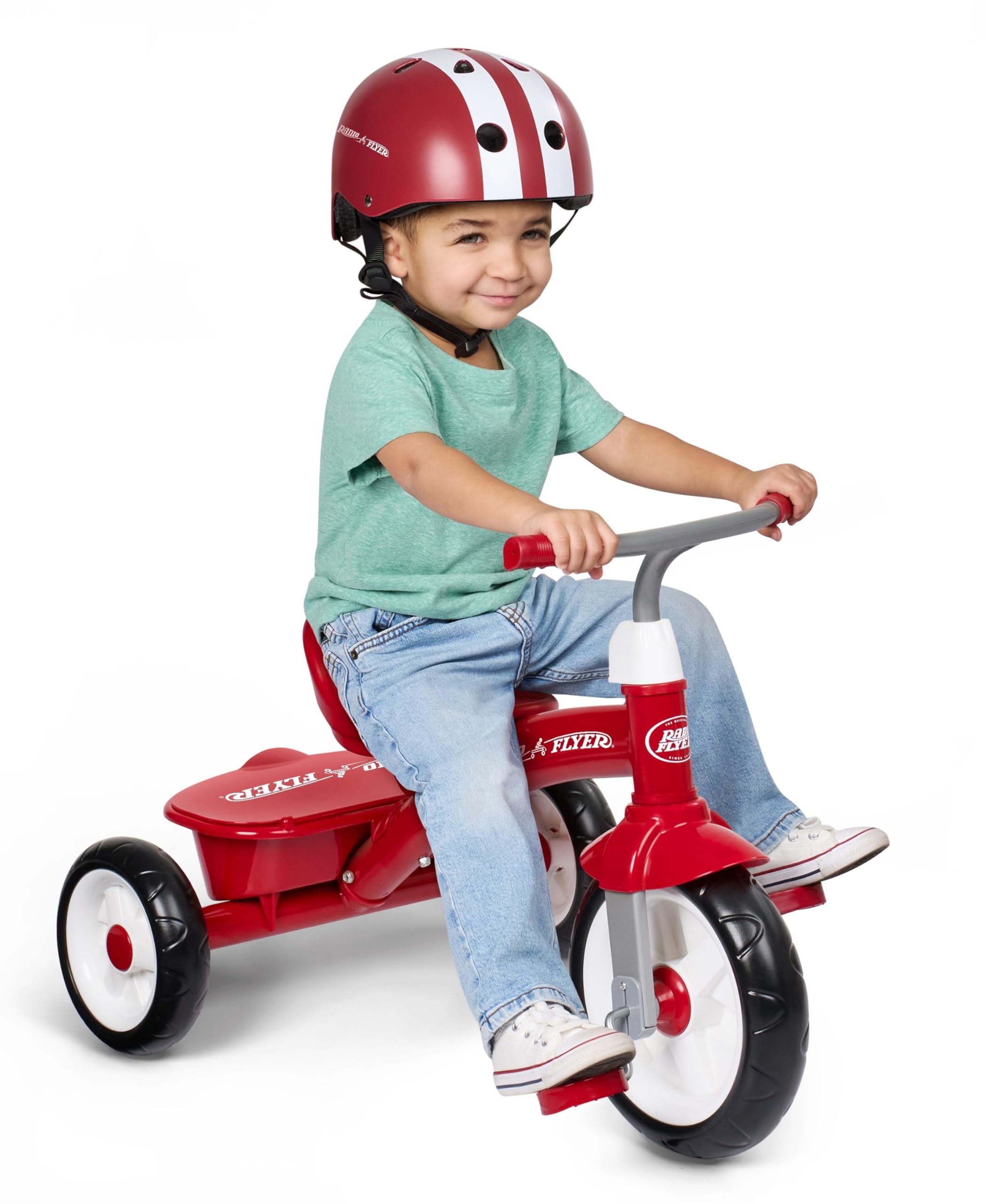
The Radio Flyer Red Rider is the trike we recommend when a toddler is ready to pedal and steer, not just be pushed. The steel frame gives it a planted feel that the plastic trikes here do not match, and the quiet-ride wheels are a welcome relief on a driveway or sidewalk. The seat adjusts across the 2.5-to-5-year range, so it has a better chance of surviving growth spurts than a fixed-seat trike.

We also appreciate the covered rear storage bin, which gives a child a place for a snack or a small toy, and the seat-back carry grip makes it easier to lift into a trunk. At 9.9 pounds it is light enough for an adult to move without fuss, and the 49-pound capacity means it can handle a preschooler for years. The comfort-grip handlebars and steel frame make the whole thing feel more like a real first bike than a toy.

The catch is that the Red Rider puts the child in charge from the start. It suits a child who can reach the pedals and is ready to practice steering. If you need to steer from behind for a 1- or 2-year-old, the newyoo or Stroll 'N Trike is the better fit. For everyone else, this is the classic pedal trike we reach for first.

Bottom line: We recommend the Red Rider as the best first pedal trike for a child ready to steer, with a steel frame and an adjustable seat that lasts from toddler to preschool.

#2

Radio Flyer Stroll 'N Trike

Radio Flyer Stroll 'N Trike

Long parent walks

Doodle Score 9.4/10
Check Price

Worth Noting

  • Large footprint for storage
Modes
4
Canopy
Removable UV canopy
Rider Age
1-5 years
Maximum Weight
49 lb
Read the full review

The Stroll 'N Trike is the closest thing here to a stroller that grows into a trike. The UV canopy, wraparound tray, headrest, and seat belt make it useful for a 1-year-old who is not pedaling, while the height-adjustable push handle lets an adult steer from behind. As the child grows, the accessories come off and it becomes a classic trike.

The removable design means you are not stuck with a canopy and tray forever. The high-density foam tires roll quietly on pavement, and the seat belt and footrest give a small rider a secure place to sit. The trade-off is bulk: at 13.7 pounds and 36 inches long, it takes up more room in a garage or trunk than the Red Rider.

We think it is the best choice here for long parent-led walks, especially if your child is still too small to pedal. The steering can feel less planted in a fast turn, so take corners slowly and keep a hand on the handle. If you mainly need a driveway trike, the simpler Red Rider is easier to live with.

Bottom line: For families who want a stroller replacement for the first year or two, the Stroll 'N Trike's canopy, tray, and parent handle make it the most useful push trike here.

#3

Umatoll Tricycle

Umatoll Tricycle

Baskets and lights

Doodle Score 9.4/10
Check Price

Worth Noting

  • Fasteners need periodic tightening
Wheels
Light-up rear wheels
Rider Age
2-5 years
Maximum Weight
50 lb
Seat Positions
2
Read the full review

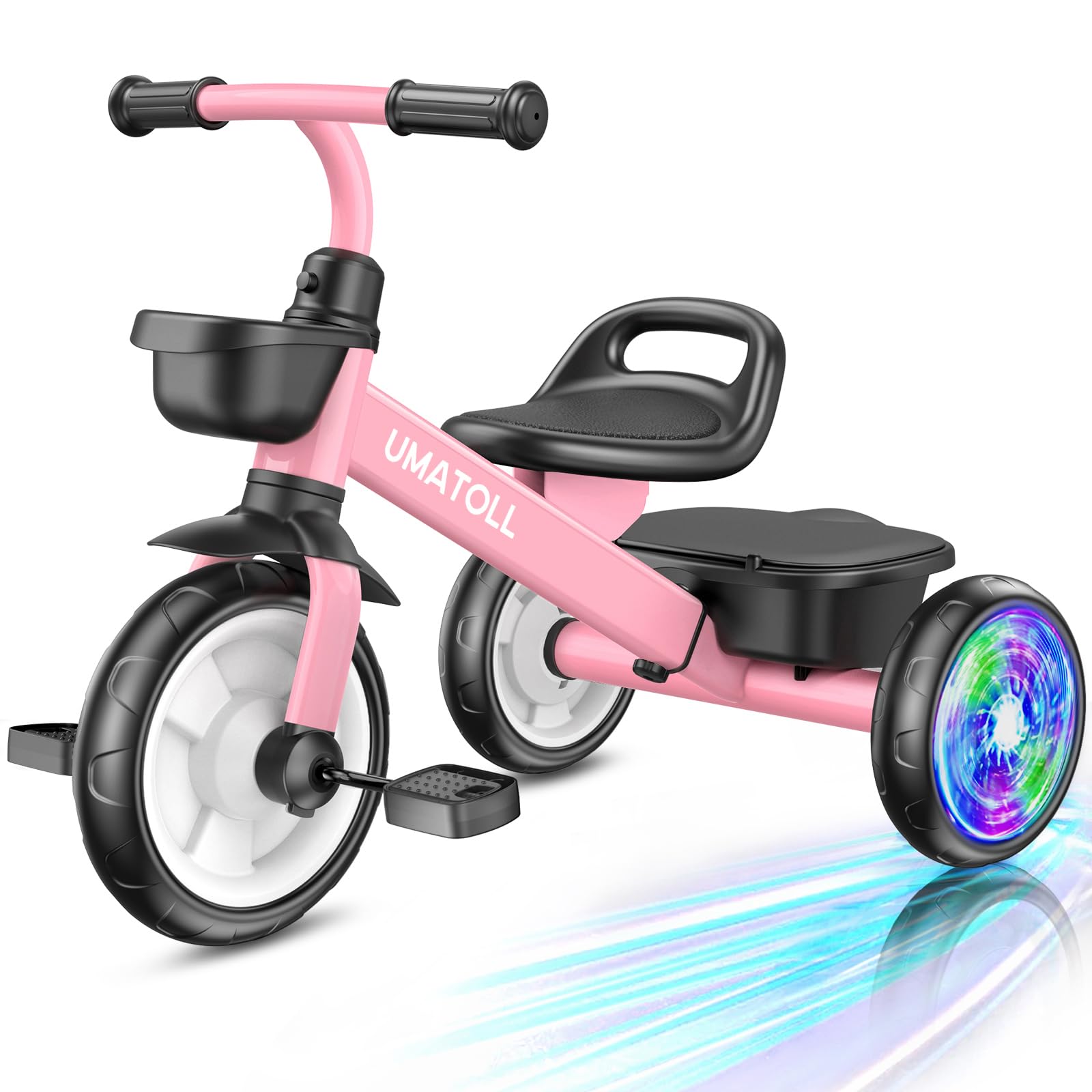
The Umatoll is the trike that turns a ride into a parade. Its rear wheels light up as they turn, with no batteries, and the front and rear baskets give a toddler something to load, unload, and show off. The carbon steel frame and two-position seat make it more than a novelty, but the lights are clearly the hook.

We appreciate the baskets more than we expected: they give a small rider a job and keep small toys from ending up in a parent's pocket. The 50-pound capacity is generous for the price, and the wide rear wheelbase helps it feel steady on pavement. It is not the plushest ride here, but it rolls smoothly enough for sidewalk laps. For a toddler who needs a reason to get on and ride, the lights and baskets are a strong one.

The hardware needs periodic checking, especially the pedals and the handlebar clamp; a loose fastener is the sort of thing that turns a fun ride into a frustrating one. That is the trade-off for a trike this affordable and feature-heavy. Keep a wrench handy and it remains an easy trike to like.

Bottom line: For a toddler who is more excited by lights and cargo than by pedaling, the Umatoll is the most playful budget trike here.

#4

Fisher-Price Harley-Davidson Tough Trike

Fisher-Price Harley-Davidson Tough Trike

Rugged outdoor play

Doodle Score 9.4/10
Check Price

Worth Noting

  • Long pedal reach for short toddlers
  • Plastic wheels are noisy on pavement
Frame
Plastic
Storage
Under-seat compartment
Rider Age
2-5 years
Maximum Weight
55 lb
Read the full review

The Harley-Davidson Tough Trike is the trike for a family that wants a chunky, toy-like ride rather than a scaled-down bicycle. The plastic body, treaded tires, wide stance, and Harley graphics make it look ready for the driveway, and the seat lifts to reveal a storage compartment that is genuinely useful for a toddler's treasures.

At 7.5 pounds it is easy to move around, and the 55-pound capacity is generous. The large pedals and easy-grip handlebars are shaped for small feet and hands. We like that it is simple: there is no parent handle to adjust, no canopy to store, and no modes to switch. It is just a trike.

The fit is the part to watch. The 2-to-5 age range reads broad, but the seat-to-pedal distance is long for shorter toddlers; a 2-year-old may be able to sit on it and still not reach the pedals well enough to ride. If your child is tall for their age or already pedaling, it is less of an issue. If not, a push trike or a smaller convertible is the better first step.

We think it works best as a budget trike for a taller 3- or 4-year-old who will use it on pavement and grass. The plastic wheels are noisy on concrete and less grippy than rubber, so it is not the quietest or smoothest ride here. For the money, though, the capacity and storage are hard to argue with.

Bottom line: The Harley-Davidson Tough Trike is a sturdy, storage-friendly budget pick for a taller toddler who can already reach the pedals.

#5

newyoo TR007 5-in-1 Tricycle

newyoo TR007 5-in-1 Tricycle

Younger toddlers

Doodle Score 9.2/10
Check Price

Worth Noting

  • 35-pound weight limit
Modes
5
Rider Age
1-3 years
Push Handle
135-degree steering
Maximum Weight
35 lb
Read the full review

The newyoo TR007 earns its place with the thing a 1-year-old actually needs: a parent at the controls. Its rear handle rotates 135 degrees to steer and slow the trike, while the child sits in the padded seat and harness. That alone makes it more useful for early walks than a classic pedal trike.

The five-mode design is the other draw. It moves from push trike to balance bike to pedal trike and bike-ish configurations, so it can follow a child from about 1 to 3. We like the adjustable seat and handlebar, and at 9.7 pounds it is easy to lift in and out of a car. The solid EVA wheels also roll quietly on pavement, which matters when you are pushing a toddler through the neighborhood.

The weak point is the parent-steering linkage, which can feel loose when a child leans or the trike is pushed hard. Keep a hand on the handle and make sure the connection is tight before each walk. Tall parents may also find the handle short at full extension. For a first trike and short neighborhood walks, though, it is a smart, compact choice.

Bottom line: For a 1- to 3-year-old who needs a parent at the handle, the newyoo's five modes and rear steering make it our first choice.

#6

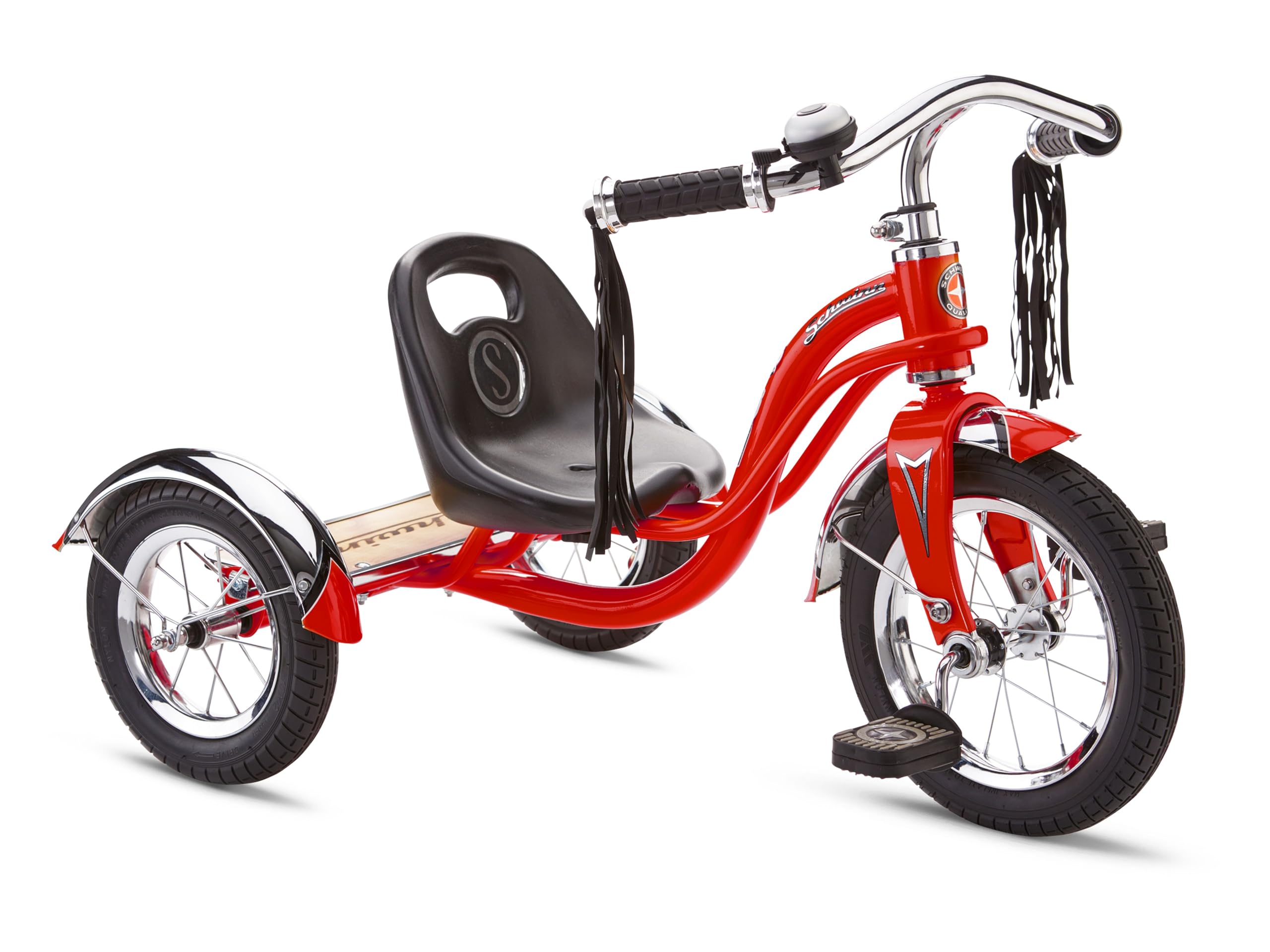
Schwinn Roadster Tricycle

Schwinn Roadster Tricycle

Retro style

Doodle Score 9.2/10
Check Price

Worth Noting

  • Rider height limited to 29-37 inches
  • Hardware can loosen with use
Frame
Steel with wood deck
Front Wheel
12 inches
Rider Height
29-37 inches
Seat Positions
5
Read the full review

The Roadster is the trike that makes adults stop and look. Chrome fenders, a wood deck, mustache handlebars, a bell, and streamers give it a vintage feel that none of the plastic trikes here can match. Before you fall for the look, check the height range: Schwinn puts it at 29 to 37 inches tall, so a child at the lower end may need to grow into it.

We were struck by the low center of gravity and the 12-inch front wheel, which give it a smoother, more bike-like feel on pavement than the small-wheel trikes. The five-position seat is genuinely useful for growth. But this is not the set-and-forget pick: pedal and steering hardware can loosen, and a few hard rides can leave it feeling wobbly. Check the pedals and handlebar clamp regularly.

The air tires and steel frame make it a premium choice for a style-conscious family, but they also make it more precious than a plastic trike. We see it as a neighborhood and park trike, not the one you toss in the back of a truck. If your child is within the height range and you want the best-looking ride here, it earns the splurge.

Bottom line: The Schwinn Roadster is the style pick, with a smooth-riding steel-and-wood build for a child who fits its 29- to 37-inch height range and will ride on pavement.

#7

KRIDDO Toddler Tricycle

KRIDDO Toddler Tricycle

Quick assembly

Doodle Score 9.2/10
Check Price

Worth Noting

  • Hardware can loosen with use
Assembly
Tool-free
Rider Age
2-5 years
Item Weight
9 lb
Rear Wheelbase
Extended rear wheels
Read the full review

The KRIDDO is the trike we hand to the family that wants it assembled before the birthday cake is cut. It goes together without tools, and the 9-pound body is light enough for one adult to carry by the seat. We think that matters more than it sounds: a trike that is easy to move is a trike that gets used in the driveway, the park, and grandma's house.

The extended rear wheels and wider wheelbase give it a more stable stance than its simple frame suggests, and the silent wheels are a plus indoors. It is a basic pedal trike, not a convertible, so it suits a child who is ready to pedal rather than one who still needs a parent push handle. It has a clean, simple look that does not pretend to be a balance bike or a stroller.

The hardware is the part to watch: screws can loosen and pedals can work free, so check them after the first few rides. For a first pedal trike at the lower end of the price range, it is an easy recommendation. It will not feel as substantial as the steel classics, and it is not the one for rough daily use by multiple kids. But for a single toddler on pavement, it does the job with less fuss.

Bottom line: The KRIDDO is our pick for quick setup and easy carrying, with a light, stable ride that suits a first pedal trike on pavement.

#8

besrey 5-in-1 Toddler Bike

besrey 5-in-1 Toddler Bike

Compact conversion

Doodle Score 9.0/10
Check Price

Worth Noting

  • Fits petite toddlers best
  • Balance mode feels compromised
Modes
5
Rider Age
1-4 years
Item Weight
7.3 lb
Maximum Weight
55.1 lb
Read the full review

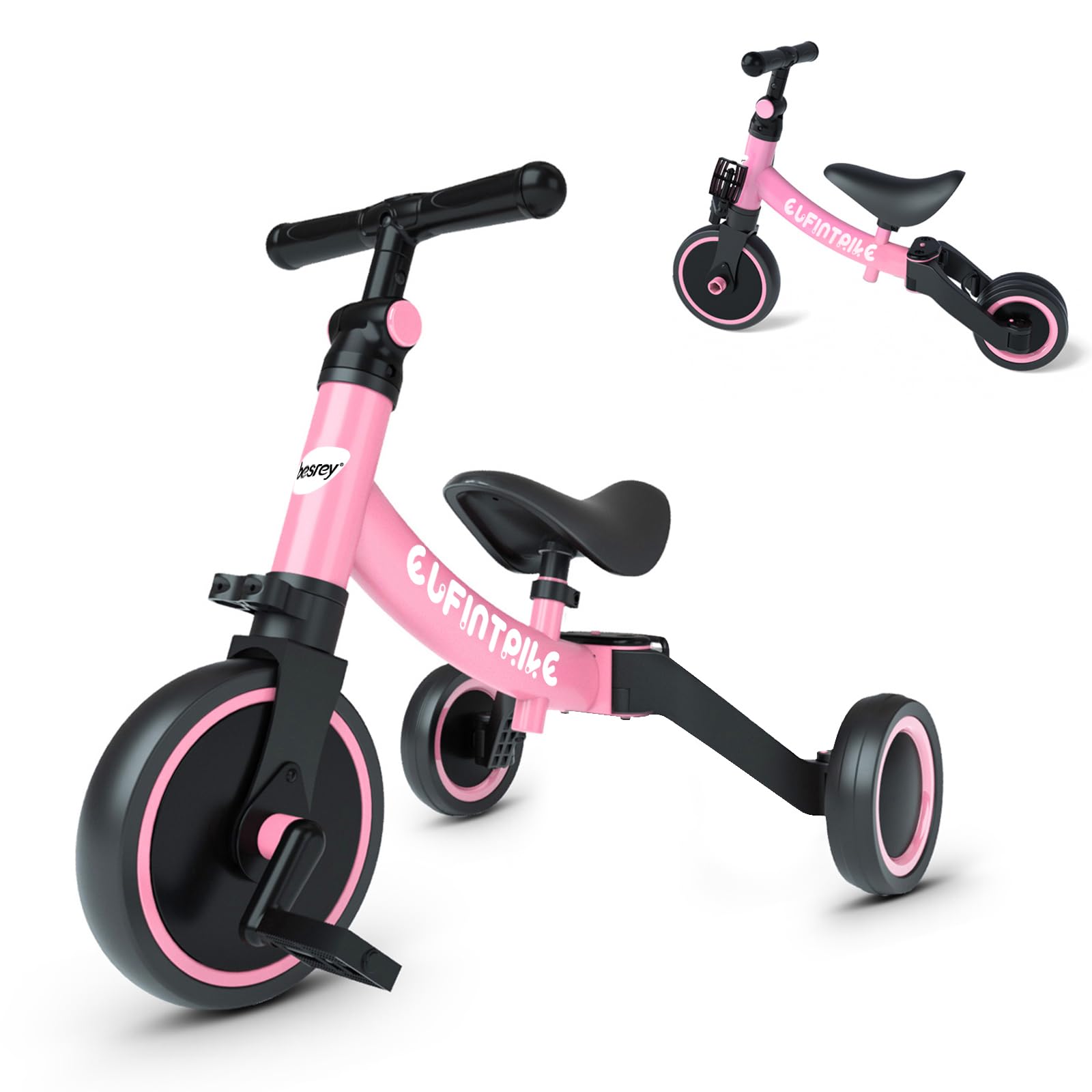
The besrey 5-in-1 is the trike for a small apartment, a crowded garage, or a car trunk that has to swallow a ride-on. It packs five configurations into a 7.3-pound package, and its 24-inch length makes it one of the easier trikes here to store. The compact size is the point, not a side effect.

The 70-degree steering limit is designed to reduce rollover risk, and the curved, edge-softened frame is a thoughtful detail for a toddler. The seat and handlebar adjust, and the pedals come off for balance-bike mode. The 55.1-pound capacity is generous for a trike this small, though the actual fit is another matter.

Small is also the limitation. The besrey suits a petite 1- to 3-year-old better than a tall 3- or 4-year-old, who may look folded up on it. The balance-bike and bike modes are clever, but they do not feel as natural as a dedicated balance bike, and the rear axle can need attention when you switch configurations. This is a space-saver, not the most polished ride here.

We recommend it for a family that needs one compact item to cover push-along play, early pedaling, and a bit of balance practice, especially if storage is tight. If you have the room and want the most durable, straightforward pedal trike, the Red Rider is the better long-term buy. The besrey earns its place by doing more in less space.

Bottom line: The besrey 5-in-1 is the space-saving convertible to choose when a small rider needs multiple modes and your storage is tight.

How We Tested Toddler Tricycles

We started by pulling together models across the main styles—parent-push, pedal-only, and grow-with-me—then filtered by age range, seat height, wheel type, replacement-part availability, and price. We cut anything with vague assembly instructions or a seat that couldn’t be adjusted.

That left 12 tricycles, which we tested for six months with toddlers of different heights and confidence levels. Assembly happened in our living rooms during nap time: one adult, the included tools, and a stopwatch. We noted how many steps required a second set of hands, whether the instructions matched the hardware, and if any bolts needed re-tightening after the first week.

On the driveway and sidewalk, we watched how each trike handled tight turns, uneven pavement, and a child shifting their weight to one side. We checked whether the seat height let short legs reach the pedals without sliding off, how much effort steering took, and whether the trike tipped when a rider leaned out of a turn. We also noted how easily kids transitioned from being pushed to pedaling alone, and whether they asked to ride again.

After each ride, we inspected frames for wobble, wheels for wear, and finishes for scuffs and fading. We compared what each trike offered against its price—adjustable seats, replaceable parts, and a frame that stayed tight after months of use counted for more than flashy decals. The best ones felt solid from the first assembly through the hundredth lap.

How to Choose Tricycles for Toddlers

Check Reach Before You Trust the Age Range

A trike's age label is a rough guide, not a fit guarantee. The number that matters is whether your child can sit on the seat and reach the pedal at its farthest point with a slight bend in the knee. A short 2-year-old may fit a push trike long before a classic pedal trike; the Fisher-Price Harley-Davidson is a good example of a trike whose 2-to-5 label runs long in the pedal department. If the child cannot pedal yet, buy for push-and-steer now and plan to graduate.

Decide Whether You Need Parent Steering

A parent push handle is not a luxury for every family, but it is close to essential if your child is 1 or 2 and you plan to walk farther than the driveway. The handle lets you steer and slow the trike while the child rides, and models like the newyoo TR007 and Radio Flyer Stroll 'N Trike turn into pedal trikes as the child grows. Check the handle's height and how firmly it connects; a loose linkage is a weak point. A classic trike is simpler and lighter once the child can steer alone.

Stability Is a Rear-Wheel and Steering Story

A stable trike starts with a wide rear wheelbase and a low seat, not with a heavy frame alone. Look for rear wheels that sit well outside the seat and a steering limit that keeps the front wheel from swinging too far. Trikes can still tip in a fast turn, especially when a child leans to one side, so teach slow corners and keep a hand on the push handle when one is fitted. The Schwinn Roadster's low center and the KRIDDO's extended rear wheels show the idea.

Match Wheels and Frame to the Surface

Plastic wheels are fine on smooth pavement and driveways, but they are noisy and less grippy on grass or gravel. Rubber or air tires smooth out bumps better, which is why the Schwinn Roadster feels more planted on rough pavement; EVA foam wheels are a quiet middle ground for sidewalks. Steel frames tend to feel more substantial, while plastic bodies are lighter and less precious. Match the trike to where it will actually ride, not to the most rugged-looking photo.

Plan for Growth, Storage, and Hand-Me-Downs

Adjustable seats, removable canopies, and convertible modes can stretch a trike across several years, but more modes do not always mean a better ride. A simple adjustable trike like the Red Rider may suit a child from 2.5 to 5 with fewer parts to break, while a convertible like the besrey earns its keep in a small space. Check the weight limit, the assembled footprint, and whether replacement parts are available. Buy for the next two years, not the next six.

Frequently Asked Questions

Final Verdict

Buy the Radio Flyer Red Rider Trike if your toddler is ready to pedal and you want the most planted, straightforward classic here. It is the one we recommend first for ages 2.5 to 5.

If your child is still 1 or 2 and needs a parent at the handle, choose the newyoo TR007; for long walks with a canopy and tray, the Stroll 'N Trike is the better tool. The right trike is the one that matches your child's reach and your walking routine, not the one with the longest feature list.