Outdoor Play

Best Stunt Scooters for Kids of 2026

A stunt scooter looks simple enough—a deck, two wheels, a handlebar—until your kid asks to drop into the skatepark bowl and the whole thing starts rattling. I’ve watched kids get excited about a new scooter only to have the grips twist or the headset loosen within a week. The right stunt scooter is built to take that abuse: a solid deck, tight tolerances, and wheels that roll smooth without sounding like a shopping cart. Over the past six months, my team and I tested 12 stunt scooters with kids ages 5 to 10, and the differences in build quality showed up fast.

One thing first-time buyers miss is that a stunt scooter isn’t just a smaller version of an adult scooter. Deck length, bar height, and wheel hardness all change how stable and forgiving it feels for a child, and a model that’s too big or too twitchy can turn a fun afternoon into a frustrating one. We paid attention to how each one handled sidewalk cracks, how the grips held up after sweaty afternoons, and whether the handlebars stayed straight after a few falls. The picks below are the ones that survived the testing with their alignment—and our kids’ enthusiasm—intact.

#1

Envy One S3

Envy One S3

Smaller beginners

Doodle Score 9.4/10
Check Price

Worth Noting

  • Durability can be inconsistent under hard tricks
Weight
7.89 lb
Wheel Size
11 centimeters
Weight Capacity
220 lb
Handlebar Height
23 inches
Read the full review

If the rider is still small enough to be intimidated by a full-size deck, this is the scooter we reach for. At 3.58 kg the Envy One S3 is easy to pick up and throw into a trick, and the 220-pound capacity means it is not fragile under a heavier kid who is just learning. The 23-inch handlebar sets the fit.

We like the quality of the parts at this level. The aluminum deck, TPR grips, and 11 cm polyurethane wheels give it a smooth, quiet roll, and the rear brake is predictable rather than grabby. For a rider who is just starting to pump ramps and learn hops, that combination is more useful than a longer deck they cannot control.

The trade-off is fit. The short bar and deck are built for smaller kids; if your rider is already near 5 feet, the Madd Gear or Playshion will fit better. The short bar is what keeps this from being the default for every kid, but it is not a build-quality problem.

Bottom line: Buy the Envy One S3 for a smaller beginner who needs a light, smooth-rolling scooter; its short bar is the reason it is not our default for taller kids.

#2

VOKUL K1

VOKUL K1

Adjustable fit

Doodle Score 9.4/10
Check Price

Worth Noting

  • Heavier than the lightest picks
Weight
9 lb
Handlebar
Adjustable
Weight Capacity
220 lb
Handlebar Height
23.5 inches
Read the full review

The K1's adjustable bar is the reason it stays in the bag for families with more than one rider. The handlebar can move through a useful range for growing kids, and the 220-pound capacity means it can handle a teen or an adult taking a turn without feeling like a toy.

The build feels solid and planted on the ramp. The 110mm wheels and rear brake are predictable, and the TPR grips are comfortable for smaller hands. We also like that the deck has a non-slip surface, which helps when a rider is learning to place a foot for a trick.

The adjustable clamp is the part we watch. On any telescoping bar, the clamp can let the bar shift out of alignment, so check it before each session and tighten it if the bars move. The K1 is still a strong choice for a shared family scooter; it is just not the set-and-forget option that a fixed bar is.

Bottom line: The K1 suits families who need one adjustable scooter for mixed-age riders, as long as they check the clamp and accept the extra weight.

#3

Playshion Probee

Playshion Probee

Growing riders

Doodle Score 9.2/10
Check Price

Worth Noting

  • Heavier than the lightest picks
Weight
9.35 lb
Handlebar
Adjustable
Weight Capacity
220 lb
Handlebar Height
32 inches
Read the full review

Between-sizes is where the Probee earns its keep. Its handlebar is adjustable to a 32-inch height, and the deck is rated for riders 4'3" and taller, so it can start on the low setting and move up as the child grows. That adjustability is the reason it earns a runner-up spot: it covers a wider range than the short Envy without the fixed-bar commitment of the Madd Gear.

The 4.24 kg build feels settled on the ramp. The 100mm aluminum-core wheels roll smoothly, the rear brake is responsive, and the 220-pound capacity gives it room for bigger kids or a parent taking a turn. We also like the reinforced Y-bar and triple-bolt clamp, which give the front end a solid feel for a scooter in this price range.

The adjustable bar adds a clamp to check, and we keep an eye on it as the rider changes height. That is a small maintenance habit rather than a dealbreaker. For a growing rider who wants one scooter to last through a few growth spurts, the Probee is the value pick for families who want a stable park scooter without jumping to the premium end.

Bottom line: The Probee is our value pick for growing riders, with an adjustable bar and a stable deck that cover more sizes than the budget competition.

#4

Madd Gear MG3

Madd Gear MG3

Older kids

Doodle Score 9.0/10
Check Price

Worth Noting

  • Fixed 32-inch bar won't adjust for shorter riders
Weight
10 lb
Warranty
3 years
Weight Capacity
220 lb
Handlebar Height
32 inches
Read the full review

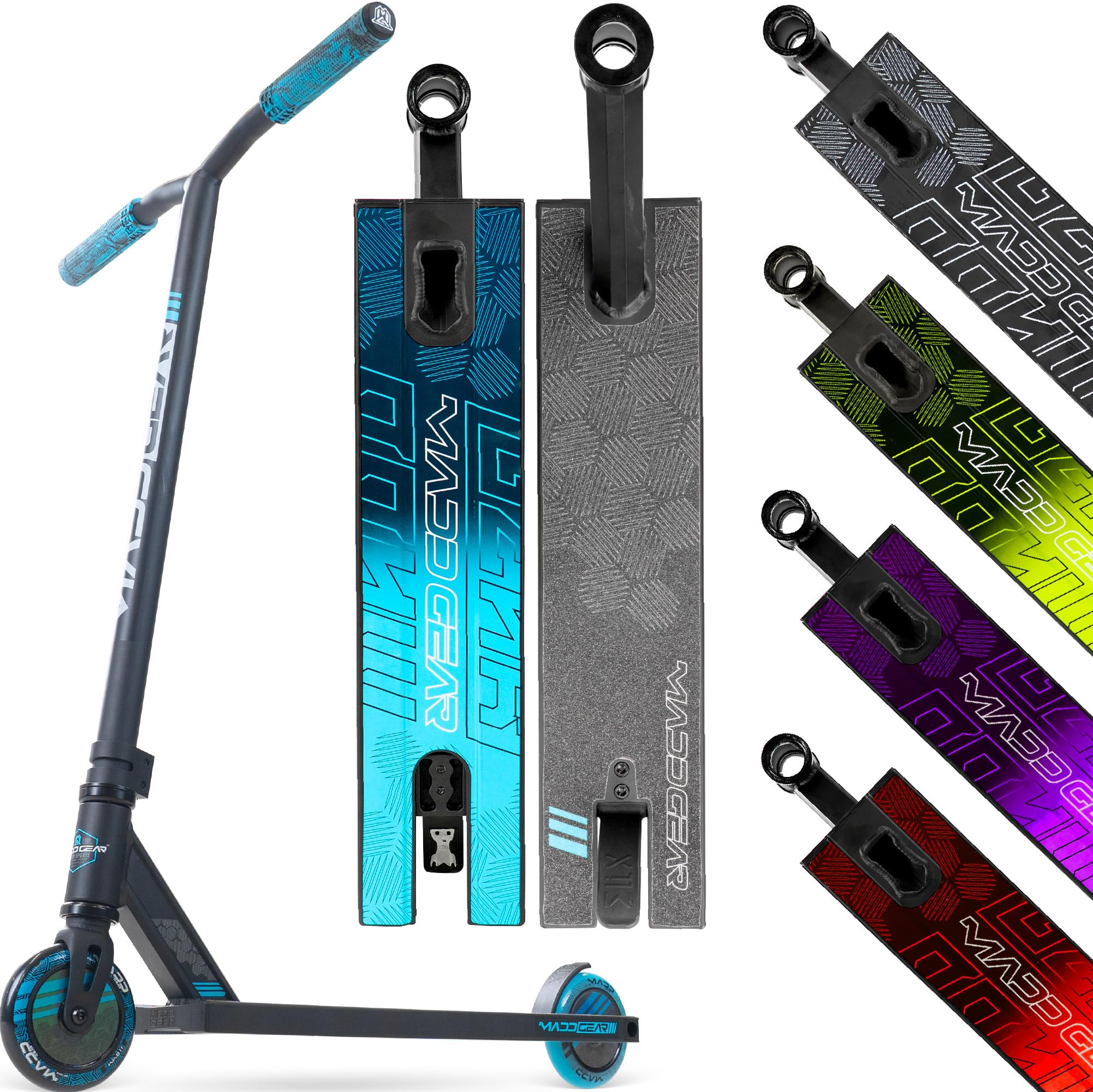
The first thing we noticed about the MG3 is how planted it feels for a kids' scooter. The 32-inch bar and 220-pound rider limit put it in a different class from the short beginner decks, and on ramps the extra mass reads as stability rather than sluggishness. At 10 pounds it is a substantial scooter, but the mass pays back in stability for an 8- to 12-year-old who is already chasing speed.

The build is the reason it earns our top spot. Madd Gear uses an extruded aluminum deck, a double clamp, and 110mm polyurethane wheels on ABEC-7 bearings. We found the roll quiet and quick on smooth concrete, and the textured grip tape gives a sure footing when the deck gets dusty. The 3-year manufacturer warranty is a strong backup for a scooter that will be thrown, dropped, and landed on.

Assembly is a two-bolt job, and the fixed bar keeps the front end simple; there is no adjustable clamp to drift. The 3-year warranty backs up the part that takes the most abuse, and the scooter felt just as solid after a session of repeated drops. For a rider who is ready for a full-size park scooter, that is the right set of priorities.

Bottom line: We recommend the MG3 as our top pick for kids 8 to 12, because its planted 32-inch build and 3-year warranty make park sessions feel secure.

#5

Freedare JB1

Freedare JB1

Budget tricks

Doodle Score 9.0/10
Check Price

Worth Noting

  • Fixed 810 mm bar limits taller riders
Weight
7.05 lb
Wheel Size
100 mm
Weight Capacity
220 lb
Handlebar Height
810 mm
Read the full review

At 3.2 kg, the Freedare is a budget scooter that does not ask a young rider to fight the hardware. It is light enough to throw into a hop, and the 810 mm bar sits at a useful middle height for a child who is ready to move from a recreational scooter to a two-wheel trick deck.

The 220-pound weight limit and 100mm polyurethane wheels give it more headroom than the price suggests. We found the roll smooth on pavement and predictable on smooth park concrete, and the fixed bar keeps the front end simple. The deck is stable underfoot, and the rear brake is easy to find with a heel.

For a young beginner, the Freedare is a sensible first stunt scooter. It does not have the planted heft of the Madd Gear, but it also does not ask a small rider to manage a heavy deck. We were pleasantly surprised by how much scooter it feels like for the money.

Bottom line: For a young rider learning tricks on a tight budget, the Freedare's 3.2 kg build is the easy recommendation, provided the fixed bar fits now.

#6

Joycruise S2

Joycruise S2

Entry-level park

Doodle Score 9.0/10
Check Price

Worth Noting

  • Fixed 30.3-inch bar won't adjust for growth
Weight
7.94 lb
Wheel Size
10 centimeters
Weight Capacity
220.5 lb
Handlebar Height
30.3 inches
Read the full review

A fixed 30.3-inch bar, a light 3.6 kg build, and no folding mechanism: the Joycruise S2 keeps the recipe simple. That simplicity is the appeal for a rider who just wants to learn tricks without a lot of setup.

The 100mm polyurethane wheels and ABEC-7 bearings give it a smooth, quiet roll, and the reinforced chromoly bar and aluminum deck feel more solid than the price suggests. We also like the IHC compression system and sealed bearings, which keep the front end feeling tight and simple to maintain.

The 100 kg weight limit is fine for most kids and many teens, but a heavier adult should look at the 220-pound-capacity picks instead. The simple parts are easy to maintain, and the fixed front end has fewer things to check before a session.

For a first park scooter, the Joycruise keeps the recipe simple and the weight low. It is not the most versatile fit here, but it is a sensible entry point for a rider who is ready to move on from a recreational scooter. The low weight and simple front end are the reasons it stays in the conversation.

Bottom line: We see the Joycruise S2 as a simple first park scooter for a shorter rider, with a light build and a fixed bar that keeps maintenance easy.

#7

Boldcube Stunt

Boldcube Stunt

Young light riders

Doodle Score 8.8/10
Check Price

Worth Noting

  • Less planted at speed than heavier decks
Weight
6.39 lb
Bearings
ABEC 7
Handlebar
Adjustable
Weight Capacity
220.5 lb
Read the full review

The Boldcube made us reconsider how much a kids' stunt scooter needs to weigh. At 2.9 kg it is the lightest complete scooter in this group, and that changes the learning curve: a younger rider can pick it up, throw it into a spin, and carry it home without asking for help.

We think the light build is the point. The adjustable handlebar runs to a 32.28-inch height, the 100 kg capacity covers most kids and many teens, and the quad-bolt collar clamp gives the front end a more solid feel than the weight suggests. The micro-crystallized grip tape is a nice practical touch, too; it stands up to scuffed shoes better than the smooth tape on some beginner decks.

The clamp is the part to watch as the bar height changes; check it after adjustment and again after the first session. If your rider is light and still building confidence, the light build is a feature, not a fault. It is the scooter we reach for when the priority is confidence, not heft.

Bottom line: We point light, cautious young riders to the Boldcube: at 2.9 kg it is the easiest scooter here to throw around, and the adjustable bar gives it room to grow.

#8

Dadywheels Stunt

Dadywheels Stunt

Budget starters

Doodle Score 8.8/10
Check Price

Worth Noting

  • Short 31.5-inch bar limits taller riders
  • Compact deck leaves less room for big feet
Weight
7.3 lb
Warranty
Lifetime
Weight Capacity
220 lb
Handlebar Height
31.5 inches
Read the full review

Budget does not have to mean toy-like on the ramp. The Dadywheels pairs a 31.5-inch bar and a 220-pound capacity with a 7.3-pound build, and the result feels more substantial than the price suggests.

The simple steel T-bar and aluminum deck are built for repeated knocks. The 100mm polyurethane wheels and ABEC-9 bearings roll smoothly on pavement and smooth park concrete, and the rear foot brake is easy to find with a heel. The textured grip tape gives a secure stance, and the soft rubber grips are comfortable for small hands.

The 7.3-pound weight is light enough for a younger rider to manage, and the 220-pound capacity gives it room for a growing kid. The simple steel T-bar and aluminum deck are built for repeated knocks, and the parts are easy to check and tighten between sessions.

For a first stunt scooter, the Dadywheels gets a kid onto a two-wheel deck without the price or the weight of a premium park build, and the simple parts are easy to live with. It is a strong value for a rider who is still growing into park tricks.

Bottom line: The Dadywheels is a smart budget starter for a shorter child, pairing a stable 31.5-inch build with simple parts and a low weight.

How We Tested the Best Stunt Scooters for Kids

We started by gathering more than 40 stunt scooters from brands with a track record for kids’ gear, then narrowed the field to 12 based on deck material, adjustable bar height, wheel size, and replacement-part availability. We filtered out plastic decks, vague weight limits, and models whose bars couldn’t be raised enough to grow with a child.

For six months, those 12 scooters lived in garages, car trunks, and beside front doors. Kids rode them to school, around the neighborhood, and at the local skatepark; we also ran a series of curb drops and tight turns on cracked pavement.

We dropped each scooter from curb height onto concrete to check for dents, loose headsets, and cracked decks. For stability, kids wove through cones and rode one-handed where age-appropriate; we noted whether the front wheel lifted or the deck flexed. Size was measured against kids ages 5 to 10—could they stand with both feet comfortably, and did the bars adjust as they grew? Grip durability got a sweaty-hands test and a close look for slipping or wear. Noise was a quiet-block lap, listening for rattles from the headset or brake. Handle alignment was checked after every fall and after a week of normal use—did the bars stay square to the front wheel?

Smooth ride came down to wheel hardness and bearings: we rolled each scooter on smooth skatepark concrete and rough asphalt, noting vibration through the deck. At the end, we compared what each scooter cost against how it held up—the best values weren’t the cheapest, but the ones that didn’t need replacement parts after a month.

How to Choose Stunt Scooters for Kids

Start With Bar Height and Deck Length

Fit decides more than any spec sheet. A stunt scooter's bar height sets how much leverage a child has over the front end; too tall, and the scooter feels vague, too short, and the rider is hunched. The Envy One S3's 23-inch bar is a good example of a small-rider fit, while the Madd Gear MG3 and Playshion Probee sit around 32 inches and suit taller kids. Adjustable bars, like the ones on the Playshion and Boldcube, cover more growth but add a clamp to check.

Measure the rider before ordering, and match the bar to the child's current height rather than the top of the age range. The Dadywheels lists a rider range of 3'6" to 5'1"; the Playshion lists 4'3" and taller. If the child is between sizes, an adjustable bar is the safer buy.

Weight Buys Either Agility or Stability

At one end, the Boldcube's 2.9 kg build is easy for a young rider to throw into a spin and carry home. At the other, the Madd Gear MG3 weighs 10 pounds and feels planted on ramps. Neither is automatically better: a light scooter helps a small rider learn tricks, while a heavier one can feel calmer at speed and under a bigger kid. We prioritize the lighter build for younger, smaller riders and the more planted build for older kids who are already confident.

Check the weight limit as well as the weight. Most scooters here are rated 220 pounds, while the Joycruise and Boldcube list 100 kg, effectively the same ceiling. A scooter that is too heavy for the rider is harder to control; one that is too light for a hard-charging teen can feel nervous.

Check the Clamp, Bar, and Front Wheel

Stunt scooters take impacts that a recreational scooter never sees, so the connection between bar and deck matters. Fixed bars are simpler, with fewer parts to loosen. Adjustable bars, like the VOKUL K1 and Playshion Probee, are convenient for growing riders but need a proper tighten and a check before each session. A bar that shifts out of alignment changes steering, so treat it as a maintenance item rather than a set-and-forget feature.

Before the first ride, check the clamp bolts and the front wheel fasteners. After a hard session, do it again. This is not a reason to avoid adjustable scooters; it is the habit that makes them work.

Warranty and Replaceable Parts Matter

Stunt scooters live on their decks, wheels, and brakes, so the warranty and parts support tell you how long the scooter can stay in service. The Madd Gear MG3 carries a 3-year manufacturer warranty, a strong backup for a scooter that will take repeated drops. Others use limited warranties, so read what is covered before you buy. A strong deck and a replaceable brake are more useful than a long list of colors.

Look for standard wheel and bar sizes if you plan to replace parts. The Envy One S3 and VOKUL K1 use 11 cm wheels; the others use 10 cm wheels. Check the size before ordering replacements, and keep the clamp hardware together when you adjust the bar.

Frequently Asked Questions

Final Verdict

For most families, we start with the Madd Gear MG3. Its 32-inch bar, planted 10-pound build, and 3-year warranty make it the most reassuring default for kids who are already riding hard. If the rider is small, the Envy One S3's lighter build is the better fit; if the budget is tight, the Freedare JB1 and Playshion Probee are the value picks. The MG3 wins on the combination of stability and warranty support.