Outdoor Play

Best Playhouse for Kids of 2026

The playhouse conversation in our house started with a cardboard box. It lasted three weeks, got taped back together twice, and my kid ate lunch in it every day — which is roughly the whole case for buying a real one, and the whole risk of buying the wrong one. A good playhouse gives kids a corner of the yard that's genuinely theirs, somewhere to disappear to for an hour. What separates a great one from a frustrating one has little to do with how cute it looks in the listing.

We've spent the last eight months with ten playhouses, from plastic pop-ups to full cedar kits, in backyards through a rainy spring and a run of 95-degree days. Assembly was the great divider: a few went up in under an hour with one adult, and one took two of us, a drill, and most of a Saturday. My advice to a first-time buyer is to pick the spot before you order, since almost every playhouse wants level ground and anchoring. The picks below all earned their place in the yard.

#1

Tiny Land Cotton Canvas Teepee
Tiny Land Cotton Canvas Teepee

Indoor everyday play

Doodle Score 9.4/10
Check Price

Worth Noting

  • Indoor only
  • Instructions vague on which pole goes where
Use
Indoor
Material
100% cotton canvas
Peak Height
66"
Play Footprint
48" x 48"
Read the full review

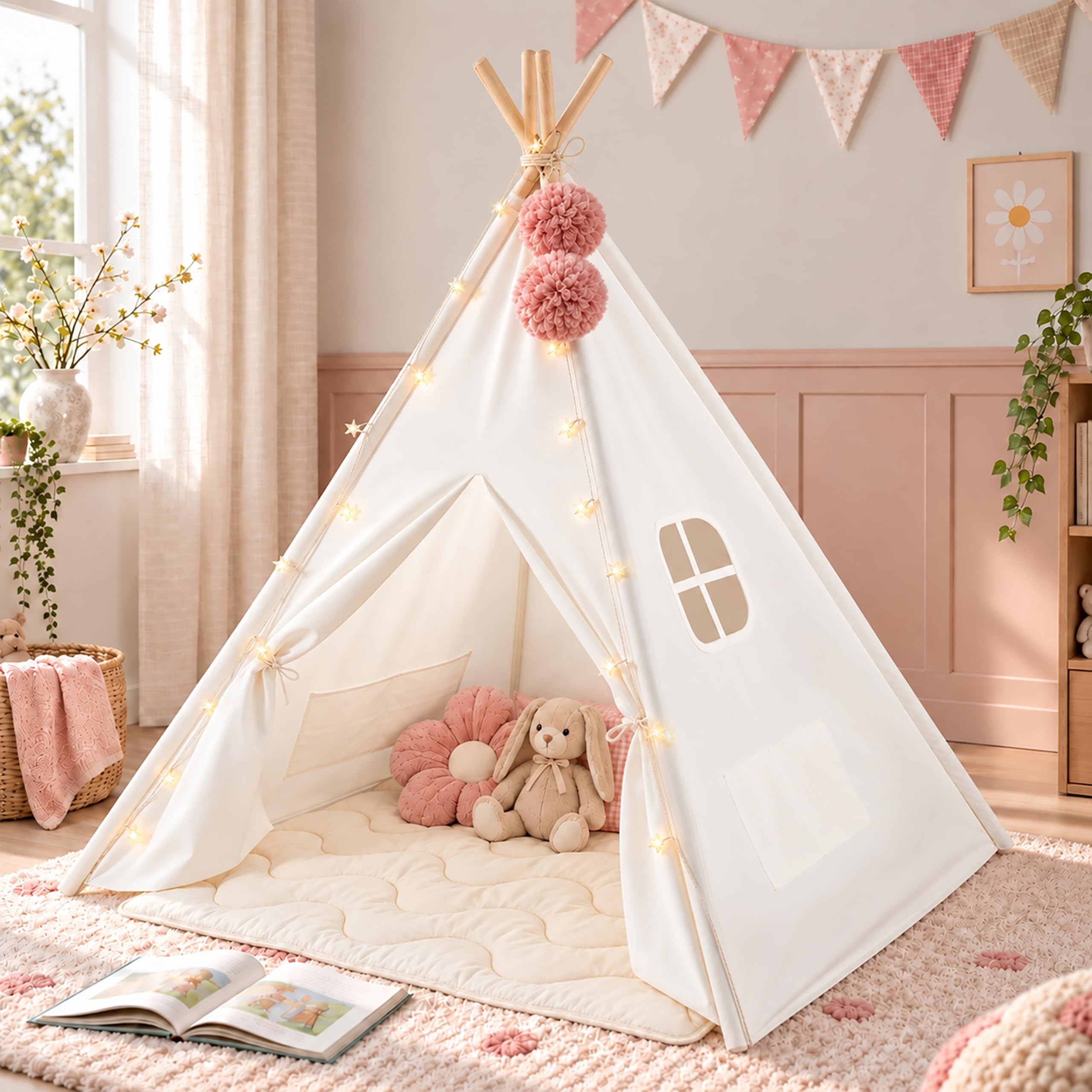
The first thing you notice lifting the Tiny Land out of its bag is the canvas itself. It's 100% cotton, thick enough to fall in soft folds instead of creasing the way the printed polyester tents here do, and the pine poles slide through sewn sleeves rather than being knotted on. Set up, it stands 66 inches at the peak over a 48-inch square base, and the off-white finish with its small window reads as a corner of the room rather than a toy taking the room over.

That combination is why it's our top pick. Plenty of playhouses here are bigger or louder; none is easier to live with. An adult can sit upright inside with a toddler, and that changes how the thing gets used — it becomes the place you read together, not a tent you supervise from the sofa. The cotton mat that comes with it covers the floor, and the sewn-in pockets give the books somewhere to live.

One adult puts it up in a few minutes, though the instructions are hazy about which pole goes where, and the wooden poles are the part to look over when the box arrives. It is an indoor tent: the fabric behaves like one, and a wet lawn isn't where it belongs. Spread the four corners properly on a level floor and it holds its shape; leave them loose and it leans.

Bottom line: Our default pick: the canvas is thick, an adult can sit inside with a child, and it has the most consistent build quality in this group.
#2

Step2 All Around Playtime Patio

Step2 All Around Playtime Patio

Outdoor yards

Doodle Score 9.4/10
Check Price

Worth Noting

  • Some fasteners need a power drill
  • Large footprint for a small yard
Height
60"
Material
Double-walled plastic
Warranty
3-year limited
Play Footprint
47.5" x 47.5"
Read the full review

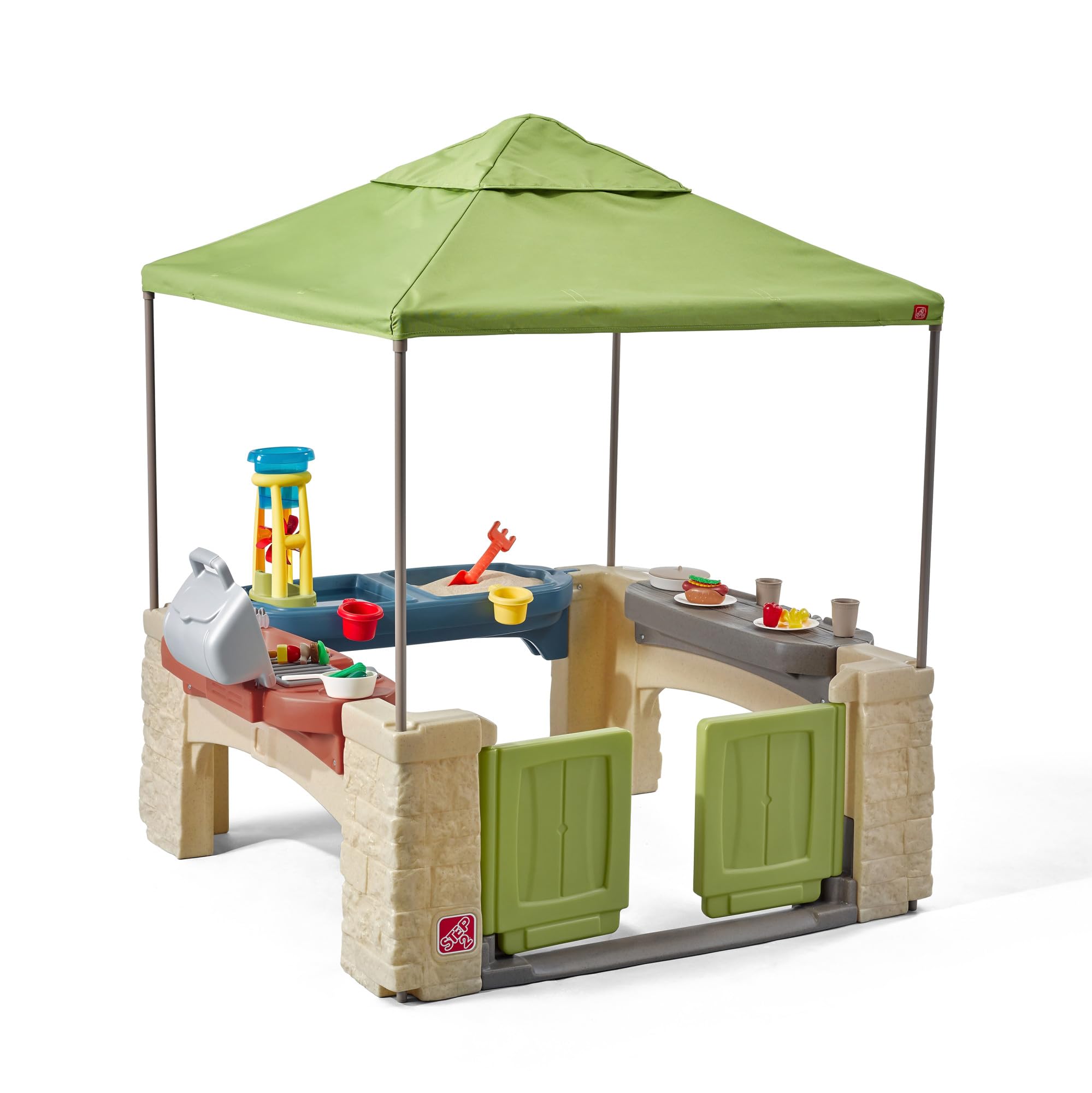
Water, sand and a pretend grill under a canopy: that's a combination nothing else on this list offers, and it's the reason this one earns its price. The All Around Playtime Patio is a 47.5-inch square of double-walled plastic standing 60 inches tall, with a long countertop, two basins for water and sand, a grill, and a 16-piece accessory set of pots, pans, plates, utensils and sand toys.

Assembly is an evening's work the first time and mostly a matter of panels and screws. The hardware is included, but a couple of the fastenings want a power drill, so have one within reach before you start. The canopy lifts off if you want it under cover, though at this footprint it's a yard toy in practice — it needs roughly the space a small patio table needs.

What we like most is how it handles a crowd. The open front and low counter mean two or three toddlers can work side by side without anyone jammed in a doorway, the canopy makes a shaded spot that stays usable in July, and the open design is roomy enough to accommodate a wheelchair. It's the outdoor pick here: double-walled plastic and a three-year limited warranty make it the one plastic house in this group that's built to stay out through a summer rather than come in after every shower.

Bottom line: Buy this one if the playhouse stays outside — it handles weather, water and a crowd of toddlers in a way none of the fabric tents can.

#3

Hamdol Ice Castle Pop-Up Tent

Hamdol Ice Castle Pop-Up Tent

Small spaces

Doodle Score 9.4/10
Check Price

Worth Noting

  • Fixed Frozen-style theme
  • Tight for more than two toddlers
Use
Indoor and outdoor
Frame
Fiberglass
Play Size
40" x 51"
Folded Size
16.9" x 2.3" x 13.3"
Read the full review

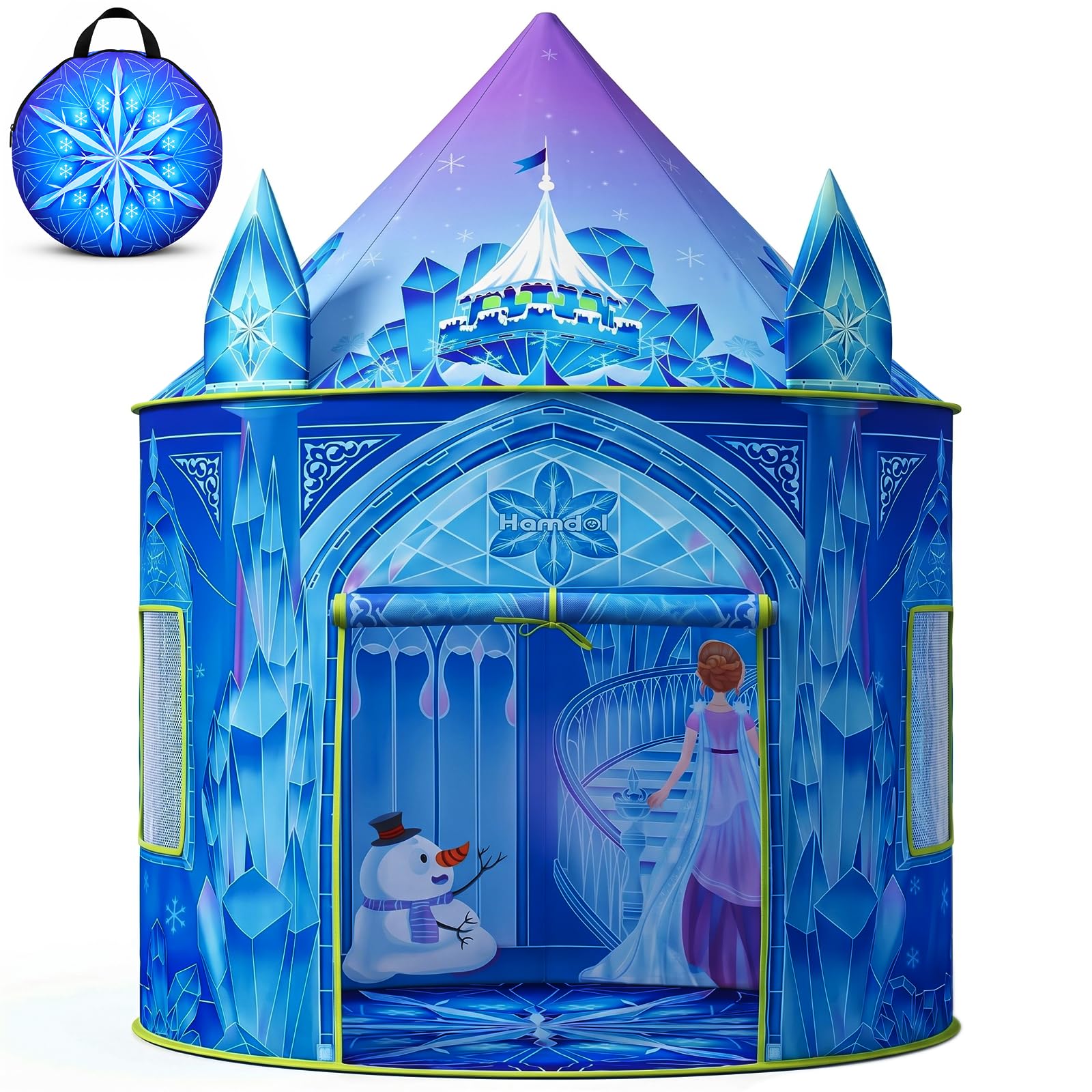
Pull it out of the bag, let go, and it's a castle. The Ice Castle is a pop-up, so the fiberglass frame springs into shape and locks in seconds, and it folds back into a flat disc about the size of a large pizza box that slides under a bed. That's the reason to buy it, and it's why this is the one we recommend for small apartments, grandparents' houses and anyone who doesn't want a structure in the living room all week.

Inside, at 40 by 51 inches, it's a sitting-down space — two toddlers side by side with a basket of toys, tight for much more. The Frozen-style graphics are printed on a polyester shell, the top panel is mesh so you can check in without opening anything, and the whole thing wipes down with a damp cloth.

It's a fair-weather toy. The listing offers indoor and outdoor use, and a dry afternoon on the patio is genuinely good fun, but a light fabric shell on a springy frame is not what you leave out overnight. Bring it in, and it will last far longer than an afternoon's convenience suggests.

Bottom line: A pop-up that lives in a closet and comes out on wet afternoons — the easiest setup here and the easiest to put away.

#4

Monobeach Princess Castle Tent

Monobeach Princess Castle Tent

Budget castle play

Doodle Score 9.4/10
Check Price

Worth Noting

  • Plastic connectors feel fragile
  • Star lights don't always work
Height
53"
Material
Polyester taffeta
Play Footprint
55" x 55"
Stated Capacity
Up to 3 kids
Read the full review

Fifty-five inches square and 53 inches tall, in pink polyester taffeta, with a carry bag and a string of star lights in the box: this is the biggest interior in the budget end of the list, and it isn't close.

The play is the reason it holds a place. Three children fit inside with cushions and a small sofa, and it's tall enough that older kids sit up in it rather than lie down, which is more than the toddler-scale plastic cottages manage. The castle print and the lights do the rest; a kid who wants a castle gets a castle.

Assembly is the gamble. The frame is plastic poles pushed into plastic connectors, and matching pole to connector is the whole task — the box carries two sets of instructions, and the shorter, simpler one is the one to follow. Once you know the order it goes up quickly and comes down faster.

We keep it on the list because the value is real: the most interior here for the least outlay, and a shape that packs into a bag for a weekend at grandma's. For a family who wants the castle experience without handing a corner of the house over to it permanently, this is the sensible buy.

Bottom line: The most castle for the least money here — buy it for the interior space and expect to be gentle with the frame.

#5

Razee Indoor Play Tent

Razee Indoor Play Tent

Playrooms

Doodle Score 9.2/10
Check Price

Worth Noting

  • Indoor only
Use
Indoor
Height
53"
Material
Polycotton
Play Footprint
57" x 35.5"
Read the full review

Beige polycotton, a row of little pennant flags and a shape that's longer than it is wide: the Razee doesn't look like a play castle, and that's exactly why we like it. At 57 inches long, 35.5 wide and 53 tall, it slides along a bedroom wall or into the corner of a playroom and reads as part of the room — the pick here for anyone who wants a playhouse that doesn't announce itself.

The frame is PVC poles through a polycotton cover, and the labeled pieces go together in minutes without tools. What's inside is the selling point: the length takes a crib mattress with room to spare, so it becomes a lying-down nook for a book or a video, and two or three toddlers fit sitting up. Check your mattress against the 35.5-inch width — a thick one pushes at the walls.

It's an indoor tent, and that's the whole boundary. Fabric and PVC don't belong in the yard, and the corners can lift off the floor when kids flop in and out; a beanbag in each back corner settles that. For a playroom or a bedroom that has to look like a grown-up's house the other 22 hours a day, this is the one that gets left up.

Bottom line: We point design-conscious families here: a long, low canvas nook that blends into the room and takes a crib mattress.

#6

Backyard Discovery Sweetwater Cedar Playhouse

Backyard Discovery Sweetwater Cedar Playhouse

Permanent backyard

Doodle Score 9.0/10
Check Price

Worth Noting

  • Two adults and an afternoon to build
  • Outgrown around age six
Height
55"
Material
Cedar wood
Warranty
5-year limited
Play Footprint
46" x 42"
Read the full review

This arrives as a flat stack of cedar boards, and it is not a one-person, one-hour job. Two adults and most of an afternoon is the realistic version, best started on a dry morning. The instructions are better than most flat-pack furniture we've handled, with 3D diagrams and online assembly videos for the awkward parts. It is a build, not an assembly.

What you get at the end is the only true cottage here. Cedar walls with a hinged half door, four windows, a snack bar ledge for passing juice boxes through, and a play kitchen with a sink, a stove, cookware, utensils, a cordless phone and a doorbell that actually rings. It has the proportions of a garden building rather than a toy parked in one, and there's a five-year limited warranty behind it.

Cedar is the reason and also the caveat. Boards can split when screws go in without a pilot hole, edges sometimes arrive rough enough to want sanding, and it will want a coat of sealant if it's facing real winters. None of that is hard, but it turns the purchase into a weekend project — and if you're making that trade, the return is a structure that stays in the garden and gets used until your child is too big for it.

Bottom line: For a yard fixture your child will grow up around, this cedar cottage earns the afternoon of assembly it demands.

#7

Little Tikes Cape Cottage Playhouse

Little Tikes Cape Cottage Playhouse

First playhouse

Doodle Score 9.0/10
Check Price

Worth Noting

  • Thin single-wall panels flex under a lean
Windows
2
Assembly
Snap-together panels
Material
Plastic
Recommended Age
24 months–6 years
Read the full review

Snap the panels, push in the shutters, and you're done: of everything here, this is the fastest trip from box to playable. One adult can manage it with a screwdriver you probably already own — the tools aren't included — and the whole house is light enough to shift against a wall when the room needs to be something else.

The details are what a toddler goes for. A door that really swings, two windows with shutters that open, and a mail slot built into the wall do more for pretend play than any printed mural, and the sequence — post the letter, open the shutter, come inside — is one a two-year-old works out alone.

On this list it's the first playhouse: the one you buy when the child is two or three, and the one you pass to a cousin in a couple of years. It works indoors or on a patio and wipes down in a minute. Go in knowing the scale — the manufacturer's range stops at six because a tall six-year-old is already at the roofline.

Bottom line: The right first playhouse for a two- or three-year-old: it goes up in minutes and the door, shutters and mail slot do what a toddler expects.

#8

Easy Playhouse Cardboard Castle

Easy Playhouse Cardboard Castle

Rainy-day crafts

Doodle Score 9.0/10
Check Price

Worth Noting

  • Cardboard bows when kids lean on it
  • Can't be wiped clean or rained on
Use
Indoor
Height
43.5"
Material
Cardboard
Play Footprint
32" x 32"
Read the full review

This is a coloring book you can walk into. The Fairy Tale Castle is corrugated cardboard cut and folded into a 32-by-32-inch fort standing 43.5 inches tall, with four turrets, windows, a door and a mail slot, all printed with line art — a dragon, a queen, a mouse — waiting for crayons.

Crayons, colored pencils and markers all take to the surface, and the coloring is the play: the walls keep a child busy for days before anyone thinks about going inside. The castle is also reversible, so when the outside is full you flip it inside out and start the second pass, which is the smartest thing about it.

It is cardboard, and it behaves like it. The walls soften, the edges fur up, and a drink put down inside is the end of that panel. That's not a fault so much as the material — but it does mean this is a season of play rather than a fixture you hand down.

Judge it as an activity with a structure attached and it's excellent value: a birthday afternoon, a rainy week, a project that keeps two kids busy together instead of a screen. If you want something still standing in March, spend it elsewhere on this list.

Bottom line: A coloring project that happens to be a fort — worth it for a rainy week or a birthday, not for a permanent playroom.

How We Tested: Assembly, Weather, and a Lot of Six-Year-Olds

We started with more than 40 playhouses and narrowed by material, footprint, price against expected years of use, and whether the maker actually sells replacement parts — a playhouse with a broken door and no way to reorder is a lawn ornament. The ten we bought and built ran from a plastic cottage that arrived in one box to a cedar kit that came on a pallet.

Assembly got its own stopwatch. One adult started every build alone and called in a second person only when the instructions demanded it, timing each stage and checking whether the pre-drilled holes still lined up once the frame went square. One panel kit needed fresh pilot holes because the gaps closed as the walls straightened; another had you fit the roof before the walls, which is as awkward as it sounds.

Then we left them out through the rain and the heat, checking monthly for splinters, fading, warped panels, and screws backing out of the frame. We shoved each one hard at the corner posts, sent a 60-pound kid up onto the roof, and watched what a gust did — the light plastic models walked across the patio until we anchored them, and one roof collected an inch of rainwater.

Playability was the part we couldn't fake. We watched kids from 2 to 8 in 45-minute stretches, noting how long they stayed inside, whether they dragged chairs and toys in, and whether the older ones came back after week two. On bright afternoons we checked how dark or hot the inside got, since a playhouse with one small window bakes by noon. Appearance went the same way — judged by which ones kids showed their friends, not by which ones photographed best.

How to Choose the Right Playhouse for Kids

Where it will live decides the material

Fabric tents, teepees and pop-up castles are indoor toys. Their polyester, cotton and polycotton shells wipe clean and fold away, but none of them wants a wet lawn or a windy night, whatever the listing's indoor/outdoor line implies. Plastic cottages can stay out through a summer and come back in for winter. Cedar is the only material here meant to live outside permanently, and even cedar wants sealing if it faces real weather.

So answer the placement question first. A playroom or a bedroom corner points you at fabric and the light, foldable picks. A patio that gets used all summer points at plastic. A garden where you want something to stay put points at cedar, and at an afternoon of building.

Read the footprint and the peak height

Two numbers decide whether a playhouse fits: the base and the peak. The base is measured at the widest point, so leave a few inches of clearance on every side — fabric tents spread as the corners go down, and a 55-inch tent needs a clear corner of the room, not a 55-inch gap between furniture. The height is the peak at the center pole, so if your child is tall for their age, look at the door opening instead.

The spread in this group is real: interiors run from about 32 inches square, which seats one toddler, to 57 by 35, and 55 by 55, which seat three. Match the figure to the number of children who will actually be in there at once, not to the number who might visit.

Judge the frame, not the print

A printed castle is cheap to produce. A frame that survives a four-year-old is not, and the frame is what decides whether you're still putting this thing back up in March. The most reassuring setup here is fabric sewn into sleeves over wooden or PVC poles and tied off at the top: the fabric can't slide off and the poles can't pull out of knots. Pop-up frames trade that rigidity for speed, which is a fair trade only if the tent lives indoors.

Plastic cottages hold their shape through their own panels, so the moving parts — doors, shutters, hinges — are what loosen. Cedar is the stiffest of the lot, provided the screws go in without splitting a board first.

Match the setup to how often it moves

Ask how many times a year this comes down, and buy for that number rather than for the photo on the box. Pop-up castles go up in seconds and fold flat enough for a closet shelf. Pole-and-sleeve tents take ten or fifteen minutes and are happy to move between rooms a few times a season. Snap-together plastic panels are quick but bulky to store. A cedar cottage is an afternoon with two adults and then it stays where you built it.

The more often it moves, the more of your money is going into setup speed rather than play value — which is fine, as long as that's the thing you actually need.

Buy for the age you have now

Most playhouses are toddler-scale, and the age printed on the box is roughly the point where a child's head reaches the roofline — not a promise of a decade of use. A two- or three-year-old wants a door they can work themselves and a floor they can sit down on. A six-year-old wants somewhere to disappear with a book, and will use the same structure as a den rather than a house.

Size it for the child in front of you, and expect the playhouse to become a reading corner before it becomes clutter.

Frequently Asked Questions

Final Verdict

Start with the Tiny Land teepee. It has the thickest fabric in the group, enough height for an adult to sit inside with a child, and the cleanest quality record of anything here, which is why it's the one most families will still be using a year from now.

If the playhouse is going to live outside, the Step2 patio is the better buy: it handles weather, water and three toddlers at once, and it's the only plastic house here built to stay out. And if the yard is permanent and you want a structure rather than equipment, the cedar Sweetwater is the one that becomes part of the garden.